Volume 19 · Number 3 · September 2017 213
Self-expandable Graft Stenting in an Iatrogenic Fistula between Common Carotid Artery and Internal Jugular Vein
Sung Chul Jin, Dong Hyuk Lee, Chae Wook Huh
Department of Neurosurgery, Inje University, Haeundae Paik Hospital, Busan, Korea
A 47-year-old woman with stage IV chronic kidney disease developed a fistula between common carotid artery (CCA) and internal jugular vein (IJV) during central catheterization of the right IJV. The patient was treat- ed with a self-expandable graft stent, which achieved successful closure of the carotid-jugular fistula. As demonstrated in our case, self-expandable graft stents could be a feasible treatment option for CCA-IJV fistulas with- out additional interventional procedures such as balloon angioplasty.
J Cerebrovasc Endovasc Neurosurg.
2017 September;19(3):213-216 Received : 18 July 2017
Revised : 21 August 2017 Accepted : 26 September 2017 Correspondence to Chae Wook Huh Department of Neurosurgery, Inje University Haeundae Paik Hospital, 875 Haeundae-ro, Haeundae-gu, Busan 48108, Korea Tel : 82-51-797-0607
Fax : 82-51-703-0434 E-mail : [email protected]
ORCID : http://orcid.org/0000-0002-7020-0468
This is an Open Access article distributed under the terms of the Creative Commons Attribution Non- Commercial License (http://creativecommons.org/li- censes/by-nc/3.0) which permits unrestricted non- commercial use, distribution, and reproduction in any medium, provided the original work is properly cited.
Keywords Carotid-jugular, Fistula, Self-expandable, Grafted stent Journal of Cerebrovascular and Endovascular Neurosurgery
pISSN 2234-8565, eISSN 2287-3139, http://dx.doi.org/10.7461/jcen.2017.19.3.213
Case Report
INTRODUCTION
The right internal jugular vein (IJV) is widely used as an initial site of central catheter insertion and a temporary route for hemodialysis catheter placement.
The IJV is favored over the subclavian vein due to its easier accessibility and lower incidence of pneumo- thorax and stenosis.2)3) However, several fatal compli- cations have also been reported.2) Unexpected injury of the carotid artery is a procedural complication that may lead to airway obstruction secondary to hema- toma formation or the development of a carotid-jug- ular fistula. We recently treated a patient with a de- veloped an iatrogenic fistula between common carotid artery (CCA) and IJV using a self-expandable graft stent. Together with a review of the relevant liter- ature, we will discuss the feasibility of this technique
for the treatment of this rare complication.
CASE REPORT
A 47-year-old woman with stage IV chronic kidney disease was admitted to our hospital for the manage- ment of dyspnea, anuria and systemic edema. Despite intensive medical treatment, the patient's symptoms did not improve, and emergent hemodialysis was necessary. Using ultrasound guidance, we attempted to place a perm catheter in the right IVJ. Although the blood flow was poor and the right IJV was not visi- ble, we navigated the perm catheter into the right jug- ular vein. Because the catheter did not function, we changed the insertion site of the perm catheter to the right femoral vein. A sudden hematoma immediately developed on the patient's neck after the removal of
COMMON CAROTID-JUGULAR FISTULA TREATMENT USING A GRAFT STENT
214 J Cerebrovasc Endovasc Neurosurg
A B
C D
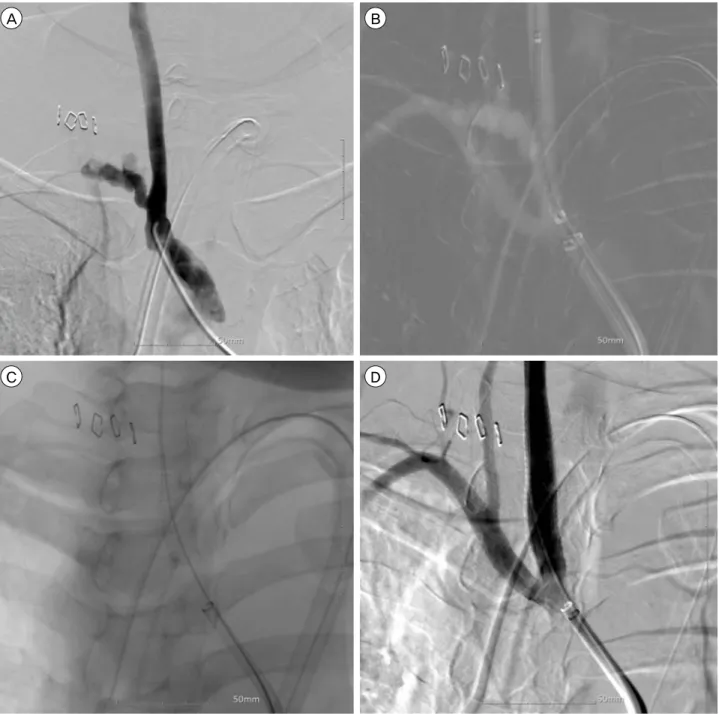
Fig. 1. Serial digital subtraction angiography (DSA) showing the stent deployment procedure. (A) A 6 French envoy guiding catheter was inserted in common carotid artery (CCA), revealing a fistula between CCA and internal jugular vein (IJV). (B) A graft stent was introduced in CCA. The origin of right subclavian artery was preserved. (C) The grafted stent were deployed. (D) The final control angiography showed complete occlusion of the fistula and patency of the right subclavian artery.
the perm catheter from the right jugular vein. The neck hematoma did not further increase after manual com- pression of the puncture site. However, the patient went into respiratory arrest one day later as a result of upper airway obstruction due to the mass effect of the hematoma. After an emergency tracheostomy with
evacuation of the hematoma and right percutaneous pleural drainage, the patient's vital signs stabilized. A computed tomography (CT) neck angiography showed a right carotid artery-jugular fistula (Fig. 1). We treat- ed the patient with an endovascular graft stent rather than open neck surgery because of the risk to the pa-
SUNG CHUL JIN ET AL
Volume 19 · Number 3 · September 2017 215 tient from general anesthesia during surgery. A right
carotid artery angiography confirmed a fistula between CCA and IJV. To avoid unexpected occlusion of the right subclavian artery, a self-expandable Viabahn graft stent (W.L. Gore and Associates, Flagstaff, AZ, USA) was deployed above the origin of the right sub- clavian artery with the aid of the road map image.
The final control angiography showed complete occlu- sion of the fistula without requiring balloon angio- plasty as well as patency of the right subclavian ar- tery (Fig. 1).
DISCUSSION
The IJV is a reliable and effective route to secure immediate temporary access for the initiation of hemodialysis. Arteriovenous fistulas occur in 0.58% of all temporary hemodialysis patients and may lead to congestive heart failure, systemic embolization, and infection.6) Prompt surgical treatment should be con- sidered to avoid the development of these complications.
Surgical options for carotid-jugular fistulas include li- gation of the fistula and arterial repair. However, these surgical treatments incur a mortality rate of 0%
to 22% and a rate of postoperative progression of neurologic deficits of 0% to 21%.3)8-12)14)
Studies have reported that endovascular carotid re- pair has a significantly lower mortality rate than open surgical options.5) Endovascular methods have dem- onstrated efficacy in treating many complications from traumatic arterial damage.1)7)13) Graft stenting may make it possible to occlude the branches originating from the artery covered by the stent. Because the common carotid artery has no significant branch proximal to the carotid bifurcation, graft stenting can be used to treat common carotid artery injuries or carotid jugular fistulas.
A balloon-mounted graft stent has complications that include distal migration of the graft stent and endoleaks.4)15) In our case, the fistula was proximal to the carotid bifurcation; therefore, self-expendable graft stenting was more favorable than balloon-mounted
graft stenting. In this case, complete occlusion of the fistula and patency of the right subclavian artery was observed. Deploying a self-expandable graft stent to cover the fistula site may be a feasible treatment op- tion for common carotid-jugular fistulas.
CONCLUSION
Our case demonstrates that self-expandable graft stents can be used to treat iatrogenic fistula between CCA and IJV. In this case, complete occlusion of the fistula as well as patency of the right subclavian ar- tery was achieved. Deployment of self-expandable graft stent to cover the fistula site may be a feasible treatment option for CCA-IJV fistulas.
Disclosure
The authors report no conflict of interest concerning the materials or methods used in this study or the findings specified in this paper.
REFERENCES
1. Castelli P, Caronno R, Piffaretti G, Tozzi M, Lagana D, Carrafiello G, et al. Endovascular repair of traumatic in- juries of the subclavian and axillary arteries. Injury.
2005 Jun;36(6):778-82.
2. Cimochowski GE, Worley E, Rutherford WE, Sartain J, Blondin J, Harter H. Superiority of the internal jugular over the subclavian access for temporary dialysis.
Nephron. 1990;54(2):154-61.
3. Demetriades D, Skalkides J, Sofianos C, Melissas J, Franklin J. Carotid artery injuries: experience with 124 cases. J Trauma. 1989 Jan;29(1):91-4.
4. Din IU, Shaikh U, Fisher RK, McWilliams RG. Renal stent crushed during open aneurysmorrhaphy for endoleak after fenestrated EVAR. J Endovasc Ther. 2016 Jun;23(3):533-5.
5. DuBose J, Recinos G, Teixeira PG, Inaba K, Demetriades D. Endovascular stenting for the treatment of traumatic internal carotid injuries: expanding experience. J Trauma.
2008 Dec;65(6):1561-6.
6. el-Shahawy MA, Khilnani H. Carotid-jugular arterio- venous fistula: a complication of temporary hemodialysis catheter. Am J Nephrol. 1995;15(4):332-6.
7. Kaitzis DG, Balitas AG, Skandalos IK, Hatzibaloglou AK. Carotid artery repair after erroneous insertion of a hemodialysis catheter: case report. J Vasc Access. 2006 Jul-Sep;7(3):136-8.
8. Karlin RM, Marks C. Extracranial carotid artery injury.
COMMON CAROTID-JUGULAR FISTULA TREATMENT USING A GRAFT STENT
216 J Cerebrovasc Endovasc Neurosurg
Current surgical management. Am J Surg. 1983 Aug;146(2):
225-7.
9. Khoury G, Hajj H, Khoury SJ, Basil A, Speir R.
Penetrating trauma to the carotid vessels. Eur J Vasc Surg. 1990 Dec;4(6):607-10.
10. Ledgerwood AM, Mullins RJ, Lucas CE. Primary repair vs ligation for carotid artery injuries. Arch Surg. 1980 Apr;115(4):488-93.
11. Meyer JP, Walsh J, Barrett J, Schuler JJ, Durham JR, Eldrup-Jorgensen J, et al. Analysis of 18 recent cases of penetrating injuries to the common and internal carotid arteries. Am J Surg. 1988 Aug;156(2):96-9.
12. Navsaria P, Omoshoro-Jones J, Nicol A. An analysis of 32 surgically managed penetrating carotid artery injuries.
Eur J Vasc Endovasc Surg. 2002 Oct;24(4):349-55.
13. Pikwer A, Acosta S, Kolbel T, Malina M, Sonesson B, Akeson J. Management of inadvertent arterial catheter- isation associated with central venous access procedures.
Eur J Vasc Endovasc Surg. 2009 Dec;38(6):707-14.
14. Ramadan F, Rutledge R, Oller D, Howell P, Baker C, Keagy B. Carotid artery trauma: a review of contemporary trauma center experiences. J Vasc Surg. 1995 Jan;21(1):46-55;
discussion 55-6.
15. Wadhwa R, Toms J, Nanda A, Abreo K, Cuellar H.
Angioplasty and stenting of a jugular-carotid fistula re- sulting from the inadvertent placement of a hemodial- ysis catheter: case report and review of literature. Semin Dial. 2012 Jul;25(4):460-3.