• 검색 결과가 없습니다.

Changes in Isoflavone Contents and Physicochemical Properties of Soybean Leaf Extract by Extraction Conditions

N/A
N/A
Protected

Academic year: 2021

Share "Changes in Isoflavone Contents and Physicochemical Properties of Soybean Leaf Extract by Extraction Conditions"

Copied!
5
0
0

로드 중.... (전체 텍스트 보기)

전체 글

(1)

추출조건에 따른 콩잎 추출물의 이소플라본 함량 및 이화학적 특성

윤정아1, 권세영2, 박은희1,2, 김명동1*

1강원대학교바이오산업공학부

2㈜메타스크린

Received: December 31, 2018 / Revised: January 6, 2019 / Accepted: January 10, 2019

다양한식생활의발달과바쁜일상으로인하여간편식과 건강식에대한관심이매년증가하고있으며

,

식품선택의 기준이

,

가격등에서영양

,

생산방법

,

섭취방법다양 요인을고려하는추세로변화하였다

[1].

따라서

,

새로운 식품소재와천연원료유래의기능성관련물질에대한 구개발이이어지고있으며관련시장이지속적으로성장하 있다

[2].

콩에는이소플라본

,

사포닌

,

레시틴다양한생리활성 질들이존재하며

,

중에서도이소플라본은심장질환

,

골다 공증

,

위암

,

유방암

,

폐경기증상등에대한효과가보고되었

[1, 3].

그러나

,

콩잎에대한연구는원료를활용한단순 공품단계에머물러있으며

,

콩잎장아찌와콩잎김치형태로

경상도지역에서주로소비되고있고

[4],

콩잎분말을첨가

두부등이개발되었다

[5].

콩잎은다른식물의잎들과비교하여이소플라본이풍부 하게함유되어있으며

,

항산화활성에관여하는페놀계화합

,

클로로필

,

카로티노이드

,

비타민

C

등의함량이높은 으로보고되었다

[6]. Ho

[7]

연구에의하여콩잎의부탄 추출물에서플라보노이드계열의

kaempferol glycoside

확인되었다

.

또한

,

콩잎에탄올추출물이당뇨병치료에 관여하는β

-

세포의인슐린신호전달을강화시키는것으로 고되었으며

[8],

동맥내피세포의혈관확장을유도하여동맥 경화증을예방하는효과가있는것으로보고되었다

[9].

천연물을원료로하여제조된추출물의다양한생리활성 대한연구결과가지속적으로보고되고있으며

,

이들추출 물에함유된유용물질은용매추출조건에따라함량이

크게달라지는것으로알려져있다

[10].

따라서추출물을

작하는경우유용물질의특성을고려한용매선정

,

추출

,

온도등에대한면밀한고려가필요하다

[11, 12].

톳의추출물은상압에서제조한추출물보다초고압에서 출한경우상대적으로우수한항산화활성을나타냈고

,

초고 압으로제작한추출물은

tyrosinase

elastase

효소활성에 대한저해효과가우수한것으로보고되었다

[13].

다양한

,

시간

,

용매등을고려하여항산화활성이우수한로즈마 추출물을제작한연구

[12]

동백나무잎을이용하여 산화효과가우수한추출조건을설정한결과

[14]

등도보고

Changes in Isoflavone Contents and Physicochemical Properties of Soybean Leaf Extract by Extraction Conditions

Jeong-Ah Yoon

1

, Se-Young Kwun

2

, Eun-Hee Park

2

, and Myoung-Dong Kim

1

*

1

Division of Food Biotechnology and Biosystems Engineering, Kangwon National University, Chuncheon 24341, Republic of Korea

2

Metascreen Inc., Chuncheon 24341, Republic of Korea

To utilize soybean leaf, which is a waste product in soybean production, as a value-added food material, this study aimed to investgate the extraction efficiency of isoflavone from soybean leaf and to characterize physicochemical properties of the extract. Maximum isoflavone content of 59.74 ± 4.54 mg/l was obtained from soybean leaf extracted at 90 ℃ for 12 h. DPPH (1,1-diphenyl-2-pricylhydrazyl) radical-scavenging activ- ity and total polyphenol contents reached maximum levels of 67.26 ± 3.64% and 1,688.68 ± 97.37 µg/ml chloro- genic acid equivalent, respectively. Based on the contents of isoflavone and total polyphenol, and DPPH radical-scavenging activity, optimum extraction conditions for soybean leaf using water as solvent were 90 ℃ and 12 h.

Keywords: Soy bean leaf, isoflavone, DPPH radical-scavenging activity, polyphenol, extraction

*Corresponding author

Tel: +82-33-250-6458, Fax: +82-33-259-5565 E-mail: [email protected]

© 2019, The Korean Society for Microbiology and Biotechnology

(2)

되었다

.

콩을생산하는과정에서발생하는콩잎의경우추출 가가치창출을위한기반연구가매우미흡한상황이며

,

잎에함유된고부가가치기능성물질의추출공정을개발한 사례는보고된없다

.

따라서연구에서는추출온도와 시간에따른이소플라본의추출효율이화학적특성 화를고찰하여콩잎을산업적으로활용하는데필요한기반 자료를확보하고자하였다

.

콩잎은강원도농업기술원에서제공받은호반품종

(

강원

5

)

2018

6

월에강원도춘천시소재노지에파종한

9

월에수확하여사용하였다

.

콩잎은흐르는물에세척한

,

건조기

(Jinwoo electronic Co., Korea)

사용하여

30

℃에서

24

시간 건조하였다

.

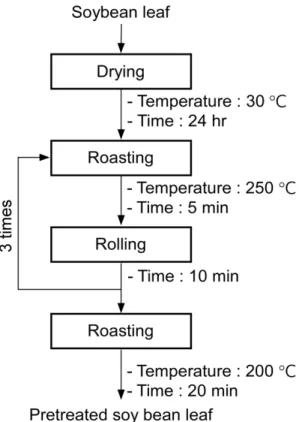
건조된콩잎은원통형덖음기

(Xiamen Yuneng Machinery Plant, China)

이용하여산화효소활 성을억제시키고

[15],

유념기

(Bohyun Eng Co., Korea)

용하여성분추출이용이

[16]

하도록전처리하였다

(Fig. 1).

전처리한콩잎

2 g

정제수

100 ml

혼합한환류냉각

방식의추출기

(MTOPS, Korea)

사용하여추출온도는

50, 70, 90

,

추출시간은

1, 12, 24

시간으로각각설정하여 추출물을제조하였다

.

추출된시료는여과하여냉동보관 하였다

.

이소플라본배당체

2

(daidzin, genistin)

비배당체

2

(daidzein, genistein)

지표물질로선정하여

LiChrospher RP-18

컬럼

(5 um, 250 mm × 4.6 mm, SUPERCO, USA)

장착된

HPLC (Shimadzu, Japan)

측정하였다

.

이동상 물과초산혼합물

(water/acetic acid, 99.9/0.1, v/v),

아세 토니트릴과 초산 혼합물

(acetonitrile/acetic acid, 99.9/0.1, v/v)

사용하여시간에따라농도구배를적용하였다

[17].

컬럼의온도는

35

℃로유지하였으며

,

자외선검출기

(254 nm)

사용하였다

.

탄닌함량은

[18]

제시한방법에따라콩잎추출물

5 ml

주석산 용액

(FeSO

4

·7H

2

O) 5 ml

첨가한

Sorensen’s

인산염완충액

(0.133 M, pH 7.2) 15 ml

가하

540 nm

에서 흡광도를 측정하였고

, Ethyl gallate

(Sigma-Aldrich, USA)

표준물질로사용하였다

.

폴리페놀함량은

Folins-Denis

방법

[19]

으로측정하였

.

추출물

0.5 ml

Folin’s & Ciocalteu’s phenol reagent (Sigma-Aldirch, USA) 0.5 ml

첨가하여

3

분간반응한

, 10% Na

2

CO

3

0.5 ml

주입하였다

.

혼합액을

1

시간동안

온에서정치한

725 nm

에서흡광도를측정하였으며

,

폴리페놀함량은

chlorogenic acid equivalent (CAE)

나타 내었다

.

[20]

방법을 변형하여

DPPH (1,1-diphenyl-2- pricylhydrazyl, Sigma-Aldrich, USA)

라디칼소거능을 가하였다

.

시료

20

μ

l

DPPH

시약

180

μ

l

혼합하고

30

반응시킨

517 nm

에서흡광도를측정하였다

. DPPH

디칼소거능은다음식을사용하여산출하였다

. DPPH

라디칼소거능

(%) =

모든측정은

3

반복하였으며평균값과표준오차는

SPSS (v 20.0, SPSS, Chicago, IL, USA)

사용하여

Duncan

다중범위검정방법

[21]

으로검정하였다

.

2017

9

월에수확한콩잎을덖음기를사용하여

30

℃에

24

시간동안건조한

, 250

℃에서

5

동안덖음처리 하고

, 10

분간유념하는과정을

3

반복하여전처리하였

(Fig. 1).

추출공정에적용하기

200

℃에서

20

분간 처리한

,

추출용매로사용한물과일정비율로혼합하 추출온도와시간을조정하여추출하였다

.

추출조건에따른콩잎추출물의이소플라본함량을측정 하였다

(Table 1).

추출온도

50

℃에서제작한콩잎추출물은 추출시간에따라이소플라본의함량이유의적인수준에서 차이가있었으며

, 12

시간동안추출한시료의이소플라 함량이

12.71

±

1.66 mg/l

으로나타났으며

,

추출시간이 길어지면서

63%

수준으로감소하였다

.

그러나

70

℃에서 작한추출물은추출시간에따라서이소플라본농도가유의

대조구의 흡광도 − 시료의 흡광도

× 100

대조구의 흡광도

Fig. 1. Pretreatment procedures for soybean leaf.

(3)

적으로증가하는경향을나타냈다

.

추출온도

70

℃에서

24

시간동안추출한콩잎추출물의이소플라본함량이

37.61

±

3.38 mg/l

로서

70

조건에서실험구가장우수하였다

.

온도를

90

℃로설정한경우추출시간에따라이소플라 농도는증가하였으나

12

시간과

24

시간간의유의적인 이는나타나지않았다

.

따라서추출물에함유된이소플라본 농도를기준으로

90

℃에서

12

시간동안콩잎을추출하는 가장적절한조건인것으로판단되었다

.

비배당체이소플 라본인

daidzein

genistein

추출초기에검출되지않았 으나

24

시간에서낮은농도로검출되었다

.

[6]

노란콩잎을가수분해한메탄올추출물을 제작하여이소플라본함량을조사하였으며

,

비배당체형태

daidzein

genistein

각각

16.30

±

0.14 mg%, 8.76

±

0.01 mg%

함유된것으로보고하였다

.

연구에서는가수

분해과정을거치지않고

,

물을용매로사용하여콩잎에 유된 이소플라본을 추출하였으므로

,

비배당체 형태인

daidzein

genistein

추출효율에부분적으로영향을 것으로판단된다

.

메탄올을용매로이용하는방법등은 추출을통하여얻은원료를직접적으로식품가공에적용하 어려우므로

,

식물의 세포벽을 가수분해하는데필요한

xylanase

등의유용효소들을적용하는생물학적가수분해

공정을활용할필요가있다

[22].

국내산콩을이용하여이소플라본함량을분석한

[23]

연구결과에따르면

,

신팔달품종의콩에서

genistein

량이

daidzein

비교하여

2

높은함량을나타냈다

.

러나연구에사용한호반품종의콩잎추출물은이소플

라본

genistin

상대적으로높은함량을나타냈으며

,

부분

80%

내외를차지하는것으로나타났다

.

[24]

구에의하면

,

볶은콩의이소플라본함량분석에서

genistin

diadzin

유사한함량을나타냈으며

,

전처리방법에

라서성분의함량이유의적으로변화하는것으로보고되었

.

검정콩의종피에서안토시아닌을추출한연구에서일정 시간이상추출시간이지속될경우추출효율이감소하는 양상이보고되었으며

[14],

자색옥수수속대추출물의경우

24

시간이후추출물은가용성고형물적색도가감소하면

품질의저하가나타났다

[8].

따라서추출물제작을위한

최적의조건을선정하는데온도와시간의설정은매우중요 것으로판단된다

.

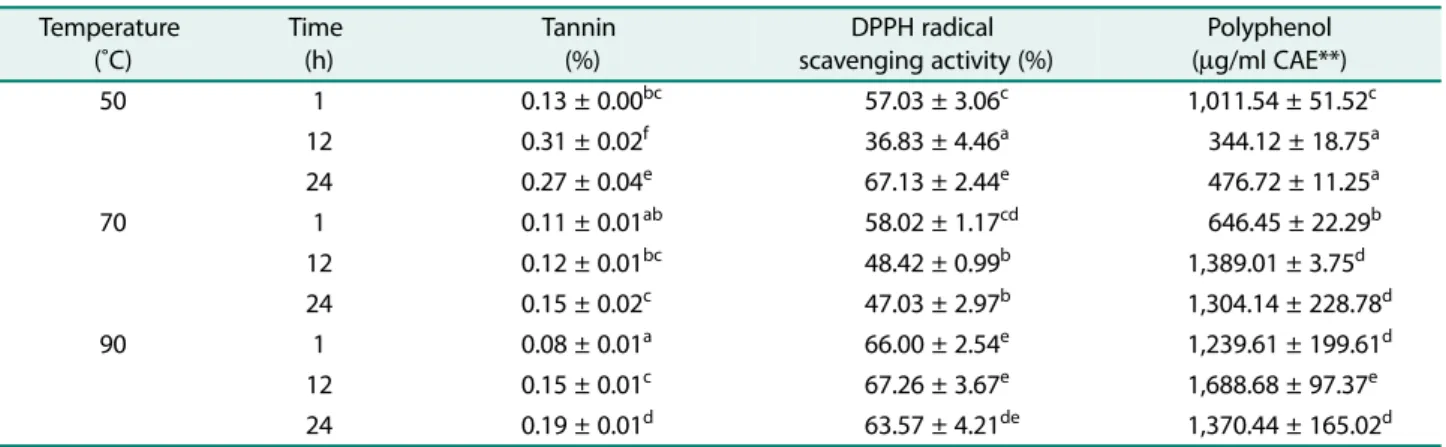
추출조건에따른콩잎추출물의탄닌의함량

, DPPH

디칼소거능

,

폴리페놀함량의변화를조사하였다

(Table

2).

탄닌은차의맛과색에영향을미치는주요인자로가공

녹차의경우

7.2%

함유하는것으로보고되었으며

[25],

내산재래종의녹차잎을이용한발효차의경우

13.7%

량을나타내는것으로알려져있다

[18].

콩잎추출물은

온도에서추출할수록탄닌의함량이높았으며

,

특히

50

에서

12

시간추출한콩잎추출물에서

0.31%

함량을나타 냈다

.

온도

90

℃에서추출한경우

,

추출시간이증가함에 라서탄닌의양이증가하였으나

, 24

시간동안추출하였을

0.19

±

0.01%

탄닌함량을나타내어시중에유통중인

녹차의

2%

수준으로매우낮은함량을나타냈다

[25].

추출

온도가증가할수록탄닌의양이증가하는것으로보고되었 으며

[26], Bressani

[27]

보고에따르면추출물에 함된탄닌은

0.32

±

1.12%

수준으로알려져있으며

,

콩잎 출물의탄닌함량도추출물과유사한수준으로판단되 었다

.

추출조건에따른콩잎추출물의항산화활성을평가하기

위하여

DPPH

이용한라디칼소거능을측정하였다

(Table

2).

추출온도

90

℃에서추출한콩잎은

50

℃와

70

℃에서 출한콩잎과비교하여상대적으로높은

DPPH

라디칼소거 능을 나타냈으며

,

특히

12

시간 동안 추출한경우

67.26

±

Table 1. Isoflavone contents of soybean leaf extract influenced by extraction conditions*.

Temperature (˚C)

Time (h)

Isoflavone (mg/l)

Daidzin Genistin Daidzein Genistein Total

50 1 0.97 ± 0.05 7.53 ± 0.39 ND** ND 08.50 ± 0.40

ab

12 1.33 ± 0.28 9.90 ± 1.40 ND ND 12.71 ± 1.66

b

24 0.45 ± 0.14 2.94 ± 0.34 0.61 ± 0.07 0.76 ± 0.14 04.76 ± 0.65

a

70 1 1.18 ± 0.02 9.98 ± 0.72 ND ND 11.16 ± 0.70

b

12 2.73 ± 0.20 24.08 ± 1.88 ND ND 26.81 ± 2.07

c

24 4.00 ± 0.45 32.99 ± 3.20 0.34 ± 0.02 0.59 ± 0.23 37.61 ± 3.38

d

90 1 2.77 ± 0.06 27.69 ± 0.73 ND ND 30.46 ± 0.77

c

12 5.49 ± 1.13 53.72 ± 3.86 ND 0.54 ± 0.07 59.74 ± 4.54

e

24 5.84 ± 0.88 51.50 ± 4.56 0.26 ±0.01 0.89 ± 0.09 58.48 ± 5.43

e

*Differrent letters in each column indicate significant difference between averages.

**ND: not dectected.

(4)

3.67%

가장우수한항산화활성을나타냈다

.

콩잎외에도작두콩추출물

[28]

검정콩추출물

[29]

산화활성이문헌에보고된있다

.

[6]

보고에따르

trolox equivalent antioxidant capacity (TEAC)

시험법 으로측정하였을콩잎이콩보다높은항산화활성을 나타냈다

.

천연물유래의추출물을제작하는경우추출시간 지나친증가는오히려제품의품질을저하시키는것으로 보고되었는데

[14, 26],

콩잎추출물의경우

,

이소플라본의 량과폴리페놀함량이가장높은조건

(90

, 12

시간

)

에서 산화활성이가장우수한것으로나타났다

.

추출조건에따른콩잎추출물의폴리페놀함량을조사하 였다

(Table 2).

콩잎을

12

시간동안추출한경우추출온도 증가할수록폴리페놀함량이증가하였으며

, 90

℃에서 출한콩잎추출물이

1,688.68

±

97.37

μ

g/ml CAE

가장 폴리페놀함량을나타냈다

.

[6]

노란콩잎의 리페놀함량을

2,324

±

30

μ

g/ml CAE

보고하여

,

연구 에서사용한호반품종의콩잎보다높은폴리페놀함량을 타냈다

.

추출온도

90

℃에서

12

시간동안추출한호반콩잎 추출물의우수한항산화활성이폴리페놀의함량이나이소 플라본의함량과밀접한관련이있을것으로사료된다

.

결론 적으로

,

물을용매로사용한호반품종콩잎의추출조건은

90

℃에서

12

시간동안추출하는것이가장효율적인것으로

판단되었다

.

초고압추출방법보다다양한추출방법의적용에의한 이소플라본고부가기능성물질추출기술이개발된다면 농산부산물로매년막대한양이폐기되는콩잎을산업적으 활용하여농산업의새로운부가가치를창출할있을 으로기대된다

.

요 약

연구는생산산업의부산물로생산되는콩잎을 부가식품원료로활용하기위해이소플라본의추출효율 이화학적특성변화를조사하였다

.

열수추출온도와 간에따른이소플라본함량

, DPPH

라디칼소거능

, tannin

함량

,

폴리페놀함량을조사하였다

.

이소플라본함량은

90

℃에서

12

시간동안추출하였을

59.74

±

4.54 mg/l

가장높게나타났으며

, 12

시간과

24

시간간의유의적인 이가나타나지않았다

.

탄닌함량은낮은온도에서추출할 수록높은함량을나타내었는데

, 50

, 12

시간에서

0.31

±

0.02%

가장높게나타났다

. DPPH

라디칼소거능은

90

에서

12

시간동안추출하였을

, 67.26

±

3.67%

가장 나타났으며

,

폴리페놀함량도

1,688.68

±

97.37

μ

g/ml CAE

가장우수하였다

.

따라서

,

이소플라본과폴리페놀의

,

항산화활성등을고려하여콩잎의열수추출조건은

90

에서

12

시간동안추출하는것이가장효율적인것으로 단되었다

.

Acknowledgments

This research was financially supported by the Ministry of SMEs and Startups (MSS), Korea, under the “Regional Specialized Industry Development Program(R&D, R0005969)” supervised by the Korea Institute for Advancement of Technology (KIAT).

Conflict of Interest

The authors have no financial conflicts of interest to declare.

Table 2. Changes in tannin contents, DPPH radical-scavenging activity, and polyphenol contents of soybean leaf extract by extraction conditions*.

Temperature (˚C)

Time (h)

Tannin (%)

DPPH radical scavenging activity (%)

Polyphenol ( µg/ml CAE**)

50 1 0.13 ± 0.00

bc

57.03 ± 3.06

c

1,011.54 ± 51.52

c

12 0.31 ± 0.02

f

36.83 ± 4.46

a

344.12 ± 18.75

a

24 0.27 ± 0.04

e

67.13 ± 2.44

e

476.72 ± 11.25

a

70 1 0.11 ± 0.01

ab

58.02 ± 1.17

cd

646.45 ± 22.29

b

12 0.12 ± 0.01

bc

48.42 ± 0.99

b

1,389.01 ± 3.75

d

24 0.15 ± 0.02

c

47.03 ± 2.97

b

1,304.14 ± 228.78

d

90 1 0.08 ± 0.01

a

66.00 ± 2.54

e

1,239.61 ± 199.61

d

12 0.15 ± 0.01

c

67.26 ± 3.67

e

1,688.68 ± 97.37

e

24 0.19 ± 0.01

d

63.57 ± 4.21

de

1,370.44 ± 165.02

d

*Differrent letters in each column indicate significant difference between averages.

**CAE: chlorogenic acid equivalent.

(5)

References

1. Wada K, Tsuji M, Tamura T, Konishi K, Kawachi T, Hori A, et al.

2015. Soy isoflavone intake and stomach cancer risk in Japan:

from the takayama study. Int. J. Cancer. 137: 885-892.

2. Nam H. 1999. Development of bioactive peptides and its mar- ket trend. Food Indust. Nutr. 4: 17-19.

3. Choi Y, Yoon S, Lee MJ, Lee SK, Lee BS. 2001. Dose response relationship of isoflavone supplementation on plasma lipid profiles and total antioxidant status in permenopausal and postmenopausal women. Korean Nutri. Soci. 34: 322-329.

4. Lee SH, Choi DJ, Kim JG. 2003. Effect of salt concentration on soybean leaf kimchi fermentation. Korean J. Food Preserv. 10:

512-516.

5. Kim MK, Lee SH, Hwang K. 2011. Physicochemical properties of soybean leaf by cultivar and development of soybean curd prepared with soybean leaf powder. Korean J. Food Cookery Sci.

27: 557-565.

6. Ryu SH, Lee HS, Lee YS, Moon GS. 2005. Contents of isoflavones and antioxidative related compounds in soybean leaf, soybean leaf Jangachi, and soybean leaf Kimchi. Korean J. Food Cookery Sci. 21: 433-439.

7. Ho HM, Chen R, Huang Y, Chen ZY. 2002. Vascular effects of a soy leaves (Glycine max) extract and kaempferol glycosides in isolated rat carotid arteries. Planta. Med. 68: 487-491.

8. Li H, Ji HS, Kang JH, Shin DH, Park HY, Choi MS, et al. 2015. Soy leaf extract containing kaempferol glycosides and pheophor- bides improves glucose homeostasis by enhancing pancreatic beta-cell function and suppressing hepatic lipid accumulation in db/db Mice. J. Agric. Food Chem. 63: 7198-7210.

9. Han JM, Li H, Cho MH, Baek SH, Lee CH, Park HY, Jeong TS.

2017. Soy-leaf extract exerts atheroprotective effects via mod- ulation of kruppel-like factor 2 and adhesion molecules. Int. J.

Mol. Sci. 18: 21-26.

10. Kim JW, Kwon YR, Youn KS. 2012. Quality characteristics and antioxidant properties in spray-dried and freeze-dried powder prepared with powdered seaweed extracts. Korean J. Food Sci.

Technol. 44: 716-721.

11. Kang JR, Lee SJ, Kwon HJ, Kwon MH, Sung NJ. 2012. Establish- ment of extraction conditions for the optimization of the black garlic antioxidant activity using the response surface method- ology. Korean J. Food Preserv. 19: 577-585.

12. Lee CY, Kim KM, Son HS. 2013. Optimal extraction conditions to produce rosemary extracts with higher phenolic content and antioxidant activity. Korean J. Food Sci. Technol. 45: 501-507.

13. Kwon YR, Youn KS. 2017. Antioxidant and physiological activi- ties of Hijikia fusiforme by extraction methods. Korean Soc. Food Preserv. 24: 631-637.

14. Chung JH, Lee HJ, Lee SY, Kim KS, Rim YS, Chin SC, et al. 2006.

Establishment of conditions for hot water extraction of Camel- lia japonica leaves. Korean J. Food Sci. Technol. 38: 823-828.

15. Kim DC, Kim DW, Lee SD, In MJ. 2006. Preparation of barley leaf powder tea and its quality characteristics. J. Korean Soc. Food Sci. Nutr. 36: 734-737.

16. Kwon GJ, Choi DS, Wang MH. 2007. Biological activities of hot water extracts from Euonymus alatus Leaf. Korean J. Food Sci.

Technol. 39: 569-574.

17. Alam A, Naik KK, Upadhaya NK, Kumar S, Char KL. 2017. Simple, efficient and economical methods for isolation and estimation of novel isoflavone using RP-HPLC. MethodsX 4: 128-133.

18. Han SK, Song YS, Lee JS, Bang JK, Suh BS, Cho JY, et al. 2010.

Changes of the chemical constituents and antioxidant activity during microbial-fermented tea (Camellia sinensis L.) process- ing. Korean J. Food Sci. Technol. 42: 21-26.

19. Folin O, Denis W. 1912. On phophotungstic-phosphomolybdic compounds as color reagents. J. Biol. Chem. 12: 239-243.

20. Woo KS, Jeong JY, Hwang IG, Lee YJ, Lee YR, Park HJ, et al. 2009.

Antioxidant activity of ethanol extraction on citron seed by response surface methodology. J. Korean Soc. Food Sci. Nutr.

38: 384-390.

21. Duncan DB. 1955. Multiple range and multiple F test. Biomet- rics 11: 1-42.

22. Heo SY, Kwak JY, Oh HW, Park DS, Bae KS, Shin DH, et al. 2006.

Characterization of an extracellular xylanase in Paenibacillus sp. HY-8 isolated from an herbivorous longicorn beetle. J.

Microbiol. Biotechnol. 16: 1753-1759.

23. Choi JS, Kwon TW, Kim JS. 1996. Isoflavone contents in some varieties of soybean. Food Sci. Biotechnol. 5: 167-169.

24. Shin JH, Joo NM. 2016. Component changes in antioxidant activity and isoflavones ( β-glucoside & aglycone) contents of small black bean according to different cooking methods.

Korean J. Food Cook Sci. 32: 197-203.

25. Lee MH, Park YH, Oh HS, Kwak TS. 2002. Isoflavone content in soybean and its processed products. Korean J. Food Sci. Tech- nol. 34: 365-369.

26. Kim YM, Kim YW. 1998. Changes of enzyme activity, trypsin inhibitor, tannin and phytic acid during heat treatment of soy- bean. Korean J. Food Sci. Technol. 30: 1012-1017.

27. Bressani R, Elias LG, Wolzak A, Hagerman AE, Butler LG. 1983.

Tannin in common beans : methods of analysis and effects on protein quality. J. Food Sci. 48: 1000-1001.

28. Kim JP, Yang YS, Kim JH, Lee HH, Kim ES, Moon YW, et al. 2012.

Chemical properties and DPPH radical scavenging ability of sword bean (Canavalia gladiata) extract. Korean J. Food Sci.

Technol. 44: 441-446.

29. Lee LS, Choi EJ, Kim CH, Kim YB, Kum JS, Park JD. 2014. Quality

characteristics and antioxidant properties of black and yellow

soybeans. Korean J. Food Sci. Technol. 46: 757-761.

수치

Fig. 1. Pretreatment procedures for soybean leaf.
Table 2. Changes in tannin contents, DPPH radical-scavenging activity, and polyphenol contents of soybean leaf extract by extraction conditions*

참조

관련 문서

Effect of planting date on growth and seed yield of Danfa black

This study was carried out to select superior soybean cultivars for forage production and to determine the optimum plant density and phosphate rate for

In this study, sequential solvent fractions of hot water extract and 70% ethanol extract were prepared from domestic (Imsil region) and foreign (Chile

In SDE extraction, a total of 117, 115 and 120 volatile compounds were detected in Aster yomena, Aster tataricus and Chrysanthemum zawadskii, individually, whereas their total

To measure antioxidant effects of the yuzu seed oil, DPPH radical scavenging and lipid peroxidation were investigated... DPPH radical scavenging

Contents of total cholesterol in the epididymal adipose tissue of STZ-induced diabetic rats containing barley leaf powder for 4 weeks ··· 147 Fig.. The change of growth rate

Antiinflammatory and superoxide radical scavenging activities of procyanidins containing extract from the bark of Pinus pinaster Sol.. and

The crude extract and its solvent-partitioned fractions were evaluated for their antioxidant and antiproliferative effects.. In the DPPH radical assay system,