Complete response of locally advanced left-sided pancreatic cancer after
modified FOLFIRINOX chemotherapy followed by conversion surgery: A case report
Sun Jung Kim
1,3, Jeong Youp Park
2,3, Hyeo Seong Hwang
4, Chang Moo Kang
1,31
Division of Hepatobiliary and Pancreatic Surgery, Department of Surgery, Yonsei University College of Medicine, Seoul, Korea,
2
Division of Gastroenterology, Department of Internal Medicine, Yonsei University College of Medicine, Seoul, Korea,
3
Pancreatobiliary Cancer Center, Yonsei Cancer Center, Severance Hospital, Seoul, Korea,
4
Division of Hepatobiliary and Pancreatic Surgery, Department of Surgery, National Health Insurance Service Ilsan Hospital, Goyang, Korea
Case Report
For years, neoadjuvant chemotherapy for locally advanced pancreatic cancer is being investigated and radical surgical resection with laparoscopic approach is getting up to speed. Pathological complete remission is known as a predictive marker for a good prognosis for various carcinomas. Although there are a few case reports about pathological complete remission, there has been no case report of pathological complete remission resulted from successful extensive resection by laparoscopic surgery after a neoadjuvant modified FOLFIRINOX chemotherapy. A 68-year-old male patient was admitted due to a palpable abdominal mass which turned out to be 16-cm-sized huge locally advanced left-sided pancreatic cancer with possible stomach, left adrenal gland, left kidney, and colon inva- sion. After administration of 10th modified FOLFIRINOX chemotherapy, the tumor had decreased and he underwent laparoscopic radical distal pancreatectomy with splenectomy, left adrenalectomy, wedge resection of stomach, and segmental resection of transverse colon. Although patient had a postoperative micro-abscess around the colon anastomosis site, he was successfully managed with con- servative treatment and discharged on 12 days postoperatively. The final pathology reported complete tumor regression. We hereby emphasize the oncologic significance of neoadjuvant chemotherapy in huge left-sided pancreatic cancer and the potential role of lapa- roscopic conversion surgery.
Key Words: Locally advanced pancreatic neoplasm; Neoadjuvant chemotherapy; Complete response; Laparoscopic surgery
INTRODUCTION
Pancreatic cancer is a cancer with a poor prognosis. Its 5-year survival rate is less than 5% [1]. Although surgical resection is
the most effective treatment, only 15% to 20% of patients could be operated at the time of diagnosis because most patients are found to be in an advanced stage of the cancer [1]. Thus, neo- adjuvant chemotherapy, which enables surgery for advanced pancreatic cancer that could not be operated at time of diag- nosis, is gaining prominence in pancreatic cancer. For years, neoadjuvant chemotherapy for locally advanced pancreatic cancer is being investigated and radical surgical resection with laparoscopic method is getting up to speed.
Locally advanced pancreatic cancer is mostly associated with major vascular involvement [2]. In particular, when the superi- or mesenteric artery or the celiac trunk is surrounded by a tu- mor, or when the superior mesenteric vein/superior mesenteric vein-portal vein confluence is blocked, it can be defined as a locally advanced or un-resectable case [2]. For such cases, neo-
Received: November 5, 2020, Revised: March 18, 2021, Accepted: March 25, 2021
Corresponding author: Chang Moo Kang
Division of Hepatobiliary and Pancreatic Surgery, Department of Surgery, Yonsei University College of Medicine, 50-1 Yonsei-ro, Seodaemun-gu, Seoul 03722, Korea
Tel: +82-2-2228-2100, Fax: +82-2-313-289, E-mail: [email protected] ORCID: https://orcid.org/0000-0002-5382-4658
Copyright Ⓒ The Korean Association of Hepato-Biliary-Pancreatic Surgery
This is an Open Access article distributed under the terms of the Creative Commons Attri- bution Non-Commercial License (http://creativecommons.org/licenses/by-nc/4.0) which permits unrestricted non-commercial use, distribution, and reproduction in any medium, provided the original work is properly cited.
In the past, for a locally advanced pancreatic cancer, it was natural to proceed with open surgery because surgical access was difficult and extensive combined resection of surrounding organs, massive bleeding, and long operation time were ex- pected. However, advances in laparoscopic technology have en- abled us to see the potential of extensive laparoscopic resection for well selected locally advanced pancreatic cancer [6].
In various carcinomas, pathological complete remission is known as a predictive marker for a good prognosis [7].
Moreover, confirming a complete response of the tumor after neoadjuvant chemotherapy is expected to predict a patient’s long-term survival [7]. Much research is needed on whether complete remission means a good survival even for pancreatic cancer with a poor prognosis. Although few case reports have been reported [8,9], there has been no case reports of patholog- ical complete remission due to successful extensive resection by laparoscopic surgery after a neoadjuvant modified FOLFIRI- NOX chemotherapy.
We report a case of pathological complete remission of local- ly advanced pancreatic cancer successfully managed by lapa- roscopic radical resection following a neoadjuvant modified FOLFIRINOX chemotherapy.
CASE
Case presentation
A 68-year-old male patient had visited our outpatient clinic due to a palpable abdominal mass presented from 3 months ago. The patient had diabetes mellitus, chronic obstructive pulmonary disease, and former prostate cancer treated with proton therapy 13 years ago. Initial radiological evaluations showed a 16-cm-sized large solid mass in the pancreas body and tail with splenic hilum lymph node enlargements, splenic vessel invasion, and possible tumor abutment to the stomach, the left adrenal gland, the left kidney, and the colon. No oth- er major vessel involvement was noted (Fig. 1). Endoscopic ultrasonography-guided biopsy confirmed carcinoma with
The first operation
A diagnostic laparoscopy was done on November 21st, 2019.
Intraoperative findings were compatible with preoperative im- age. It was observed that there was diffuse invasion of the tu- mor to the mid-body of stomach with presumed adjacent organ invasions. The tumor even had extended to pancreatic head lesions, requiring total pancreatectomy for potential curative resection. Considering potential postoperative co-morbidity related to total pancreatectomy with combined multi-visceral resection, and aggressive tumor biology, an attempt for cu- rative resection was aborted. Under the plan for neoadjuvant chemotherapy, the patient was discharged two days after post- operative care.
Neoadjuvant chemotherapy
The first chemotherapy was started on January 23rd, 2020.
Modified FOLFIRINOX [4] (oxaliplatin, 85 mg/m
2; leucovorin, 400 mg/m
2; irinotecan, 150 mg/m
2; and continuous fluoroura- cil, 2,400 mg/m
2; without bolus fluorouracil) with 20% dose reduction regimen was used at 2 week intervals. The patient well-tolerated the therapy. He did not suffer severe chemother- apy-related complications other than mild nausea. After 10th doses, follow-up CT scan showed largely decreased tumor size from 16 cm to 10 cm without celiac or superior mesenteric ar- tery invasion. No peritoneal seeding or distant metastasis was noted (Fig. 2).
The second operation
On July 10th, 2020, laparoscopic radical distal pancreatecto- my was attempted. There was a large cystic tumor occupying pancreas tail, still abutting to the stomach posterior wall. Pan- creas head lesion seemed to be preserved from the tumor. The pancreatic neck portion was safely dissected and divided. No definite tumor invasion around the celiac axis or the superior mesenteric artery was noted. Soft tissues around the celiac axis were dissected and both the splenic artery and the vein were
Fig. 1. (A, B) Initial abdominopelvic com- puted tomography showing a 16-cm sized mass in the pancreas body and tail abutting to stomach, left adrenal gland, left kidney, and colon with splenic vessel invasion.
A B
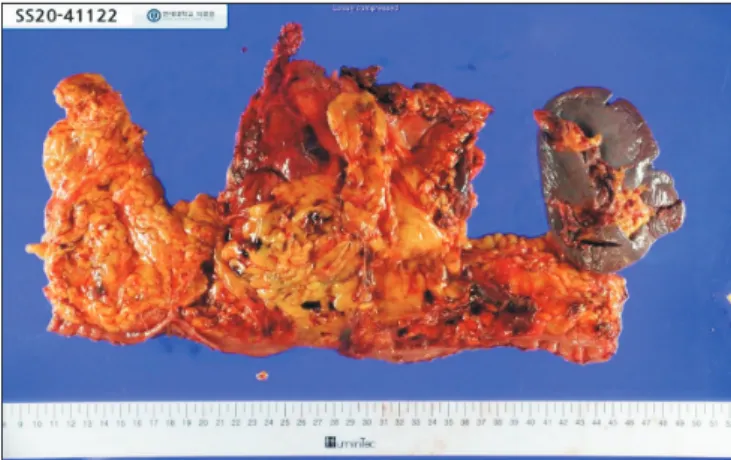
controlled. Stomach posterior wall was sleeved-resected with endoscopic gastrointestinal anastomosis stapler and re-en- forced with knotless suture. Some parts of the splenic flexure of colon were invaded. Combined en bloc resection of colonic segment was performed. For tangential margin clearance, dis- section of retroperitoneal soft tissues around the left kidney and left adrenalectomy were performed (Fig. 3). After bleeding control, two open silastic drains were inserted to be placed at the splenectomy site and the pancreatectomy site each. Total operation time was 437 minutes. Blood loss was 600 mL with- out intraoperative transfusion. The patient was awoken and sent to the post-anesthesia care unit. Finally, he was sent to the general ward.
Postoperative course and pathological examination
Postoperative days (POD) were uneventful until POD #5 when the open drain was removed and his fever spiked with mild leukocytosis observed. Abdominopelvic CT scan showed possible local peritonitis or ischemia of colon anastomosis with scarce fluid collection. However, conservative management with broad-spectrum intravenous antibiotics, transient nil per os, and nutritional support was sufficient. Finally, he was dis-
charged at 12 days postoperatively. The final pathologic report revealed complete regression of the tumor without residual carcinoma, showing cystic degeneration with necrosis (Fig. 4).
He is now just followed up without chemotherapy. Up to date, there is no evidence of tumor recurrence.
Fig. 2. (A, B) Abdominopelvic computed tomography after administration of the 10th doses of modified FOLFIRINOX, showing decreased size and solidity of mass (arrow).
A B
104.78 mm
104.78 mmFig. 3. (A) SpA (long white arrow) and SpV (short white arrows) were ligated and celiac artery dissection was done. (B) Left adrenal gland was resected and left pararenal fat layer were dissected. Note LRA and LRV, as well as resected spelnic artery (long white arrow). (C) Laparoscopic wedge resection of the s tomach was p er forme d with endoscopic gastrointestinal anasomosis (GIA) stapler. (D) Segmental resection of the affected colon was done with GIA stapler. CHA, common hepatic artery; LGA, left gastric artery; SpA, splenic artery; SpV, splenic vein; SMV, superior mesenteric vein;
IMV, inferior mesenteric vein; Sp, spleen; P, pancreas; Ad, adrenal gland; LRA, left renal artery; LRV, left renal vein; K, kidney; G, stomach; C, colon.
A B
C D
LGA LGA
CHA CHA
P P
SMV
SMV IMVIMV
Sp Sp SpV SpV SpA
SpA
SpA SpA
Ad Ad
Sp Sp
K K LRA LRA LRV LRV
C Sp C Sp G
G
Sp Sp SpV SpV