특 집
Thermal and Electrical Properties of PS/MWCNT Composite Prepared by Solution Mixing: Effect of Surface Modification of MWCNT
Eun Ju Park*, Jeongwoo Lee*, Dongsoo Jung**, and Sang Eun Shim†
*Department of Chemical Engineering, Inha University, 253 Yonghyundong, Namgu, Incheon, S. Korea 402-751
**Department of Mechanical Engineering, Inha University, 253 Yonghyundong, Namgu, Incheon, S. Korea 402-751 (Received January 8, 2010, Revised & Accepted January 19, 2010)
Solution Mixing법에 의한 PS/MWCNT 복합재료의 열 및 전기전도 특성: MWCNT 표면 개질의 영향
박 은 주*․ 이 정 우*․ 정 동 수**․ 심 상 은†
*인하대학교 화학공학과, **인하대학교 기계공학과 (2010년 1월 8일 접수, 2010년 1월 19일 수정 및 채택)
ABSTRACT:Herein, the effect of the dispersion uniformity of the multi-wall carbon nanotube (MWCNT) on the thermal and electrical conductivity of polystyrene (PS)/MWCNT composite was investigated. The PS/MWCNT composites were prepared by solution mixing from dispersions of various MWCNTs in PS/tetrahydrofuran (THF) solution. Three types of MWCNTs were used; pristine MWCNT, hydroxyl functionalized MWCNT, which was functionalized with KMnO4 in the presence of a phase transfer catalyst at room temperature, and pristine MWCNT with BYK-9077 as a dispersant. It was found that the stable dispersion state of MWCNT in PS/THF solutions significantly improved the thermal and electrical conductivity of the ultimate composites. It is noted that the thermal and electrical conductivity of PS/3 wt% pristine MWCNT composite with BYK-9077 were about 9.4 and 30~50% higher than those of PS/3 wt% pristine MWCNT composite, respectively.
요 약:본 논문에서는 MWCNT/PS 복합재료 제조 시, MWCNT의 표면 개질에 의한 분산도에 따른 열 및 전기전도도 에 관하여 연구하였다. 다양한 종류의 MWCNT를 PS/THF 용액에서 분산시킨 후 침전을 통하여 복합재료를 제조하였 다. 사용된 MWCNT는 pristine MWCNT의 상이동 촉매 존재 하에서 상온에서 KMnO4를 이용하여 하이드록실기로 개질된 MWCNT, BYK-9077 분산제를 이용한 MWCNT를 사용하였다. 분석 결과 MWCNT의 PS/THF 용액 내에서 의 분산 안정성은 최종 제조되어진 복합재료의 열 및 전기전도도 특성 향상에 중요하게 기여하였다. PS/3 wt% pris- tine MWCNT에 비하여, 특히 분산제 BYK-9077을 사용한 경우에는 열전도도가 9.7% 및 전기전도도가 30~50%
향상되는 결과를 얻었다.
Keywords:carbon nanotube, polystyrene, composite, thermal conductivity, electrical conductivity
†Corresponding Author. E-mail: [email protected]
Ⅰ. Introduction
Carbon nanotube (CNT) has a unique structure and remark- able mechanical, electrical, and thermal properties that make CNT an excellent candidate to substitute or complement the conventional nanofillers in polymer nanocomposites.1-4 To achieve full reinforcing potential of CNT, it should be sepa- rated from bundles and well dispersed in a polymer matrix for maximizing their contact surface area with the matrix.5
However, it is generally difficult to disperse CNT in polymer matrixes due to its large surface area and possess strong van der Waals forces, which result in significant aggregation.6 Moreover, it is insoluble in most organic solvents due to the pure carbon element and its stable structure.7 In order to over- come these problems, the chemical modification of the CNT's surface or utilization of surfactants is regarded as an effective way to improve its dispersion uniformity.8,9
It is well-known that pristine CNT surface can be simply carboxylated by treatment with strong acids such as nitric acid (HNO3) and sulfuric acid (H2SO4). This chemical oxidation can significantly increase the dispersion stability of the suspen-
sions.10 In our previous study, we have found that the MWCNT with carboxylate (COOH) was very well dispersed in polar media including water and alcohols due to the combination of polar-polar affinity and electrostatic repulsion.9 However, the treatment with strong acids led the structural damage of CNT. In order to minimize the structural damage of CNT dur- ing the initial chemical oxidation process, Zhang et. al.7 re- ported a novel methodology for the surface modification of CNT using an oxidant, potassium permanganate (KMnO4), in the presence of a phase transfer catalyst (PTC) at room tem- perature. It has been found that PTC methodology possesses several advantages over conventional oxidation methods using strong acids: (1) efficiency of oxidation drastically increases, (2) product selectivity between carboxylic acid and hydroxyl group is improved, (3) reaction condition is very mild, and (4) damage of carbon structure is minimized.11,12 Their ten- dency of locating at the interface of two phases (liquid-liquid or solid-liquid) introduces continuity between the two different phases.13 In this experiment PTC assists to extract permanga- nate from the water phase to organic liquid phase. Permanga- nate is a powerful oxidizing agent in organic reactions.14 Hydroxyl group with high selectivity is generated by the con- tact of CNT in methylene chloride, KMnO4, acetic acid em- ploying tetrabutyl ammonium bromide (TBABr) as a PTC dis- solved in water.
In this study, the polystyrene/multi-wall carbon nanotube (PS/MWCNT) composite was fabricated by step reactions with minimized damage of MWCNT during oxidation process.
First, hydroxyl groups were generated on the surface of MWCNT using KMnO4 in conjunction with TBABr as a PTC. And then, we prepared the PS composite consisting of MWCNT via sol- ution mixing. To confirm the effect of a MWCNT dis- persibility on thermal and electrical conductivities, three differ- ent MWCNTs including pristine, hydroxylated MWCNT, and MWCNT dispersed with a commercial dispersant were used and the properties of the composites were evaluated.
Ⅱ. Experimental
1. Materials
MWCNT (> 95%, diameter : 10-15 nm, length : 10-20 μm) produced by thermal chemical vapor deposition (CVD) method was purchased from Hanwha Nanotech, Korea. Hydrochloric acid (HCl, 36%), potassium permanganate (KMnO4, 99.3%), acetic acid, and methylene chloride (CH2Cl2) were purchased from Duksan Chemical, Korea. Tetrabutyl ammonium bromide (TBABr, 99%) was purchased from Junsei Chemical, Japan.
BYK-9077 (BYK Chemical Inc, Germany) is a solution of a high molecular weight copolymer with pigment affinic groups, and was selected as a dispersing agent. Commercial-
grade polystyrenes (PS) (Mw: 153,000 g/mole) were obtained from LG Chemical Co, Korea. Tetrahydrofuran (THF) was purchased from J.T. Baker, Europe.
2. Functionalization of MWCNT
MWCNT (0.2 g) was dispersed in 100 mL CH2Cl2 by ultra- sonication (200 W, Materials & Sonics Co., USA) for 10 min.
1 g TBABr, known as a phase transfer agent, was added in mixture of 20 mL H2O, 10 mL acetic acid, and KMnO4 sol- ution (0.5 g KMnO4 dissolved in 10 mL H2O). The suspension was mixed by high-speed stirring at 1,000 rpm and room tem- perature for 24 hrs. After that, the mixture was filtered using 0.2 μm Teflon filter (Advantec MFS) and washed with con- centrated HCl and methanol to remove any remnant. After vac- uum drying the filtrate, hydroxyl group modified MWCNT was achieved.
3. Fabrication of PS/MWCNT composites
MWCNT (0.25 - 0.75 g, 1 - 3 wt% to PS matrix) was dis- persed in 100 mL THF at room temperature by ultrasonication for 10 min. In order to compare the properties of composites as a dispersibility of MWCNT, three types of MWCNT sol- utions were prepared; pristine MWCNT/PS/THF, hydroxylated MWCNT (MWCNT-OH)/PS/THF, and pristine MWCNT/PS/
THF with a dispersant (BYK-9077). The dispersant was added as much amount as MWCNT; 100 wt% with respect to MWCNT. These solutions were then admixed with a solution of PS in THF. These mixtures were homogenized using shear mixing at 10,000 rpm in an ice bath for 30 min. After that, the PS solution with MWCNT suspension was precipitated by excessive methanol and the precipitates were vacuum-dried at 60 ℃ for 48 hrs. Thin composite films were produced from these dried mixtures using hot-press molding at 180 ℃.
4. Characterization
The functional groups of MWCNT were determined by a Fourier transform infrared spectrometer (FT-IR, VERTEX 80V, Bruker Optics). X-ray photoelectron spectroscopy (XPS) spectrum of MWCNT was obtained by a K-Alpha XPS spec- trometer. The Raman spectra were observed using RFS 100/S Brucker. The dispersion of MWCNT within PS matrix was characterized using scanning electron microscopy (SEM S4300, Hitachi). The thermal stability of these composites was measured by thermogravimetric analysis (Diamond TG/DTA thermal analysis instrument, Perkin Elmer) with a heating rate 10 ℃/min in a continuous nitrogen flow. The thermal and elec- trical conductivity properties of the composites were measured by thermal conductivity meter (QTM500, Kyoto electronics)
and resistivity meters (Hiresta-UP and Loresta-GP, Mitsubishi Chemical), respectively.
Ⅲ. Results and discussion
1. Grafting of hydroxyl groups on the MWCNT surface Dispersion of the MWCNT in a polymer matrix is important to improve the potential of polymer/MWCNT composites.
However, MWCNT usually tends to form strong agglomerates due to high van der Waals forces. To obtain uniform dispersion of MWCNT in a polymer matrix, MWCNT was surface-func- tionalized by chemical modification method. The surface mod- ification of CNT or fullerene using phase transfer catalysts (PTC) can be carried out in very mild conditions such as al- most neutral condition and a room temperature and the damage of MWCNT can be minimized for these reasons. Furthermore, it offers a high concentration of acid groups and high yield of hydroxyl groups.7 In the functionalization reaction using KMnO4 with a PTC, the color of the suspension changes from dark purple to dark brown. It means that the transformation of Mn+7 to Mn+4 occurs and MWCNT is successfully modified.
The FT-IR spectra were analyzed to verify the functional groups on the surface of MWCNT after surface modification using a PTC. In Figure 1, the strong characteristic peak at 3433 cm-1 was attributed to the existence of O-H groups on the surface of modified MWCNT, and the peak at 2942 cm-1 of samples indicated the aliphatic CH (-CH groups) deforma- tion vibration, one of the basic structures of MWCNT. Com- pared with the corresponding peak in Figure 1(a), the peak of O-H groups in Figure 1(b) was much stronger. The spectra of functionalized MWCNT also showed the stronger peaks at 1631 and 1124 cm-1 than those of pristine MWCNT. The peaks was attributed to the C=O and C-O groups stretching vi- brations, respectively.15 The presence of these vibration peaks suggests that functional groups had attached onto the surface of MWCNT.
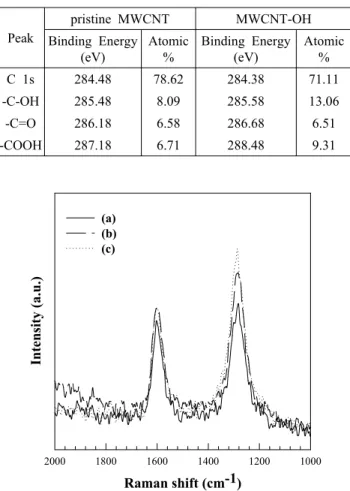
Figure 2 represents the XPS spectra of pristine MWCNT and functionalized MWCNT. XPS is a surface chemical ana- lytical technique that collects information about chemical bonding on the surface.16 The main peak (about 284.5 eV) is attributed to the C1s, and the other peaks are attributed to -C-OH (about 285.8 eV), -C=O (about 286.4 eV), and -COOH (about 287.7 eV), respectively.7 The XPS spectra in- dicate that the functional groups of MWCNT surface were changed after chemical oxidation process using KMnO4. The outermost peak is the XPS spectra, the inner peaks are the deconvoluted ones versus the binding energy of each func- tional group. The atomic concentration of functional groups is calculated based on the area under each deconvoluted peak.16 As shown in Table 1, on the pristine MWCNT surface, 8.09%
Wavenumber (cm-1)
1000 1500 2000 2500 3000 3500 4000
Transmission Intensity (%) (a) pristine MWCNT
(b) MWCNT‐OH
Figure 1. FT-IR spectra of (a) pristine MWCNT and (b) MWCNT-OH.
Binding Energy (eV)
282 283 284 285 286 287 288 289 290
Counts/s
0.0 2.0e+4 4.0e+4 6.0e+4 8.0e+4 1.0e+5 1.2e+5 1.4e+5 1.6e+5 1.8e+5
(a) C 1s
Binding Energy (eV)
282 283 284 285 286 287 288 289 290
Counts/s
0.0 2.0e+4 4.0e+4 6.0e+4 8.0e+4 1.0e+5 1.2e+5 1.4e+5 1.6e+5 1.8e+5
C 1s (b)
Figure 2. XPS spectra of (a) pristine MWCNT and (b) MWCNT-OH.
Table 1. Semi-quantitative analysis of the pristine MWCNT and MWCNT-OH
Peak
pristine MWCNT MWCNT-OH Binding Energy
(eV)
Atomic
%
Binding Energy (eV)
Atomic
%
C 1s 284.48 78.62 284.38 71.11
-C-OH 285.48 8.09 285.58 13.06
-C=O 286.18 6.58 286.68 6.51
-COOH 287.18 6.71 288.48 9.31
Raman shift (cm-1)
1000 1200
1400 1600 1800
2000
Intensity (a.u.)
(a) (b) (c)
Figure 3. FT-Raman spectra of (a) pristine MWCNT, (b) MWCNT-OH, and (c) MWCNT-COOH.
of carbon atoms were bonded with -OH groups, 6.71% with -COOH groups, and 6.58% with =O groups. In comparison with pristine MWCNT, the functionalized MWCNT had 13.06% of carbon atoms bonded with -OH groups, 9.31% with -COOH groups, and 6.51% with =O groups, respectively. This XPS result suggests that the MWCNT was majorly functional- ized with the hydroxyl groups (-OH) on the surface by the KMnO4 treatment.
The FT-Raman spectra of pristine, carboxylated MWCNT (MWCNT-COOH) functionalized by acid treatment, and hy- droxylated MWCNT (MWCNT-OH) functionalized by KMnO4 are shown in Figure 3. There are two dominant opti- cally active phonon modes in all the Raman spectra, where the line at 1600 cm-1 is the G line, corresponding to graphite carbon band from the sp2-hybridized of MWCNT; the D line at 1280 cm-1 is related to defective carbon band from the dis- ordered sp3-hybridized carbons in the curved graphite sheets.12 The intensity ratio of the D to G bands means the degree of defects in MWCNT by chemical treatment. The calculated D/G band intensity ratios in Figure 3 are (a) 1.14 for pristine
MWCNT, (b) 1.29 for MWCNT-OH and (c) 1.44 for MWCNT- COOH, respectively.
Conventional chemical modification for the oxidation of MWCNT is performed at very severe conditions using mixture of strong acids at high temperature above 100 ℃. Under these conditions, the significant damages to the molecular frame- work of MWCNT including sidewall opening, breaking, and transformation to amorphous carbon are resulted.17,18 From the FT-Raman data, the lower D- to G-band ratio of 1.29 for the PTC modification compared to 1.44 for the conventional chemical oxidation method using H2SO4/HNO3 means that the less damage of MWCNT was achieved. Also, it reveals that the treatment with a PTC at room temperature offers a similar degree of oxidation to the common acid treatment as reported by Varadan and coworkers.7
2. Dispersion stability of MWCNT dispersion
As seen in Figure 4, 0.01 wt% MWCNT-OH were dispersed in various solvents including (a) THF, (b) benzene, (c) MEK, (d) ethylacetate, and (e) cyclohexane using a sonicator. The photographic images were taken 2 months after dispersion.
MWCNT-OHs in benzene, ethylacetate and cyclohexane were severely aggregated and completely precipitated. On the other hand, MWCNT-OH in THF and MEK were stable even after 2 months. Therefore, THF and MEK could be considered as the most proper solvents for this work.
A dispersant adjusts the interaction between MWCNT and PS matrix and makes it stable for a long time. Dispersants consisting of a high molecular weight copolymer and pigment affinic groups adsorb on the surface of MWCNT. Therefore, they inhibit MWCNT from reflocculation and aggregation through a steric hindrance, and make MWCNT uniformly dis- persed in the matrix.19 BYK-9077 containing basic affinic
(a) (b) (c) (d) (e)
Figure 4. Photographs of 0.01 wt% MWCNT-OH dispersion in (a) THF, (b) benzene, (c) MEK, (d) ethylacetate, and (e) cyclohexane.
(a) (b)
10 μm 10 μm
10 μm 10 μm
(c) (d)
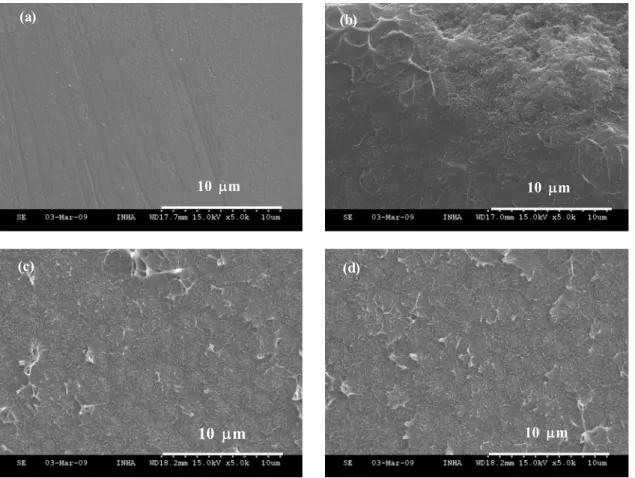
Figure 6. SEM microphotographs of the composites containing 3 wt% different MWCNTs; (a) pure PS, (b) pristine MWCNT, (c) MWCNT-OH, and (d) pristine MWCNT with BYK-9077.
groups was selected as an adequate dispersant in this study through preliminary screening. In Figure 5, the mixture of 0.01 wt% various MWCNTs, PS, and THF was dispersed by ultra- sonication for 10 min. The pristine MWCNT dispersed in PS/THF solution severely aggregated within a few hours and sedimentation started in a day. After 2 months, most pristine MWCNT settled down in the solution. In contrast, MWCNT-
(a) (b) (c)
Figure 5. Dispersion stability of (a) PS/pristine MWCNT/THF solution (b) PS/MWCNT-OH/ THF solution and (c) PS/pris- tine MWCNT/THF solution with BYK 9077 with the same concentration of MWCNT to PS (0.01 wt%).
OH and pristine MWCNT with a dispersant were shown a significantly improved stability in PS/THF solution even for 2 months and more. It is very clear that modification of MWCNT and addition of a dispersant have augmented the chemical affinity between the MWCNT and PS solution.
3. Properties of PS/MWCNT composites
Figure 6 shows the SEM images of a fractured surface of PS/MWCNT composite films containing 1.0 wt % of pristine MWCNT, MWCNT-OH and pristine MWCNT with BYK- 9077 as a dispersant. Figure 6(a) is a SEM picture of fractured surface of pure PS, which exhibits a relatively smooth surface.
For the composite with pristine MWCNT, severely aggregated masses of MWCNT are frequently observed on fracture surface as seen in Figure 6(b), whereas MWCNT-OH and pristine MWCNT with BKY 9077 are spatially well dispersed in the composite as shown in Figure 6(c) and (d).
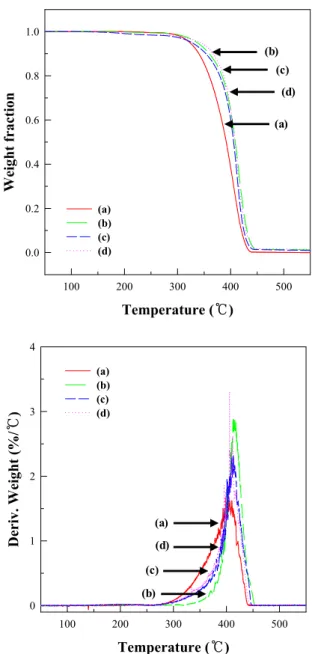
The TGA curves and differential TGA curves (D-TGA) of each PS/MWCNT composite film containing 1 wt% various MWCNTs are shown in Figure 7, including the curve of pure
Temperature ( )℃
100 200 300 400 500
Weight fraction
0.0 0.2 0.4 0.6 0.8 1.0
(a) (b) (c) (d)
(d) (c) (b)
(a)
Temperature ( )℃
100 200 300 400 500
Deriv. Weight (%/)℃
0 1 2 3 4
(a) (b) (c) (d)
(d) (c) (b)
(a)
Figure 7. TGA weight loss and DTGA curves for PS/MWCNT films containing 1wt% different MWCNTs; (a) pure PS, (b) pristine MWCNT, (c) MWCNT-OH, and (d) pristine MWCNT with BYK-9077.
PS. In TGA curves, the thermo-degradation of the composites took place in one step, producing one peak on D-TGA curves.
For all composites, a constant weight was maintained up to 300 ℃, and the weight loss occurred between 300 - 440 ℃ resulting from the thermal decomposition of PS molecules. The pure PS was completely decomposed, while PS/MWCNT com- posites remained MWCNT as a residue. The D-TGA plots show that the degradation temperature of pure PS is 400 ℃, while that of PS/MWCNT composite samples is 405-415 ℃.
It indicates that the thermal stability of PS/MWCNT is slightly improved by the incorporation of MWCNT.
Kim et al. have reported that the thermal conductivity of pristine MWCNT at room temperature is 3000 W/m·K.20 However, the thermal conductivity of our PS/MWCNT compo- sites was not as good as the expected one, because of the small interface thermal conductance of MWCNT.21 The ther- mal conductivity values of the PS/MWCNT composite films with various MWNTs were given in Table 2. The results were compared to investigate the effect of the types and amount of MWCNT on the thermal conductivity. The thermal con- ductivity of the pure PS was 0.1805 W/m·K and that of the composite films increased with increasing the concentration of MWCNT. When the various MWCNTs were loaded by 3 wt% in composites, the thermal conductivities of PS/pristine MWCNT, PS/MWCNT-OH and PS/pristine MWCNT with BYK-9077 composite films were improved by 5.8, 8.3 and 15.8 % compared to the value of pure PS. This result shows that the thermal conductivity of PS/MWCNT composites was enhanced by adding MWCNT. Among the PS/MWCNT com- posite films, PS/pristine MWCNT with BYK-9077 composite has the highest thermal conductivity because BYK-9077 im- proves the dispersibility of MWCNT in PS matrix as enhanc- ing an affinity between PS and MWCNT.
Table 3 shows the electrical conductivity values of the PS/MWCNT composite films containing various MWCNTs at room temperature. It is widely known that the PS is electrically insulating materials (1.0×10⁻¹⁴ S/cm).22 With the addition of the conductive MWCNT into the PS matrix, the conductivity of the PS/MWCNT composites increases as the amount of MWCNT increases. When the amount of MWCNT was 3 wt%
in composite, the conductivity of the composites increases
Table 2. Thermal conductivity of pure PS and PS/MWCNT composites containing 1, 2 and 3 wt% different MWCNTs
MWCNT wt% to PS Thermal conductivity (W/mK)
- 1 2 3
pure PS 0.1805 - - -
pristine MWCNT - 0.1847 0.1891 0.1911 MWCNT-OH - 0.1896 0.1944 0.2028 MWCNT/BYK-9077 - 0.1937 0.1956 0.2091
Table 3. Electrical conductivity of pure PS and PS/MWCNT composites containing 1, 2 and 3 wt% different MWCNTs
MWCNT wt% to PS Electrical conductivity (S․cm2)
- 1 2 3
pure PS 1.10×10⁻¹⁴ - - -
pristine MWCNT - 8.30×10-101.13×10⁻⁹ 7.62×10⁻⁷ MWCNT-OH - 2.52×10⁻⁹ 3.04×10⁻⁸ 2.30×10⁻⁶ MWCNT/BYK-9077 - 6.17×10⁻⁸ 5.70×10⁻⁶ 2.40×10⁻⁵
from 7.62×10⁻⁷ (PS/pristine MWCNT composite) to 2.40×10⁻⁵ S/cm (PS/pristine MWCNT composite with BYK-9077). Among the PS/MWCNT composite films, PS/pristine MWCNT with BYK-9077 composite has the highest electrical conductivity due to improvement of an affinity between the PS and MWCNT.
Ⅳ. Conclusions
In this work, PS/MWCNT nanocomposite films containing various MWCNTs were prepared by solution mixing tech- nique. The MWCNTs including pristine MWCNT, MWCNT- OH, and pristine MWCNT with a dispersant were uniformly dispersed in PS/THF solution using high shear mixing. And the mixtures were precipitated in excessive methanol. Thin composite films were prepared from the coagulated precip- itates using hot-press molding after complete drying. For the composite containing pristine MWCNT, severely aggregated masses of MWCNT are frequently observed on the morphol- ogy, whereas MWCNT-OH and MWCNT with a dispersant are spatially well dispersed in the composites. The thermal stability of PS/MWCNT composite was enhanced as compared to pure PS. The thermal and electrical conductivity of the com- posite films changed according to the types and the amount of MWCNT. Among the PS/MWCNT composite films studied in this article, PS/pristine MWCNT with BYK-9077 composite exhibited the highest thermal and electrical conductivity be- cause BYK-9077 improves the dispersibility of MWCNT in PS matrix as enhancing an affinity between PS and MWCNT.
Acknowledgement
This work was supported by the Korea Science and Engi- neering Foundation (Grant no. R01-2007-000-20055-0).
References
1. M. Moniruzzaman and K.I. Winey, “Polymer nanocomposites containing carbon nanotubes”, Macromolecules, 39, 5194 (2006).
2. P. Chen, H.S. Kim, and H.J. Jin, “Preparation, properties and application of polyamide/carbon nanotube nanocomposites”, Macromol. Res., 17, 207 (2009).
3. D.S. Bang, H.S. Kye, U.R. Cho, B.G. Min, and K.C. Shin,
“Elastomer nanocomposites(I)”, Elastom. Compos., 44, 22 (2009).
4. H.T. Ham, C.M. Koo, S.O. Kim, Y.S. Choi, and I.J. Chung,
“Influence of oxyfluorination on physicochemical character- istics of carbon fibers and their reinforced epoxy composites”, Macromol. Res., 12, 384 (2004).
5. E.T. Thostenson, C. Li, and T.W. Chou, “Nanocomposites in context”, Compos. Sci. Technol., 65, 491 (2005).
6. H.S. Kim, B.H. Park, J.S. Yoon, and H.J. Jin, “Nylon 610/functionalized multiwalled carbon nanotubes composites by in situ interfacial polymerization”, Mater. Lett., 61, 2251 (2007).
7. N. Zhang, J. Xie, and V.K. Varadan, “Functionalization of carbon nanotubes by potassium permanganate assisted with phase transfer catalyst”, Smart Mater. Struct., 11, 962 (2002).
8. L. Vaisman, H.D. Wagner, and G. Marom, “The role of sur- factants in dispersion of carbon nanotubes”, Adv. Colloid Interf. Sci., 128, 37 (2006).
9. J. Lee, M. Kim, C.K. Hong, and S.E. Shim, “Measurement of the dispersion stability of pristine and surface-modified multiwalled carbon nanotubes in various nonpolar and polar solvents”, Meas. Sci. Technol., 18, 3707 (2007).
10. M.W. Marshall, S. Popa-Nita, and J.G. Shapter, “Measure- ment of functionalised carbon nanotube carboxylic acid groups using a simple chemical process”, Carbon, 44, 1137 (2006).
11. S. Hong, M. Kim, C.K. Hong, D. Jung, and S.E. Shim,
“Encapsulation of multi-walled carbon nanotubes by poly(4- vinylpyridine) and its dispersion stability in various solvent media”, Synthetic Met., 158, 900 (2008).
12. M. Kim, C.K. Hong, S. Choe, and S.E. Shim, “Synthesis of polystyrene brush on multiwalled carbon nanotubes treated with KMnO4 in the presence of a phase-transfer catalyst”, J. Polym. Sci. Part A: Polym. Chem., 45, 4413 (2007).
13. Y. Sasson and R. Neumann, Handbook of phase transfer cat- alysis, Chapman & Hall, London, UK (1997).
14. D.G. Lee and V.S. Chang, “Polyethylene glycol as a phase transfer catalyst for aryldiazonium salt reactions”, J. Org.
Chem., 43, 1532 (1978).
15. G. Wang, Z. Qu, L. Liu, Q. Shi, and J. Guo, “Study of SMA graft modified MWNT/PVC composite materials”, Mater. Sci.
Eng. A, 472, 136 (2008).
16. H. Meng, G.X. Sui, P.F. Fang, and R. Yang, “Effects of acid- and diamine-modified MWNTs on the mechanical properties and crystallization behavior of polyamide 6”, Polymer, 49, 610 (2008).
17. M. Monthioux, B.W. Smith, B. Burteaux, A. Claye, J.E.
Fischer, and D.E. Luzzi, “Sensitivity of single-wall carbon nanotubes to chemical processing: an electron microscopy in- vestigation”, Carbon, 39, 1251 (2001).
18. F.H. Ko, C.Y. Lee, C.J. Ko, and T.C. Chu, “Purification of multi-walled carbon nanotubes through microwave heating of nitric acid in a closed vessel”, Carbon, 43, 727 (2005).
19. Y. Li, Y. Liu, Y. Zuo, W. Chi, B. Liu, and Z. Shen, “Effects of dispersants on dispersion of carbon nanotubes and proper- ties of fluorocarbon resin nanocomposites”, J. Mater. Sci., 43, 3738 (2008).
20. J.P. Smalla, L. Shib, and P. Kim, “Mesoscopic thermal and thermoelectric measurements of individual carbon nano- tubes”, Solid State. Commun., 127, 181 (2003).
21. S.T. Huxtable, D.G. Cahill, S. Shenogin, L.P. Xue, R. Ozisik,
P. Barone, M. Usrey, M.S. Strano, G. Siddons, M. Shim, and P. Keblinski, “Interfacial heat flow in carbon nanotube sus- pensions”, Nat. Mater., 2, 731 (2003).
22. J. Brandrup, E.H. Immergut, E.A. Grulke, and D.R. Bloch, Polymer handbook, Wiley, New York (1999).