Special Issue Paper
High Temperature Thermo-mechanical Properties of HfC Reinforced Tungsten Matrix Composites
Malik Adeel Umer*, Dong Ju Lee**, Ho Jin Ryu***†, Soon Hyung Hong****†
ABSTRACT: In order to improve the mechanical properties of tungsten at room and elevated temperature, hafnium carbide (HfC) reinforced tungsten matrix composites were prepared using the spark plasma sintering technique. The effect of HfC content on the compressive strength and flexural strength of the tungsten composites was investigated.
Mechanical properties of the composites were also measured at elevated temperatures and their trends, with varying reinforcement volume fraction, were studied. The effect of reinforcement fraction on the thermal properties of the composites was investigated. The thermal conductivity and diffusivity of the composites decreased with increasing temperature and reinforcement volume fraction. An inherently low thermal conductivity of the reinforcement as well as interfacial losses was responsible for lower values of thermal conductivity of the composites. Values of coefficient of thermal expansion of the composites were observed to increase with HfC volume fraction.
Key Words: Tungsten, Metal matrix composites (MMCs), Microstructure, Mechanical properties, Thermal conductivity
1. INTRODUCTION
Extreme applications such as nuclear fusion, engine pro- pulsion and hypersonic leading edges involve temperatures reaching above 3000oC in a few seconds. This leaves us with a narrow range of materials which should not only sustain these exceptionally high temperatures but also retain their strength and chemical stability. In such circumstances, materials pos- sessing good resistance to ablation attack with high tempera- ture strength are preferred. Owing to an extremely high melting point (3422oC) and remarkable room and high tem- perature thermal, physical and mechanical properties, tung- sten is largely preferred for use in such applications [1-7].
Presently, tungsten and its alloys are good candidates for rud- der and nozzle components of rocket motors, nose caps of missiles, and high strength clamps for testing high tempera- ture mechanical behavior of metals [2,8-10]. However, Tung- sten loses a significant amount of its mechanical ability at temperatures above 1000oC (strength of monolithic tungsten
decreases by 60% at 1000oC) as well as its oxidation in the presence of oxygen poses a serious challenge [2,4].
Methods of improving low temperature plasticity and high temperature strength of tungsten by solid solution strength- ening and second phase particles have been extensively explored over the past few decades [2,11-14]. The addition of rhenium (Re) has been beneficial in increasing the room-tem- perature ductility of tungsten, as well as its high-temperature strength as it has high melting temperature (3186oC); only 3.6% Re increases the strength of W up to double by forming stable intermetallic phases [2]. The use of composite systems gives us the additional advantage of tailoring the various prop- erties of the composites by controlling the compositions or the fabrication processes of the system [15]. Keeping refractory metal as the matrix with ceramic particles as the reinforcement have produced composites with interesting chemical, thermal, and mechanical properties. Recently, ceramic particle (such as TiC, ZrC, TiN, ZrO2, ThO2 and/or La2O3) reinforced tungsten composites have gained popularity as they show significant
Received 24 September 2015, received in revised form 14 December 2015, accepted 16 December 2015
***
***†
****†
School of Chemical and Materials Engineering, National University of Science and Technology, Pakistan Division of Nuclear Materials Development, Korea Atomic Energy Research Institute, Korea
Department of Nuclear and Quantum Engineering, Korea Advanced Institute of Science and Technology, Korea Corresponding author (E-mail: [email protected])
Department of Materials Science and Engineering, Korea Advanced Institute of Science and Technology, Korea Corresponding author (E-mail: [email protected])
improvements in mechanical properties of tungsten [2,7,12, 16-18].
Among the ceramic reinforcements, hafnium carbide pro- vides an excellent prospect to be used for high temperature applications because of its high refractory nature, high melting point (3890oC), superior mechanical properties, high thermal stability and high ablation resistance as compared to other reinforcement candidates at high temperatures [1,3,7,19,20].
We have demonstrated how large volume fraction ceramic reinforced tungsten composites are effective in enhancing the ablation resistance of tungsten [21,22]. Although the room temperature mechanical and ablation properties of HfC rein- forced W composites have already been reported by many researchers [7,12,23], this paper reports on the high tempera- ture flexural strength, compressive strength, thermal conduc- tivity, coefficient of thermal expansion of HfC reinforced W composites prepared by spark plasma sintering (SPS), which has not been explored so far.
2. EXPERIMENTAL PROCEDURE
The HfC particles reinforced W composite samples were prepared by mixing 10, 20 and 30 vol%HfC powder having mesh size under 400 in tungsten powder of 2.5 μm particle size. The ball mixer was operated with 10:1 tungsten ball to powder ratio, in dry condition up to 12 hours at 100 rpm.
These powder samples along with monolithic tungsten were consolidated under vacuum of 10 Pa via SPS with a minimum heating rate of 100oC/min, sintering temperature of 1800oC, holding time 5 minutes, and 50 MPa compressive pressure.
Archimedes’ method was employed to measure relative den- sities of consolidated samples prior to the characterization by high resolution scanning electron microscopy (SEM) (Phillips XL30SFEG), image analysis program (Matrox Inspector 2) and X-ray diffractometry (XRD) (Rigaku D/MAX-IIIC).
The mechanical behavior of the HfC reinforced W com- posite was evaluated via compression and flexural strength tests. The rectangular specimen having dimensions 12 × 1 × 1.5 mm (length, thickness, width) was subjected to the three point bending test. Samples with polished surface and cham- fered edges were subjected to room temperature flexural test by using INSTRON 5585 universal testing machine with crosshead speed of 0.2 mm/min. The samples were heated up to 1000oC in a box type resistance furnace to carry out high temperature flexural test in an Ar atmosphere. The room tem- perature compressive test was performed on samples having 4 mm diameter and 6 mm height by the same machine and cross head speed as flexural test, whereas the high temperature compressive strength was measured at 1200oC in Ar atmo- sphere by computer controlled servo-hydraulic Gleeble 3500 with strain and heating rates of 0.1 s−1 and 10°C/s, respectively.
The measurement of thermal conductivity, by laser flash technique, and coefficient of thermal expansion, by dilatom-
eter were carried out at room temperature, 200oC, 400oC, 600oC, 800oC and 1000oC on the cylindrical shaped samples having dimensions φ12.7 mm × 2 mm and φ6 mm × 16 mm, respectively. Both of these tests were performed in inert atmo- sphere. α-Al2O3 as a reference and He for inert atmosphere were used in both of these tests. However, the samples were heated at different rates, which was 1oC/min for the former and 5oC/min for the latter technique.
3. RESULTS AND DISCUSSIONS
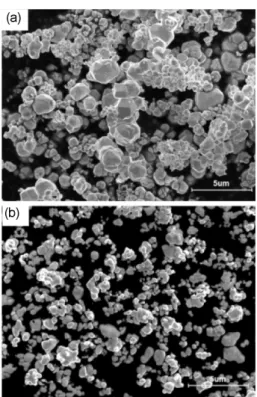
The SEM micrographs of W and HfC (under 325 mesh size) have shown in Fig. 1(a) and (b), respectively. X ray diffraction results for the 30vol% HfC/W composite sintered at 1800oC can be seen in Fig. 2. It can be confirmed from the XRD results that only tungsten and HfC exist. Oxides of hafnium or tung- sten carbide that form as a result of interfacial reaction or reac- tion with impurities (e.g. oxygen or carbon during ball milling process) do not exist in the sintered samples.
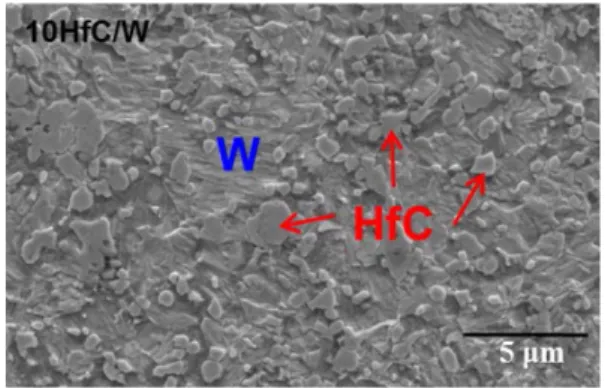
Sintering at 1800oC increased the grain size of tungsten powder up to 13.8 ± 2.66 μm, which is four times higher than the average particle size of raw powder. Microstructures of composite samples consisting of 10 vol% HfC/W are shown in Fig. 3. The HfC phase is uniformly distributed in the tungsten matrix indicating that the powders were efficiently mixed prior to sintering, the uniform dispersion of HfC is very important as it plays a vital role in maintaining high tem- perature strength of the material by dislocation pinning [7,12, 23]. Average grain size of tungsten in the HfC/W composites was much smaller than in the monolithic tungsten samples.
Fig. 1. SEM images of as received (a) tungsten and (b) HfC powder
For example the average grain size of tungsten was measured to be 4.57 ± 1.29 μm for 10 vol% HfC/W composites, a value that lies in coherence with the size of the tungsten starting powder. HfC particles act as grain growth inhibitors, thus pre- venting the thermal growth of tungsten during sintering. The presence of HfC particles in the tungsten matrix exerts a pin- ning pressure on surrounding tungsten grains, preventing the movement of tungsten. This results in a considerably smaller grain size of tungsten while using reinforcement particles.
Smaller W grains are useful for improving the strength of the HfC/W composites.
At room temperature, an increase in compressive strength has been observed with increasing reinforcement up to 30 vol%, due to grain refinement and influence of reinforce- ment particles on dislocation movement. Grain refinement plays a significant role in hard matrices where other forms of strengthening mechanisms are of less importance [24]. The hard HfC particles in the tungsten matrix hinder the defor- mation of the tungsten matrix by restricting the dislocation motion. Therefore reinforcing the tungsten matrix by HfC particles can enhance the strength of the composites. The highest value of compressive strength was achieved with 30 vol% HfC reinforcement [22]. The flexural strength, which is more sensitive to porosity and agglomeration of reinforcing particles, displayed different behavior than compressive strength. The flexural strength measured at room temperature increased up to 10 vol% of the reinforcement phase and then decreased for higher reinforcement contents. Because the rel- ative densities of HfC/W composites were 99.3%, 98.3% and 96.1% for 10 vol% HfC/W, 20 vol% HfC/W and 30 vol% HfC/
W, respectively, the decrease in the flexural strengths of 20%
HfC/W and 30% HfC/W are partly attributed to the porosity [22].
Due to the poor sinterability of HfC-HfC particles, some microscoporosity is left between them. This porosity is evident of short consolidation times [12]. As the volume fraction of HfC particles increase, the presence of porosity becomes a
latent source of microcrack formation. The reinforcement clusters cannot transfer stresses to the matrix because of the weak adhesion between adjacent ceramic particles. Therefore, a decline in the values of flexural strength occurs on increasing the ceramic reinforcement, contrary to an increase in com- pressive strength.
The values of high temperature compressive strength, car- ried out at a temperature of 1200oC, can be seen in Fig. 4(a).
The strength of tungsten decreases significantly at elevated temperatures. At room temperature, tungsten behaves in a Fig. 2.X ray diffraction pattern of 30 vol% HfC/W sintered com-
posite
Fig. 3.An SEM image of cross sectional microstructures of 10 vol% HfC/W composite
Fig. 4.(a) Compressive strength of HfC/W composites and (b) flexural strength of HfC/W composites measured at ambi- ent & high temperatures [22]
brittle manner. The ductile to brittle transition temperature (DBTT) of tungsten ranges over 100-400oC [25]. Above these temperatures, the behavior of the tungsten matrix becomes more ductile in nature. The flow stresses required to strain tungsten decrease above the ductile-brittle transition region.
The presence of reinforcement particles in tungsten matrix helped increase the compressive strength of tungsten. 30 vol%
HfC/W composites showed the highest compressive strength at elevated temperatures. The flexural strength values of the composites are shown in Fig. 4(b). With less resistance to motion at elevated temperature, a significant reduction in the flexural strength of tungsten was recorded. The composite samples show a different trend in the values of flexural strength at 1000oC than at room temperature. There is a sig- nificant enhancement in the flexural strength of tungsten by reinforcing with HfC. The flexural strength of the composites increases with the addition of reinforcement content up to 30 vol%. At 1000oC 30 vol% HfC enhances the strength of tungsten by a factor of more than three, which is much larger than the increase in strength due to 35% ZrC [2]. At room temperature, the already little mobility of tungsten is further limited by the presence of reinforcement particles, which restrain the dislocation movement. Due to this lack of duc- tility, tungsten composites are subjected to catastrophic failure in the presence of flaws. The probability of having flaws in the structure increases with an increase in the volume fraction of reinforcement phase. Therefore, flexural strength decreases for high volume fractions of reinforcement at room temperature.
At elevated temperature, the ductile behavior of the tungsten matrix and the interaction of reinforcement particles with dis- locations results in a strengthening effect. Since there are no issues of a brittle fracture, the strengthening effect of rein- forcement phase increases with an increase in its volume frac- tion. The enhancement of strength of tungsten composites at elevated temperatures can be extremely beneficial in allowing higher volume content of ceramic reinforcements to be used.
Higher volume fraction ceramic reinforced tungsten compos- ites are particularly interesting as they exhibit a significant improvement in the resistance to ablation as compared to monolithic or low volume fraction ceramic reinforced tung- sten. The fact that the overall density decreases with increasing the volume fraction of less dense ceramic reinforcement could be utilized in reducing the overall weight of the components.
Values for thermal diffusivity of the composites measured at different temperatures are shown in Fig. 5(a). The values were employed to calculate the thermal conductivity, k, using the following equation [26,27]:
(1) Where α is the thermal diffusivity, cρ is the specific heat and ρ is the density of the material. Thermal conductivity of the composites decreases with the volume fraction of HfC content as shown in Fig. 5(b). This is due to inherently low thermal
conductivity of HfC. The measured room temperature value of thermal conductivity of pure tungsten is 164 W/mK. The ther- mal conductivity of 10 vol% HfC/W composite was decreased with temperature. However, 30 vol% HfC/W composite did not show similar amount of reduction in thermal conductivity with temperature. This is because the conductivity of hafnium carbide increases with temperature.
Fig. 6 presents the comparison of thermal expansion coef- ficients of tungsten and HfC/W composites from room tem- k=α c× ρ×ρ
Fig. 5. (a) Thermal diffusivity and (b) thermal conductivity of the composites
Fig. 6. Coefficients of thermal expansion of the composites
perature to 1000oC. While pure tungsten possesses the lowest thermal expansion coefficient, the thermal expansion coeffi- cients of HfC/W composites were increased with increasing HfC volume fraction because HfC has a higher thermal expansion coefficient than pure tungsten.
4. CONCLUSIONS
The average grain size of tungsten after sintering was decreased by 10 vol% HfC particle addition from 13.8 μm to 4.57 μm by HfC particles addition. The compressive strength of HfC/W, which was found to increase with increasing HfC up to 30 vol% due to HfC’s role in grain refinement and dis- locations pinning, got decreased with increasing temperature at 1200oC. Poor sinterability among HfC particles in the com- posite samples affected the flexural strength adversely and it was found to increase up to 10 vol% of HfC only. At high tem- perature, the increasing HfC causes flexural strength to con- tinually rise and maximum flexural strength was observed with 30 vol% HfC at 1000oC. The thermal conductivities of HfC/W composites were decreased with the volume fraction of HfC particles. However, the coefficient of thermal expan- sion was found to increase with increasing temperature and HfC volume fraction.
ACKNOWLEDGMENT
This research was supported by National R&D Program through the National Research Foundation of Korea (NRF) funded by the Ministry of Science, ICT & Future Planning (NRF-2015M1A7A1A02002190).
REFERENCES
1. Lee, J.M., Kim, J.H., and Kang, S.H., “Advanced W-HfC Cermet Using In-situ Powder and Spark Plasma Sintering”, Journal of Alloys and Compounds, Vol. 552, 2013, pp. 14-19.
2. Zhang, S.C., Hilmas, G.E., and Fahrenholtz, W.G., “Zirconium Carbide–Tungsten Cermets Prepared by In Situ Reaction Sin- tering”, Journal of the American Ceramic Society, Vol. 90, No.07, 2007, pp. 1930-1933.
3. ASM International Engineering Materials Handbook. ASM International, Metals Park, 1991.
4. Yih, S.W.H. and Wang, C.T., Tungsten-Sources, Metallurgy, Properties and Applications, Plenum Press, New York, 1979.
5. Lassner, E., and Schubert, W.D., Tungsten: Properties, Chemis- try, Technology of the Element, Alloys, and Chemical Com- pounds, Plenum Publishers, New York, 1999.
6. Opeka, M.M., Talmy, I.G., Wuchina, E.J., Zaykoski, J.A., and Causey, S.J., “Mechanical, Thermal and Oxidation Properties of Refractory Hafnium and Zirconium Compounds”, Journal of the European Ceramic Society, Vol.19, No. 13-14, 1999, pp.
2405-2414.
7. Liu, M., and Cowley, J., “Hafnium Carbide Growth Behavior
and Its Relationship To The Dispersion Hardening in Tungsten at High Temperatures”, Materials Science and Engineering, Vol.
160, No. 2, 1993, pp. 159-167.
8. Manning Jr, C.R. and Lineback, L.D., Development of High Temperature Materials for Solid Propellant Rocket Nozzle Appli- cations, Technical Report, NASA, United States, 1974.
9. El-Genk, M.S. and Tournier, J.M., “A Review of Refractory Metal Alloys and Mechanically Alloyed-Oxide Dispersion Strengthened Steels for Space Nuclear Power Systems”, Journal of Nuclear Materials, Vol. 340, No. 1, 2005, pp. 93-112.
10. Smid, I., Akiba, M., Vieider, G., and Plochl, L., “Development of Tungsten Armor and Bonding to Copper for Plasma-inter- active Components”, Journal of Nuclear Materials, Vol. 2598- 263, No. 1, 1998, pp. 160-172.
11. Ozaki, Y. and Zee, R.H., “High Temperature Diffusion of Haf- nium in Tungsten and a Tungsten-hafnium Carbide Alloy,”
Scripta Materialia, Vol. 30, No. 10, 1994, pp. 1263-1267.
12. Lou, A., Jacobson, D.L., and Shin, K.S., “Tensile Properties of Tungsten-3.6% Rhenium-0.4% Hafnium Carbide above 0.5 Tm”, Scripta Materialia, Vol. 23, No. 3, 1989, pp. 397-400.
13. Lee, K.H., Cha, S.I., Ryu, H.J., Dilmore, M.F., and Hong, S.H.,
“Effect of Mechanical Alloying Process on Microstructure and Mechanical Properties of ODS Tungsten Heavy Alloys”, Journal of Alloys and Compounds, Vol. 434, 2007, pp. 433-436.
14. Kim, Y., Lee, K.H., Kim, E.P., Cheong, D.I., and Hong, S.H.,
“Fabrication of High Temperature Oxides Dispersion Strength- ened Tungsten Composites by Spark Plasma Sintering Process”, International Journal of Refractory Metals and Hard Materials, Vol. 27, No. 5, 2009, pp. 842-846.
15. Clyne, T.W. and Withers, P.J., An Introduction to Metal Matrix Composites, Cambridge University Press, New York, 1995.
16. Teague, M.C., Hilmas, G.E., and Fahrenholtz, W.G., “Mechan- ical Properties of Reactively Processed W/Ta 2 C-based Com- posites,” Journal of the European Ceramic Society, Vol. 30, No.
11, 2010, pp. 2197-2201.
17. Song, G.M., Wang, Y.J., and Zhou, Y., “Elevated Temperature Ablation Resistance and Thermophysical Properties of Tung- sten Matrix Composites Reinforced With ZrC Particles,” Jour- nal of Materials Science, Vol. 36, 2001, pp. 4625-4631.
18. Chen, Y., Wu, Y.C., Yu, F.W., and Chen, J.L., “Microstructure and Mechanical Properties of Tungsten Composites Co- Strengthened by Dispersed TiCand La2O3 Particles,” Interna- tional Journal of Refractory Metals and Hard Materials, Vol. 26, No. 6, 2008, pp. 525-529.
19. Rea, K.E., Viswanathan, V., Kruize, A., De Hosson, J.Th.M., O’Dell, S., McKechnie, T., Rajagopalan, S., Vaidyanathan, R., and Seal, S., “Structure and Property Evaluation of a Vacuum Plasma Sprayed Nanostructured Tungsten–Hafnium Carbide Bulk Composite”, Materials Science and Engineering: A, Vol.
477, No. 1-2, 2008, pp. 350-357.
20. Klopp, W.D., Raffo, P.L., and Witzke, W.R., “Strengthening of Molybdenum and Tungsten Alloys With HfC”, J. Metals Vol.
23, No. 6, 1971, pp. 27-38.
21. Umer, M.A., Lee, D.J., Ryu, H.J., and Hong, S.H., “High Tem- perature Ablation Resistance of ZrNp Reinforced W Matrix
Composites”, International Journal of Refractory Metals and Hard Materials, Vol. 42, 2014, pp. 17-22.
22. Lee, D.J., Umer, M.A., Ryu, H.J., and Hong, S.H., “Elevated Temperature Ablation Resistance of HfC Particle-reinforced Tungsten Composites”, International Journal of Refractory Met- als and Hard Materials, Vol. 43, 2014, pp. 89-93.
23. Witzke, W.R., “The Effects of Composition on Mechanical Properties of W-4Re-Hf-C Alloys”, Metallurgical Transactions, Vol. 5, No. 2, 1974, pp. 499-504.
24. Song, G.M., Wang, Y.J., and Zhou, Y., “The Mechanical and Thermophysical Properties of ZrC/W Composites at Elevated
Temperature”, Materials Science and Engineering: A, Vol. 334, No. 1-2, 2002, pp. 223-232.
25. Smid, I., Akiba, M., Vieider, G., and Plöchl, L., “Development of Tungsten Armor and Bonding to Copper for Plasma-inter- active Components”, Journal of Nuclear Materials, Vol. 258, 1998, pp. 160-172.
26. Eckert, E.R.G. and Drake, R.M., Heat and Mass Transfer, McGraw-Hill, Kogakusha, 1959.
27. Lee, S.H., Kwon, S.Y., and Ham, H.J., “Thermal Conductivity of Tungsten–copper Composites”, Thermochimica Acta, Vol. 542, 2012, pp. 2-5.