INTRODUCTION
Lignocellulose is the most abundant on earth and has been considered as a sustainable resource for biofuel and biomaterial production. The cultivation of mushrooms is the most economically viable process for the bioconversion of the lignocellulosic waste annually generated from agricul ture, forestry and food processing activities(Buswell et al. 1996). The utilization of lignocellulosic materials by mush room fungi depends on their ability to produce relevant hy drolytic cellulases and oxidative ligninases(Buswell et al. 1996).
To increase the economic feasibility of lignocellulose as well as the mushroom yield, improved cellulase activity is needed. The induction of mutations for desirable function improvements has been employed by using chemical, mole cular biological and physical agents(Roychowdhury and Tah 2013). Historically, certain types of chemicals were
used to induce mutations, such as nitrous acid, intercalating agents and alkylating agents(Ulukapi and Nasircilar 2015). Currently, the processes of nucleotide insertion, deletion and substitution by molecular biological techniques are commonly used to induce mutants(SatheshPrabu and Lee 2011). At present, mutant induction by using gamma ray radiation is showing promise in many areas of the life sci ences(Ulukapi and Nasircilar 2015). Lignocellulolytic mu tants of Pleurotus ostreatus and P. florida(Lee et al. 2000; SatheshPrabu and Lee 2012), highly productive mutants of P. florida(Djajanegara and Harsoyo 2009), and phenolic compounds increased mutant of Agaricus bisporus(Beaulieu et al. 1999) have been successfully induced. Generally, ra diation mutation is regarded as an environmentally friendly (no secondary pollution) and convenient(simple irradiation process) technique.
Cellulose degradation is accomplished by a combina tion of the three main types of cellulases: endoglucanases (EC3.2.1.4), exoglucanases(EC3.2.1.91), and β-glucosidases (EC3.2.1.21). Endoglucanases randomly hydrolyze the in ternal β-glycosidic bonds of the loose amorphous regions of
Sequence Variation of cel7A in a Cellulase Activity Enhanced
Mutant of Lentinula edodes KACC42378
Kyung Sook Chung1, YoungKeun Lee1,* and JinBaek Kim11Advanced Radiation Technology Institute, Korea Atomic Energy Research Institute, Geumgu-gil 29, Jeongeup-si, Jeollabuk-do 56212, Republic of Korea
Abstract - The cel7A sequence variation was analyzed between the wild type(Lentinula edodes KACC42378) and its cellulase activity enhanced mutant LER277. LER277 was induced by using gamma ray radiation(60Co) at the LD
99 dose(0.94kGy). Cloning and sequencing results
showed that the cel7A coding DNA sequence(CDS) of LER277 had five nucleotide substitutions (T→C, 201, 285 and 744nt; A→G, 525nt; C→T, 540nt) and one hexanucleotide repeat insertion (GGCACC, within 1375-1392nt) compared to that of the wild type. The Five nucleotide substitutions did not change the deduced amino acids and the hexanucleotide insertion elongated the GT repeat in a serine/threonine/glycine-rich linker. These results suggest that the enhancement of the cellulase activity in LER277 partly stemmed from cel7A changes by which the GT repeat of the linker is elongated.
Key words : cel7A, Cellulase, Lentinula edodes, Linker, Mutant, Radiation
─ 145 ─ Technical Paper
* Corresponding author: YoungKeun Lee, Tel. +82635703300, Fax. +82635703309, Email. [email protected]
cellulose and release the new end of cellulose for exogluca nases(Teeri 1997). Exoglucanases act processively on the reducing ends(cellobiohydrolase I) or nonreducing ends (cellobiohydrolase II) of crystalline cellulose and cleave cellulose chains into cellobiose units. β-Glucosidases cleave cellobiose into glucose(Ni and Tokuda 2013).
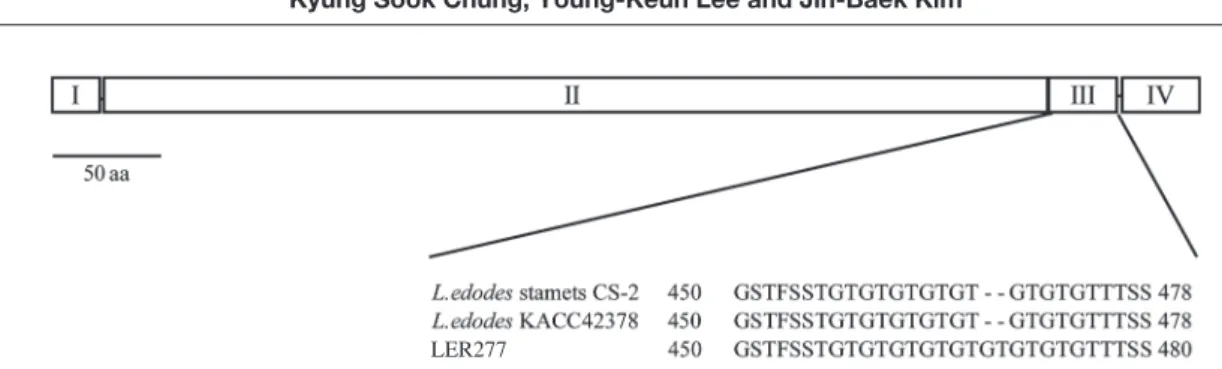
cel7A is the most studied cellobiohydrolase I, and it has a catalytic module belonging to glycoside hydrolase family 7 which is produced only in fungi(Strobel et al. 2016). In L. edodes, cel7A encodes a 516 amino acid(aa) protein, i.e., a signal peptide at the Nterminus(118aa), a glycoside hydro lase family 7 catalytic domain(21449aa), a serine/threonine/ glycinerich linker(450478aa) and a fungaltype cellulose binding domain(fCBD)(483516aa)(MarchlerBauer et al. 2015).
We induced a cellulase activity enhanced mutant, LER277, in L. edodes KACC42378 by using gamma ray radiation. We cloned and analyzed cel7A in the LER277 mutant in order to validate the sequence variation as related to the cel lulase activity.
MATERIALS AND METHODS
1. Mutation induction
L. edodes KACC42378 was cultured on potato dextrose agar(PDA) at 25℃. To measure the radiation sensitivity of L. edodes KACC42378, mycelia were irradiated by gamma ray radiation(60Co, dose rate; 920Gy·h-1) at doses of 0, 0.2, 0.4, 0.6, 0.8, 1.0, 1.2, 1.4 and 1.6kGy at the Advanced Ra diation Technology Institute of the Korea Atomic Energy Research Institute(Republic of Korea) and were cultured for ten days. The mycelial lengths in four directions were measured every day starting three days after irradiation. The D10 value and the LD99 value were determined by an equation in which the survival ratio(Li/L0) was plotted as a function of the radiation dose(kGy)(Li; mycelial length at each dose, L0; initial mycelial length). The cellulase activity enhanced mutant, LER277, was induced at the LD99 dose (0.94kGy) with gamma ray radiation and selected on agar plates with 1% carboxymethylcellulose(CMC, Sigma), 10.0g; KH2PO4, 1.0g; K2HPO4, 0.4g; MgSO4·7H2O, 0.5g; CaCl2·2H2O, 0.013g; Lasparagine, 1.5g; NH4NO3, 0.5g; Thiamine·HCl, 0.0025g and Agar, 15g per 1L. All agents were reagent grade and were purchased from Sigma and Difco.
2. Congo red staining
Cellulase activity of LER277 was measured by Congo red staining. Mycelia of the wild type and LER277 grown on 1% CMC agar plates were stained by adding 0.2% Con go red solution for 15min and then rinse the plates with 1 M NaCl solution with 15min. The radius of transparent zone(r2) and mycelia(r1) were measured(Lin 2004).
3. Cloning and sequence analysis
The mycelia of the wild type and LER277 were cultured on 1% CMC agar plates for 20 days. Mycelia were harvested by scraping and were immediately frozen with liquid nitro gen. Frozen mycelia were ground with a mortar and blue pestle in liquid nitrogen. The total RNA was extracted using PureLink RNA mini kits coupled with Trizol(Ambion, Life Technology) according to instruction protocol. cDNA was reverse transcribed using the SuperScript III Firststrand Synthesis Supermix(Invitrogen). One microgram of the total RNA and oligo(dT) primer were used. The cel7A CDS of the wild type and LER277 were amplified by PCR. The cel7A CDS forward primer(5′ATG TTC CGA ACA GCA GCT CTC C3′) and the cel7A CDS reverse primer(5′CTA TGC AGT AAA AGT GGT CCC AAT3′) were designed based on GeneBank accession number AF411250(L. edo-des Stamets CS2, cel7A) as a reference(Lee et al. 2001). Thermo Scientific Phusion HighFidelity DNA Polymerase was used to minimize the error of the PCR product. The PCR reaction was set up at a final volume of 50μL contain ing 2μL of the above synthesized cDNA as a template, 10 μL of 5X Phusion HF Buffer, 1μL of 10mM dNTPs, 2.5 μL of each primer(10μM), and 0.5μL of Phusion DNA Polymerase under the following initial denaturation con ditions: 98℃; 3min, 35X cycling(98℃; 10sec, 69℃; 10 sec, 72℃; 1min), final extension 72℃; 10min. Amplicons were purified from agarose gel and cloned into the pCR®8/ GW/TOPO vector(Invitrogen). The DNA sequence was analyzed by Cosmo Genetech after positive clones were selected with colony PCR and EcoRI cutting. A nucleotide sequence alignment analysis was conducted with Clustal W.
RESULTS
1. Mutant induction
42378, mycelia were irradiated by gamma ray radiation (60Co) at doses of 0, 0.2, 0.4, 0.6, 0.8, 1.0, 1.2, 1.4 and 1.6 kGy. The D10 value and the LD99 value were calculated and found to be 0.86kGy and 0.94kGy from the linear equation of the survival ratio, respectively(Y=-1.0478X+0.9999, R2=0.9911). Mutation induction was carried out at the LD
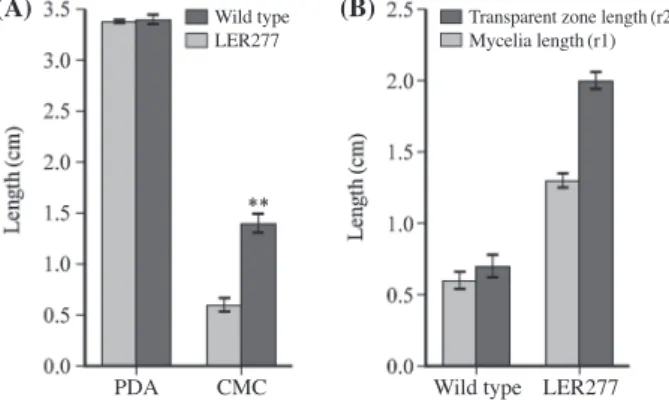
99 dose(0.94kGy). Rapidly growing LER277 was selected on 1% CMC agar plates. There was no difference in mycelial length between the wild type and LER277 on PDA plate, but the mycelial length of LER277 increased 2.3 times more than that of the wild type on 1% CMC agar plate(Fig. 1). The ratio of transparent zone length(r2)/mycelial length(r1) in LER277 was 1.6 that was higher than that of the wild type(1.2), resulted from Congo red staining(Fig. 1).
2. Cloning of cel7A
To validate the sequence variation of cel7A in LER277, we cloned cel7A which plays a principal role in crystalline cellulose degradation as a type of exoglucanase. Primers designed on the basis of the nucleotide sequence of cel7A in L. edodes stamets CS2 worked well to amplify the full length cDNA of cel7A from the wild type and the LER277 mutant. Amplicons were successfully inserted into the pCR®8/GW/TOPO vector(Invitrogen) and transformed into DH5α. We selected four and two colonies including cel7A of the wild type and LER277, respectively, and sequenced their plasmids. A homology search of the cel7A sequences of L. edodes KACC42378 using the blast N algorism showed 99.1%(1537/1551bp) identity with cel7A of L. edodes sta mets CS2. cel7A of LER277 consisted of 1557bp, which is 6bp longer than that of the wild type(L. edodes KACC 42378), and it had 99.2%(1546/1557bp) identity.
3. Sequence variation of cel7A
When we compared cel7A of L. edodes stamets CS2 with that of L. edodes KACC42378, fourteen single nucleotides were found to differ from each other(Table 1). The differ ence in nucleotide 226(A→G) resulted in a deduced amino acid change(THR76ALA), which corresponds to the Xaa of the consensus sequence Asn-Xaa-Ser/Thr(where Xaa denotes any amino acid except Pro) of a potential Ngly cosylation site(Gavel and von Heijne 1990). The sequence comparison between cel7A of L. edodes KACC42378 and LER277 showed five nucleotide substitutions(T→C, 201,
Table 1. Sequence analysis of cel7A in wild type and LER277
Necleotideposition L. edodes Stamets CS2 L. edodes KACC42378 LER277
Substitution 201 C T C 226 A G G 285 T T C 525 G A G 540 T C T 744 T T C 1218 T C C 1236 C T T 1239 T C C 1248 T C C 1371 C T T 1374 C T T 1392 T C C 1395 T C C 1401 C T T 1464 T C C
Hexanucleotide repeat insertion 13751392 - - GGCACC
Bold represents nucleotide changed compared with L. edodes KACC42378. Fig. 1. Mycelia length and cellulase activity of the wild type and
LER277. (A) Mycelia of the wild type and LER277 were grown on PDA and 1% CMC agar plates for 10 days. (B) Mycelia length(r1) and transparent zone length(r2) were measured after Congo red staining of the wild type and LER277 on 1% CMC agar plates for 10 days. Data indicate mean±SD(n=15). **represents p<0.01(ttest).
(A) (B)
Wild type LER277 PDA CMC
Wild type
285 and 744nt; A→G, 525nt; C→T, 540nt) and one hexa nucleotide repeat insertion(GGCACC, within 13751392nt) (Table 1). Five nucleotide substitutions did not change the deduced amino acid. One hexanucleotide insertion elongated the GT repeat from (GT)8 to (GT)9 in a serine/threonine/ glycinerich linker(Table 1 and Fig. 2).
DISCUSSION
To increase the economic feasibility of lignocellulose as well as the mushroom yield, improved cellulase activity is needed. In this study, gamma ray radiation was used to induce a cellulase activity enhanced mutant. The radiation sensitivity(i.e., the D10 value) of the mycelium of L. edodes KACC42378 was 0.86kGy and the LD99 dose was 0.94kGy. The D10 values of P. florida, P. eryngii, P. sajor caju, and P. ostreatus were 0.26, 0.28, 0.72, and 0.5kGy, respectively (Lee and Chang 1999; SatheshPrabu and Lee 2012). It ap pears that the mycelium of L. edodes is more radioresistant than that of Pleurotus spp. The selected LER277 increased the mycelial length 2.3 times on 1% CMC agar plates so as to enhance the cellulase activity.
The cel7A CDS of L. edodes KACC42378 showed four teen single nucleotide polymorphisms(SNPs) with L. edodes stamets CS2. Five of the fourteen SNPs occurred in a serine/ threonine/glycinerich linker connecting two independent domains, the GH7 catalytic domain and the fCBD. These sequence variation of cel7A likely derived from spontaneous mutation by evolutional force. The cel7A CDS of LER277 showed five nucleotide substitutions in the catalytic domain and one hexanucleotide repeat insertion(GGCACC) in the serine/threonine/glycinerich linker compared to the wild type(L. edodes KACC42378), as noted above. The deduced amino acid change did not occur due to the five nucleotide
substitutions in LER277. We are unsure if this substitution is closely related to the enhanced cel7A enzyme activity, although it has been reported that nucleotide substitution without a deduced amino acid change could have an effect on the RNA stability and its level, and the structure and function of protein(Bali and Bebok 2015).
Most cellulases consist of a catalytic domain for cellulose hydrolysis and a cellulose binding domain separated by flexible linkers that are rich in serine and threonine with O glycosylation(Beckham et al. 2010). The linker can have effects on the enzymatic activity, stability, flexibility and substrate specificity(Jentoft 1990; Li et al. 2016; Ruiz et al. 2016; Strobel et al. 2016). The linker length varied from 6 to 59 amino acids(Srisodsuk et al. 1993). As the linker length increased, the flexibility increased and the protease resistance decreased(Li et al. 2016). Longer linkers facilitate the relo cation of the binding of the domain and substrates, making them more easily accessible toward the catalytic domain(Li et al. 2016). Oglycosylation of the linker serves to protect against protease attacks without any change of the linker flexibility(Zhou et al. 2009). Thus, GT insertion in the linker of LER277 could result in a more structurally flexible and physiologically proteolytic resistant protein. This suggests that the enhancement of the cellulase activity in LER277 partly stems from the cel7A change in which the GT repeat of the linker is elongated. Further study to find the optimal length of the GT repeat linker is expected to be useful for the maximum enhancement of the cellulase activity and for subsequent industrial applications.
ACKNOWLEDGEMENT
This work was supported by grants from the Korea Atomic Energy Research institute(KAERI), Republic of Korea.
Fig. 2. Schematic domain architecture of the cel7A protein. A serine/threonine/glycinerich linker showed sequence variation between the
wild type and LER277. From left to right, 118(18aa); signal peptide(I), 21449(429aa); glycoside hydrolase family 7 catalytic do main(II), 450478(29aa); a serine/threonine/glycinerich linker(III) with the sequence of each line, 483516(34aa); and the fungal type cellulose binding domain(fCBD)(IV). The scale bar represents 50aa.
REFERENCES
Bali V and Bebok Z. 2015. Decoding mechanisms by which silent codon changes influence protein biogenesis and func tion. Int. J. Biochem. Cell Biol. 64:5874.
Beaulieu M, D’aprano MB and Lacroix M. 1999. Dose rate effect of gamma irradiation on phenolic compounds, poly phenol oxidase, and browning of mushrooms(Agaricus bisporus). J. Agric. Food Chem. 47:25372543.
Beckham GT, Bomble YJ, Matthews JF, Taylor CB, Resch MG, Yarbrough JM, Decker SR, Bu L, Zhao X, Mccabe C, Wohlert J, Bergenstrahle M, Brady JW, Adney WS, Him mel ME and Crowley MF. 2010. The Oglycosylated linker from the Trichoderma reesei Family 7 cellulase is a flexi ble, disordered protein. Biophys. J. 99:37733781.
Buswell JA, Cai YJ, Chang ST, Peberdy JF, Fu SY and Yu HS. 1996. Lignocellulolytic enzyme profiles of edible mush room fungi. World J. Microbiol. Biotechnol. 12:537542. Chang ST. 2006. The world mushroom industry: trends and
technological development. Int. J. Med. Mushrooms 8:297 314.
Djajanegara I and Harsoyo. 2009. Mutation study on white oyster mushroom(Pleurotus floridae) using gamma(60Co)
irradiation. J. Chem. Nat. Resour. Eng. 4:1221.
Gavel Y and Von Heijne G. 1990. Sequence differences between glycosylated and non-glycosylated Asn-X-Thr/Ser acceptor sites: implications for protein engineering. Protein Eng.
3:433442.
Jentoft N. 1990. Why are proteins Oglycosylated? Trends Bio-chem. Sci. 15:291294.
Lee CC, Wong DW and Robertson GH. 2001. Cloning and characterization of two cellulase genes from Lentinula edo-des. FEMS Microbiol. Lett. 205:355360.
Lee YK and Chang HH. 1999. Radiation sensitivity of basido spore and mycelium in Pleurotus ostreatus. J. Kor. Nuclear Soc. 31:287293.
Lee YK, Chang HH, Kim JS, Kim JK and Lee KS. 2000. Lin gocellulytic mutants of Pleurotus ostreatus induced by gammar ray radiation and their genetic similarities. Radiat. Phys. Chem. 57:145150.
Li P, Zhou Y, Li Q, Zhang C, Sun Z, Tian L and Weng H. 2016. Extending the linker region increases the activity of the Bacillus subtilis cellulase CelI15. Biotechnol. Lett. 38: 15871593.
Lin YS. 2004. Separate and screen fungus which can biodegrade cellulose and assay its enzyme activity. Acta Sci. Nat. Univ. Sunyatseni. 43:8285.
MarchlerBauer A, Derbyshire MK, Gonzales NR, Lu S, Chit
saz F, Geer LY, Geer RC, He J, Gwadz M, Hurwitz DI, Lanczycki CJ, Lu F, Marchler GH, Song JS, Thanki N, Wang Z, Yamashita RA, Zhang D, Zheng C and Bryant SH. 2015. CDD: NCBI’s conserved domain database. Nucleic Acids Res. 43:D222226.
Ni J and Tokuda G. 2013. Lignocellulosedegrading enzymes from termites and their symbiotic microbiota. Biotechnol. Adv. 31:838850.
Philippoussis A, Diamantopoulou P, Papadopoulou K, Lakhtar H, Roussos S, Parissopoulos G and Papanikolaou S. 2011. Biomass, laccase and endoglucanase production by Lenti nula edodes during solid state fermentation of reed grassm, bean stalks and wheat straw residues. World J. Microbiol. Biotechnol. 27:285297.
Roychowdhury R and Tah J. 2013. Mutagenesis a potential approach for crop improvement. pp. 149187. In: Crop im provement: new approaches and modern techniques(Ha keem KR, Ahmad P, Ozturk M, eds.), Springer, New York. Ruiz DM, Turowski VR and Murakami MT. 2016. Effects of
the linker region on the structure and function of modular GH5 cellulases. Sci. Rep. 6:28504.
SatheshPrabu C and Lee YK. 2011. Mutation breeding of mushroom by radiation. J. Radiat. Ind. 5:285295.
SatheshPrabu C and Lee YK. 2012. Improvement of cellulo lytic activity of Pleurotus florida through radiation muta genesis. J. Radiat. Ind. 6:181188.
Srisodsuk M, Reinikainen T, Pentillä M and Teeri TT. 1993. Role of the interdomain peptide of Trichoderma reesei cel lobiohydrolase I in its interaction with crystalline cellulose. J. Biol. Chem. 268:2075620761.
Strobel KL, Pfeiffer KA, Blanch HW and Clark DS. 2016. Engineering Cel7A carbohydrate binding module and linker for reduced lignin inhibition. Biotechnol. Bioeng.
113:13691374.
Teeri TT. 1997. Crystalline cellulose degradation: new insight into the function of cellobiohydrolases. Trends Biotechnol.
15:160167.
Ulukapi K and Nasircilar AG. 2015. Developments of Gamma Ray Application on Mutation Breeding Studies in Recent Years. pp. 3134. In: International conference on AABE: 22 23 July, London, UK. DOI 10.15242/iicbe.c0715044. Zhou F, Olman V and Xu Y. 2009. Large-scale analyses of
glycosylation in cellulases. Genomics Proteomics Bioinfor-matics 7:194199.
Received: 16 June 2017 Revised: 23 August 2017 Revision accepted: 5 September 2017