© Korean Powder Metallurgy Institute 1271
-Effect of Powder Size on Infiltration Height in Producing MgO Reinforced Al
Matrix Composite by Vacuum Infiltration Method
Recep CALIN1, a Ramazan CITAK2, b
1 Kirikkale Vocational High School, Kirikkale, TURKIYE
2G.U., Technical Education Faculty, Dep. of Metallurgical Edu., Ankara, TURKIYE a [email protected], b[email protected]
Abstract
The vacuum infiltration method is one of the composite producing methods. There are several parameters in composite production by vacuum infiltration. One of them is particle size of reinforcement in particulate reinforced composites. In this study, MgO powder and Al were used as reinforcement and matrix respectively. MgO powders with different size and amount to give same height were filled in quartz tubes and liquid metal was vacuum infiltrated into the MgO powder under same vacuum condition and for same time. Infiltration height was measured and microstructure and fracture behavior of composite were investigated. It has been found that infiltration height and fracture strength were increased with particulate reinforcement sizes. It has also been determined that molten metal temperature facilitates infiltration.
Keywords: Composites, infiltration, MgO
1. Introduction
There are several methods for fabricating metal matrix composites MMCs, such as casting methods, powder metallurgy techniques, in situ processes and infiltration methods [1-3]. Infiltration methods have also a few different application techniques [4,5] such as pressureless infiltration, pressure infiltration and vacuum infiltration. Some oxides and carbides, and many metals and alloys have been used as reinforcemnt and matrixes. Molten metal temperature, reinforcement powder size, reinforcement volume ratio, vacuum or pressure value, molten matrix composition, infiltration atmosphere and time are important parameters in the infiltration of molten metal into preformed reinforcement. Studies on particulate reinforced composites have revealed that larger reinforcement sizes showed faster and higher infiltration [6, 7] and composites with larger reinforcement sizes yield higher fracture strength [8, 9]. In this study, the effect of reinforcement particle size on infiltration height and fracture strength of infiltrated Al-MgO systems has been investigated.
2. Experimental procedure and results
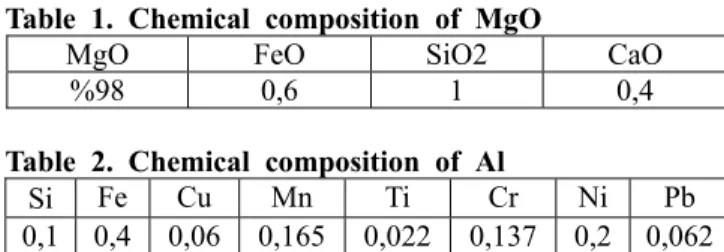
Commercially pure magnesia (MgO) with 74, 105, 149, 210, 297, 420 and 590 µm particle sizes and Al, the chemical compositions of which are given in Table 1 and 2 have been used as reinforcement and matrix respectively.
Infiltration tests have been carried out with a quartz tube with a 10 mm outside diameter, 1 mm wall thickness and
Table 1. Chemical composition of MgO
MgO FeO SiO2 CaO %98 0,6 1 0,4 Table 2. Chemical composition of Al
Si Fe Cu Mn Ti Cr Ni Pb
0,1 0,4 0,06 0,165 0,022 0,137 0,2 0,062 300 mm length. Stainless steel filter was placed at the bottom of the tube and on the filter an Al foil was placed. MgO powders with different particle sizes were filled to form 50 mm height freely. A filter, alumina blanket and a weight were placed on the powders. The molten metal temperature was kept at 700, 720, 750, 800 and 850 oC ± 5 oC. 500 ± 10 mmHg vacuum was applied to the tube in normal atmosphere for 3 min. Then the tubes were taken out and cooled to the room temperature in normal atmosphere. The tubes were broken and the composites were removed from the tubes. Infiltration height, densities, porosity ratio and fracture strengths were determined. Microstructure and fracture surfaces of the composites were investigated by SEM analysis.
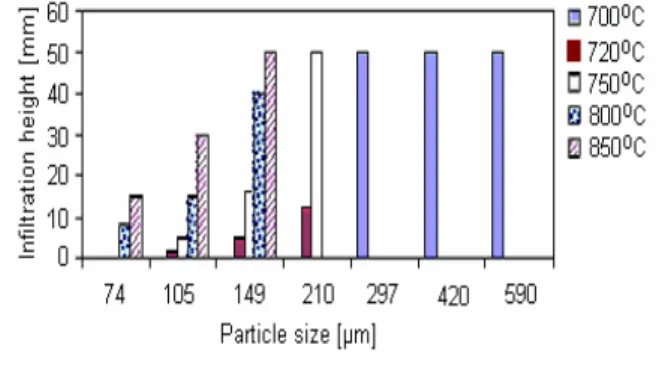
Figure 1 shows the infiltration heights against MgO particle size and matrix temperature. In Figure 2, SEM micrographs of composites with different particulate reinforcement sizes are given.
As particle sizes increased infiltration height increased. Infiltration is related to the dimension of pore besides other parameters. As can be seen in Figure 2, when particle size is increased the pore dimension in the preform increases. The larger pores facilitate the forced infiltration. When molten 2006 POWDER METALLURGY
World Congress
© Korean Powder Metallurgy Institute 1272 -metal temperature goes up to higher values, infiltration is done more easily.
Fig. 1 Infiltration height against reinforcement particle size and temperature
a b
Fig. 2 SEM micrographs of composites with reinforcement size of a) 590 µm b) 297 µm 0 50 100 150 200 250 300 200 300 400 500 600 Particle size (µm) F ract ur e st re nght ( M Pa)
Fig. 3 The relationship between reinforcement particle size and fracture strength
It has been determined that as reinforcement particle size increased, the density and fracture strength (Fig. 3) of the composites increased and porosity ratio decreased.
From the SEM micrographs it can be said that the fracture behavior of composite is generally brittle although some ductile fracture appeared in some areas. Almost all fracture took place in matrix-reinforcement interfaces because of poor wettabilty.
Fig. 4 Fracture surface of composite with 590 µm r einforcement particle size.
3. Conclusion
As reinforcement particle size decreased infiltration was more difficult because of smaller pore dimension.
These difficulties could be overcome with an increase in temperature.
The densities of composites increased with increasing reinforcement particle size and thus porosity ratio decreased.
The fracture strength of the composites increased as reinforcement particle size increases depending on less porosity of the product composite.
Acknowledgement. The authors are grateful to the State Planning Organization of Turkey for the support of this work with the project number of 2003 K 120470-34.
4. References
[1] Stefanescu, D. M., et al., Met. Trans. V 23 A, p 2326 (1988)
[2] Zhou, W., Hu, W., and Zhang, D., V 39, No 12, p 1743 (1998)
[3] Gedeon, S. A. And Tangerini, I., Mat. Sci. and Eng., A, 144, p 237, Elsevier Sequoia (1991)
[4] Buhrmaster, C. L., Clark, D. E. And Smart, U., J. Of Metals, p 44 (1988)
[5] Martinez,J. A., et al., Materials Letters, 57, p 4332 (2003)
[6] Elwahed, M., Asar, M., J. of Mat. Proc. Tech., 86, p 152 (1999)
[7] Candan, E., Atkinson, H. V. and Jones, H., Mat. Sci. and Eng. V 35, p 4955 (1993)
[8] Stephens, J. J., Lucas, J. P. and Hosking, F. M., Scr. Metal., V 22, p 28 (1988)
[9] Demir, A., Altinkok, N., Composites Science and Technology, 64, p 2067 (2004)