Hydrophilic property change ion implanted polymer
Chan Young Lee, Jae Keun Kil, Jae Hyung Lee
Korea Atomic Energy Research Institute, Proton Engineering Frontier Project [email protected]
1. Introduction
Ion implantation was performed onto polymer, PC(polycarbonate), in order to investigate surface hydrophilic property through contact angle measurement. PC was irradiated with N, Ar, Kr, Xe ions at the irradiation energy of 20~50keV and the dose range of 5×10¹⁵, 1×10¹⁶, 7×10¹⁶ ions/cm2. The contact angle of water has been reduced with increasing fluence and ion mass but decreased with increasing implanted energy. The root mean square of surface roughness examined by means of AFM changed smoothly from 3.59Å to 2.22Å and the change of wettability was discussed with respect to elastic and inelastic collisions obtained as results of TRIM simulation.
2. Methods and Results
Polycarbonate(PC) film sheets were irradiated with low energies (20~50)keV at different ions and fluences ranging from 5×10¹⁵ to 7×10¹⁶ ions/cm2.
2.1 Wettability measurement
Generally, wettability change is carried out contact angle measurement and the contact angle of water for PC is about 82º. 1E16 45 50 55 60 65 70 75 80 85 Co n tact An g le ( ° )
Ion Dose(ions/cm2) 7E16 5E15
Substrate Implantation Energy : 50keV N Ar Kr Xe
Figure 1. Contact angle of PC film with N+, Ar+, Xe+ irradiation at 50keV.
Fig. 1. and Fig. 2. show change of surface contact angle with a various energy and ions. Contact angles were reduced to 65°(N+), 50°(Ar+), 47°(Xe+) after implantation at fluence rate 7×10¹⁶ ions/cm2 in Fig. 2. Also Fig 3. shows contact angles went down according to implanted energy at N+ implantation.
20keV 30keV 40keV 50keV
50 55 60 65 70 75 80 85 Substrate Cont act Angle ( ° ) Implanted energy Implanted Ion : N
Ion Dose : 7X10¹⁶(ions/cm2)
Figure 2. Contact angle of PC film at N+ with various implanted energy
2.2 AFM analysis
AFM observation was carried out for unimplanted and implanted PC film in order to clarify the effect of the variation of dose at a 50keV. Fig. 3(a)-(c) shows the surface nano-morphology of unimplanted and implanted films at fluences. At the fluence of 7×10¹⁶ ions/cm2, implanted film surface has more flat than the unimplanted film, which is obviously different from the surface nano-morphology of unimplanted PC film. The surface roughness was reduced with an increase in ion fluence in the range 1×10¹⁶ and 7×10¹⁶ ions/cm2. This means the surface nano-morphology of PC film was significantly affected by 50keV implantation and the surface roughness and contact angle reduced depending on ion fluence[1].
(a) Unimplanted (Rrms : 0.387nm) (b) 1×10¹⁶ (Rrms : 0.212nm)
(c) 7×10¹⁶ (R
rms : 0.207nm)
Figure 3. AFM image of surface morphology Table 1. The Comparison of Rrms and Rmax Transactions of the Korean Nuclear Society Autumn Meeting
(Z-axis : 1nm/div.) Fluence (ions/cm2) Untreated 1×10¹⁶ 7×10¹⁶ Contact Angle(°) 82 66.22 61.82 Rrms(nm) 0.387 0.212 0.207 Rmax(nm) 3.622 1.805 1.684
2.3 Effect of energy transfer
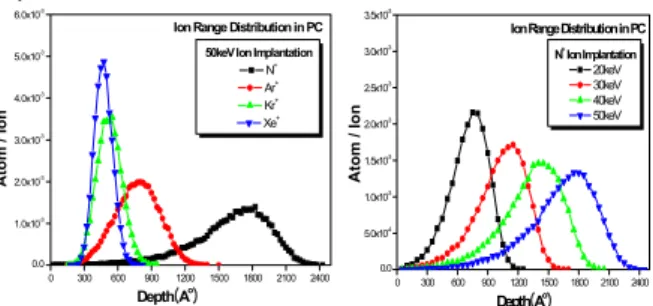
The interaction of energetic heavy ions with organic polymers involves several relevant differences with respect to those induced by other ionizing projectiles, like X-rays, neutrons and electrons. This phenomenon may cause change of surface wettability. Therefore, in order to evaluate the thickness of a polymer layer, modified by ion implantation, as well as elastic and inelastic energy losses. we calculated some spatial and energy parameters for ions, implanted in PC. Calculations were performed with allowance for recoil atom motion. The evaluated projected range, projected range straggling and some other parameters are summarized below Figure 4-5[3].
. 0 300 600 900 1200 1500 1800 2100 2400 0.0 1.0x10⁻³ 2.0x10⁻³ 3.0x10⁻³ 4.0x10⁻³ 5.0x10⁻³ 6.0x10⁻³ Depth(Ao )
50keV Ion Implantation
N+ Ar+ Kr+ Xe+ At om / Ion
Ion Range Distribution in PC
0 300 600 900 1200 1500 1800 2100 2400 0.0 5.0x10⁻⁴ 1.0x10⁻³ 1.5x10⁻³ 2.0x10⁻³ 2.5x10⁻³ 3.0x10⁻³ 3.5x10⁻³ Depth(Ao) N+ Ion Implantation 20keV 30keV 40keV 50keV Ion Range Distribution in PC
Atom / Ion
Figure 4. Ion range distribution with a various ions and N+ implantation at 50keV
Figure 4. shows ion range distribution with a various ions and implanted energy. The more mass of ion is heavy, the more ion is close to surface ,whereas The nitrogen ion with high energy is penetrated deeply from surface. For low energy ions(keV/amu) the dominant energy deposition process involves elastic binary collisions and the energy localization volume coincides with the collision cascade volume[3-5].
5 0 0 1 0 0 0 1 5 0 0 2 0 0 0 2 5 0 0 5 1 0 1 5 2 0 2 5 E ne rgy Los s ( eV /ion) D e p th (n m ) E e (2 0 k e V ) E e (3 0 k e V ) E e (4 0 k e V ) E e (5 0 k e V ) E n (2 0 k e V ) E n (3 0 k e V ) E n (4 0 k e V ) E n (5 0 k e V )
Fig. 5. Energy loss profile for Electron stopping power(Ec) and nuclear stopping power(En) with a various energy Table 2. The values of Stopping power on surface with a various energy.
(Ee : electronic stopping, En : nuclear stopping)
20keV 30keV 40keV 50keV Ee (eV/ion) 17.117 20.019 22.371 24.387 En (eV/ion) 0.401 0.306 0.252 0.215 Ee + En 17.518 20.325 22.623 24.602 Ee / En 42.686 65.421 88.774 113.42
Table 3. The values of Stopping power on surface with a various ions. N+ Ar+ Xe+ Ee (eV/ion) 24.427 26.321 27.608 En (eV/ion) 0.177 0.858 2.590 Ee + En 24.604 27.179 30.198 Ee / En 138.006 11.975 4.975 3. Conclusion
An experimental study has been made of wettability, structure and chemical states of a various ion at energies implanted polycarbonate. Wettability was investigated by a sessile drop method, and AFM measurement. Also prior to an experimental TRIM code simulated and investigated between surface interaction and ions. Results are as follows:
1) The contact angle of water drops on N+, Ar+, Kr+, and X+ implanted polycarbonate decreases from 82° to 47° as the fluence increases.
2) The surface morphology is reduced with the increase in the ion fluence.
It is concluded that the improvement in the wettability of the modified PC surface may be caused by nuclear stopping or linear energy transfer which may cause a chain scission by displacing an atom from the polymer chains. Also it was greatly dependant on the surface roughness and, the sputtering phenomenon caused by ion-polymer interactive collision facilitates chemical bonding in the interface between a liquid and a solid.
REFERENCES
[1] D. J. Li, F. Z. Cui, and Bull. Mater. Sci. 21 (1994) 588 [2] J. S. Cho, W. K. Choi, H. J. Jung and S. K. Koh., J. Mater. Res., vol. 12, No. 1, Jan (1997)
[3] J. F. Ziegler, J. P. Biersack, U. Littmark, "The stopping and range of ions in solids" (1985)
[4] J. Lindhard, M. Schaff, and H. F. Schitott, Kgl. Danske videnskab, Ma. Fys. Med., 33, 14 (1963)
[5] A. Dunlop, F. Rullier-Albenque, C. Jaouen, C. Templier and J. Davenas "Materials under Irradiation"