© Korean Powder Metallurgy Institute 1018
-Materials and Experimental Procedure
A standard TRS bars compacted from the blend equivalent to 8620 steel to green densities 7.0, 7.1, 7.2, 7.3, 7.4 and 7.5 g/cm3 were used for the carburizing test.
Reference coupons of 8620 steel were used. Chemical composition of the samples and reference coupons are given in table 1.
To get the machined surface, half of the samples were ground 0.1mm with two passes. Carbon content was measured with a glow discharge spectrometer (Leco GDS400). Usually 5 runs were made for each depth level. Carbon profiling was achieved by subsequent grinding and spectral analysis.
Vacuum carburizing was carried out in a SECO/ WARWICK furnace working with the pulse/pause technique or in a second furnace with the pulse/pump method of gas circulation. In both furnaces, process temperature was maintained 900° C /1652°F and the same boost and diffusion time – 16 min and 21 min respectively.
In the SECO/WARWICK furnace, the boost period consists of 3 pulses – 3 min + 1.5 min + 1.5 min separated by 5 min pauses. During each pulse, the pressure was fluctuating between 4.5 Torr to 8 Torr with the frequency 1 fluctuation per 30 sec. The carburizing atmosphere was a mixture of 30% acetylene + 30% ethylene + 40% hydrogen.
Boost in the second furnace consisted of three pulses separated by two pumping periods. Each pulse lasted 5 min and included 8 injections, causing a pressure increase of up to 100 Torr. Pumping periods between pulses lasted 1 min., and the pressure was reduced to 2 Torr before the beginning of the next pulse. The carburizing atmosphere consisted of acetylene diluted with nitrogen in a ratio 1:7. Diffusion was carried out under a vacuum of 0.2 Torr.
Results
Fig. 1 shows that after grinding, samples have a thin (up to 0.001 mm) fully densified layer effectively closing the open porosity.
PB07-W-12
2006 POWDER METALLURGY World Congress
Vacuum Carburizing System for Powdered Metal Parts & Components
Janusz Kowakewski, Karol Kucharski
SECO/WARWICK Corporation, 180 Mercer Street, Meadville, PA United States SECO/WARWICK Ltd., Sobieskiego 8, 66-200 Swiebodzin, Poland
[email protected], [email protected]
Abstract
Powdered metal parts and components may be carburized successfully in a vacuum furnace by combining carburizing technology VacCarb™ with a hi-tech control system. This approach is different from traditional carburizing methods, because vacuum carburizing is a non-equilibrium process. It is not possible to set the carbon potential as in a traditional carburizing atmosphere and control its composition in order to obtain a desired carburized case. This paper presents test results that demonstrate that vacuum carburizing system VacCarb™ carburized P.M. materials faster than traditional steel with acceptable results. In the experiments conducted, PM samples with the lowest density and open porosity showed a dramatic increase in the surface carbon content up to 2.5%C and a 3 times deeper case. Currently the boost-diffusion technique is applied to control the surface carbon content and distribution in the case. In the first boost step, the flow of the carburizing gas has to be sufficient to saturate the austenite, while avoiding soot deposition and formation of massive carbides. To accomplish this goal, the proper gas flow rate has to be calculated. In the case of P.M. parts, more carbon can be absorbed by the part’s surface because of the additional internal surface area created by pores present in the carburized case. This amount will depend on the density of the part, the densification grade of the surface layer and the stage of the surface – “as machined” or “as sintered”. It is believed that enhanced gas diffusion after initial evacuation of the P.M. parts leads to faster carburization from within the pores, especially when pores are open – surface “as sintered” and interconnected – low density. A serious problem with vacuum carburizing is delivery of the carbon in a uniform manner to the work pieces. This led to the development of the different methods of carburizing gas circulation such as the pulse/pump method or the pulse/pause technique applied in SECO/WARWICK’s VacCarb™ Technology. In both cases, each pressure change may deliver fresh carburizing atmosphere into the pores and leads to faster carburization from within the pores. Since today’s control of vacuum carburizing is based largely on empirical results, presented experiments may lead to better understanding and improved control of the process.
© Korean Powder Metallurgy Institute 1019
-Fig. 2. Carbon distribution in dependence of the density.Seco/Warwick carburizing process.Surface "as sintered"
0 0.5 1 1.5 2 2.5 0 0.2 0.4 0.6 0.8 1 Case depth (mm) C a rb o n c o nt en t (mm ) 8620 steel 8620PM/7.0 8620PM/7.1 8620PM/7.2 8620PM/7.3 8620PM/7.4 8620PM/7.5
Fig. 3. Carbon distribution in dependence of the density.Seco/Warwick carburizing. Surrface machined.
0 0.2 0.4 0.6 0.8 1 1.2 0 0.2 0.4 0.6 0.8 case depth (mm) C a rbon c ont ent ( % ) 8620 steel 8620PM/7.0 8620PM/7.1 8620PM/7.2 8620PM/7.4 8620PM/7.5 8620PM/7.3
Fig. 3. Carbon distribution in dependence of the density.Seco/Warwick carburizing. Surrface machined.
0 0.2 0.4 0.6 0.8 1 1.2 0 0.2 0.4 0.6 0.8 case depth (mm) C a rbon c ont ent ( % ) 8620 steel 8620PM/7.0 8620PM/7.1 8620PM/7.2 8620PM/7.4 8620PM/7.5 8620PM/7.3 Fig. 2 and 3
Fig. 2 and Fig. 3 show experimentally obtained carbon distributions for different densities and samples surface “as sintered” or machined for a pulse/pause carburizing process performed in the SECO/WARWICK furnace.
Fig.4. %C on the carburized surface in dependence of the density.Seco/
Warw ick process
0 0.5 1 1.5 2 2.5 6.9 7 7.1 7.2 7.3 7.4 7.5 7.6 Green density (g/ccm) C a rbon c ont ent ( % ) machined as sintered
Fig. 5. Case depth at 0.5%C in dependance of green density for machined surface and "as sintered".Seco/Warwick"process
y = -0.2938x + 2.5212 y = -0.1869x + 1.6773 0 0.1 0.2 0.3 0.4 0.5 7 7.2 7.4 7.6 7.8 8 Density (g/ccm) 0. 5% C c a s e dept h ( m m )
"as sintered" machined
Fig. 4 and 5
Based on these results the other graphs showing surface carbon content and case depth at 0.5% C in dependence of the density can be made – Fig. 4 and Fig. 5
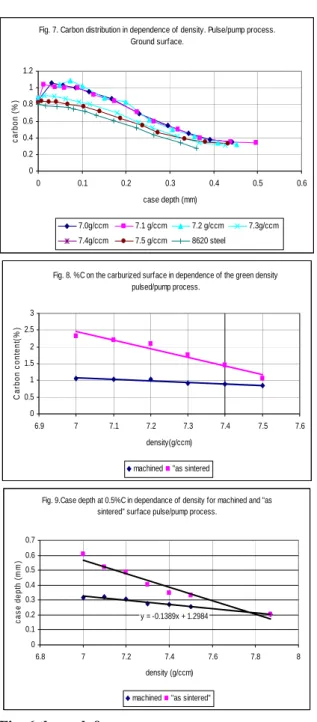
Fig. 6 to 9 show similar results obtained for the pulse/pump carburizing process performed in the second furnace.
Fig. 6. Carbon distribution in dependence of density pulse/pump process.Surface "as sintered"
0 0.5 1 1.5 2 2.5 0 0.1 0.2 0.3 0.4 0.5 0.6 0.7 0.8 Case depth (mm) C a rb on (% ) 7.00g/ccm 7.1 g/ccm 7.2 g/ccm 7.3 g/ccm 7.4 g/ccm 7.5 g/ccm 8620 steel
© Korean Powder Metallurgy Institute 1020 -Fig. 7. Carbon distribution in dependence of density. Pulse/pump process.
Ground surface. 0 0.2 0.4 0.6 0.8 1 1.2 0 0.1 0.2 0.3 0.4 0.5 0.6 case depth (mm) c a rbon (% ) 7.0g/ccm 7.1 g/ccm 7.2 g/ccm 7.3g/ccm 7.4g/ccm 7.5 g/ccm 8620 steel
Fig. 8. %C on the carburized surface in dependence of the green density pulsed/pump process. 0 0.5 1 1.5 2 2.5 3 6.9 7 7.1 7.2 7.3 7.4 7.5 7.6 density(g/ccm) C a rb on c o nt en t( % )
machined "as sintered
Fig. 9.Case depth at 0.5%C in dependance of density for machined and "as sintered" surface pulse/pump process.
y = -0.1389x + 1.2984 0 0.1 0.2 0.3 0.4 0.5 0.6 0.7 6.8 7 7.2 7.4 7.6 7.8 8 density (g/ccm) c a s e dept h (m m )
machined "as sintered"
Fig. 6 through 9
In both cases, the highest surface carbon content around 2.8% C is observed in “as sintered” samples, compacted to 7.0 g/cm3. This amount decreased linearly to around 1.2 % C for samples compacted to 7.5g/cm3. The same samples are showing the higher case depth increase – from 0.2 mm in 8620 steel reference sample up to 0.6 mm for pulse/pump process and 0.47 mm in pulse/pause process. A similar tendency is shown in the machined samples. The surface carbon content from 0.69%C-0.7%C in 8620 steel reference sample increase up to 1.0–1.1 %C at density 7.0 g/cm3 and 0.8%C for density 7.5g/cm3. The case depth increased from 0.2 mm up to 0.32mm–0.35mm.
The microstructure study of the samples carburized and pressure–quenched in SECO/WARWICK furnace revealed massive carbides present in the “as sintered” samples. Samples “as machined” shows only martensite, perlite and increase amount of retained austenite - Fig. 10
Conclusion
Vacuum carburizing of P.M. materials is much faster than solid steel. The most important factors are porosity and type of surface. In the presented experiments, the P.M. samples with lowest density and open porosity showed a dramatic increase of the surface carbon content up to 2.5%C and 3 times deeper case.
In the microstructure formation of massive carbides and the increased amount of retained austenite is obvious. The differences caused by different methods of gas circulation are not conclusive.
References
1. Ralph Poor, James Duncan and Garry Barbee, Surface Combustion In., Maumee, OhioImpact of Delivery And Control In Vacuum Carburizing
2. R. G. Weber, Powder Metal Int. 15 (1983) [2] 94Vacuum Carburizing and Carbonitriding of Powder Metallurgy Ferrous Alloys
As “sintered” As machined
Fig. 10. Samples compacted to the density 7.0 g/cm3 (left) and 7.5 g/cm3(right).Section across the “as sintered” surface with
© Korean Powder Metallurgy Institute 1021
-3. Y. T. Chen, R. W. Kiefer, Jr. Pitney Bowes, Inc. Stamford, Connecticut, USA; p.199Carburizing Of P/M Materials Carburizing Processing And Performance, Proceedings on an International Conference, July 12-14, 1989, Lakewood, Colorado, USA.
4. Jeremy St. Pierre, C. I. Hayes Incorporated, Cranston, Rhode Island, USARecent Developments In Vacuum Carburizing Carburizing Processing And Performance, Proceedings on an International Conference, July 12-14, 1989, Lakewood, Colorado, USA.
5. E. GianottiAlgorithm For Carbon Diffusion Computation In A Vacuum Furnace: Experimental Methods Predict Carburizing Times La Metallurgia Italiana 9/2003.
6. Harry W. AntesCalculating Gas Flow Rate For Vacuum Carburization An ASM International Publication: Heat Treating Process, August 2005.
7. M. Sugiyama, K. Ishikawa, H. Iwata, JH Corporation, Aichi, Japan Using Acetylene For Superior Performance Vacuum Carburizing.