Full Terms & Conditions of access and use can be found at
https://www.tandfonline.com/action/journalInformation?journalCode=tabe20
Journal of Asian Architecture and Building Engineering
ISSN: 1346-7581 (Print) 1347-2852 (Online) Journal homepage: https://www.tandfonline.com/loi/tabe20
Hybrid deep-learning model to recognise
emotional responses of users towards
architectural design alternatives
Sunwoo Chang & Hanjong Jun
To cite this article: Sunwoo Chang & Hanjong Jun (2019) Hybrid deep-learning model to
recognise emotional responses of users towards architectural design alternatives, Journal of Asian Architecture and Building Engineering, 18:5, 381-391, DOI: 10.1080/13467581.2019.1660663
To link to this article: https://doi.org/10.1080/13467581.2019.1660663
© 2019 The Author(s). Published by Informa UK Limited, trading as Taylor & Francis Group on behalf of the Architectural Institute of Japan, Architectural Institute of Korea and Architectural Society of China.
Accepted author version posted online: 27 Aug 2019.
Published online: 28 Sep 2019.
Submit your article to this journal Article views: 991
View related articles View Crossmark data
ARCHITECTURAL PLANNING AND DESIGN
Hybrid deep-learning model to recognise emotional responses of users
towards architectural design alternatives
Sunwoo Chang and Hanjong Jun
School of Architecture, Hanyang University, Seoul, South Korea
ABSTRACT
In architectural planning and initial designing process, it is critical for architects to recognise users’ emotional responses toward design alternatives. Since Building Information Modelling and related technologies focuses on physical elements of the building, a model which suggests decision-makers’ subjective affection is strongly required. In this regard, this paper proposes an electroencephalography (EEG)-based hybrid deep-learning model to recognise the emotional responses of users towards given architectural design. The hybrid model consists of generative adversarial networks (GANs) for EEG data augmentation and an EEG-based deep-learning classification model for EEG classification. In the field of architecture, a previous study has developed an EEG-based deep-learning classification model that can recognise the emotional responses of subjects towards design alternatives. This approach seems to suggest a possible method of evaluating design alternatives in a quantitative manner. However, because of the limitations of EEG data, it is difficult to train the model, which leads to the limited utilisation of the model. In this regard, this study constructs GANs, which consists of a generator and discriminator, for EEG data augmentation. The proposed hybrid model may provide a method of developing supportive and evaluative environments in planning, design, and post-occupancy evaluation for decision-makers.
ARTICLE HISTORY Received 27 March 2019 Accepted 19 August 2019 KEYWORDS Generative adversarial networks; deep-learning classification; affection recognition;
electroencephalography; TensorFlow
1. Introduction
1.1 Research background and aim
Architectural planning and initial designing involve communication among various decision-making
par-ticipants including clients, designers, engineers,
potential users, and local community members. In the architectural planning step, information that can be a basis for future decision making is generated. In the initial designing step, various design alternatives are suggested by the designer based on the informa-tion generated in the planning step. These design alternatives are then reviewed and revised by deci-sion-making participants. The designing step is of considerable importance because as it proceeds, design alternatives are specified and used as the fun-damental basis for future procedures (Sebastian
2007).
However, in architectural planning and initial designing, communication problems have constantly arisen between the client and designer (Siva and London2012). There are inevitable limitations in the client gaining an accurate understanding of the sug-gestions of the designer and in the process of com-municating requirements and aspects to be revised (Shen et al. 2013). In addition, it is difficult for the designer to grasp the client’s requirements accurately
and to quantitatively track and review the responses of users towards revised design alternatives (Kiviniemi
2005). Therefore, design processes are often ine
ffi-cient and the design quality is not guaranteed. Building information modelling (BIM) technology is used to structure physical architectural elements and their relationships in a form of a database throughout the lifecycle of a building based on a digitalised build-ing information management platform and to main-tain the accumulated building information. BIM
technology has been utilised in variousfields such as
building design, construction, and maintenance. It plays an important role in supporting the architectural design step, providing various types of building infor-mation that can be utilised in the decision-making
process. However, BIM technology does not reflect
the emotional evaluation of decision-making partici-pants because it focuses solely on information regard-ing the physical attributes of buildregard-ings. This is a major limitation of BIM technology because in the planning and designing steps, the emotional evaluation of deci-sion-making participants with regard to the design alternatives suggested by the designer can be an important basis for decision making. Against this background, research has been conducted actively in
the fields of brain science and neuroscience on the
emotional responses of users towards certain
CONTACTHanjong Jun [email protected] School of Architecture, Hanyang University, 407, ADCC, Science and Technology Building, 222, Wangsimni-ro, Seongdong-gu, Republic of Korea
2019, VOL. 18, NO. 5, 381–391
https://doi.org/10.1080/13467581.2019.1660663
© 2019 The Author(s). Published by Informa UK Limited, trading as Taylor & Francis Group on behalf of the Architectural Institute of Japan, Architectural Institute of Korea and Architectural Society of China.
This is an Open Access article distributed under the terms of the Creative Commons Attribution License (http://creativecommons.org/licenses/by/4.0/), which permits unrestricted use, distribution, and reproduction in any medium, provided the original work is properly cited.
conditions by utilising electroencephalography (Ekman and Friesen1971). In thefields of architecture and design as well, quantitative research has been conducted actively on the emotions of users by utilis-ing EEG. Brain waves are electric signals generated
during different brain activities, and EEG is
a technology to generate numerical data by attaching electrodes to the scalps of subjects for brain wave
augmentation (Schomer and Silva2010).
Recently, in the field of architecture, some
research studies have presented design alternatives to subjects in the form of images while recording their EEG and analysing the EEG data using
deep-learning classification models (Chang, Dong, and
Jun 2018). The models proposed in these studies show the basic possibility of estimating the emo-tional responses of decision-making participants towards certain spaces. However, there are limita-tions in training the model because the brain wave
data collected from experiments are insufficient. In
this reagard, as an alternative, a generative adversar-ial networks (GANs) may be utilised to generate vir-tual data using only a small volume of input data.
Goodfellow et al. (2014) proposed a GANs
consist-ing of a generator and discriminator and generated virtual data through the augmentation of a small volume of input data. A GANs can be utilised when
the available volume of data is not sufficient for the
training and evaluation of a deep-learning model. The
GANs concept is drawing attention in many fields,
particularly infields where data acquisition is challen-ging, such as facial recognition (Yang, Zhang, and Yin
2018) and voice recognition (Han et al.2018). Accordingly, this paper proposes an EEG-based hybrid deep-learning model that can classify the emo-tional responses of potential users towards architec-tural design alternatives. This model is a combination
of a GANs and EEG-based deep-learning classification
model. The GANs augments brain wave data acquired in previous studies, and the augmented brain wave data are provided tothe classification model to train it.
1.2 Study method
The rest of the paper is structured as follows.Section
2 presents a theoretical investigation on previous
studies that utilise brain waves in the field of archi-tecture and establishes the theoretical background
for GANs models and deep-learning classification
models. Section 3 describes the development of
a GANs model for brain wave data augmentation
and an EEG-based deep-learning classification
model for the data classification based on the
find-ings of the previous studies; hence, a hybrid deep-learning model based on EEG is developed by
com-bining these two deep-learning models. Section 4
presents the implementation of the proposed GANs
model for the augmentation of the brain wave data acquired under experimental settings and describes the details of an EEG-based deep-learning model training and evaluation using both existing data and augmented data. In the process of establishing the GANs model and EEG-based deep-learning
clas-sification model, the TensorFlow platform developed
by Google is utilised, which is a core open-source machine learning library (TensorFlow,2018). The pro-posed hybrid model in this research is built
espe-cially for EEG data augmentation and classification
using the TensorFlow libraries. The brain wave
data-sets are recorded using the “EMOTIV EPOC+ 14
Channel Mobile EEG” device from Emotiv and the
EmotivPro software (Emotiv2018).
2. Theoretical investigation
2.1 Utilisation of brain waves infield of architecture
Brain waves are electric signals generated during brain cell and neurons activities. The numerical data of these waves are recorded using EEG, for which electrodes are attached to the scalps of subjects
(Schomer and Silva 2010). Brain waves have drawn
attention because it is possible to usually detect them in any person and to utilise their quantitative numerical data, which indicate the responses of the brain towards external stimuli. In thefield of architec-ture, the quantitative data are utilised for research on the concentration and productivity of space occu-pants, dependence of sleep patterns on environmen-tal changes, biological reactions of occupants or subjects in satisfaction analysis, and so on. Lan and Lian (2009), Lee, Choi, and Chun (2012), and Zhang et al. (2017) utilised brain waves to observe and verify changes in the productivity of occupants depending on the indoor temperature. Pan, Lian, and Lan (2011), Lan et al. (2013), and Lan, Lian, and Lin (2016) utilised EEG for obtaining quantitative data, using which they analysed the dependence of the sleep patterns and satisfaction of subjects on the spatial environment. All such studies utilise brain waves for obtaining quanti-tative data, which are used to examine the physiolo-gical changes in occupants depending on the physical architectural conditions.
Many previous studies relevant to architectural design have used EEG to grasp the emotional responses of users towards changes in the architec-tural space. One such research included a preference survey and brain wave experiments among youths, who were given indoor images with emotional voca-bularies of community facilities in an apartment com-plex (Hwang, Kim, and Kim2013). Hwang et al. (2014) used brain wave data to examine facility preferences
correlations between colour changes in an indoor residential space and brain waves. Such studies are important in that they utilise the quantitative data obtained from brain to grasp the emotional responses of subjects in architectural design perspectives and to observe relevant changes. However, these studies have limitations in terms of establishing specific mod-els for EEG data analysis. In contrast, Chang, Dong,
and Jun (2018) recorded the brain waves of subjects
while showing them images of a small residential space and asking them to select the most-preferred and least-preferred images. This study also proposed
an EEG-based deep-learning classification model
through which the recorded brain wave data could be analysed. This model is important in that it ana-lyses the subjective emotional responses of users towards architectural spaces in a limited experimental situation, but the quantity of brain wave data obtained from experiments is limited. Therefore, it is
difficult to apply this model universally, and further
learning and evaluation of the model is required. In addition, the process of obtaining brain wave data is complicated and requires EEG equipment, making it difficult to apply this model to various other research areas. Thus, the present study aims to establish a generative adversarial networks model through which a small quantity of brain wave data acquired through experiments from previous studies could be augmented and converted into virtual data and to
train the EEG-based deep-learning classification
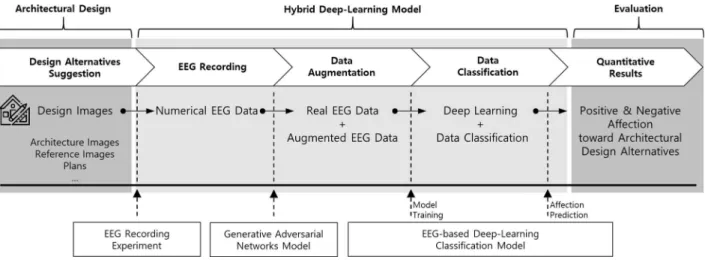
model using the acquired data. Figure 1 shows
a diagram that illustrates how the proposed hybrid deep-learning model could be applied to an architec-tural design process.
2.2 Generative adversarial networks
Goodfellow et al. (2014) proposed the concept of
a GANs, which is a deep-learning algorithm based on unsupervised learning. Supervised deep-learning
method algorithm processes data based on the fea-ture values of input data, calculates differences(loss) between model predictions and actual data labels based on the user-given results, and proceeds to
reduce the loss from such differences (Hinton and
Salakhutdinov2006). When this process occurs while
classification values of actual data (labels) are pro-vided, it is called supervised learning. When any clas-sification values of actual data are provided, it is called unsupervised learning. However, in the case of super-vised learning, model training is limited if any label values of actual data are provided or if the quantity of data is small. In contrast, the GANs model is different in that this algorithm is based on unsupervised learn-ing and thus can generate virtual data based on input data even if the quantity of the input data is small. This data augmentation supports the process of train-ing the supervised deep-learntrain-ing algorithm. The GANs model consists of a generator and discriminator. The generator generates virtual data using latent data and delivers the generated data to the discriminator. The discriminator processes the data from the generator and the original data simultaneously, distinguishing the original data from the virtual data. As the training is repeated, the generator and discriminator continue to adjust the weight and bias values that indicate the extent of connection among the nodes in each hid-den layer. The discriminator continues learning with regard to distinguishing the original data from the virtual data, whereas the generator proceeds to gen-erate virtual data that are similar to the original data. Because the generator and discriminator continue learning in a hostile and competing environment,
the algorithm is adversarial, competitive and
generative.
The GANs model is utilised to increase the size of
data whose actual classification values are hardly
secured as well as to generate certain data types
such as image, video, and voice. Caramihale,
Popescu, and Ichim (2018) and Luo and Lu (2018)
augmented key facial expression data and brain wave data by utilising the GANs. Theirfinding indicates that as augmented data are utilised for training an
emo-tional lassification model, the model’s accuracy is
enhanced.
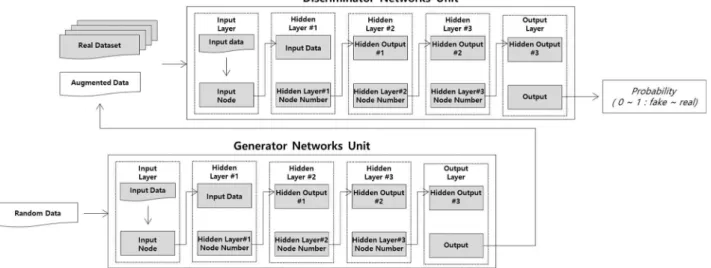
Figure 2 shows the structure of the GANs consist-ing of the discriminator and generator. The discrimi-nator receives virtual data generated by the generator in addition to actual data, whereas the generator receives random data. Input datasets pass through the neural networks of both the generator and dis-criminator. The discriminator receives actual data and data generated by the generator simultaneously. It distinguishes the actual data from the fake data and calculates the loss. The generator and discriminator continue learning in a manner that reduces this loss.
2.3 Deep-learning classification
Hinton and Salakhutdinov (2006) proposed a concept
of deep learning that combines multiple artificial
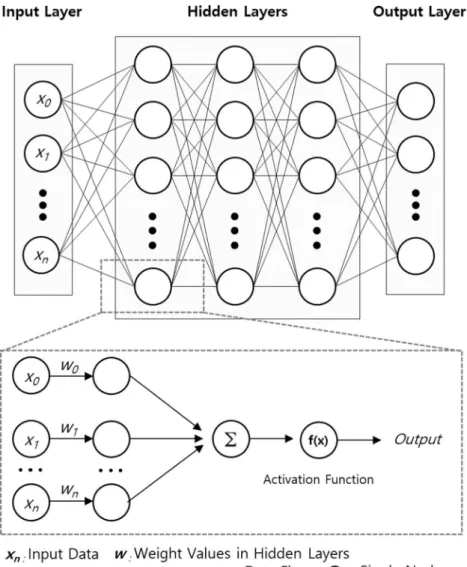
neural networks. The deep-learning model is mainly divided into three types of layers: the input layer, hidden layers, and output layer. The hidden layers consist of multiple nodes and the weight and bias values that indicate the extent of connection between the nodes. These values pass through the activation function and then through the following layer. As data enter into the deep-learning model, computa-tional operations are performed on them while they pass through each layer. The output layer presents
the predicted values after the model classifies the
data. In the case of the supervised learning classi fica-tion model, both the labels and feature values of the
data are put into the model. The difference between
the classification values of the actual data and the
values predicted by the model is calculated which is so called loss.
Figure 3 shows the structure of the deep neural networks. An input (xn) is multiplied by a weight value
(wn), and then, the result works as an input for the activation function. The activation function then cal-culates the input and transmits it to the following node as an output value.
If the classification values of the actual data are
provided to the model in the process of entering data to the deep-learning model and training it, it is called supervised learning. If such values are not pro-vided, it is called unsupervised learning. If the model is trained through supervised learning, the training
may proceed in a manner that reduces the difference
between the values predicted by the model and the
classification values of the actual data. However, in
this case, the learning may be limited if the quantity of data is small or if no classification values are pro-vided. In contrast, the unsupervised learning method has limitations in that it may produce different values
depending on the model’s structure or parameters
although it is possible to train the model even with-out the classification values of the data (Jain, Duin,
and Mao2000).
Accordingly, this study aims to develop an EEG-based hybrid deep-learning model that can recognise the emotional responses of users in the initial design-ing step. It consists of a GANs for brain wave data augmentation and an EEG-based deep-learning classi-fication model for brain wave data classiclassi-fication. Brain wave datasets of subjects from previous studies are augmented through the GANs, and then, the aug-mented datasets are utilised to train and evaluate
the classification model (Chang, Dong, and Jun 2018).
3. Proposed hybrid deep-learning model
In this work, two distinct deep-learning-based models
are suggested. The first is a generative adversarial
networks (GANs) model for EEG data augmentation, and the second is an EEG-based deep-learning model
for data classification. The hybrid deep-learning
model consists of a combination of these two models.
Both these models were built in this study using Google TensorFlow, which is a core open-source library for machine learning and deep learning.
Brain wave data collected from experiments work as input values for GANs and then augmented in a competitive environment between the generator and discriminator. The augmented data work as
input values for deep-learning classification model
along with raw brain wave data collected through experiments, and then, the model proceeds with
training and evaluation based on the data. Figure 4
shows how the GANs used for brain wave data aug-mentation is combined with the EEG-based
deep-learning classification model used for EEG data
classification.
3.1 Generative adversarial networks for brain wave data augmentation
This section aims to establish a GANs model to aug-ment a small quantity of brain wave data collected in
previous studies. In the process of establishing this model, the open-source library Google TensorFlow was used.
The EEG data that are to be used by the estab-lished model have 14 channels, and datasets are nor-malised for each channel. This step is necessary to prevent data distortion in the event that the value of a certain channel is larger than that of another channel.
The generator and discriminator of the established GANs consist of three hidden layers, which consist of 50, 100, and 50 nodes, respectively. The number of nodes in each layer was determined after evaluations with multi-ple combinations of hyper parameters that showed the highest training speeds. The generator receives random values between 0 and 1 and generates virtual EEG data. The discriminator receives EEG collected through experiments and virtual data and distinguishes the ori-ginal data from the virtual data. Once the training is completed, the EEG data generated by the generator are presented to users and saved as csv format.Figure 5
shows the structure of the generator and discriminator of the established GANs.
3.2 EEG-based deep-learning classification model for brain wave data classification
The purpose of the EEG-based deep-learning classi-fication model is to classify the emotional states of
the brain wave data as “positive” or “negative”
toward architectural design alternatives. The classi-fication model utilises TensorFlow as well as appli-cation programming libraries related to supervised learning.
The model consists of three layers: the input layer, hidden layers, and output layer. And the hidden layers consist of three layers which consist of 100,200 and Figure 5.GANs generator and discriminator.
100 nodes respectively. A number of nodes in the hidden layers were selected after preliminary tests with various combinations of hyper-parameters and were optimised for training speed and accuracy.
The classification model proceeds with learning
according to the following steps: (1) data input and normalisation, (2) distinction of training data from evaluation data(train-test split), (3) training, and (4) evaluation and accuracy measurement. (1) In the data input and normalisation step, the brain wave data of 14 channels are entered according to each
channel’s feature data values and are normalised.
The actual classification values of the corresponding
brain wave data are also given to the model. (2) In the data splitting step, the entire input data are
shuffled and divided: 70% for training and 30% for
testing. The division between the training and test datasets was determined after conducting multiple optimisations of the model and was intended to
prevent over-fitting or under-fitting problems. (3) In
the training step, the classification model presents
the predicted values based on the feature values of the input data, and the weight and bias values are
adjusted in a manner that reduces the difference
between the predicted output values and actual classification values. (4) In the evaluation and accu-racy measurement step, the model accuaccu-racy is
mea-sured and given to users. Figure 6 shows the
structure of the model.
4. Implementation of
electroencephalography-based hybrid deep-learning model
4.1 Brain wave dataset
Chang, Dong, and Jun (2018) performed an experiment
in which they recorded EEG data of subjects. The experiment was performed in an experiment room of Hanyang University with the help of 18 individuals (12 women and 6 men) who were healthy physically and mentally. The experiment was performed in the follow-ing order: (1) presentation of space images to subjects for selection, (2) machine calibration and meditation, (3) brain wave measurement, and (4) questionnaire completion. (1) In the step of presenting space images to subjects for selection, eight space images were pre-sented and subjects selected images that they most preferred and the ones they least preferred. (2) In the machine calibration and meditation step, subjects were
asked to wear the“EMOTIV EPOC+ 14 Channel Mobile
EEG” device from Emotiv for machine calibration using the EmotivPro software. (3) In the brain wave measure-ment step, the brain waves of subjects were recorded for 20 s. (4) In the questionnaire completion step,
subjects filled out the Positive and Negative Affect
Schedule (PANAS) questionnaire. The PANAS
question-naire included 20 questions: 10 regarding “positive
emotion” and 10 regarding “negative emotion.” For
the answer to each question, “very much” was given
5 points and “not at all” was given 1 point. In this
manner, the scores of the “positive emotion” and
“negative emotion” questions were calculated
(Watson, Clark, and Tellegen1988). Chang, Dong, and
Jun (2018) excluded the emotion scores that were
lower than the average scores of “positive emotion”
and “negative emotion” presented in the research of
Watson, Clark, and Tellegen (1988). Consequently, the brain wave data of 8 individuals for the“positive emo-tion” questions and the data of 17 individuals for the “negative emotion” questions were included in the dataset. From the brain wave data for 20 s, the data
for thefirst 5 s and last 5 s were excluded to remove
noise, and the remaining brain wave data for 10 s were
used. The number of rows in the “positive emotion”
and “negative emotion” datasets was 10,240
(8 × 128 × 10) and 21,760 (17 × 128 × 10), respectively.
Figure 7(a) shows the result of the brain wave
experiment performed on one subject, Figure 7(b)
shows the brain wave recording software called
EmotivPro(Emotiv 2018), and Figure 7(c) shows the
electrode position of the “EMOTIV EPOC+ 14
Channel Mobile EEG” device, which is the EEG
equip-ment used in this experiequip-ment (Emotiv2018).
Figure 7.(a) Subject recording EEG, (b) EmotivPro software interface with recording EEG (Emotiv2018), (c)“EMOTIV EPOC+ 14 channel mobile EEG” device technical specifications (Emotiv2018).
Figure 8.EEG-based Deep-learning classification model training dataset: (a) Features: 14 channels of recorded EEG data, (b) Affection: Re-classified PANAS Questionnaire Results, (c) Labels: “Negative” = 1 and “Positive” = 2, (d) Subject Initials, (e) Frequency (Hz).
Figure 8 shows the structure of the EEG dataset.
Figure 8(a) shows the raw brain wave data of 14 chan-nels, which include feature values.Figure 8(b) shows the
re-classified affection results of the PANAS survey.
Figure 8(c) shows numerically casted values from the survey results. Actual classification values were entered into the model as follows: 1 for“negative” items and 2 for“positive” items.Figure 8(d) shows the initials of each subject, andFigure 8(e) shows the frequency.
4.2 Brain wave dataset augmentation using generative adversarial networks
The learning process of the GANs includes the following four steps: (1) data input, (2) virtual data generation by the generator, (3) discriminator training, and (4) virtual data output. (1) In the data input step, the “positive
emotion EEG dataset” and “negative emotion EEG
data-set” recorded in the previous study were entered into the model. (2) In the step involving virtual data generation by the generator, random values between 0 and 1 were entered into the generator and the generator generated virtual brain wave data. (3) In the discriminator training step, the actual EEG data and virtual EEG data generated by the generator were entered into the discriminator
simultaneously. The discriminator distinguished the actual data from the fake data. In this phase, loss values of discriminator and generator are calculated. If gener-ated data becomes similar to actual data during training process, generator loss decreases. (4) In the virtual data output step, virtual brain wave data generated by the generator were saved in csv format. In total, 30,000 rows were generated by the generator for the“positive
emo-tion EEG dataset” and “negative emotion EEG dataset”
items respectively.
Table 1indicates that as the training was repeated, the virtual data in blue gradually became similar to the actual data in orange. Among the 14 channels of the“positive emotion” brain wave data, the two channels AF3 and T7 were visualised on the x axis and y axis, respectively. When the training was repeated 1,000 times, the generator generated data containing negative numbers with no actual data. When the training was repeated 8,000 times, the overlap of the virtual data with the actual data increased. As the training was repeated, the over-lapped parts of the actual data and virtual data on the coordinate axes increased to the point that the discrimi-nator could no longer distinguish the actual data from the virtual data. Accordingly, the generator’s loss decreased gradually.
Figure 9.Suggested Model Use Research Scenario.
Table 1.Comparison between real data and augmented data through iterations (Positive affection).
4.3 DEEG-based deep-learning classification model training using virtual brain wave data The virtual EEG data generated using the GANs model were utilised in the process of training the EEG-based
deep-learning classification model. The virtual brain
wave dataset generated based on the“positive
emo-tion EEG dataset” was added to this dataset, and then,
the“negative emotion EEG dataset” was added in the
same manner. Consequently, the “positive emotion
brain wave dataset” and “negative emotion brain
wave dataset” were combined with 40,240 and
51,760 rows, respectively.
The expanded“positive emotion EEG dataset” and
“negative emotion EEG dataset” were then entered
into the classification model for training. While the
previous classification model utilised 32,000 datasets for training, in the present model, 92,000 datasets were utilised in training as virtual brain wave data
were added. Thefinal accuracy was 0.984, which was
better than the existing accuracy (0.979). If more data are added in the future using the GANs model, the accuracy and universality may improve further.
4.4 Implications and model utilisation scenarios
The proposed EEG-based hybrid deep-learning
model enables quantitative identification of user
emotions towards architectural space images. At the design stage, the architects consider the emo-tional qualitative reviews of the decision makers, including owners and preliminary users, as well as the quantitative reviews, including legal and loca-tion-based reviews, on the design alternatives to be important. In this regard, the proposed model can
be effectively used. However, at the current stage of
research, because it is difficult to manipulate EEG
recording machines and because the experimental procedures are complicated, applying the proposed model to actual design processes will require
addi-tional research in the fields of brain science and
architecture in the future.
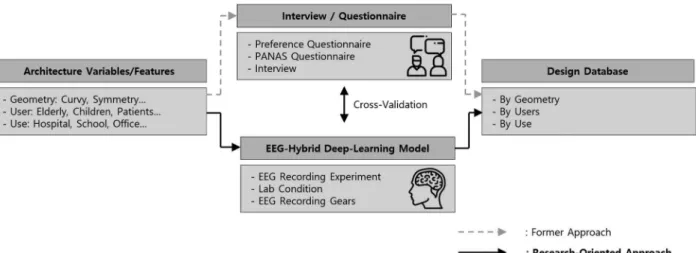
At present, we can present research scenarios that
quantitatively measure specific subjects’ responses
towards specific architectural spaces and build
data-bases by obtaining measurement data and
incorpor-ating them into design knowledge using the
proposed model. Previous studies on design knowl-edge databases mainly used surveys and in-depth interviews to measure the emotional responses of
subjects to a specific type of architecture. However,
if the model proposed in this study is adopted, archi-tects can quantitatively measure the emotional responses of users under certain conditions and sui-tably incorporate them into the knowledge base to
reflect real business processes. This scenario is sug-gested inFigure 9.
5. Conclusion
The objective of this study was to establish an EEG-based hybrid deep-learning model through which the emotional responses of users towards a architectural space could be evaluated. To this end, brain wave data collected in previous studies were augmented using the GANs model, and an EEG-based
deep-learning classification model was trained and
evalu-ated by using both actual and virtual data. The
find-ings of this study are as follows.
First, the GANs showed a major possibility of aug-menting atypical EEG data. It is expected that this
networks can be used in the field of architecture to
augment and utilise datasets whose scale and avail-ability are limited, such as simulation data, environ-mental sensor data, and observation data. Second, as the quantity of data increases, the accuracy of training and evaluating the deep-learning model will improve continually. The model has demonstrated that it can handle big data pertaining to architecture, traffic, and other environments that can be utilised in thefield of architecture. Third, by using the brain wave data and EEG-based hybrid deep-learning model, the study has demonstrated the possibility of helping the designer in the architectural design step to grasp the emo-tional responses of future users or clients towards proposed design alternatives. In this study, it was possible to utilise brain wave data as indicators of the emotional responses or preferences of subjects only in limited environments.
In future studies, the following research activities should be considered. The proposed hybrid deep-learning model should be applied to actual design pro-cesses. The hybrid deep-learning model should be eval-uated and verified. Experiments should be performed for recording additional brain wave data to facilitate the universal application of the model. The EEG-based hybrid deep-learning model should be combined with an eye tracking system for the evaluation of the emotional responses of users towards actual spatial environments.
Acknowledgments
We would like to express our sincere gratitude to GARAM Architects and Associates Research and Development Center for offering supportive environment to finish this research.
Disclosure statement
Funding
This research was supported by a grant (19AUDP-B127891-03) from the Architecture & Urban Development Research Program funded by the Ministry of Land, Infrastructure and Transport of the Korean government.
References
Caramihale, T., D. Popescu, and L. Ichim. 2018. “Emotion Classification Using a TensorFlow Generative Adversarial Networks Implementation.” Symmetry 10 (9): 414. doi:10.3390/sym10090414.
Chang, S. W., W. H. Dong, and H. J. Jun. 2018.“EEG-Based Deep Neural Networks Classification Model for Recognizing Emotion of Users in Early Phase of Design”. Journal of the Architectural Institute of Korea Planning & Design 34(12): 85-94.
Ekman, P., and W. V. Friesen.1971.“Constants across Cultures in the Face and Emotion.” Journal of personality and social psychology 17 (2): 124–129. doi:10.1037/h0030377. Emotiv. 2018. “EMOTIV EPOC+, EPOC+ Headset Details.”
Accessed 27 September 2018. https://emotiv.gitbooks. io/epoc-user-manual/content/epoc+_headset_details/
Goodfellow, I., J. Pouget-Abadie, M. Mirza, B. Xu, D. Warde-Farley, S. Ozair, A. Courville, and Y. Bengio. 2014. “Generative Adversarial Nets.” In Proceedings of the 27th International Conference on Neural Information Processing Systems, Montreal, Canada, 2 vols, 2672–2680. Han, J., Z. Zhang, Z. Ren, F. Ringeval, and B. Schuller.2018. “Towards Conditional Adversarial Training for Predicting Emotions from Speech.” In IEEE International Conference on Acoustics, Speech and Signal Processing (ICASSP), Calgary, Alberta, Canada, 6822–6826.
Hinton, G. E., and R. R. Salakhutdinov.2006.“Reducing the Dimensionality of Data with Neural Networks.” Science 313 (5786): 504–507. doi:10.1126/science.1127647. Hwang, Y. S., J. Y. Kim, A. L. Chang, E. Y. Lim, and H. W. Jung.
2014. “Planning of Apartment Community Facilities According to EEG Analysis by School Age of Youth Emotional Words.” Korean Institute of Interior Design Journal 23 (4): 181–189. doi:10.14774/JKIID.2014.23.4.181. Hwang, Y. S., S. Y. Kim, and J. Y. Kim.2013.“An Analysis of Youth EEG Based on the Emotional Color Scheme Images by Different Space of Community Facilities.” Korean Institute of Interior Design Journal 22 (5): 171–178. doi:10.14774/JKIID.2013.22.5.171.
Jain, A. K., R. P. W. Duin, and J. Mao.2000.“Statistical Pattern Recognition: A Review.” IEEE transactions on pattern analysis and machine intelligence 22 (1): 4–37. doi:10.1109/34.824819. Kiviniemi, A.2005.“Requirements Management Interface to
Building Product Models.” Thesis, Stanford University. Lan, L., and Z. Lian.2009.“Use of Neurobehavioral Tests to
Evaluate the Effects of Indoor Environment Quality on Productivity.” Building and environment 44 (11): 2208–2217. doi:10.1016/j.buildenv.2009.02.001.
Lan, L., Z. W. Lian, and Y. B. Lin. 2016. “Comfortably Cool Bedroom Environment during the Initial Phase of the
Sleeping Period Delays the Onset of Sleep in Summer.” Building and environment 103: 36–43. doi:10.1016/j. buildenv.2016.03.030.
Lan, L., L. Pan, Z. Lian, H. Huang, and Y. Lin. 2013. “Experimental Study on Thermal Comfort of Sleeping People at Different Air Temperatures.” Building and envir-onment 73: 24–31. doi:10.1016/j.buildenv.2013.11.024. Lee, H. J., Y. L. Choi, and C. Y. Chun.2012.“Effect of Indoor
Air Temperature on the Occupants’ Attention Ability Based on Electroencephalogram Analysis.” Journal of the Architectural Institute Of Korea Planning & Design 28 (3): 217–225.
Luo, Y., and B. Lu. 2018. “EEG Data Augmentation for Emotion Recognition Using a Conditional Wasserstein GAN.” In 40th Annual International Conference of the IEEE Engineering in Medicine and Biology Society (EMBC), Honolulu, Hawaii, 2535–2538.
Pan, L., Z. Lian, and L. Lan. 2011. “Investigation of Gender Differences in Sleeping Comfort at Different Environme-ntal Temperatures.” Indoor and Built Environment 21 (6): 811–820. doi:10.1177/1420326X11425967.
Ryu, J. S., and J. S. Lee. 2015. “Correlation Analysis of Emotional Adjectives and EEG to Apply Color to the Indoor Living Space.” Journal of Korea Society of Color Studies 29 (3): 25–35. doi:10.17289/jkscs.29.3.201508.25. Schomer, D., and F. Silva. 2010. Niedermeyer’s
Electro-encephalography: Basic Principles, Clinical Applications, and Related Fields. 6th ed. Lippincott Williams & Wilkins. Philadelphia, Pennsylvania, United States.
Sebastian, R. 2007. “Managing Collaborative Design.” Doctoral Thesis, Delft University of Technology.
Shen, W., X. Zhang, G. Q. Shen, and T. Fernando.2013.“The User Pre-Occupancy Evaluation Method in Designer– Client Communication in Early Design Stage: A Case Study.” Automation in Construction 32: 112–124. doi:10.1016/j.autcon.2013.01.014.
Siva, J., and K. London.2012.“Client Learning for Successful Architect-Client Relationship.” Engineering, Construction and Architectural Management 19 (3): 253–268. doi:10.1108/09699981211219599.
TensorFlow. 2018. Accessed 12 November 2018. https:// www.tensorflow.org/
Watson, D., L. A. Clark, and A. Tellegen.1988.“Development and validation of brief measures of positive and negative affect: The PANAS scales.” Journal of personality and social psychology 54 (6): 1063–1070. doi: 10.1037/0022-3514.54.6.1063.
Yang, H., Z. Zhang, and L. Yin.2018.“Identity-Adaptive Facial Expression Recognition through Expression Regeneration Using Conditional Generative Adversarial Networks.” In 13th IEEE International Conference on Automatic Face & Gesture Recognition, Xi’an, China, 294–301.
Zhang, F., S. Haddad, B. Nakisa, M. N. Rastgoo, C. Candido, D. Tjondronegoro, and R. D. Dear.2017.“The Effects of Higher Temperature Setpoints during Summer on Office Workers’ Cognitive Load and Thermal Comfort.” Building and environment 123: 176–188. doi: 10.1016/j.buil-denv.2017.06.048.