INTRODUCTION
Bee pollen is a pollen-mass, packed by worker honey bees into granules, with added honey or nectar.1 Although the
me-dicinal use of bee pollen is not proven, bee pollen has been widely consumed as a natural health supplement.1,2 There has
been a few reports of bee pollen-induced acute allergic reac-tions, including anaphylaxis.3-10 Interestingly, severe allergic
re-actions could develop after ingestion of insect-pollinated pol-lens in patients sensitized to wind-pollinated plants,3,5,7 as
hon-ey bees collect pollen from insect-pollinated flowers. Cohen et al.3 reported 3 patients with allergic rhinitis sensitized to
rag-weed who developed acute allergic reactions after ingestion of bee pollen containing dandelion, suggesting cross-allergenicity between wind-pollinated ragweed and insect-pollinated dan-delion. However, the presence of airborne pollens in bee pollen was suggested as another possible mechanism of bee-pollen-induced allergic reactions.10
Here we report a case of bee pollen-induced anaphylaxis, in
which the bee pollen contained weed pollens such as chrysan-themum, dandelion, and ragweed, etc. We investigated the cross-allergenicity of bee pollen and weed pollens and identi-fied major allergenic components.
CASE REPORT
A 40-year-old male patient was admitted to the emergency department with generalized urticaria, facial edema, and dys-pnea 1 hour after ingesting 1 tablespoon of bee pollen pur-chased from a local market. He complained of nausea, vomit-ing, abdominal pain, and diarrhea. Chest examination revealed
Bee Pollen-Induced Anaphylaxis: A Case Report and Literature
Review
Jeong-Hee Choi,
1* Young-Sook Jang,
1Jae-Won Oh,
2Cheol-Hong Kim,
1In-Gyu Hyun
11Department of Internal Medicine, Hallym University College of Medicine, Chunchun, Korea 2Department of Pediatrics, Hanyang University College of Medicine, Seoul, Korea
This is an Open Access article distributed under the terms of the Creative Commons Attribution Non-Commercial License (http://creativecommons.org/licenses/by-nc/3.0/) which permits unrestricted non-commercial use, distribution, and reproduction in any medium, provided the original work is properly cited.
Bee pollen is pollen granules packed by honey bees and is widely consumed as natural healthy supplements. Bee pollen-induced anaphylaxis has rarely been reported, and its allergenic components have never been studied. A 40-year-old male came to the emergency room with generalized urti-caria, facial edema, dyspnea, nausea, vomiting, abdominal pain, and diarrhea 1 hour after ingesting one tablespoon of bee pollen. Oxygen saturation was 91%. His symptoms resolved after injection of epinephrine, chlorpheniramine, and dexamethasone. He had seasonal allergic rhinitis in autumn. Microscopic examination of the bee pollen revealed Japanese hop, chrysanthemum, ragweed, and dandelion pollens. Skin-prick with bee pollen ex-tracts showed positive reactions at 0.1 mg/mL (A/H ratio > 3+). Serum specific IgE to ragweed was 25.2, chrysanthemum 20.6, and dandelion 11.4 kU/L; however, Japanese hop, honey-bee venom and yellow-jacket venom were negative (UniCAP®, Thermo Fisher Scientific, Uppsala, Sweden).
En-zyme-linked immunosorbent assay (ELISA) confirmed serum specific IgE to bee-pollen extracts, and an ELISA inhibition assay for evaluation of cross-allergenicity of bee pollen and other weed pollens showed more than 90% of inhibition with chrysanthemum and dandelion and ~40% inhibition with ragweed at a concentration of 1 µg/mL. Sodium dodecyl sulfate polyacrylamide gel electrophoresis (SDS-PAGE) and IgE-immunoblot analysis re-vealed 9 protein bands (11, 14, 17, 28, 34, 45, 52, 72, and 90 kDa) and strong IgE binding at 28-34, 45, and 52 kDa. In conclusion, healthcare providers should be aware of the potential risk of severe allergic reactions upon ingestion of bee pollen, especially in patients with pollen allergy.
Key Words: Pollen; bees; anaphylaxis; immunoglobulin E
Correspondence to: Jeong-Hee Choi, MD, PhD, Department of Pulmonology and Allergy, Hallym University Dongtan Sacred Heart Hospital,
144-6 Samsung 1-ro, Hwaseong 445-170, Korea.
Tel: +82-31-8086-2928; Fax: +82-31-8086-2482; E-mail: [email protected] Received: June 2, 2014; Accepted: July 23, 2014
•There are no financial or other issues that might lead to conflict of interest. Allergy Asthma Immunol Res. 2015 September;7(5):513-517.
http://dx.doi.org/10.4168/aair.2015.7.5.513 pISSN 2092-7355 • eISSN 2092-7363
a wheezing sound; his oxygen saturation was 91%. His initial blood pressure was 120/70 mmHg, pulse rate 92/min, respira-tory rate 20/min, and body temperature 37°C. His symptoms resolved after injection of epinephrine, chlorpheniramine, and dexamethasone, along with nebulization of bronchodilators. He had no known food or drug allergies, or hymenoptera sensi-tivity, but had seasonal allergic rhinitis in autumn. Serum total IgE was increased at 207 IU/mL and he showed positive reac-tions to rye (1+), mugwort (1+), ragweed (2+), and Derma-tophagoides farinae (2+) on simultaneous multiple allergen tests (food panel, AdvanSure AlloScreen®, LG, Seoul, Korea)
Microscopic examination of the bee pollen by Calberla’s fuch-sin staining revealed Japanese hop, chrysanthemum, ragweed, and dandelion pollens (Fig. 1). One month later, skin-prick tests were performed with bee pollen extracts; these showed posi-tive reactions at 0.1 mg/mL (A/H ratio >3+). He showed elevat-ed levels of serum specific IgE to mugwort 34.9, ragweelevat-ed 25.2, chrysanthemum 20.6, and dandelion 11.4 kU/L, but not to Jap-anese hop, honey-bee venom, and yellow-jacket venom (Uni-CAP®, Thermo Fisher Scientific, Uppsala, Sweden).
Serum specific IgE to bee pollen extracts was measured by en-zyme-linked immunosorbent assay (ELISA).11 Microplates
(Corning Inc., NY, USA) were coated with bee pollen extracts (10 μg/mL). Fourteen normal control sera were used and
absor-bance was read at 450 nm. The cutoff value was defined as the mean+3×SD of the absorbance values from the 14 normal con-trols. The patient’s serum had an optical density of 1.7, which was significantly higher than the cutoff value (0.3). An ELISA in-hibition assay was performed to investigate cross-allergenicity of bee and weed pollens. Serum was preincubated with the
bee-Fig. 1. Microscopic contents of bee pollen. The microscopic findings show several pollens, including Japanese hop, chrysanthemum, ragweed, and dandelion. Janpanese hop
Chrysanthemum
Dandelion
% inhibition of
bee pollen specific IgE
120 100 80 60 40 20 0 -20 1 μg/mL 10 μg/mL 100 μg/mL
Bee pollen Chrysanthemum Dandelion
Ragweed Japanese hop Dp
Fig. 2. Bee pollen ELISA inhibition results using bee pollen, chrysanthemum, dandelion, ragweed, and Japanese hop antigens. Chrysanthemum and dandeli-on show >90% inhibitidandeli-on at 1 μg/mL. Ragweed shows ~40% inhibitidandeli-on at 1 μg/mL, and Japanese hop shows relatively weak inhibition. Dp,
pollen extracts, ragweed, Japanese hop, dandelion, and chry-santhemum. Chrysanthemum and dandelion showed >90% inhibition and ragweed showed ~40% inhibition at 1 µg/mL, while Japanese hop showed weak inhibition (Fig. 2). Thus,
chry-santhemum and dandelion were the major components of the bee pollen allergenicity in this patient. Sodium dodecyl sulfate polyacrylamide gel electrophoresis (SDS-PAGE) and IgE-im-munoblot analysis were performed to identify the major
aller-Table. Reported cases of systemic allergic reactions induced by bee pollen
Case Age/Sex Symptoms and signs History of allergic disease Positive reactions to skin testsand/or serum specific IgE Composition of bee pollenthe patient ingested Reference No. 1 31/F Facial edema and urticaria,
dyspnea Seasonal allergic rhinitis Ragweed, dandelion Legume pollen, dandelion 2 27/F Facial edema and generalized
urticaria Seasonal allergic rhinitis Ragweed, dandelion Dandelion 3
3 25/M Facial edema and generalized urticaria, grand mal convulsion, hypotension
Seasonal allergic rhinitis Ragweed, dandelion Dandelion 4 46/M Paroxysm of sneezing, generalized
urticaria and angioedema, dyspnea, hypotension
Seasonal allergic rhinitis Mesquite Mesquite 4
5 49/F Facial edema, vomiting, runny nose, itching of palms and eyes, mild dyspnea
Allergic rhinitis Chrysanthemum, golden rod, aster, ragweed, mugwort, dandelion
Golden rod, sow thistle, legume pollen
5
6 33/M Neck swelling, constriction of
throat, dyspnea Na Na Na 6
7 32/M Generalized urticaria, facial
edema, dyspnea, hoarseness Seasonal allergic rhinoconjunctivitis Mugwort, dandelion, willow Dandelion (15%), mugwort (5%), willow (15%), other flower pollens, fungi (6%)
7 8 56/F Palmar pruritus, generalized
urticaria, dyspnea, throat tightness
Allergic rhinitis s/p immunotherapy with pollen, mites, fungus
Elm, blue grass, orchard grass, ragweed, cat, Alternaria, Cladosporium, Aspergillus, Penicillium, molds
Ragweed, Alternaria, honeysuckle, Cladosporium, privet shrub, vetch
8
9 54/F Generalized urticaria, facial
edema, dyspnea, hypotension Allergic rhinoconjunctivitis in spring and autumn Mugwort, ragweed, dandelion Mugwort, ragweed 9 10 30/F Facial edema, urticaria, dyspnea,
faintness
Seasonal allergic rhinoconjunctivitis in summer
Timothy grass Na 10
Ref. 3, 8 showed ELISA inhibition tests. Na, not alpplicable.
kDa 90 kDa 72 kDa 52 kDa 45 kDa 34 kDa 28 kDa 17 kDa 14 kDa 11 kDa M 250 130 95 72 36 17 55 28 10 A kDa 52 kDa 45 kDa 28-34 kDa M NC1 NC2 Pt NC3 B 250 130 95 72 36 17 55 28 B
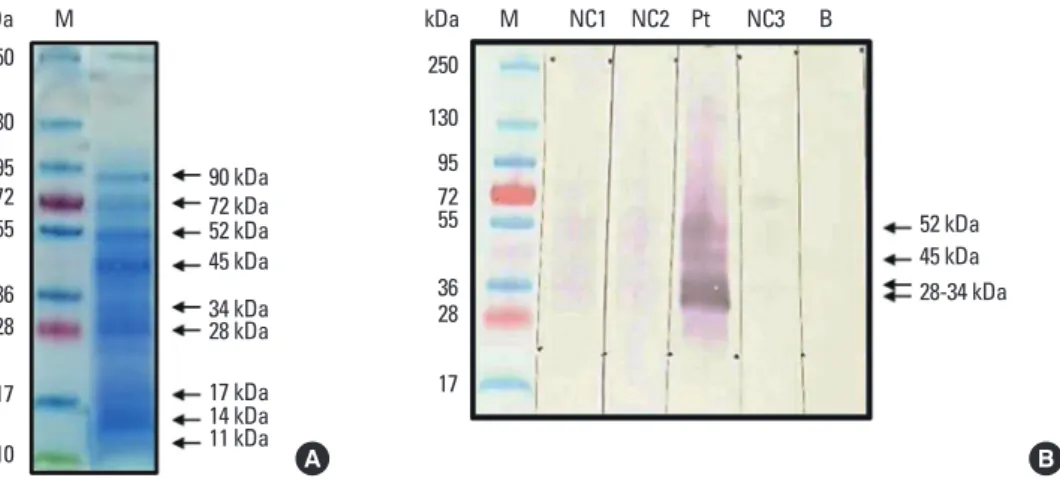
Fig. 3. Sodium dodecyl sulfate polyacrylamide gel electrophoresis (SDS-PAGE) (A) and IgE-immunoblot analysis (B) of bee-pollen extracts in sera of the patient and normal controls (NC). IgE-immunoblot results show prominent bands at 28-34, 45, and 50 kDa. M, standard marker; B, buffer control.
gens of bee-pollen extracts.11 SDS-PAGE revealed nine protein
bands (11, 14, 17, 28, 34, 45, 52, 72, and 90 kDa). IgE binding was strong at 28-34 kDa, with relatively prominent binding at 45 and 52 kDa (Fig. 3).
DISCUSSION
Our patient had allergic rhinitis with sensitization to weed pollens, such as mugwort, ragweed, chrysanthemum, and dan-delion, which belong to the Compositae family. The bee pollen examined contained these weed pollens, and ELISA inhibition showed that the bee pollen extracts had strong cross-reactivity with chrysanthemum and dandelion, suggesting that chrysan-themum and dandelion pollens played a major role in the ana-phylactic reaction.
Table shows previous case reports of bee pollen-induced al-lergic reactions. In 50% of cases, patients sensitized to wind-pollinated ragweed pollens developed systemic allergic reac-tions after ingestion of bee pollen that contained members of the insect-pollinated Compositae family, such as dandelion and goldenrod. This suggests that cross-allergenicity between the Compositae family is a major mechanism of bee pollen-in-duced allergic reactions.3,5,9
Mugwort and ragweed are the major weed pollens in autumn in our country, and the prevalence of sensitization is about 5%-10%, while insect-pollinated pollens, such as chrysanthemum and dandelion, are less implicated as a cause of pollinosis.12,13
However, Lee et al.14 reported that half of the weed pollen
sensi-tized patients were cosensisensi-tized to all 3 weed pollens such as mugwort, chrysanthemum, and ragweed, suggesting cross-al-lergenicity among weed pollens. Cross-alcross-al-lergenicity within weeds and among other allergenic plants is likely attributable to panallergens such as profillins (14 kDa), polcalcin (9 kDa), and lipid-transfer proteins (10 kDa).15 Cross-allergenicity among
mugwort, chrysanthemum, and dandelion, which showed strong IgE binding at 20-25, 36-62, and 70-173 kDa, was report-ed.13 Our results also indicated strong IgE binding at 28-34, 45,
and 52 kDa from the bee-pollen extracts. Thus, allergens of higher molecular weight than panallergens (low molecular weight), may contribute to the cross-allergenicity within weed pollens. Further studies on cross-allergenicity between wind- and insect-pollinated weeds are warranted.
Bee pollen may contain not only pollens from insect-pollinat-ed plants but also those from wind-pollinatinsect-pollinat-ed trees or weinsect-pollinat-eds that grow in the same season, resulting in systemic allergic re-actions after accidental ingestion of these airborne pollens.10,16
Furthermore, Greenberger et al.8 reported that bee pollen
con-taminated with fungi such as Aspergillus and Cladosporium could cause severe allergic reactions in patients sensitized to these fungi. Moreover, some plants are both wind- and insect-pollinated; mesquite (genus Prosopis) (Table; Case 4) is preva-lent in arid regions of the southwestern United States and
northern Mexico and causes allergic rhinitis and asthma in ear-ly summer.4,17 Pollens from Chrysanthemum, an
insect-polli-nated plant, have been detected by the Korean airborne pollen calendar in autumn; thus it may also be wind-pollinated.13
In conclusion, healthcare providers should be aware of the potential risk of severe allergic reactions upon ingestion of bee pollen, especially in patients sensitized to weed pollens. ACKNOWLEDGMENTS
This study was supported by a grant from the Basic Science Research Program through the National Research Foundation of Korea (NRF), as funded by the Ministry of Education, Sci-ence and Technology (2012R1A1A1012349).
REFERENCES
1. Almeida-Muradian LB, Pamplona LC, Coimbra S, Barth OM. Chemical composition and botanical evaluation of dried bee pol-len pellets. J Food Compost Anal 2005;18:105-11.
2. Steben RE, Boudreaux P. The effects of pollen and protein extracts on selected blood factors and performance of athletes. J Sports Med Phys Fitness 1978;18:221-6.
3. Cohen SH, Yunginger JW, Rosenberg N, Fink JN. Acute allergic re-action after composite pollen ingestion. J Allergy Clin Immunol 1979;64:270-4.
4. Mansfield LE, Goldstein GB. Anaphylactic reaction after ingestion of local bee pollen. Ann Allergy 1981;47:154-6.
5. Kang SY, Moon HB, Kim YY. A case of systemic allergic reaction af-ter ingestion of pollen granules. Allergy 1984;4:57-61.
6. Geyman JP. Anaphylactic reaction after ingestion of bee pollen. J Am Board Fam Pract 1994;7:250-2.
7. Chivato T, Juan F, Montoro A, Laguna R. Anaphylaxis induced by ingestion of a pollen compound. J Investig Allergol Clin Immunol 1996;6:208-9.
8. Greenberger PA, Flais MJ. Bee pollen-induced anaphylactic reac-tion in an unknowingly sensitized subject. Ann Allergy Asthma Im-munol 2001;86:239-42.
9. Park HJ, Hur GY, Kim HA, Ye YM, Suh CH, Nahm DH, et al. Ana-phylactic reaction after the ingestion of bee pollen. Korean J Asth-ma Allergy Clin Immunol 2007;27:57-60.
10. Jagdis A, Sussman G. Anaphylaxis from bee pollen supplement. CMAJ 2012;184:1167-9.
11. Lee SK, Yoon SH, Kim SH, Choi JH, Park HS. Chestnut as a food al-lergen: identification of major allergens. J Korean Med Sci 2005;20: 573-8.
12. Kim TB, Kim KM, Kim SH, Kang HR, Chang YS, Kim CW, et al. Sen-sitization rates for inhalant allergens in Korea; a multi-center study. J Asthma Allergy Clin Immunol 2003;23:483-93.
13. Oh JW, Lee HB, Kang IJ, Kim SW, Park KS, Kook MH, et al. The re-vised edition of Korean calendar for allergenic pollens. Allergy Asthma Immunol Res 2012;4:5-11.
14. Lee YW, Choi SY, Lee EK, Sohn JH, Park JW, Hong CS. Cross-aller-genicity of pollens from the Compositae family: Artemisia vulgaris, Dendranthema grandiflorum, and Taraxacum officinale. Ann Aller-gy Asthma Immunol 2007;99:526-33.
Jahn-Schmid B, et al. The spectrum of allergens in ragweed and mug-wort pollen. Int Arch Allergy Immunol 2005;138:337-46.
16. Pitsios C, Chliva C, Mikos N, Kompoti E, Nowak-Wegrzyn A, Kon-tou-Fili K. Bee pollen sensitivity in airborne pollen allergic
individ-uals. Ann Allergy Asthma Immunol 2006;97:703-6.
17. Novey HS, Roth M, Wells ID. Mesquite pollen--an aeroallergen in asthma and allergic rhinitis. J Allergy Clin Immunol 1977;59:359-63.