저작자표시-비영리-변경금지 2.0 대한민국 이용자는 아래의 조건을 따르는 경우에 한하여 자유롭게 l 이 저작물을 복제, 배포, 전송, 전시, 공연 및 방송할 수 있습니다. 다음과 같은 조건을 따라야 합니다: l 귀하는, 이 저작물의 재이용이나 배포의 경우, 이 저작물에 적용된 이용허락조건 을 명확하게 나타내어야 합니다. l 저작권자로부터 별도의 허가를 받으면 이러한 조건들은 적용되지 않습니다. 저작권법에 따른 이용자의 권리는 위의 내용에 의하여 영향을 받지 않습니다. 이것은 이용허락규약(Legal Code)을 이해하기 쉽게 요약한 것입니다. Disclaimer 저작자표시. 귀하는 원저작자를 표시하여야 합니다. 비영리. 귀하는 이 저작물을 영리 목적으로 이용할 수 없습니다. 변경금지. 귀하는 이 저작물을 개작, 변형 또는 가공할 수 없습니다.
A THESIS
FOR THE DEGREE OF MASTER OF SCIENCE
App Attributes and Perceived Values
Determining Chinese Consumers’ Intent
to Reuse Fashion Shopping Apps
Yu Sun
Department of Fashion & Textiles
GRADUATE SCHOOL
JEJU NATIONAL UNIVERSITY
August 2019
Acknowledgements
After an intensive period of seven months, today is the day: writing this note of thanks is the finishing touch on my dissertation. It has been a period of intense learning for me, not only in the research area, but also on a personal level. Writing this dissertation has had a big impact on me. I would like to reflect on the people who have supported and helped me so much throughout this period.
Throughout the writing of this dissertation I have received a great deal of support and assistance. I would first like to thank my tutors, Heesook Hong, for her valuable guidance. You provided me with the tools that I needed to choose the right direction and successfully complete my thesis. You always worked tirelessly to train my patience. Your continuous encouragement is my greatest motivation.
Meanwhile, I would like to express my gratitude to my parents. Your encouragement brought me power, aroused my enthusiasm and helped me to make progress every day. You make me believe that if I try my utmost to do everything, the future of my life will be hopeful and promising. Finally, there are my friends, who were of great support in deliberating over our problems and findings, as well as providing happy distraction to rest my mind outside of my research.
Thank you very much, everyone!
Contents
I. Introduction ···1
1. Research background and research objectives ···1
2. The structure of this paper ···4
Ⅱ. Theoretical Background ···6
1. Mobile apps ···6
1) The definition and type of mobile apps ···6
2) Mobile apps used in China ···10
2. Fashion apps ···13
1) The definition and types of fashion apps ···13
2) The attributes characteristics of fashion apps ···19
3) The consumer behavior studies of fashion apps ···22
3. Perceived value ···26
1) The definition of perceived value ···26
2) The dimensions of perceived value ···28
3) Utilitarian and hedonic shopping value ···30
4. Theoretical frame and research hypotheses ···33
1) Stimuli-Organism-Response theory ···33
2) The relationship between app attributes and perceived value ···36
3) The relationship between app attributes and behavioral intention ···· 47
4) The relationship between perceived value and behavioral intention · 50 5) Conceptual framework for this study ···52
Ⅲ. Research Method ···54
1. Investigation of attributes of fashion shopping apps available in China ···54
2. Focus group interviews with Chinese consumers ···58
3. Measurement ···59
1) Fashion shopping apps evaluated by respondents ···59
2) The attributes of fashion shopping apps ···62
3) Perceived value of fashion shopping apps ···62
4) Reuse intention of fashion shopping apps ···65
5) Demographic characteristics ···65
4. Data collection and respondent characteristics ···66
1) Questionnaire development ···66
2) Data collection ···67
3) Respondent characteristics ···67
4) Data analysis ···69
Ⅳ. Research Results ···70
1. Exploratory factor analysis and reliability ···70
1) The factor analysis of fashion shopping app attributes ···70
2) The factor analysis of dependent variables ···73
2. Hypothesis testing ···74
1) The effects of app attributes on the perceived value of fashion shopping apps ···75
2) The effects of app attributes on the reuse intention of fashion shopping apps ···77
3) The effects of perceived values on the reuse intention of fashion shopping apps ···78
4) The indirect effects of app attributes on the reuse intention of fashion shopping ···79
Ⅴ. Conclusion and Implication ···82
1. Research result and discussion ···82
2. Academic contributions and academic implications ···85
3. Practical contributions and practical implications ···87
4. Limitation and future research ···88
References ···90
Appendix 1: The questionnaire and measurement items (English) ···110
List of Tables
Table 1. The definition of mobile apps ···6
Table 2. The types of mobile apps ···8
Table 3. The definition of brand apps ···9
Table 4. The definition of fashion apps by various scholars ···18
Table 5. The types of fashion apps ···19
Table 6. Various researches on fashion apps ···24
Table 7. The name of selected 50 retail apps ···55
Table 8. The name of selected 50 fashion brand apps ···56
Table 9. The comparison of attributes between fashion brand apps and retail apps in China accounts ···58
Table 10. The characteristics and app experience of interviewee ···59
Table 11. The forty-four apps presented in a questionnaire ···60
Table 12. Measurement items and references ···63
Table 13. Respondent characteristics ···68
Table 14. The factor analysis of fashion shopping app attributes ···71
Table 15. The factor analysis of dependent variables ···74
Table 16. The effects of app attributes on perceived values ···76
Table 17. The direct effects of the attributes on the reuse intention of the apps ···78
Table 18. The effects of perceived values on the reuse intention of the apps ···79
Table 19. The indirect effects of app attributes on the reuse intent of apps ···80
List of Figures
Figure 1. The conceptual model and hypotheses ···53 Figure 2. The significant relationship among research variables ···81
Abstract
Over the last few years, the number of Chinese consumers who purchase fashion products via mobile apps has been increasing. This study aims to identify the app attributes which significantly influence Chinese female consumers’ perception of utilitarian and hedonic values of fashion shopping apps, and their intention to reuse such apps. Another objective of this study is to clarify how app attributes influence the reuse intention of the apps, using the S-O-R model.
The research data for this study were collected from Chinese female consumers via a survey, and a total of 304 usable data were analyzed. The respondents in this study were in their 20s (36.2%), 30s (33.9%), 40s (22%), and 50s (7.9%). Most respondents were employees (85.9%) and married women (75.7%), and college graduates (75.4%). Approximately half of the respondents (54.3%) reported their household monthly income to be from 5,000 yuan (US$ 723) to less than 10,000 yuan (US$ 1,446). Metropolitan residents (48.3%) from places such as Beijing (14.1%), Shanghai (15.8%) and Guangdong (18.4%) accounted for about half of the respondents. The measurement items used to assess the attributes, perceived values and reuse intention of fashion shopping apps were selected from previous research and modified, or were newly developed based on the focus group interviews conducted prior to the survey. The data were analyzed by exploratory factor analysis and regression analysis.
As a result of factor analysis (principal components, varimax rotation, extracting factors with eigenvalues above 1.0), the attributes of fashion shopping apps were categorized into twelve factors: payment, privacy/security, app design, entertainment, real-time communication, fashion information,
customer reviews, live streaming sales, photo sharing through SNS, product assortment, money-saving price, and delivery.
Based on the results of regression analysis, attributes such as app design, fashion information, and product assortment were seen to significantly influence the perceived utilitarian value of fashion shopping apps (H1). In addition, five attributes, namely payment, customer reviews, entertainment, product assortment, and money-saving price, were observed to have significantly positive effects on perceived hedonic value of the apps (H2). This means hypothesis 1 and hypothesis 2 were partially supported. Real-time communication, live streaming sales, photo sharing through SNS and money-saving price were determined to have significantly positive effects on the reuse of fashion shopping apps (H3). This implies that hypothesis 3 was partially supported. The perceived utilitarian value (H4) and hedonic value (H5) of fashion shopping apps were also ascertained to have positive influence on the reuse intention of apps, supporting hypothesis 4 and 5 were supported.
Based on analyzing the significance of the indirect effects of the app attributes on the reuse intention of the apps, the app design, fashion information, and product assortment were seen to indirectly influence the reuse intention of fashion shopping apps through perceived utilitarian value, though the three attributes had no direct effect on the reuse intent of the apps. Similarly, four attributes, namely payment, entertainment, product assortment, and saving-money price, also indirectly influenced the reuse intention of the apps through perceived hedonic values. However, the indirect effect of customer reviews on the reuse intention of fashion shopping apps was not significant. On the contrary, two attributes, namely privacy/security and delivery, had no both direct and indirect effects on the reuse intent of fashion shopping apps.
The findings of this study can help to understand consumers’ shopping app choice behavior by determining which and how app attributes influence the reuse intention of fashion shopping apps. The research findings can serve as a guide to companies planning app-marketing and app-commerce targeted at Chinese consumers who use apps for fashion shopping.
Keywords: Fashion shopping apps, Mobile app shopping, Fashion apps, Perceived value, Utilitarian value, Hedonic value, Reuse intention, Chinese consumers
I. Introduction
1. Research Background and Research Objectives
In recent years, the number of mobile users in China has been increasing rapidly. According to research, smartphone users spend almost 90% of their time on mobile apps and just 10% of their time on mobile websites (Fritschle, 2017). Companies have realized the need to effectively use mobile channels to acquire customers by starting new operations or expanding existing ones through mobile apps. Several studies, have defined a mobile app, which is short form for “mobile application”, as an application software running on a smartphone and which can be used anytime and anywhere through a wireless device(e.g., Bowerman & Delorme, 2014; Food and Administration, 2011; Maguire, 2013). Mobile apps are aimed at providing consumers with a variety of information, entertainment or purchasability, and can be relatively selective and personalized through various functions and multimedia environments (e.g., Korea Internet & Security Agency, 2013; Nayebi, Adams & Ruhe, 2016; Asia Distribution & Retail, 2018). Through mobile apps, firms can offer better customer personalization, easily send notifications, and push users down the conversion funnel (Kumar, 2019).
These advantages of mobile apps have accelerated the number of mobile users in China, where mobile infrastructure is more popular than web-based Internet. It is reported that China ranks first globally in the number of mobile app users (“China mobile app user insights 2018”, 2018). According to China Internet Network Information Center (CNNIC), about 97% of China’s population using the Internet (about 727 million people) access the Internet through smartphones, a figure that is about three times bigger than the 270 million mobile users in the US (Bernard, 2018). In addition, the number of
mobile payment users in China rose from 578 million in 2016 to 726 million in 2017, according to QuestMobile (“China mobile app user insights 2018”, 2018). In 2018, China’s mobile commerce conducted on smartphones was estimated at about $1 trillion, with the majority of mobile commerce coming from Chinese app users, who are more than 713 million (Bernard, 2018). In this background, substantial research on the factors that predict Chinese consumers’ app preference, choice and reuse has been conducted for various types of apps, such as brand apps (Fang, 2019), catering apps (e.g., Wang, Tseng, Wang, Shih & Chan, 2019), mobile coupon apps (e.g., Liu, Zhao, Chau & Tang, 2015), social shopping curation apps (Wang & Lee, 2015), app-based tour guide (Lai, 2015), and so on.
One of the most popular products that Chinese young consumers have purchased through mobile shopping apps is reported to be fashion goods. For instance, a survey of 600 Chinese millennials (18 and 35 years old) residing in Shanghai, Beijing, Guangzhou, Wuhan and Chengdu found that most Chinese millenniums buy clothing at least every two to three weeks, over 82% of Chinese millennials use apps from apparel brands to check out new apparel items, buy clothes, or check out the latest promotions (Asia Distribution & retail, 2018). However, little research has been done on Chinese consumers’ usage of fashion apps. A few studies have focused on fashion apps but in different contexts, including Korean context (e.g., Choi & Lee, 2012; Choi & Kim, 2011; Lee & Lee, 2013; Heo, Bae, Gang, U, Han & Kim, 2016; Sung, 2013; So & Kim, 2013; Kho & Lee, 2015; Kang & Sung, 2014), Spanish context (e.g., Romo, Contreras-Espinosa & Medina, 2016; Park & Ko, 2014), British context (e.g., Parker & Wang, 2016) or American context (e.g., Ju, Lee, Jeon & Lee, 2013). Furthermore, most of the existing studies analyzed the contents and functions of fashion apps, and only a few researches investigated consumers’ use of fashion apps, though they still
focused on Korean consumers (e.g., Lee & Lee, 2013; Soo & Kim, 2013; Heo et al., 2016).
However, Chinese consumers have been reported to be different from consumers in other countries in several aspects, including cultural values. For instance, Chinese people focus more on collectivist values, power distance, and long-term oriented goals than people of other nationalities (Hofstede, 2001). Although Chinese people’s sense of masculinity was similar to that of Americans (Hofstede, 2001), recent studies have indicated that it is lower than that of Americans (Lu, Wong, Gallagher, Tou, Young & Loh, 2017). In particular, uncertainty avoidance among Chinese people was slightly lower than that of Americans (Hofstede, 2001; Lu et al., 2017). In fact, an empirical study showed there were differences between Chinese and American consumers in regard to cultural factors influencing consumers’ continuous intent to shop products using mobile devices (Lu et al., 2017), though the investigation was not based on an app use context. Owing to the unique cultural context of China, it is expected that Chinese consumers’ app shopping behavior could be differentiated from those of other countries. Therefore, the current study examined the use behavior of fashion shopping apps among female consumers in China, a country with the largest population in the world (Xinhuanet, 2019) and the highest mobile app usage rate (‘China mobile app user insights 2018’, 2018). Specifically, this study focused on fashion shopping apps that allow users to shop and purchase fashion products from the app itself.
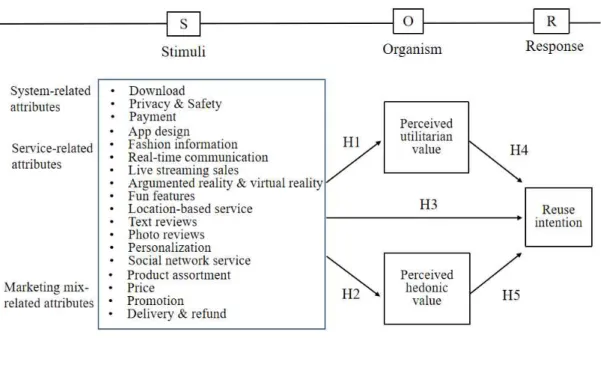
The current study adopted the S-O-R model (Mehrabian & Russell, 1974) as the theoretical framework of the study. The S-O-R model explains how the behavior of shoppers in a store changes according to the stimuli in the store. According to the model, the environmental elements (stimuli) in a store could influence shoppers’ internal state (organism), such as their psychological
state, and in turn, their internal state could influence shoppers’ behavior (response) in the store. This model has been applied in offline and online stores and mobile environment and has been confirmed as a feasible model for explaining the effect of environmental stimuli on consumer behavior.
The first purpose of this study is to identify relevant app attributes (S) that determine perceived utilitarian and hedonic values (O) and the reuse intention of fashion shopping apps (R) for Chinese female adults who have had fashion shopping experience through mobile apps. The second objective of this study is to investigate how app attributes (S) affect the reuse intention (R) of fashion shopping apps, based on a multi-dimensional approach of perceived values (O) for fashion shopping apps.
This study was conducted in three steps. In the first step, potential attributes of fashion shopping apps in China were investigated and determined. In the second step, focus group interviews were held with Chinese students attending one of Korean universities to find out the importance of each app attribute. Finally, the hypotheses were tested by a survey with a large sample of Chinese female adults living in China. The findings of this study will provide useful ideas for app developers and managers so they can develop app marketing strategies for Chinese consumers, who account for the largest market share in the world. This study will also expand the academic knowledge base of app shopping behavior.
2. The Structure of This Paper
This paper consists of five parts that are structured as follows:
consists of four chapters. The first chapter highlights the definitions and types of mobile apps available in China. The second chapter presents the definitions, types, and characteristics of fashion apps and discusses previous studies on consumer behavior of fashion apps. The third chapter presents the definitions and dimensions of perceived values, as well as the definitions and previous studies on utilitarian and hedonic shopping values. The fourth chapter presents the Stimuli-Organism-Response model as the theoretical frame for this study. This chapter also presents previous studies that established or implied the relationship between app attributes and perceived utilitarian value (hypothesis 1), the relationship between app attributes and hedonic value (hypothesis 2), the relationship between app attributes and behavioral intention (hypothesis 3). In addition, the chapter discusses previous studies drawing the relationship between perceived value and behavioral intention (hypothesis 4 and hypothesis 5).
Part 3 of this study describes the research method, which is composed of five sub-sections, namely prior investigation, focus group interview and questionnaire development, measurement of research variables, data collection, and respondent characterization.
Part 4 presented the research results, which are related to exploratory and hypothesis testing. Part 5 consists of three chapters, which include the discussion and summary of the research results, academic contributions and practical implications, and study limitations and future research direction.
Ⅱ. Theoretical Background
1. Mobile Apps
1) The definition and type of mobile apps
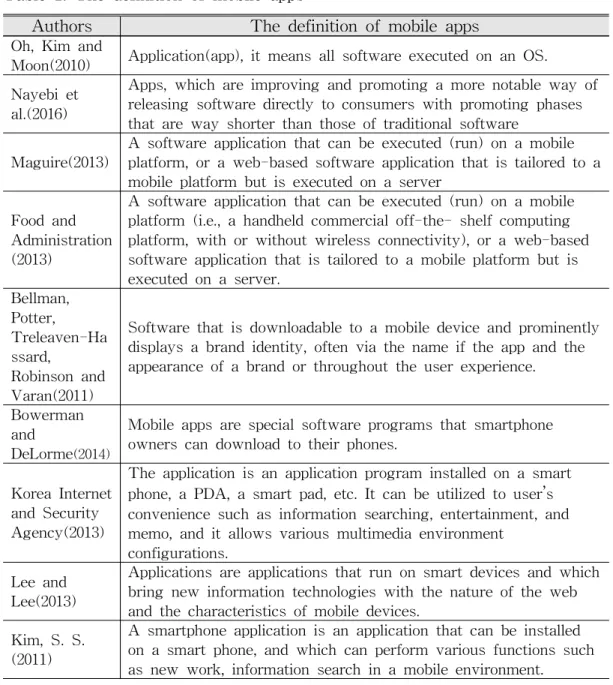
The term “app” is an abbreviation of “application” which means literally an application, and is also called an apple. The definition of an app is slightly different for every scholar. As shown in Table 1, some scholars defined apps very simply and comprehensively (Bowerman & DeLorme, 2014; Maguire, 2013), while some scholars defined apps very specifically in relation to devices (Nayebi et al., 2016; Lee & Lee, 2013; Korea Internet & Security Agency, 2013), and functional aspects (Korea Internet & Security Agency, 2013; S.S.Kim, 2011). Based on the existing researchers’ definitions of an app or the type of apps, an app can be defined as a “category killer” type of application software running on various devices (e.g., smartphone, web, PAD, etc.). The apps can provide consumers with a variety of information, entertainment or purchasability and it can be selective and personalized for an individual through various functions and multimedia environment. While apps can run on both web and mobile smartphones, consumers tend to consider apps as mobile apps, as most consumers have recently used apps on their smartphones frequently rather than the web(Lockwood, 2018; Xia, Zhang & Zhang, 2018). Taking a look at the definition of a mobile app in Table 1, an mobile app is defined as an application software running on a smartphone and used anytime and anywhere through a wireless device.
Authors The definition of mobile apps
Oh, Kim and
Moon(2010) Application(app), it means all software executed on an OS. Nayebi et
al.(2016)
Apps, which are improving and promoting a more notable way of releasing software directly to consumers with promoting phases that are way shorter than those of traditional software
Maguire(2013) A software application that can be executed (run) on a mobileplatform, or a web-based software application that is tailored to a mobile platform but is executed on a server
Food and Administration (2013)
A software application that can be executed (run) on a mobile platform (i.e., a handheld commercial off-the- shelf computing platform, with or without wireless connectivity), or a web-based software application that is tailored to a mobile platform but is executed on a server. Bellman, Potter, Treleaven-Ha ssard, Robinson and Varan(2011)
Software that is downloadable to a mobile device and prominently displays a brand identity, often via the name if the app and the appearance of a brand or throughout the user experience.
Bowerman and
DeLorme(2014)
Mobile apps are special software programs that smartphone owners can download to their phones.
Korea Internet and Security Agency(2013)
The application is an application program installed on a smart phone, a PDA, a smart pad, etc. It can be utilized to user’s convenience such as information searching, entertainment, and memo, and it allows various multimedia environment
configurations. Lee and
Lee(2013)
Applications are applications that run on smart devices and which bring new information technologies with the nature of the web and the characteristics of mobile devices.
Kim, S. S. (2011)
A smartphone application is an application that can be installed on a smart phone, and which can perform various functions such as new work, information search in a mobile environment.
Table 1. The definition of mobile apps
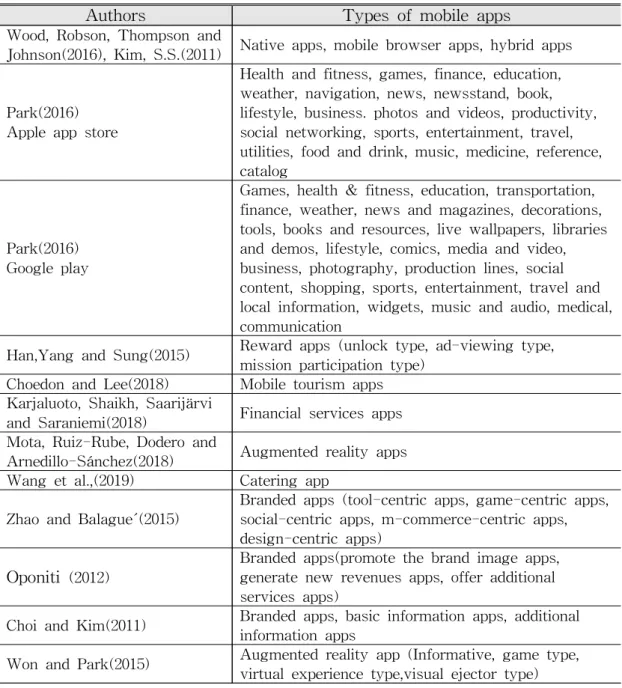
Mobile apps can be divided into different types because they are often developed focusing on one specific purpose. The types of mobile apps are shown in Table 2. For example, mobile apps can be roughly classified as game apps (e.g., Engybird, Candy Crush), informational apps (e.g., apps related to news, weather, traffic information, airline reservation), social network apps (e.g., Twitter, Facebook, and Instagram apps), location-based apps (e.g., apps related to navigation and directions), augmented reality apps,
Authors Types of mobile apps
Wood, Robson, Thompson and
Johnson(2016), Kim, S.S.(2011) Native apps, mobile browser apps, hybrid apps
Park(2016) Apple app store
Health and fitness, games, finance, education, weather, navigation, news, newsstand, book, lifestyle, business. photos and videos, productivity, social networking, sports, entertainment, travel, utilities, food and drink, music, medicine, reference, catalog
Park(2016) Google play
Games, health & fitness, education, transportation, finance, weather, news and magazines, decorations, tools, books and resources, live wallpapers, libraries and demos, lifestyle, comics, media and video, business, photography, production lines, social content, shopping, sports, entertainment, travel and local information, widgets, music and audio, medical, communication
Han,Yang and Sung(2015) Reward apps (unlock type, ad-viewing type,mission participation type) Choedon and Lee(2018) Mobile tourism apps
Karjaluoto, Shaikh, Saarijärvi
and Saraniemi(2018) Financial services apps Mota, Ruiz-Rube, Dodero and
Arnedillo-Sánchez(2018) Augmented reality apps Wang et al.,(2019) Catering app
Zhao and Balague´(2015)
Branded apps (tool-centric apps, game-centric apps, social-centric apps, m-commerce-centric apps, design-centric apps)
Oponiti (2012)
Branded apps(promote the brand image apps, generate new revenues apps, offer additional services apps)
Choi and Kim(2011) Branded apps, basic information apps, additionalinformation apps Won and Park(2015) Augmented reality app (Informative, game type,virtual experience type,visual ejector type)
Table 2. The types of mobile apps
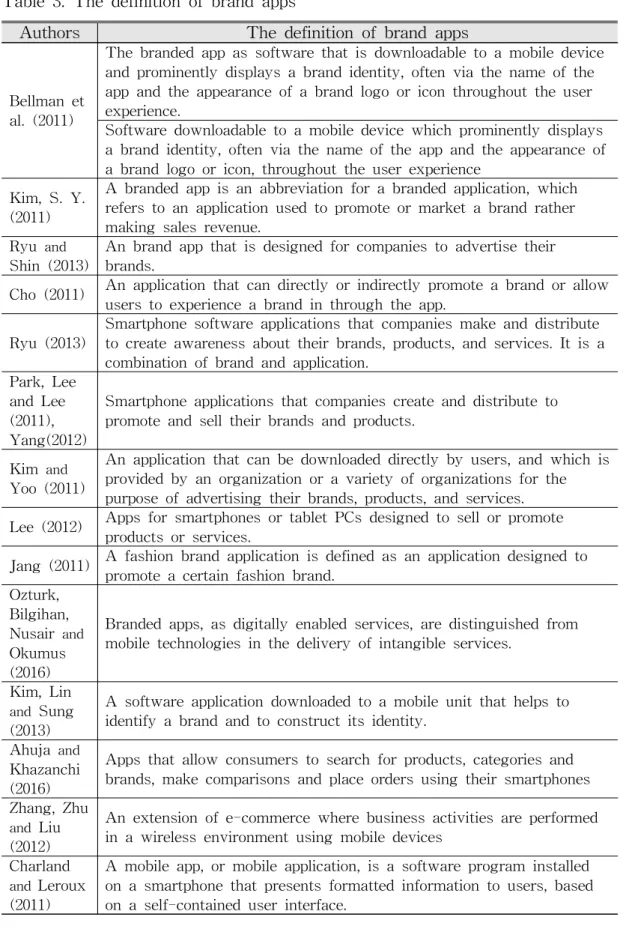
branded apps(e.g., Chanel, Gucci, Adidas brand apps.), and retail-specific apps(e.g., Taobao apps). In particular, the definitions of branded apps were shown in Table 3. Branded apps are a type of mobile app that can be downloaded via a smartphone and can be described as apps that offer various functional and empirical benefits to indirectly and directly promoting brand identity and image. Branded apps can be also divided into apps that only have promotional features and apps that have sales capabilities.
Authors The definition of brand apps
Bellman et al. (2011)
The branded app as software that is downloadable to a mobile device and prominently displays a brand identity, often via the name of the app and the appearance of a brand logo or icon throughout the user experience.
Software downloadable to a mobile device which prominently displays a brand identity, often via the name of the app and the appearance of a brand logo or icon, throughout the user experience
Kim, S. Y. (2011)
A branded app is an abbreviation for a branded application, which refers to an application used to promote or market a brand rather making sales revenue.
Ryu and Shin (2013)
An brand app that is designed for companies to advertise their brands.
Cho (2011) An application that can directly or indirectly promote a brand or allowusers to experience a brand in through the app.
Ryu (2013) Smartphone software applications that companies make and distributeto create awareness about their brands, products, and services. It is a combination of brand and application.
Park, Lee and Lee (2011), Yang(2012)
Smartphone applications that companies create and distribute to promote and sell their brands and products.
Kim and Yoo (2011)
An application that can be downloaded directly by users, and which is provided by an organization or a variety of organizations for the purpose of advertising their brands, products, and services. Lee (2012) Apps for smartphones or tablet PCs designed to sell or promoteproducts or services. Jang (2011) A fashion brand application is defined as an application designed topromote a certain fashion brand. Ozturk,
Bilgihan, Nusair and Okumus (2016)
Branded apps, as digitally enabled services, are distinguished from mobile technologies in the delivery of intangible services.
Kim, Lin and Sung (2013)
A software application downloaded to a mobile unit that helps to identify a brand and to construct its identity.
Ahuja and Khazanchi (2016)
Apps that allow consumers to search for products, categories and brands, make comparisons and place orders using their smartphones Zhang, Zhu
and Liu (2012)
An extension of e-commerce where business activities are performed in a wireless environment using mobile devices
Charland and Leroux (2011)
A mobile app, or mobile application, is a software program installed on a smartphone that presents formatted information to users, based on a self-contained user interface.
2) Mobile apps used in China
As the use of smartphones in China increases, the downloading of mobile apps by Chinese people is also surging. According to China Internet Network Information Center (CNNIC), about 60% of China's population are Internet users, and among them 97% are smartphone users (Bernard, 2018; Chang, 2019). As mentioned previously, the Chinese market comprises approximately 727 million mobile users, a figure that is three times as big as that of the US market having approximately 270 million mobile users(Bernard, 2018).
In fact, China boosts the largest mobile commerce volume in the world (Bernard, 2018; “China was the largest app market”, 2018), as well as the most extensive Internet connectivity via mobile phones (Biggs, Chande, Matthews, Mercier, Wang & Zou, 2017). On average, Chinese consumers invest more than 30 minutes a day in Taobao app (the largest e-commerce market in China), which is about three times longer than Americans typically spend on Amazon (Biggs et al., 2017).
In Korea and most countries in Asia and Europe, consumers download and use apps for free from Apple’s App Store, Google’s Android Market (Google Play) and Microsoft's Windows Marketplace etc., (Palomba, Linares-Vásquez, Bavota, Oliveto, Penta, Poshyvanyk & De Lucia, 2017), which are provided by global companies rather than being locally-developed. In China, however, Chinese consumers mainly use local app stores, because, currently, access to Apple’s App Store or Google Play is prohibited nationally or permitted most limitedly. Unlike Korea and other countries where apps from a few global firms (e.g., Apple’s app store, Google’s google play) dominate the app market, there are so many local app stores in China, whose market share is fragmented across the whole app market in China (Ao, 2018; “App Annie 2017 retrospective”, 2018; Chang, 2019; “China was the largest app market”,
2018; “Mobile app spend soars with China a top market”, 2019).
By the end of April 2018, there were about 4.14 million apps available in China, with game apps accounting for about a quarter of them (about 1.45 million), and the number of life service apps and e-commerce apps also increased steadily and was about 498,000 and 392,000, respectively (“How many mobile apps”, 2018). Moreover, there were 366,000 audio and video player apps and 13,000 online payment apps (“How many mobile apps”, 2018).
In 2017, China’s mobile commerce conducted through smartphones was estimated at about $1 trillion, with most coming from more than 713 million e-commerce app users (Ao, 2018; Bernard, 2018).
According to i research, a market research firm situated in China (Jung, 2017), the top 20 mobile apps used by Chinese people in 2017 were communication apps (e.g., Wechat, Kyukyu), video apps (e.g., Aichi and Yuki), utility apps (e.g., Baidu search, Qumyu browser, Baidu Chinese typing machine, free vaccine, Shanda Wifi, Yousa browser, Kyukyu Secure), an e-commerce app (e.g., Taobao), and music and audio service apps (e.g., Kugo, Kyukyu Music). In particular, since world-renowned social network services (e.g., Facebook, Instagram, and Twitter) are banned or restricted in China, Wechat and QQ, which are SNS channels developed by Chinese companies, rank as # 1 and # 2 in the Chinese app space (Jung, 2017). The Wechat app, a messaging app with integrated shopping features and which is similar to Korean Kakao talk and Kakao story, has about 800 million monthly users. The QQ app (a popular messaging app with a greater focus on interactive games and blogging) has about 550 million users per month, and the Sina weibo app (China’s biggest social media platform, twitter-like microblogs) is used by about 400 million people per month (Biggs et al., 2017).
video streaming service that replaces YouTube, and dominates China's video platform (Jung, 2017). Together with PPS, Iqiyi video app enjots 20% of the video streaming market (Biggs et al., 2017). In China, video streaming apps (Youku, Tudou 20%, Tencent video 15%, LeTV, Sohu, Bilibili, 25%) are gaining more active users (Biggs et al., 2017).
Taobao, China's largest e-commerce platform and which integrates entertainment functions and social networking functions, is the sixth most widely used application in China (Jung, 2017). Taking into account that Tmal is also China’s largest third-party platform for brands and retailers, the two e-commerce apps share a market share of 75-80% between them. Further, Jingdong is a direct sales e-commerce platform (JD managers works merchandising and pricing) similar to Amazon, and its market share is estimated to be 10-15% (Biggs et al., 2017).
The Alipay app, which is usually used for both online and offline payments, is ranked 7th in terms of market share (Jung, 2017). Alipay is also China’s
biggest online third-party payment system with more than 450 million active users, compared with ApplePay’s 12 million users, and it has a market share of 50% (Biggs et al., 2017), followed by Wechat pay (20%) and Baidu Wallet (5%).The Baidu search engine ranks ninth in the number of app users (Jung, 2017), accounting for 75% of the search app market (Biggs et al., 2017).
In addition, apps that are mainly used by Chinese consumers, are game apps, information apps such as news and airline reservation apps (e.g., Tencent news, Variflight.com), car-sharing service apps similar to the Uber app in America (e.g., Di Di), video platform apps similar to South African TV (e.g., MeiPai), location-based service apps(e.g., Amap), brand promotion or business apps(e.g., HLA) and so on.
the number of users or market share, Chinese consumers also frequently use fashion apps as part of their daily life. In fact, fashion items are the most popular products purchased by Chinese consumers through mobile apps. In addition, about half of Chinese respondents reported that they received information regarding latest fashion trends and styling tips through mobile apps, while more than 82% of Chinese millennials have reported using apparel brand apps to look for new apparel items, buy clothes, or check for new promotions or offers (Asia Distribution & retail, 2018). Given these facts, it is quite necessary and meaningful to investigate Chinese consumer behavior in using mobile app for fashion shopping.
2. Fashion Apps
1) The definition and types of fashion apps
As shown in Table 4, the definition of a fashion app is expressed in terms of the devices which it runs on, as well as the content, service, functionality, or its role and features. Referring to the various definitions constructed by various researchers, a fashion app simply refers to a software application that runs on devices such as smartphones and PADs, or on the web, and which offer anything related to fashion. In other words, a mobile fashion app can be defined as a smartphone software application that focuses on fashion, in terms of information, brand advertising and promotion, commerce, virtual reality and augmented reality, entertainment, interaction with others, and so on.
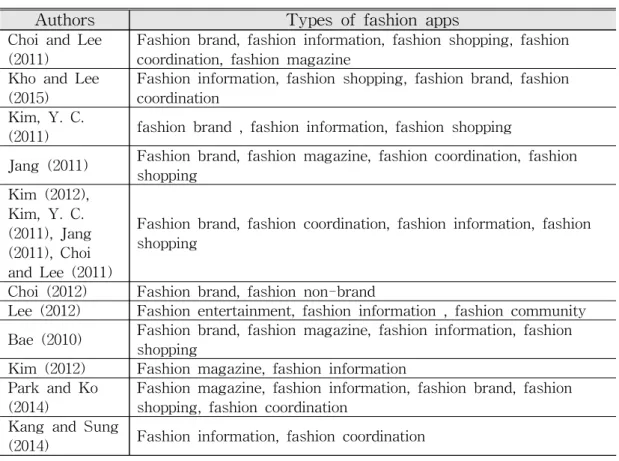
The classification categories of fashion apps varied across researchers depending on the number and content range. The different types of fashion apps discussed in previous studies are presented in Table 5. For example, Jang (2011) classified fashion apps as information apps, brand apps, shopping
apps and magazine apps, based on the content provided by the apps. Similarly, based on the purpose and use of fashion apps, Kim (2012) categorized fashion apps into four types, namely information apps, brand apps, shopping apps, and style management apps. In particular, Ju et al. (2013) investigated 120 fashion apps downloaded with Korean accounts and 120 fashion apps downloaded with US accounts, and which were registered in Apple’s App Store, and classified the apps into information apps, shopping apps, coordination apps, magazine apps, game apps and SNS apps. The number and types of fashion apps being developed are constantly increasing year by year.
Considering all of the recently developed fashion apps, fashion apps available in Korea and China can be divided into eight categories based on their purpose, core functions or services, and content. A fashion brand app is an app that provides brand-related core content and a variety of additional content aimed at promoting new brand products and building brand assets. Global brand apps include Chanel, Gucci, Uniqlo and H & M apps, and China fashion brand apps include Ochirly and Baleno, Typical branded apps with sales capabilities include Etam, Duoyi and HLA. However, among branded apps in Korea and China, apps with sales functions are very few (Park & Ko, 2014).
Fashion shopping apps are mobile apps with payment functions for merchandise sales, and they can be classified further into fashion brand apps and retail apps providing purchase functions. Gmarket app and Taobao app are representative retail shopping apps in Korea and China, respectively. User-initiated editing shop apps, such as PocketStyle with Korea account, which incorporate a variety of fashion shopping malls and allow users to create own editing shops by adding frequently visited stores, and to pay for items in the editor’s shop wish list, can be regarded as a kind of fashion
shopping apps (Jang, 2012).
Augmented reality fashion apps allow users to input their personal information (physical condition, face, body type) or photo images, and to virtually wear suggested mall items (e.g., SimCoordi) or items owned by users (e.g., Kshstyle). In some augmented reality fashion apps (e.g., fitUin), users can virtually simulate both suggested app items (e.g. SimCoordi) and items owned by users (Kang, Kim & Lee, 2017). Beauty apps that reproduce the colors and images of people’s registered faces, heads, and hands, using lipstick, hair dye, and manicure products available or sold from apps (e.g., Sephora), are also examples of virtual experience apps riding on augmented reality technology.
According to a previous study by Jang (2012), fashion game apps are apps which provide users with fun and entertainment through simulation activities, such as costume design and styling of avatars (e.g., Canvasee Fashion Holic Lite), or the building of fashion stores and interior displays, as well as store operations (e.g., Fashion Story, Fashion City).
Fashion information apps collect varied information, including trends, collections, models, and hot news, and provide app users with more organized information by re-editing information already surveyed by their own or released by others. Fashion information apps provide real-time information about global street fashions (e.g., Sikufid), hot fashion news (e.g., Style.com), and styles worn by celebrity stars in dramas and TV shows (e.g., Vogue Girl Star Style) (Jang, 2012; Kim, 2012). Fashion magazine apps could also be regarded as fashion information apps because the core function and aim of magazine apps is to provide app users with information related to fashion.
Conversely, fashion coordination apps provide style information through creative works rather than the style information that is searched or collected
as is typical with fashion information apps. According to previous studies (Kho & Lee, 2015; Jang, 2012), fashion coordination apps can be divided into style suggestion apps and wardrobe management apps. A style suggestion app is an app that gives you possible combinations of fashion items available in shopping malls included in the app depending on the date and occasion (e.g., Dr. Style). App users can shop and purchase the suggested combination items from the online shopping malls and even share the styling and particular items with other people. Typical examples include apps which provide 365 items and coordination styles that can be used in daily life for male consumers (e.g., Dr. Style), apps which suggest color coordination (e.g., Whos’ HOT), and apps which analyze users’ body shape and suggest styles that match their body shape (e.g., Style me). Unlike style suggestion apps, closet management apps provide users with coordinating styles based on users’ own closet items (e.g., triMirrorFashion Closet, Cool Guy, Quakeup Media Production Inc, Volygon Inc.).
Fashion consulting apps (e.g., Hello Codi) are communication apps that enable consumers to talk with a fashion expert for advice on fashion styles that fit an individual’s body shape, personal preference, and individuality (E. Y. Kim, 2015). Fashion social network service apps are similar to fashion consulting apps in terms of communication, but they differ from consulting apps because a user talks to and receives feedback from a general consumer, and not an expert. According to previous studies (Jang, 2012; E. Y. Kim, 2015), with such apps, users can photograph and upload their own fashion styles and receive general consumers’ feedback, such as responses, evaluations and questions. Meanwhile, app users can also evaluate and ask questions about other fashion styles that people have shared (e.g., styleShare, LuknFeed).
app are very different. For example, according to a study (Ju et al., 2013) that analyzed fashion apps registered in Apple’s App Store (122 apps for Korean accounts and 150 apps for US accounts), the percentage of magazine apps was higher than that of other types of apps in both Korean and US accounts. Among apps in the Korean account, shopping apps accounted for the highest percentage, while the majority of apps in the US account were game apps. In the case of apps (game, buyer, information apps), there were more free apps in the Korean account than in the US account.
Furthermore, after evaluating the usability of fashion apps from Korean and American app users through focus group interviews, Ju et al.(2013) found out that the usability of both SNS and information apps was more favorable than that of shopping or brand apps. Similarly, Sung (2012) established that fashion information apps (e.g., magazines, fashion trends, collection apps, etc.) were the most popular apps among Korean consumers. In particular, Korean consumers were reported to use global SPA brand apps or overseas luxury brand apps more than local Korean brand apps (Sung, 2012).
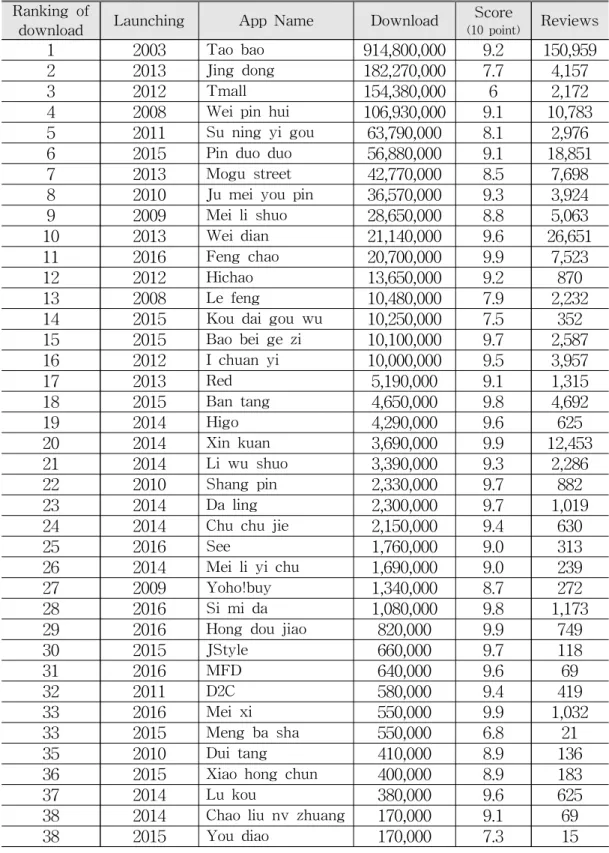
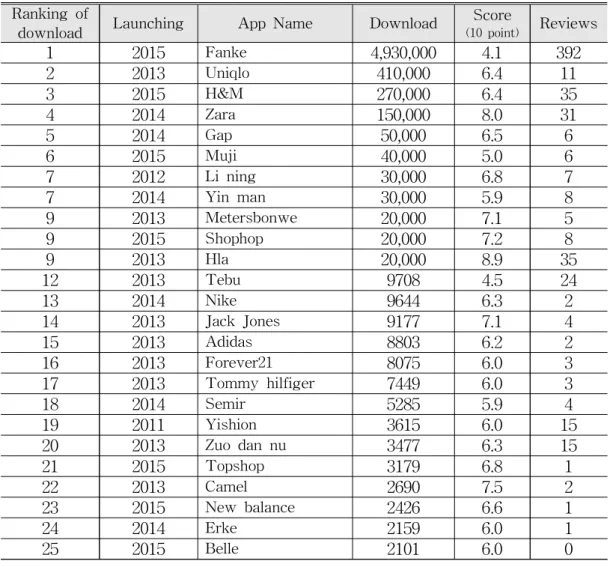
However, according to recent research investigating the number of app downloads, customer reviews and consumer ratings of top 50 brand apps and top 50 shopping apps in both Korean accounts and Chinese accounts (Sun & Hong, 2018ab).
Therefore, this study focuses on fashion shopping apps in the Chinese consumer market. In this study, a fashion shopping app is defined as an app that allows users to shop and purchase fashion products from the app itself regardless of the app’s original or core service functionality. In other words, even if the app is designed to promote a brand and build brand image, but it allows users to search, order, and pay for a fashion item from the app itself, then it is regarded as a fashion shopping app. On this basis, retail apps that sell fashion products are fashion shopping apps.
Authors The definition of fashion apps
Kim (2010)
Fashion apps means applications which provide various contents related to fashion and consumers can download or buy fashion apps registered on various mobile app stores for a free or for a fee.
An application that can be installed on a mobile device such as a smart phone, PDA, or smart pad to perform various functions such as new work, information search, and entertainment.
Chopdar, Korfiatis, Sivakumar and Lytras (2018)
Fashion apps with mobile purchasing function and which provide a thorough understanding of the various elements influencing their use.
Kim (2010)
Fashion application that can be accessed without logging on to a computer, and which enables users to watch shows, know what’s new, save their favorite looks, share their interests with others, browse or shop, and to find the nearest store, all at the touch of a button.
Bae (2010) The app is a fashion-related information application and isavailed to consumers through the smartphone’s App Store. Korea Internet and
Security Agency (2013)
A fashion information app means a mobile app that can be installed on a smart phone to enable one to information related to fashion, exchange information with others, and search for various information.
Kim, Y. C. (2011)
It is defined as an application program that can perform various functions such as new work, information search, and entertainment, and which is installed on a mobile device, such as a smart phone, PDA, or smart pad.
Lee (2012) Fashion apps that can provide information about fashion, suchas brands, shopping, and magazines.
Kim, Y. C.(2011)
A fashion app is a communication medium that connects a fashion company with a consumer on a smart phone, and it can also be defined as an application program that serves as a mediator between a brand and consumers of various tastes. Sung (2012) Mobile fashion apps are fashion related apps on mobile So and Kim
(2013)
Fashion apps downloaded from smartphone and used as fashion apps.
Choi and Lee
(2012) The fashion application is a fashion-related informationapplication available on the App store
Heo et al.(2016)
Fashion application is a communication medium that provides services such as fashion brand information, advertisement, and mobile commerce using an application installed on a smart phone.
Authors Types of fashion apps
Choi and Lee (2011)
Fashion brand, fashion information, fashion shopping, fashion coordination, fashion magazine
Kho and Lee (2015)
Fashion information, fashion shopping, fashion brand, fashion coordination
Kim, Y. C.
(2011) fashion brand , fashion information, fashion shopping
Jang (2011) Fashion brand, fashion magazine, fashion coordination, fashionshopping Kim (2012),
Kim, Y. C. (2011), Jang (2011), Choi and Lee (2011)
Fashion brand, fashion coordination, fashion information, fashion shopping
Choi (2012) Fashion brand, fashion non-brand
Lee (2012) Fashion entertainment, fashion information , fashion community Bae (2010) Fashion brand, fashion magazine, fashion information, fashionshopping Kim (2012) Fashion magazine, fashion information
Park and Ko
(2014) Fashion magazine, fashion information, fashion brand, fashionshopping, fashion coordination Kang and Sung
(2014) Fashion information, fashion coordination
Table 5. The types of fashion apps
2) The attributes and characteristics of fashion apps
Attributes refer to the properties or characteristics of an object (The Oxford English Dictionary, 2014). Few studies have directly examined the attributes of fashion apps, while several other studies have investigated the contents or features of fashion information apps (Choi & Lee, 2012; Kho & Lee, 2015; E. Y. Kim, 2015) and fashion brand apps (Choi & Kim, 2011;Kim, 2010; Kim, 2012; Park & Ko, 2014).
For instance, Kim (2010) analyzed contents of fashion brand apps (e.g., overseas luxury brand, global SPA brand, foreign brand, domestic brand, and sports brand) and fashion retail brand apps, and discovered various contents, such as information (e.g., product photos, product details, collection videos, store information, news, etc.), purchase-related features (e.g., purchase
function, wish list, coupon, search function, customer reviews, style suggestions, order functions), social networks (e.g., Facebook, Twitter, e-mail, me2day), entertainment (e.g., game, wallpapers, movies, online cards, music, style suggestions) and practicality-related features (e.g., clocks, alarms).
In addition, Choi and Lee (2012) reported that fashion brand apps have diverse contents with varied benefits, which include informational benefits (e.g., brand information, latest news, product image information), economic benefits (e.g., mobile coupons, discount events and discount coupons), recreational benefits (e.g., watches, weather, music, games, and health care), magazine information (e.g. street fashion information, and style information), coordination (e.g., situation-specific costumes, and virtual coordination), interaction (e.g., sharing style, recommendation, and comment), and wardrobe management (e.g., photo storage of own clothing, and style calendar).
Kim (2012) pointed out several characteristics of fashion brand apps, namely interactivity, dynamic variability (ubiquitous, virtual reality), and multimedia integration. The author also reported that fashion brand apps were characterized by information-oriented contents (e.g., brand, product, store-related information, video information, and concrete and detailed objective information), emotion-oriented contents (e.g., video, audio), entertainment contents, which promote participation and sharing among users, and experiential contents, which can generate users’ interest through direct experience.
While investigating the characteristics of fashion brand apps, Choi and Kim (2011) found the reactivity (capability to induce customers’ interest and reaction through product customization), reality (capability to combine virtually-created information or images with actual environments, using augmented reality technology), immediacy (capability to acquire information and goods at any time and any space), empathy (capability to share other
users’ opinions, and to evaluate products that they have purchased or are interested in). In addition, Park and Ko (2014), through the analysis of 22 domestic fashion brand apps and 37 international fashion brand apps, also argued that characteristics of fashion brand apps can be categorized into seven aspects, which include basic information, social network, augmented reality, location-based services, entertainment contents, shopping, and live broadcasting.
Almost all of the findings of the above-mentioned studies are based on case studies or content analysis of fashion branded apps. Indeed, it is rare to find studies that directly investigate what is considered to be important or useful attributes for consumers. In the context of fashion apps, or even mobile apps, important app attributes for app users were found only two qualitative studies which interviewed Korean consumers(Sung, 2012; Lee & Lee, 2013). For instance, Lee and Lee (2013) conducted a focused group interview with Korean graduate students majoring in fashion, and found out that contents, downloading feature, community, ongoing management, and design/visibility are important app features when considering which fashion apps to use.
Based on previous studies investigating the contents, characteristics, and important, useful and interesting attributes of fashion apps through case studies, content analysis, and focus group interviews, regardless of the fact that the majority of these researches mainly focused on fashion brand apps, the overall attributes of fashion shopping apps can be summarized as follows: information, economics, interactivity (social connectivity, empathy), social connectivity, virtual experience (augmented reality), entertainment, practicality, ubiquity(immediacy), customer responsiveness, location-based services, live broadcast, downloading, design/visibility, and shopping and purchase-related features (search, order, payment, delivery).
3) The studies on consumer behavior studies of fashion apps
As mentioned in the literature review, in Korea, the United States and Spain, only little research has focused on fashion apps (Choi & Lee, 2012; Kim, 2012). Most studies have only reported on the types of fashion apps (Choi & Lee, 2012; Bae, 2010; Kho & Lee, 2015; Y. C. Kim, 2011; Kim, 2012; Jang, 2011; Park & Ko, 2014; Kang & Sung, 2014), typical examples of each type of fashion app, important elements taken into consideration in the design of fashion apps (Y. C. Kim, 2011; Lee & Lee, 2013), and useful contents and features based on consumers’ use of fashion apps (Heo et al., 2016; E.Y. Kim, 2015; Sung, 2012)
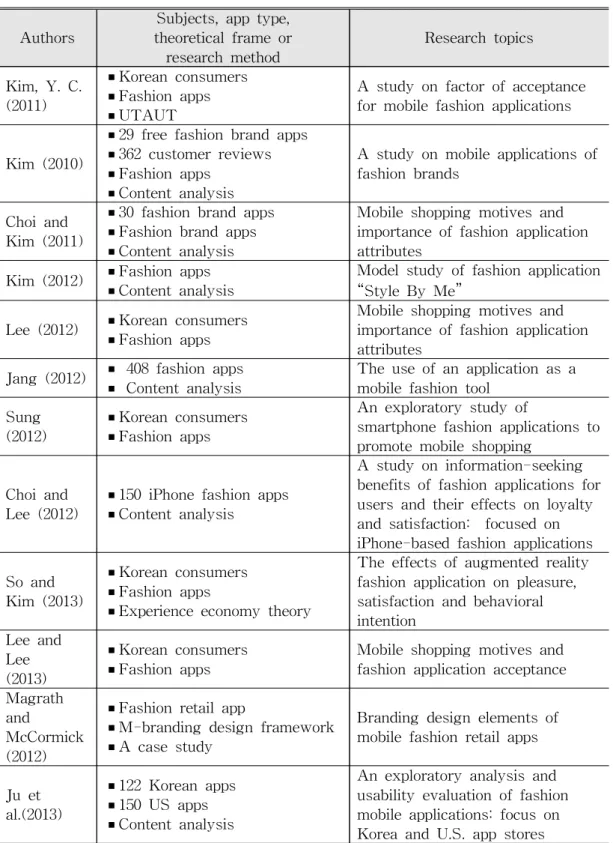
As shown in Table 6, almost all studies on consumers’ use behavior of fashion apps are limited to Korean consumers. Most studies identified the contents and characteristics of fashion apps, consumer’s perception of fashion apps, and the behavioral intention to use fashion apps. For instance, Lee and Lee (2013) determined fashion app features that positively affect the perceived ease of use, perceived usefulness, and perceived enjoyment of fashion apps. The author also found out that fashion app attributes (design/visibility, downloading, ongoing management, or contents) were significantly related to consumers’ mobile shopping motivation, such as convenience and buying motivation(Lee & Lee, 2013). In addition to information quality, Kim, Y. C. (2011) pointed out a couple of attributes of smartphone fashion apps (convenience, and location-based services) that positively influenced satisfaction with the apps. Park (2016) also pointed out some characteristics of fashion apps (innovation, visibility, newest, familiarity or accuracy) that had a significant effect on satisfaction and continuous use intention of the apps. Sung (2013) conducted an empirical study that revealed there is a positive relationship between users’ evaluation of service attributes and users’
attitude toward fashion apps.
Korean researchers also investigated whether antecedent variables such as consumer characteristics (shopping orientation, shopping motivation, fashion involvement, gender), perception of fashion apps (perceived risk, perceived usefulness, perceived ease of use), and perceived atmosphere of fashion apps do influence the attitude, satisfaction, or behavioral intention of using the apps (Heo et al., 2016; E. Y. Kim, 2015; Sung, 2012).
Fashion involvement moderated the relationships between characteristics of fashion apps and consumer responses, such as satisfaction and continuous usage of apps (Park, 2016). Additionally, consumer’s hedonic shopping orientation was determined to also have significant influence on the shopping behavior of apparel products through mobile apps (Lee & Kim, 2018). In particular, highly perceived usefulness and low perceived risk (security risk, product quality risk) in fashion shopping apps was seen to increase consumers’ favorable attitudes toward shopping through fashion apps (Sung, 2013).
As mentioned in literature review, there is barely any research on Chinese users of fashion shopping apps. In particular, app attributes that contribute to the perceived utilitarian value and hedonic value of fashion shopping apps were yet to be directly and systematically examined. Furthermore, as far as the author knows, there is almost no research to identify the relationship among attributes of fashion shopping apps, perceived value of the apps, and the reuse intent of the apps for shopping or purchase of fashion items. Therefore, in a fashion shopping context and a Chinese consumer context, the current study examined the relationship among the mentioned app attributes, the perceived value of apps, and the reuse intention of the apps for fashion shopping.
Authors theoretical frame orSubjects, app type, research method Research topics Kim, Y. C. (2011) ◾Korean consumers ◾Fashion apps ◾UTAUT
A study on factor of acceptance for mobile fashion applications
Kim (2010)
◾29 free fashion brand apps ◾362 customer reviews ◾Fashion apps
◾Content analysis
A study on mobile applications of fashion brands
Choi and Kim (2011)
◾30 fashion brand apps ◾Fashion brand apps ◾Content analysis
Mobile shopping motives and importance of fashion application attributes
Kim (2012) ◾◾Fashion appsContent analysis Model study of fashion application
“Style By Me”
Lee (2012) ◾◾Korean consumersFashion apps Mobile shopping motives andimportance of fashion application attributes
Jang (2012) ◾ ◾ 408 fashion appsContent analysis The use of an application as amobile fashion tool Sung
(2012)
◾Korean consumers ◾Fashion apps
An exploratory study of
smartphone fashion applications to promote mobile shopping
Choi and Lee (2012)
◾150 iPhone fashion apps ◾Content analysis
A study on information-seeking benefits of fashion applications for users and their effects on loyalty and satisfaction: focused on iPhone-based fashion applications So and
Kim (2013)
◾Korean consumers ◾Fashion apps
◾Experience economy theory
The effects of augmented reality fashion application on pleasure, satisfaction and behavioral intention Lee and Lee (2013) ◾Korean consumers ◾Fashion apps
Mobile shopping motives and fashion application acceptance Magrath
and
McCormick (2012)
◾Fashion retail app
◾M-branding design framework ◾A case study
Branding design elements of mobile fashion retail apps
Ju et al.(2013)
◾122 Korean apps ◾150 US apps ◾Content analysis
An exploratory analysis and usability evaluation of fashion mobile applications: focus on Korea and U.S. app stores
Authors theoretical frame or researchSubjects, app type, method Research topics Kang and Sung (2014) ◾Korean consumers ◾Fashion information apps
An analysis of group characteristics according to technological innovativeness and clothing involvement: focused on the usage status of smart phone fashion information applications
Park and Ko (2014)
◾Fashion brand apps ◾59 fashion brand apps ◾Content analysis
The analysis of the characteristic types of fashion brand
applications: concentrating on Korean application cases
Kho and
Lee (2015) ◾Fashion coordination apps
Information architecture design for fashion coordination apps based on the men’s need for fashion information
Kim, Y. (2015)
◾hello codi app
◾Fashion coordination apps ◾Case study
A study on development of application focusing on
personalized fashion coordination Kim, E. Y.
(2015)
◾Korean consumers ◾Fashion apps
Effects of mobile browsing motives on using fashion app contents
Park (2016)
◾Korean consumers ◾Fashion apps ◾ECM
The effect of characteristics of mobile fashion applications on satisfaction and continuous usage intention
Romo et al. (2016)
◾10 fashion branded apps ◾Spain context
◾Content analysis
Branded apps in Spain as a Means of Communicating Trends in Fashion
Heo et al. (2016)
◾Korean consumers ◾Fashion apps
Effects of search motives and content usage of mobile fashion applications on purchase
intentions Parker and
Wang (2016)
◾Fashion retail apps ◾The UK participants
Examining hedonic and utilitarian motivations for m-commerce fashion retail app engagement Sornapudi
and Mahesh (2017)
◾Fashion brand apps ◾Case study
Fashion on smartphone: apps that connect with consumers
3. Perceived Value
1) The definition of perceived value
The definition of perceived value vary across researchers and researchers’ diverse perspectives depend on the types of sacrifices that are made in the process of purchasing or the types of benefits that are gained by using certain goods and services. The initial research on perceived value defined “sacrifice” in monetary sense, and mainly defined “benefits” in terms of quality. For instance, Fornell, Johnson, Anderson, Cha and Bryant (1996) defined perceived value as “the perceived level of product quality relative to the price paid” (p. 9). On the other hand, Stevens (1992) defined perceived value as “the relationship between price, quality and quantity” (p. 44). Unlike the view of sacrifice in monetary sense, some researchers have considered sacrifices as non-monetary factors such as time, effort, poor performance risk, etc. (Snoj, Korda & Mumel, 2004). In other words, perceived value is defined as “the mental estimate that consumers make of the product, where perceptions of value are drawn from a personal cost/benefit assessment” (Morrison, 1989).
In particular, Zeithaml (1988) expanded the range of sacrifices by including various risks that need to be taken into consideration when purchasing and acquiring goods, in addition to searching, waiting and all other efforts invested to obtain such goods. Zeithaml (1988) also defined the range of perceived benefits more broadly (“what is received”), by putting forward that perceived quality depends on the consumer's judgment of the overall excellence or superiority of a product or service. Based on this broad perspective, Zeithaml (1988, p. 14) described perceived value as “the consumer’s overall assessment of the utility of a product based on the
perceptions of what is received and what is given”. According to the definition of Zeithaml (1988), the perceived value can be regarded as the result of personal comparison of the benefits gained after the purchase action and individual sacrifice (both monetary and non-monetary), but this concept is considered to be very subjective and personal (Parasuraman, Zeithaml & Berry, 1985).
Therefore, even though the definition of perceived value is expressed slightly differently according to the narrow or broad viewpoints of researchers, the core of the concept is consumers’ assessment (Zeithaml. 1988, p. 14), cognitive judgment (Dodds, Monroe & Grewal, 1991, p. 361), or mental estimation (Morrison 1989), based on the comparison of sacrifices made and benefits received in the process of obtaining or by obtaining products or services. These definitions of past researches on perceived value are based on a one-dimensional perspective and focus on just the utilitarian aspect.
As a consequence, some researchers believe that this definition, which describes perceived value only as a uni-dimensional view of ‘comparison of what is gained and sacrificed’, is too simplistic and too restrictive to be able to capture the comprehensive meaning and scope of the concept (Woodruff & Gardial, 1996; Sinha & DeSarbo, 1998). From this critical point of view, another point of view was presented, which argued that the various dimensions of social psychology experienced in the purchase or consumption process can also be included in perceived value concepts. In other words, the literature of perceived value showed two main research streams, namely uni-dimensional and multi-dimensional approaches of perceived value construct.
2) The dimensions of perceived value
As can be inferred from definitions of perceived value by several researchers (e.g., Monroe, 1979; Zeithaml, 1988; Bolton & Drew, 1991), the uni-dimensional approach emphasizes that perceived value results from personal comparison of the benefits gained (positive side) and the sacrifices made (negative side) after the purchase action. The multi-dimensional approach of perceived value is based on consumer’s perception toward various types of consumption values, which are independent and make differential contributions in any given situation (Sheth, Newman & Gross, 1991, p. 160). For instance, Sheth et al. (1991) identified five dimensions of perceived value, namely social, emotional (affective), functional (useful), epistemic and conditional values. Here, social value means the acceptability at an individual level and relations with the social environment (e.g. acceptance from peer group, the expression of social status), epistemic value means arousing curiosity and satisfying the desire for knowledge, and conditional values means values which are related to specific social situations.
The number and types of the dimensions of perceived value are very diverse across researchers. For example, Sweeney and Soutar (2001) derived three values (functional, social and emotional values) from Sheth et al. (1991)’s original five dimensions, and developed a scale known as PERVAL scale used in retail purchase situations (Sweeney & Soutar, 2001). In this scale, functional value is further divided into two different components of quality (performance quality) and price (value for money) based on Zeitham (1988)’s study. The PERVAL scale was found to be valid and reliable in both pre-purchase and post-purchase situations (Morar, 2013).
In a service context, Petrick (2002) proposed five dimensions of perceived value (quality, emotional response, reputation obtained by acquiring the
service, and the monetary price as the benefits which consumers received by purchasing a service/product), and then developed the PERVAL SERV scale. Similarly, Sánchez, Callarisa, Rodriguez & Moliner (2006) proposed three
dimensions (functional, emotional, and social values) for measuring
post-purchase perceived value in the tourism field. In addition, Sanchez et al. (2006) developed the GLOBAL scale, which considers both the consumption and the purchase experience.
A few studies have been interested in investigating the values experienced online and in mobile environment contexts, which tend to be different from a brick-and-mortar retail context (Scarpi, Pizzi & Visentin, 2014). In their assessment of perceived values, online shoppers mainly refer to their experience in respect to the search, order, and delivery of products, as well as the design and variety of contents provided by a website. On the other hand, offline shoppers mainly rely on the point of contact (e. g. sales persons), location, and merchandising, and other factors in their assessment of perceived values (Grewal, Levy, & Kumar, 2009). Research focusing on an online and mobile environment has also presented the multidimensionality of perceived value, and pointed out that wider conceptualization of perceived value is desirable in order to capture its complex and multidimensional nature (Sweeney & Soutar. 2001). According to Gentile, Spiller and Noci (2007), a consumer's experience in an online shopping context is based on interactions between the consumer and the e-retailer. It is strictly personal and it involves active participation at different levels in terms of rational, emotional, sensorial, physical, and spiritual aspects (Gentile et al., 2017, p. 397).
These different aspects can be broadly classified into two psychological dimensions, namely cognitive and affective, which have been consistently identified in many researches as significantly influential factors of consumer behavior (Martin, Mortimer & Andrews, 2015; Rose, Clark, Samouel & Hair,
2012). For example, in a survey of online store customers in Taiwan, Chiu, Wang, Fang and Huang (2014) ascertained the effects of utilitarian and hedonic value on repurchase intentions of consumers and the role of perceived risk in moderating the relationship. Similarly, in explaining and predicting the adoption of mobile data services, several studies have also confirmed the saliency of utilitarian and hedonic values (e.g., Kim, Chan & Gupta, 2007; Turel, Serenko & Bontis, 2007). Therefore, perceived values can be categorized into two broad dimensions, i.e. utilitarian and hedonic values (Im, Bhat & Lee, 2015), in a mobile shopping app context.
On this basis, a few empirical studies have directly investigated the relationships between utilitarian and hedonic values perceived in mobile shopping apps (particularly mobile apps for fashion shopping) and other constructs. Thus, this current study focused on two dimensions of perceived values (utilitarian and hedonic values) which can be cognitively and affectively assessed or experienced by consumers, investigated what attributes contribute to perceived values in a fashion shopping app context, and also identified whether the two dimensions of perceived values influence consumers’ reuse intention of fashion shopping apps.
3) Utilitarian and hedonic shopping values
Consumer shopping is usually discussed in terms of its utilitarian and hedonic value (Scarpi et al., 2014). In earlier studies with traditional perspectives, shopping is considered as the activity of examining goods and services with the intent to buy and/or to hunt, through the market, for the best purchase option (Hong & Kim, 2016). This idea is based on the maximization of utilitarian value. A utilitarian shopping value is characterized by task related, goal oriented, rational, and useful shopping, which takes
shopping some kind of “work” (Griffin, Babin & Modianos, 2000, p. 3). In the shopping context, utilitarian value is mainly achieved when searching for products and making decisions on purchases (Hirschman & Holbrook, 1982), and it is evaluated by consumers’ cognitive judgment, which is associated with the thinking or conscious mental processes (Gentile et al., 2007).
As for hedonic value, researchers argue that consumers can experience different types of feelings, and criticize the notion that the rational perspective only emphasizes product function and ignores the emotional arousal taking place while purchasing or shopping for products (Hirschman & Holbrook, 1982). While utilitarian value comes from effectively or efficiently obtaining the desired product during a shopping trip, hedonic value is derived from the pleasure, enjoyment and satisfaction experienced in a shopping process (Holbrook & Hirschman, 1982; Bellenger, Steinberg & Stanton, 1976; MacInnis & Price, 1987). In other words, the hedonic value of shopping is related to consumers’ affective state experienced when examining window displays, browsing shelves, chatting with staff, finding bargains, and such, even if shopping does not result in an actual purchase (Markin, Lillis & Narayana, 1976; MacInnis & Price, 1987; Babin, Darden & Griffin,1994). The freedom, fantasy and escape experienced by enjoying the shopping process or from the mood of the shopping environment are also components that can contribute to hedonic value (Hirschman, 1983; Bellenger et al., 1976).
In an online shopping context, both perceived utilitarian and hedonic value can be key factors in explaining consumers’ preference for online stores. In an online shopping context, shoppers enjoy convenience or efficiency because of the reduced shopping time, effort and money spent on browsing, searching, ordering, and delivery of products (Rintamäki, Kanto, Kuusela & Spence, 2006), which can explain why they make a decision to embrace online shopping. Online shoppers also experience hedonic value as well as utilitarian