2020년 한국방송·미디어공학회 추계학술대회
Weather Classification and Image Restoration Algorithm
Attentive to Weather Conditions in Autonomous Vehicles
*Jaihoon Kim *Chunghwan Lee Sangmin Kim **Jechang Jeong
Department of Electronic Engineering, Hanyang University
[email protected], [email protected], [email protected], [email protected]
*These authors contributed equally to this work.
**Jechang Jeong is the corresponding author of the paper.
자율주행 상황에서의 날씨 조건에 집중한 날씨 분류 및 영상 화질 개선 알고리듬
*김재훈 *이정환 김상민 **정제창
한양대학교 융합전자공학부
*위 두 저자는 동일하게 논문에 참여함.
**정제창 교수는 본 논문의 교신저자임.
SUMMARY
With the advent of deep learning, a lot of attempts have been made in computer vision to substitute deep learning models for conventional algorithms. Among them, image classification, object detection, and image restoration have received a lot of attention from researchers. However, most of the contributions were refined in one of the fields only.
We propose a new paradigm of model structure. End-to-end model which we will introduce classifies noise of an image and restores accordingly. Through this, the model enhances universality and efficiency. Our proposed model is an 'One-For-All' model which classifies weather condition in an image and returns clean image accordingly. By separating weather conditions, restoration model became more compact as well as effective in reducing raindrops, snowflakes, or haze in an image which degrade the quality of the image.
1. INTRODUCTION
Among the many factors which degrade the quality of images, weather induced noises such as raindrops, snowflakes, and haze seriously distort and blur images. However, recovering from weather-induced noises received significantly less attention compared to restoration of images from artificial noises such as JPEG blocking effect and Gaussian noise. Autonomous vehicles rely on numerous sensors, radar, and cameras. Among the detection sensors, cameras provide the most accurate information; however, they prove not to be so reliable under severe weather conditions. One possible solution for the problem would be restoring images distorted by raindrops, snowflakes, or haze. Restoration algorithm could further be enhanced if the algorithm classifies weather condition of the image prior to restoration. In that way, we saves computing time and resources from being wasted on restoring clear images which already provide enough visuality.
One of the challenges in building a model which restores images from natural noises is the lack of training data. It is virtually impossible to acquire both clean images and raining images without any changes in the background. Therefore, we had to resort to weather dataset with artificial raindrops, snowflakes, and haze.
In this paper, we used MobileNets [1] layers for classification and U-Net [2] for restoration. Once a weather condition in an image is specified by the classification model, it will be fed as an input to the restoration model. We trained three different restoration models for rain, snow, and haze respectively. Our model showed peak signal-to-noise ratio (PSNR) and structural similarity (SSIM) which do not pale in comparison to many other cutting-edge restoration models. Moreover, our model is more compact than other cutting-edge models. With less computations, our model outperforms other models in efficiency. Considering that, the model is suitable for many autonomous vehicles where computation speed is
2020년 한국방송·미디어공학회 추계학술대회
crucial.
2. DEEP LEARNING MODEL
A. Classification
Model Architecture
Our model for classification is a four-layer MobileNet classifier. MobileNet was adopted instead of conventional convolutional layers to reduce computation time by lowering dimension of computation. MobileNets compute in two separate steps. Depthwise convolution ignores nearby pixels and two dimensional convolution over each feature map. Due to this, the number of parameters of our classifier is 682,264 which is relatively low.
Our initial model needed to pay more attention to the sky, which contains significant portion of weather condition. We added two extra feature maps to the model which are as follows. Overall architecture is illustrated in Fig. 1.
1) Edge components are extracted from a image since rain streaks and snowflakes increase edge components. On the contrary, hazy images barely possess any edge features. Fig. 2 shows distinctness of hazy images in edge maps.
2) In contrast to common RGB color space, HSV color space separates image luminance from color information. With HSV, importance to a specific color is emphasized., highlighting one color while attenuating the others.
Training
We used MWI Dataset [3], [4] which has four weather classes: rainy, snowy, hazy, and sunny. We used 14,000 images for training and 1,200 for validation. We trained 35 epochs using cross entropy loss function.
Result
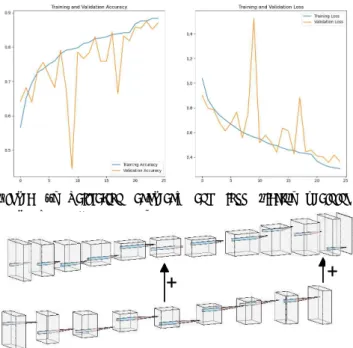
We tested the model on 400 images. The accuracy of our model is accuracy 0.859. Considering compactness of our model, it is pretty accurate. Accuracy and loss is shown in Fig. 3 for first 25 epochs.
B. Restoration
Model Architecture
Our model for restoration is multi-scale [5] U-shaped network and overall architecture is shown in Fig. 4. Multi-scale structure has shown its effectiveness in many image reconstruction projects. It extracts features from different scales offering richer feature representations. Moreover, U-shaped architecture has two halves. First half is responsible for feature extraction and second half is responsible for representation. Two halves are symmetric and each layer is connected to its counterpart. The model has both long and short connects to prevent gradient vanishing.
For dehazing model, we preprocessed input data before
Figure 3. Validation accuracy and loss (left). Training accuracy and loss (right).
Figure 1. The overall architecture of our classifier model.
Figure 4. U-Net model architecture.
Figure 2. Hazy, snowy, and rainy images with their edge maps.
2020년 한국방송·미디어공학회 추계학술대회
the deep learning model. Dark channel algorithm [6] restores images noting to the fact that pixels without haze possess low luminance at least at one of their RGB channels. Once preprocessing is done images will be scaled to 1 and 1/2 for multi-scale image training. To make bottleneck shapes of two models equal, each scaled image is fed into downsampling layers of U-shaped network with slightly different filter sizes. In the bottleneck, features of half-scaled models are added to the non-scaled model to enrich feature maps.
We also added dilated convolutional layers in the bottleneck to enlarge receptive fields from the feature maps. This will ensure the latter part of the model to construct complex edge structures more accurately. Then the model begins upsampling to construct clean images. In the last layer, the number of filters in feature maps is reduced to three to convert them into images with RGB channels.
Training
Each model for dehazing, deraining, and desnowing shares the same architecture, except for loss functions and data preprocessing such as dark channel algorithm. In dehazing model, we used conventional mean squared error loss (1) as well as SSIM loss (2) because maximizing SSIM enhances the quality of restored images seen by human eyes.
SE
(1) (2)Edge loss (3) is included for deraining and desnowing model in contrast to dehazing model. This is because both rain and snow images show strong edge properties.
LSELaplacian x y (3)
For deraining, we used 1,600 images for training. Our dataset for deraining is composed of Rain 12,600 dataset from PreNet [7] and derain dataset from ID-CGAN [8]. For dehazing, we used 3018 OTS (Outdoor Training Set) from RESIDE dataset [9]. For desnowing, we used 6,400 images from Desnownet dataset [10]. Each model was trained for 25-35 epochs with Adam optimizer and PSNR metrics.
Result
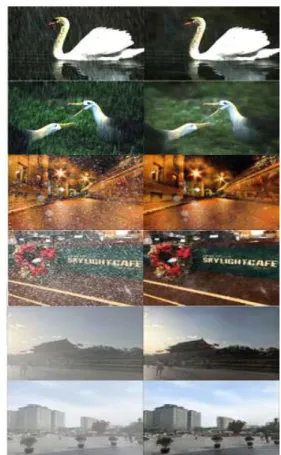
PSNR and SSIM of our model outperformed any other conventional models as shown in Table 1, 2, and 3. Fig. 5 shows some refined images produced by the model. Our model
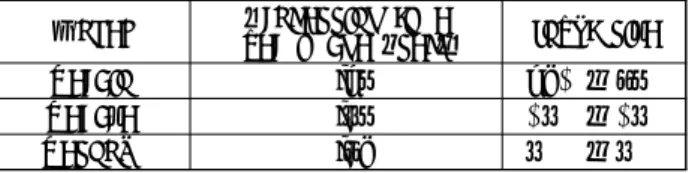
significantly curtailed the number of parameters in reconstruction models. In Table 4, our model possesses parameters 6% that of our counterpart, U-Net. In case of classification, our number of parameters is 37% that of VGG-16 and less than 1% that of ResNet 150. With reduced parameters, Table 5 shows that our model processes a frame less than a second. By classifying noises prior to reconstruction we built a improved model with decent accuracy and speed.
Table 1. PSNR and SSIM of our derain model on Test100
dataset with other models.
Table 2. PSNR and SSIM of our dehaze model on RESIDE
outdoor dataset with other models.
Figure 5. Rainy, snowy, and hazy images (left). Clear
DerainNet [11] RESCAN [12] DIDMDN [13] UMRL [14] PSNR 22.77 25.00 22.56 24.41 SSIM 0.81 0.83 0.81 0.82 SEMI [15] [7] Ours PSNR 22.35 24.81 27.43 SSIM 0.78 0.85 0.80 [6] AOD-Net [16] DehazeNet [17] PSNR 19.13 20.29 22.46 SSIM 0.81 0.87 0.85 GFN [18] Ours PSNR 21.55 25.18 SSIM 0.84 0.94 62
2020년 한국방송·미디어공학회 추계학술대회
images produced by our models (right).
Table 3. PSNR and SSIM of our desnow model on Snow100K-L dataset with other models.
Table 4. Comparison of the number of parameters.
Table 5. Image processing time of our model.
Model per image (sec)Processing time Input size
Derain 0.58 512 x 380
Dehaze 0.48 240 x 240
Desnow 0.31 400 x 400
3. CONCLUSION
Classifying the weather condition prior to reconstruction enabled us to build reconstruction model specialized for removing noises from the weather condition. Our model is an 'One-for-All' model which restores images regardless of the weather condition, unlike other deraining, dehazing, and desnowing models which focus on only one weather condition. Our model was trained with synthetic dataset, where raindrops, snowflakes, and haze are quite different from those we see in real life. For this reason, the model shows unsatisfactory performance on real life images or videos. Therefore, we will implement an unsupervised model with real life dataset for our future work.
ACKNOWLEDGEMENT
This work was supported by the Technology Innovation Program(20013726, Development of Industrial Intelligent Technology for Smart Factory) funded By the Ministry of Trade, Industry & Energy(MOTIE, Korea)
REFERENCE
[1] Howard et al., "Mobilenets: Efficient convolutional neural networks for mobile vision applications," arXiv preprint arXiv:1704.04861, 2017.
[2] Ronneberger et al., "U-net: Convolutional networks for biomedical image segmentation," International Conference on Medical image computing and computer-assisted intervention. Springer, Cham, 2015.
[3] Zheng et al., “Multi-class weather classification on single images,” Proceedings of IEEE International Conference on Image Processing, 2015.
[4] Zheng et al., “Scene-free multi-class weather
classification on single images,” Neurocomputing, 207, pp.365-373, 2016.
[5] You et al., "Structurally-sensitive multi-scale deep neural network for low-dose CT denoising," IEEE Access, 6, pp.41839-41855.
[6] He et al. "Single image haze removal using dark channel prior," IEEE transactions on pattern analysis and machine intelligence, 33(12), pp.2341-2353.
[7] Ren et al., "Progressive image deraining networks: A better and simpler baseline," Proceedings of the IEEE conference on computer vision and pattern recognition, 2019.
[8] Zhang et al., "Image de-raining using a conditional generative adversarial network," IEEE transactions on circuits and systems for video technology, 2019.
[9] Li et al., "Reside: A benchmark for single image dehazing," arXiv preprint arXiv:1712.04143, 1, 2017.
[10] Liu et al., "DesnowNet: Context-aware deep network for snow removal," IEEE Transactions on Image Processing, 27(6), pp.3064-3073, 2018.
[11] Fu et al., "Clearing the skies: A deep network architecture for single-image rain removal," IEEE Transactions on Image Processing, 26(6), pp.2944-2956, 2017.
[12] Li et al., "Recurrent squeeze-and-excitation context aggregation net for single image deraining," Proceedings of the European Conference on Computer Vision (ECCV), 2018.
[13] Zhang et al., "Density-aware single image de-raining using a multi-stream dense network," Proceedings of the IEEE conference on computer vision and pattern recognition, 2018.
[14] Yasarla et al., “Uncertainty guided multi-scale residual learning-using a cycle spinning cnn for single image de-raining,” IEEE Conference on CVPR, pp.8405– 8414, 2019.
[15] Wei et al., “Semi-supervised transfer learning for image rain removal,” IEEE Conference on CVPR, pp.3877– 3886, 2019.
[16] Li et al., “Aod-net: All-in-one dehazing network,” Proceedings of the IEEE International Conference on Computer Vision, pp.4770–4778, 2017.
[17] Cai et al., “Dehazenet: An end-to-end system for single image haze removal,” IEEE Transactions on Image Processing, 25(11), pp.5187–5198, 2016.
[18] Ren et al., “Gated fusion network for single image dehazing,” Proceedings of the IEEE Conference on Computer Vision and Pattern Recognition, pp.3253–3261, 2018.
[19] Simonyan et al., "Very deep convolutional networks for large-scale image recognition," arXiv preprint arXiv:1409.1556, 2014.
[20] He et al., "Deep residual learning for image recognition," Proceedings of the IEEE conference on computer vision and pattern recognition. 2016.
Classification model Restoration model VGG-16 [19] 1,830,000 U-Net 51,500,000 ResNet100 [20] 83,600,000 - -Ours 682,264 Ours 3,200,920 [11] [17] Ours PSNR 19.18 22.61 24.67 SSIM 0.74 0.79 0.79 63