© Korean Powder Metallurgy Institute 844 -1. Introduction
Heat sink materials for electronic packaging have to provide high thermal conductivities to protect electronic components against exceeding operating temperature and adjustable thermal expansion coefficients to prevent mechanical strains of the package.
The conventional material systems like Cu-W/Mo, Al-SiC and Cu-SiC allow thermal conductivities in the range of 200-250 W/(mK) at sufficient optimisations. Due to the excellent thermal and mechanical properties of carbon nanofibers like having thermal conductivities up to 2000 W/(mK) [1] and thermal expansion coefficients of 0 ppm/K, it is possible to get a carbon nanofiber reinforced copper composite with thermal conductivities higher than 400 W/(mK) and CTE lower than 10 ppm/K. It is assumed that these new materials will show a good machinability in conventional processes.
In this study, a suitable technology was developed to disperse carbon nanofibers in copper, several technologies of compaction were tested for a homogeneous mixture of copper and nanofibers and the influence to microstructure and thermophysical properties of the produced samples will be discussed herein.
2. Experimental and Results
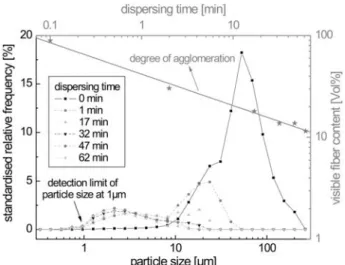
To avoid the typical carbon nanofiber agglomerates [2,3], several conventional mixing processes were tested to disperse carbon nanofiber agglomerates at dry or wet state. None of these processes was able to produce a homogeneous mixture with submicron-sized copper powder. An ultrasonic flow cell allows the dispersion of each investigated delivery states carbon nanofibers in an aqueous media and the creation of a homogeneous stabilised suspension with the help of an emulsifying agent in economically justifiable ultrasonic periods of time less than one hour. The reached degree of agglomeration with can be proved either by standardised particle size measurements (Fig. 1) or by metallographic sections of consolidated samples analysed by scanning electron microscopy was always lower than 10 percent. After addition of the submicron-sized copper powder and different alloying elements and redisper- sion the suspensions were tried at elevated temperatures and deoxidised at reducing atmosphere. Homogeneous mixtures of copper powder and carbon nanofibers with volume contents of 10-30Vol% and even 60Vol% are realisable via such preparing route described above.
2006 POWDER METALLURGY World Congress
C03-01-1
Carbon-nanofiber Reinforced Copper Composites Prepared by Powder Metallurgy
for Thermal Management of Electronic Devices
H. Weidmueller1,a, T. Weissgaerber1,b,T. Hutsch1,c, R. Huenert2,d, T. Schmitt3,e, K. Mauthner3,f, and J. Schulz-Harder4,g 1
Fraunhofer-Institute for Manufacturing and Advanced Materials,
Dept. Powder Metallurgy and Composite Materials, Winterbergstr. 28, 01277 Dresden, Germany
2
ECKA-Granulate MicroMet GmbH, Hoevestrasse 46a, 20539 Hamburg, Germany
3
Electrovac Ges.mbH, Aufeldgasse 37-39, 3400 Klosterneuburg, Austria
4
Curamik electronics GmbH, Am Stadtwald 2, 92676 Eschenbach, Germany
a [email protected], b [email protected], c [email protected], [email protected], e
[email protected], [email protected], [email protected] Abstract
For microelectronic circuits, the main type of failure is thermal fatigue. Therefore, the search for matched coefficients of thermal expansion (CTE) of packaging materials in combination with a high thermal conductivity is the main task for developments of heat sink materials electronics, and good mechanical properties are also required. The aim of this work is to develop copper matrix composites reinforced with carbon nanofibers to meet these requirements. In this paper, a technology for obtaining a homogeneous mixture of copper and nanofibers will be presented and the microstructure and properties of consolidated samples will be discussed.
© Korean Powder Metallurgy Institute 845
-Fig. 1. Particle size distributions of C-nanofibers and degree of agglomeration at different dispersing times. Samples were consolidated by extrusion, hot isostatic pressing and hot pressing.
Physical density measurements confirm a nearly complete densification, that is higher than 95% of the theoretical density, for hot isostatic pressed samples, even at a fiber content of 30Vol%. Densities higher than 90% of the theoretical density were determined for hot pressed and extruded materials.
The microstructures analysed by SEM are significantly influenced by consolidating methods. Metallographic sections of extruded samples represent a one-dimensional orientation of nanofibers. A distinct fiber alignment for hot pressed materials was not detected. Hot isostatic pressed specimens possess an isotropic fiber dispersion with no distinct fiber orientation.
Considering specific material characteristics (Fig. 2) like thermal conductivity (TC) and the thermal expansion coefficient (CTE) calculated from laser flash thermal diffusivity and low temperature dilatometer measurements, the following conclusions could be drawn. Composites containing carbon nanofibers with low content of catalytic elements exhibit the highest values in TC. Increasing carbon nanofiber contents results in a decrease in TC of the whole sample. This fact confirms that there is insufficient bonding strength between copper and nanofibers which makes the interface modification a necessary step. It is well-known from the carbon-copper phase diagram [4], that neither solubility nor compound formation exists between these components. Four point measurements of electrical conductivity also represent the poor bonding strength. In the same context, the results of the measured CTE should be considered. Only at high nanofiber contents (higher than 30Vol%) can a reduced CTE be detected. First, the evidences for anisotropic fiber properties arise from extruded or hot pressed samples, considering material their
characteristics that are dependant on sample orientation. Hot pressed materials containing nanofibers with high aspect ratio between fiber length and fiber diameter show a significant higher TC perpendicular to hot pressed direction (⊥ 196.5 W/(mK) > II 120.1 W/(mK). Along the one-dimen- sional fibre orientation of extruded samples, a stronger reduced thermal expansion coefficient is determinable (Fig. 2 – II).
Fig. 2. TC (black) and CTE (grey) of hot isostatic pressed (I) and extruded (II – along the one-dim. fiber orientation) samples at different C-nanofiber content.
3. Summary
Dispersion of carbon nanofibers with ultrasonic flow cell in an aqueous media is important for preparing homogeneous mixtures of nanofiber and copper powder. Excellent fiber distributions between copper particles ensure that the sample densities are higher than 90% after consolidation. SEM analyses of consolidated samples confirm homogeneous fiber distributions and anisotropic properties for hot pressed and extruded materials. The measurements of the TC and CTE show that bonding strength between copper and nanofibers is weak. Thus, current investigations are focusing on finding ways to improve the interface by adding different alloying elements so as to enhance TC to that higher than copper and to obtain a significant reduction in CTE.
4. References
1. J. Heremans, C. B. Beetz, Jr., Physical Review B 32, 1981(1984).
2. S. Arai, M. Endo, Electrochemistry Communications 5, 797(2003).
3. S. Arai, M. Endo, Electrochemistry Communications 7, 19(2005).
4. Subramanian, Laughlin, Binary Alloy Phase Diagrams Vol.1 SE – Massalski 839(1990).