Resonances in the scattering of obliquely incident waves
by cylindrical shells immersed in a fluid
S. H. Lim, Y. S. Joo, H. S. Eom, J. H. Kim
Korea Atomic Energy Research Institute, P.O.Box 105, Yuseong, Daejeon, Korea, 305-353, [email protected]
1. Introduction
Scattering problem of normally and obliquely incident plan acoustic wave by isotropic cylindrical structure immersed in a fluid has been discussed for the last several decades [1]. Resonance scattering theory (RST) was one of the principal works in this area, and suggested that the acoustic pressure scattered from the scattering object is consisted of background and resonance, and resonance signal can be obtained by rejecting of background signal from scattered acoustic pressure [2].
In this paper, the acoustic resonances in the scattering of an obliquely incident plane wave by submerged cylindrical shells have been theoretically studied. Scattering form functions considered the inherent background coefficient [3] are calculated for incidence angles varying from 0o to 50o, in the dimensionless parameter ka<30.
2. Mathematical Description
Figure 1 illustrates the geometry of an acoustic plane wave incident obliquely on a submerged cylindrical shell. The acoustic plane wave having wave number kρ is incident at angle α on the shell whose dimension is a in 0 inner radius and a in outer radius. The incident wave 1 external to the scattering object is represented by
θ ε ωt i J k r n z k i P n n x n n z
inc exp[( )] ( )cos
0
∑
∞=
−
= , (1)
and the outgoing scattered wave can be written as θ ε ωt i RH k r n z k i P n n x n n n z sc exp[( )] ( )cos ) 1 ( 0
∑
∞ = − = . (2)In the above equations, kx=kcosα, kz=ksinα and R are n
the scattering coefficients to be determined from boundary conditions. Jn(x) is the first kind Bessel function and H(1)(x)
n is first kind Henkel function of order
n .
For each summation index n, seven parameters are to be found from the contact conditions:
on the outer surface of the shell
P rr =− ) 1 ( τ , Ur(1)=Ur, (1)=0 θ τr , 0 ) 1 ( = rz τ at r=a1, and on the inner surface of the shell
0 ) 1 ( = rr τ , (1)=0 θ τr , 0 ) 1 ( = rz τ at r=a0.
From Eq. (2), The far-field scattering pressure can be written as
∑
∞ = − + ≈ 0 1 1 2 cos 2 )] ( exp[ n n n sc R n ika r a t kz kr i P ε θ π ω . (3)Then, the normalized far-field amplitude called a form function is given as θ ε η π η θ R n i fn( , )= 2 n ncos , (4)
where η is a normalized frequencyka . 1
The resonant part of each mode can be obtained by rejecting the acoustical background (b)(θ,η)
n
f from normal
mode components fn(θ,η) according to the following
equation: θ ε η π η θ R R n i f b n n n reso n ( )cos 2 ) , ( () ) ( = − . (5)
Figure 1. Geometry of an acoustic plane wave obliquely incident on a submerged cylindrical shell
3. Results and Discussion
The resonance spectra and form function of a stainless cylindrical shell are computed for incidence angles varying from 0o to 50o, in the dimensionless parameter ka<30. Physical properties of the shell and water are given in Table 1. The ratio of inner diameter and outer diameter (ID/OD) of the stainless steel shell is 0.86.
Transactions of the Korean Nuclear Society Autumn Meeting Busan, Korea, October 27-28, 2005
Table 1. Physical properties of stainless steel material and water ρ ) / (kg m3 L C ) / (m s T C ) / (m s Stainless steel 7.83 5,800 3,100 Water 1 1,480 -
The travel path of all wave propagated along the surface are helices, and the angle of each helix depends on the phase velocity of the corresponding surface wave [4,5]. 10 20 30 40 50 0.00 0.25 0.50 0.75 1.00 T0 S0 A normal incidence oblique incidence(angle=3o) oblique incidence(angle=5o) A m pli tude Normalized freq.[ka]
Figure 2. Resonances of the partial wave (n=15) for normal incidence (α =0ο
)
and oblique incidence (α=3οand
5ο)
Figure 2 shows the resonances for some partial wave (n=15) with α=0ο, 3 and ο 5 . As compared with the ο
normal incidence, the new resonances observed on the spectrum are expected to be the guided wave. These additional modes are called the guided T modes [6]. With the increase of α, all resonance peaks are shifted up.
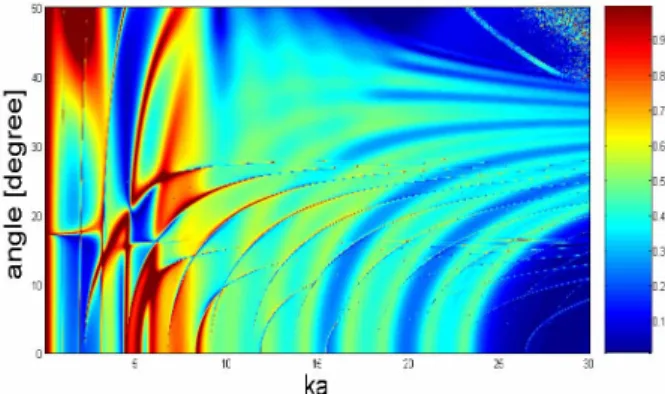
Figure 3 shows the calculated backscattering spectral magnitude from the cylindrical shell, over a range of aspect angles from α=0ο to α=50ο, in 0.3οincrements.
Figure 3. Calculated backscattering spectral magnitude as a function of frequency and aspect angle
The theoretical backscattering spectra as a function of ka and incident angle show the resonances of 3-types of helical waves: Stonely, circumferential and transversal waves [4]. The resonance frequency of the Stoneley wave (A wave) slowly increases when the incidence angle increases. The resonances of circumferential waves (S0 waves) increase towards infinity when the incidence angle tends towards the transverse critical angle. The resonances of the transversal guided waves (T0 waves) do not increase when the incidence angle increases.
4. Conclusion
The acoustic scattering of obliquely incident plan acoustic wave by an isotropic cylindrical shell immersed in a fluid was researched. Scattering form functions considered the inherent background coefficient are calculated for incidence angles from 0o to 50o, in 0 .3ο
increments. When the wave is obliquely incident on the cylindrical shell, the new waves called transversal guided wave (T0 waves) are observed in the resonance spectrum. The resonances of circumferential waves increase towards infinity when the incidence angle tends towards the transversal critical angle. The resonances of transversal guided waves do not increase when the incidence angle increases.
ACKNOWLEDGEMENT
This study was supported by the Korean Ministry of Science & Technology through its National Nuclear Technology Program.
REFERENCES
[1] N. D. Veksler, Resonance Acoustic Spectroscopy,
Springer-Verlag Berlin Neidelberg, 1993.
[2] L. Flax et al, JASA 63, 675, 1978. [3] Y. S. Joo et al, JASA 101 (3) 1997. [4] S. F. Morse et al., JASA 103 (2) 1998. [5] A. Nagl et al, Wave Motion 5, 235, 1983. [6] F. Leon et al, JASA 91, 1992.