Welcome to ICACT 2010
3. Collision Reduction for Heterogeneous Wireless Sensor Networks
Dongsoo. S. Kim, Sree R. Kanury(Indiana U. Purdue U. Indianapolis, USA)
··· 464
4. Location-Based Spiral Clustering for Transmission Scheduling in Wireless Sensor Networks
Young-Uk Yun , Jae-Kark Choi, Nan Hao, Sang-Jo Yoo(Inha University, Korea)··· 470
5. Study on Robustness Middleware using Integrating Sensor Observation Service in Sensor Web
Enablement
Woo Suk Ahn, Ki Hyung Kim, Seung Wha Yoo(Ajou univ., Korea)
··· 476
Session 4C: IT Service Technology (II)
1. A Novel MIMO detection method for Mobile IPTV
Soon Yong Song, Young-il Kim(ETRI, Korea)
··· 483
2. A Smart Framework for Web Content and Resources Adaptation in Mobile Devices
Shawkat K. Guirguis, Mohamed A. Hassan (Alexandria University, Egypt)
··· 487
3. Method for Distribution, Execution and Management of the Customized Application based on
SoftwareVirtualization
Kyong-I Ku, Won-Hyuk Choi, Moonyoung Chung, Kiheon Kim, Won-Young Kim, Sung-Jin Hur(ETRI, Korea)
··· 493
4. A GROUPING ALGORITHM of HELPERS in PEER-TO-PEER VIDEO-ON-DEMAND
SYSTEMS
Xia Li, Hua Zou, Xinchao Zhao, Fangchun Yang(Beijing University, China)
··· 497
5. Seamless Multicast Handover in PMIPv6-based Wireless Networks
Moneeb Gohar, Seok Joo Koh(Kyungpook National University, korea), Tae-Won Um, Hyun-Woo Lee(ETRI, korea)
··· 502
Session 4D: Digital Broadcasting Technology (II)
1. OFDM/VSF-CDMA for DVB-H Communications
Mohamed M. A. Moustafa(Akhbar El Yom Academy, Egypt)
··· 511
2. An Advanced Hierarchical Modulation with Rotated Constellation
Soonki Jo,Jinyong Choi, Jongsoo Seo(Yonsei University, Korea)
··· 515
3. 3DTV System for HFC Network
Woongshik You, O-Hyung Kwon(ETRI, Korea), Oh-Seok Kwon(Chungnam National University, Korea)
··· 519
4. Noise Speech wavelet analyzing in special time ranges
Amin Daneshmand Malayeri(Malayer Azad University, Iran)
··· 525
Seamless Multicast Handover in PMIPv6-based
Wireless Networks
Moneeb Gohar*, Seok Joo Koh*, Tae-Won Um**, Hyun-Woo Lee**
*School of Computer Science and Engineering, Kyungpook National University **Electronic Telecommunications Research Institute (ETRI)
Abstract In this paper we propose the three schemes to support seamless multicast handover in the Proxy Mobile IPv6 (PMIPv6) based wireless networks. In the existing scheme, there is a problem of packet loss and larger handover latency, in which Mobile Node (MN) cannot receive the multicast data packets until the new Mobile Access Gateway (MAG) completes the Proxy Binding Update with Local Mobility Anchor (LMA). In this paper, we propose the packet forwarding schemes for multicast handover to reduce the packet losses and handover delay, among which the first two schemes are for intra-LMA domain handover and the other one is for inter-LMA domain handover. To evaluate the proposed schemes, we performed the numerical analysis to compare the proposed scheme with the existing schemes in terms of the signaling overhead associated with multicast handover. From the analysis, it is shown that the proposed scheme can provide relatively small signaling costs, compared to the existing schemes.
Keywords-PMIPv6, Multicasting, Handover, Packet Forwarding
I. INTRODUCTION
In the wireless communication networks, the multimedia streaming services are considered as primary applications, as shown in the IPTV applications [1, 2]. These services are based on the group communication and IP multicasting. For support of these services, a lot of protocols have been proposed, which include Multicast Listener Discovery (MLD) [3, 4] and Internet Group Management Protocol (IGMP) [5, 6] for multicast group join and leave operations, and also several multicast routing protocols are employed for construction of multicast trees, such as Protocol Independent Multicast [7] and Source Specific Multicast [8].
To support the seamless mobility for multicasting services, we may consider the Mobile IPv6 (MIPv6) [9] and FMIPv6 [10], which are based on the host mobility, whereas the Proxy MIPv6 (PMIPv6) [11] is a network-based mobility solution, and provides the local mobility management to a mobile node without any modification in the same PMIPv6 domain. These management functions are performed by Local Mobility Anchor (LMA) and Mobile Access Gateway (MAG). The MIPv6-based multicasting schemes have been studied so far, whereas the studies on PMIPv6-based multicasting have not been done enough yet. In this paper, we propose the PMIPv6-based multicasting schemes to reduce the handover
latency and packet losses, which is featured by using the packet forwarding during handover.
The rest of this paper is organized as follows. Section II reviews the existing works on PMIPv6-based mobile multicasting. Section III describes the proposed schemes in details. Section IV compares the performance of proposed and existing schemes. Section V concludes this paper.
II. RELATED WORKS
Several schemes have been proposed for PMIPv6 multicasting in [12], in which the multicast router function is separated from LMA of PMIPv6 to solve the problem of the so-called tunnel convergence and also to solve the problem of handover latency caused by MLD query/report. When a Mobile Node (MN) moves into a new network region, the previous MAG (PMAG) will forward a context transfer message to the new MAG (NMAG), which includes MN_ID, current MAG‟s IP address, and multicast IP address. Then NMAG will check whether there is a receiving node that has joined the same group in the subnet domain. If this is not the case, the NMAG joins the group by sending an MLD report to the attached multicast router.
Another work was done to improve the PMIPv6-based mobile multicasting scheme in the fast handover for PMIPv6 multicast [13]. This scheme can reduce the handover latency and packet loss by specifying the bi-directional tunneling between PMAG and NMAG, as the NMAG requires the multicast context information to set up the bi-directional tunnel to deliver multicast data to mobile node continuously. This context information contains MN_ID.
In the PMIPv6 extension for multicast in [14], the MAG operates as an MLD proxy. Whenever MN attaches to NMAG, the NMAG requests the context transfer information to PMAG. The PMAG can use a context transfer protocol to deliver the MN profile to NMAG and multicast context information. The NMAG subscribes the multicast channel on behalf of MN by sending PBU-M (Proxy Binding Update for Multicasting) to LMA. LMA replies to NMAG with a Proxy Binding ACK (PBA). If the PBA message has the status field set to „0‟, it means that the PBU is accepted and then NMAG will establish a multicast tunnel between LMA and NMAG for forwarding of the multicast data packets delivered from LMA. After that, to receive the new multicast data packets, MN will exchange the messages of MLD query and report with NMAG, and
further NMAG will exchange the MLD report message with LMA.
III. PROPOSED SCHEMES
In this paper we propose the three schemes for PMIPv6-based mobile multicasting that use the packet forwarding for seamless multicast handover, among which the two schemes are for intra-LMA domain, and the other one is for inter-LMA domain.
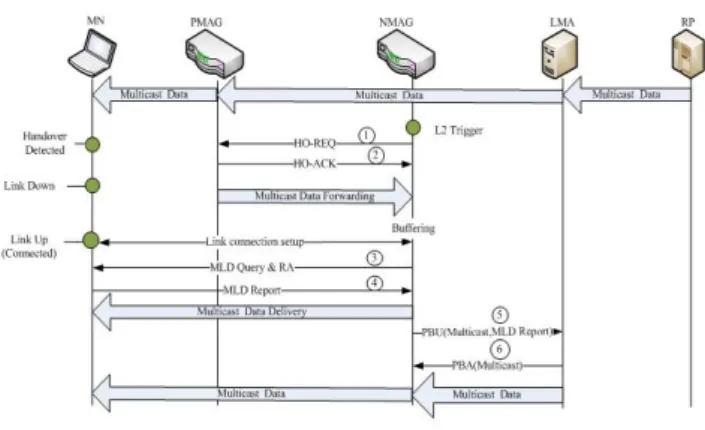
A. Multicasting with Packet Forwarding from PMAG In this scheme, NMAG detects the handover event using the underlying link-layer triggers, which is shown in Figure 1, and then it sends the handover request (HO-REQ) message to PMAG. The PMAG will send the multicast information of MN via the handover acknowledgement (HO-ACK) message to NMAG. The handover acknowledgement message contains MN_ID and multicast group address. NMAG also requests PMAG to forward the multicast data packets. The tunnel is established between PMAG and NMAG, and the multicast data packets will be forwarded from PMAG to NMAG.
Figure 1. Packet forwarding from PMAG to NMAG
After the new link connection setup, NMAG will send the MLD query and Router Advertisement (RA) message to MN. MN sends the MLD report back to NMAG, and now the multicast data packets will be delivered to MN after the MLD report. NMAG subscribes the multicast channel on behalf of MN, and transmits PBU to LMA with the multicast address and the MLD report. LMA sends the PBA message back to NMAG, and a new multicast tunnel is established between LMA and NMAG for forwarding the corresponding multicast data from LMA to NMAG.
B. Multicasting with Packet Forwarding from LMA In this scheme, NMAG detects the handover event and sends the handover request message to PMAG, which is shown in Figure 2. In the figure, PMAG sends the multicast information of MN to NMAG via the HO-ACK message to NMAG. The HO-ACK message contains MN_ID and the multicast group
address. NMAG requests LMA to forward the multicast data packets by sending PBU message with a packet forwarding request. The LMA sends the PBA message back to NMAG. The tunnel is now established between LMA and NMAG, and the multicast data packet will be forwarded from LMA to NMAG.
Figure 2. Packet forwarding from LMA to NMAG
After the new link connection setup, the NMAG sends the MLD query and RA message to MN. The MN sends the MLD report back to NMAG and now new multicast data packets are delivered to MN after MLD report process. NMAG subscribes the multicast channel on behalf of MN, and transmit a PBU to LMA with the multicast address and MLD report. LMA sends PBA message back to NMAG and the multicast tunnel is established between LMA and NMAG for forwarding the corresponding multicast data from LMA to NMAG.
C. Multicast Handover between LMAs
We now consider the inter-LMA handover in the mobile multicasting. In this scheme, NMAG detects the handover and sends the handover request message to LMA2, which is shown in Figure 3.
Figure 3. Inter-LMA handover
After receiving this message, LMA2 sends the HO-REQ message to LMA1. LMA1 sends the multicast information of MN back to LMA2. The HO-ACK message contains MN_ID
and multicast group address. LMA2 sends the PIM join message to the Rendezvous Point (RP) and also sends the HO-ACK message to NMAG, after receiving the HO-ACK message from LMA1. LMA2 also requests from LMA1 to forward the multicast data. The NMAG also requests LMA2 to forward the multicast data. The tunnel is established between LMA1 and LMA2, and also between LMA2 and NMAG. Accordingly, the multicast data packets will be forwarded from LMA1 to LMA2, and then from LMA2 to NMAG. After the new link connection setup, NMAG sends the MLD query and RA message to MN. The MN sends the MLD report back to NMAG. Now, multicast data packets will be delivered to MN directly.
NMAG subscribes the multicast channel on behalf of MN, and transmits PBU to LMA with the multicast address and MLD report. LMA sends PBA message back to NMAG, and the multicast tunnel is established between LMA and NMAG to forward the corresponding multicast data from LMA to NMAG.
IV. PERFORMANCE ANALYSIS
For performance evaluation of the proposed scheme, we analyze the signaling costs for the existing scheme and the proposed scheme. The signaling cost is calculated by considering the messages used for handover procedure.
For analysis, we consider a network model and define the following cost components:
Ta-b: transmission delay between two nodes a and b, which is applied between PMAG and NMAG, between MN and NMAG, and between NMAG and LMA. Pk: processing delay of a message at node k, which is
applied to MN, PMAG, NMAG, and LMA. A. Signaling Cost Analysis
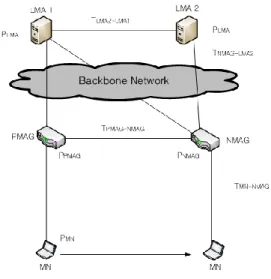
For the cost analysis, we consider the following two network models, as shown in Figure 4 and 5.
Figure 4. Network model for Intra-LMA handover
Figure 5. Network model for inter-LMA handover
1) Existing Scheme [14]
In this scheme, named PMIP-MM, MN detects the handover event and starts the handover operation after attachment to NMAG by sending the Router Solicitation (RS) message to NMAG. Thus the signaling cost of the existing scheme consists of the following cost component:
Transmission of RA, RS, MLD Query and MLD Report messages for handover between MN and NMAG, which is equal to 4TMN-NMAG.
Transmission of CT-Req, CXTP messages for handover between PMAG and NMAG, which is equal to 2TPMAG-NMAG.
Transmission of PBU-M, PBA and MLD Report messages for handover between NMAG and LMA is equal to 3TNMAG-LMA.
Processing of RA and MLD Query messages at node MN, which is equal to 2PMN.
Processing of CT-Req messages at node PMAG is equal to PPMAG.
Processing of RS, CXTP, PBA, MLD Report messages at node NMAG is equal to 4PNMAG.
Processing of PBU-M, MLD Report messages at node LMA is equal to 2PLMA.
Based on these observations, the signaling cost of the existing
scheme denoted by PMIP-MM can be represented as CPMIP-MM = 4TMN-NMAG + 2TPMAG-NMAG + 3TNMAG-LMA + 2PMN +
PPMAG + 4PNMAG + 2PLMA (1) 2) Proposed Schemes
In this scheme, named PMAG-NMAG, the NMAG detects the handover event and starts the handover operations before the link down by sending HO-REQ message to PMAG.
Thus, the associated signaling cost consists of the following
cost component:
The transmission of HO-Req, HO-ACK messages for handover between the PMAG and NMAG is equal to 2TPMAG-NMAG.
The transmission of MLD-Query &RA and MLD Report messages for handover between MN and NMAG is equal to 2TMN-NMAG.
The transmission of PBU-M, PBA messages for handover between NMAG and LMA is equal to 2 TNMAG-LMA. Processing of MLD Query & RA messages at node MN is
equal to PMN.
Processing of HO-Req messages at node PMAG is equal to PPMAG.
Processing of HO-ACK, MLD Report and PBA messages at node NMAG is equal to 3PNMAG.
Processing of PBU-M messages at node LMA is equal to PLMA.
Accordingly, the signaling cost of PMAG-NMAG can be represented as CPMAG-NMAG = 2TPMAG-NMAG +2TMN-NMAG +2TNMAG-LMA +PMN
+PPMAG +3PNMAG +PLMA (2) In the PMIPv6-based mobile multicasting with packet forwarding from LMA to NMAG for intra-LMA handover, the NMAG detects the handover event and starts the handover operations before the link down event by sending the HO-REQ message to PMAG. Thus, the signaling cost of the proposed LMA-NMAG scheme includes the following cost component: The transmission of HO-Req, HO-ACK messages for handover between the PMAG and NMAG is equal to 2TPMAG-NMAG.
The transmission of MLD-Query &RA and MLD Report messages for handover between MN and NMAG is equal to 2TMN-NMAG.
The transmission of PBU (for packet forwarding), PBA (for packet forwarding), PBU-M and PBA messages for handover between NMAG and LMA is equal to 4TNMAG-LMA.
Processing of MLD Query & RA messages at node MN is equal to PMN.
Processing of HO-Req messages at node PMAG is equal to PPMAG.
Processing of HO-ACK, PBA (for packet forwarding), MLD Report, PBA messages at node NMAG is equal to 4PNMAG.
Processing of PBU (for packet forwarding), PBU-M messages at node LMA is equal to 2PLMA.
Based on these observations, the signaling cost of the proposed LMA-NMAG scheme can be represented as
CLMA-NMAG=2TPMAG-NMAG +2TMN-NMAG +4TNMAG-LMA +PMN +PPMAG +4PNMAG +2PLMA (3) On the other hand, in the PMIPv6-based mobile
multicasting with packet forwarding from LMA to LMA for inter-LMA handover, the NMAG detects the handover event and starts the handover operations before the link down by sending the HO-REQ message to LMA2. Thus, the signaling cost of the proposed LMA-LMA scheme consists of the following cost component:
The transmission of HO-Req, HO-ACK, PBU-M and PBA messages for handover between the NMAG and LMA2 is equal to 4TNMAG-LMA.
The transmission of HO-Req, HO-ACK messages for handover between LMA1 and LMA2 is equal to 2TLMA2-LMA2.
The transmission of MLD-Query &RA and MLD Report messages for handover between MN and NMAG is equal to 2TMN-NMAG.
Processing of MLD Query & RA messages at node MN is equal to PMN.
Processing of HO-ACK,MLD Report and PBA messages at node NMAG is equal to 3PNMAG.
Processing of HO-Req messages at node LMA1 is equal to PLMA.
Processing of HO-Req, HO-ACK and PBU-M messages at LMA2 is equal to 3PLMA.
Based on these observations, the signaling cost of the proposed LMA-LMA scheme can be represented as CLMA1-LMA2=4TNMAG-LMA +2TLMA1-LMA2 +2TMN-NMAG+PMN
+3PNMAG+PLMA +3PLMA
=4TNMAG-LMA +2TLMA1-LMA2 +2TMN-NMAG+PMN +3PNMAG+4PLMA (4)
B. Numerical Results
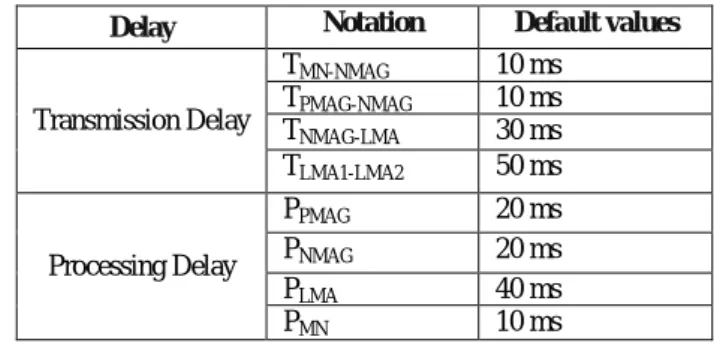
Based on the cost analysis given until now, we compare the signaling costs of the existing and proposed schemes. For the numerical analysis, we set the default parameter values, as shown in Table 1.
Table 1. Parameter values used for numerical analysis
Figure 6 shows the signaling costs of the existing and proposed schemes for different transmission delays between MN and NMAG (TMN-NMAG). From the figure, it is shown that
the signaling cost increases for all the candidate schemes, as
Delay Notation Default values
Transmission Delay TMN-NMAG 10 ms TPMAG-NMAG 10 ms TNMAG-LMA 30 ms TLMA1-LMA2 50 ms Processing Delay PPMAG 20 ms PNMAG 20 ms PLMA 40 ms PMN 10 ms
TMN-NMAG gets larger. All the candidate schemes give better
performance than the existing scheme, as TMN-NMAG gets larger
and the gap between the existing scheme and proposed schemes gets larger.
Figure 6.Signaling costs for different TMN-NMAG
Figure 7 shows the signaling costs of the existing and proposed schemes for different transmission delays between NMAG and LMA (TNMAG-LMA). From the figure, it is shown
that the signaling cost increases for all the candidate schemes and the existing scheme, as TNMAG-LMA gets larger. But one of
the candidate scheme give better performance than the existing scheme as the TNMAG-LMA gets larger value and the gap
between the existing scheme and one of the proposed scheme gets larger.
Figure 7. Signaling costs for different TNMAG-LMA
Figure 8 shows the signaling costs of the existing and proposed schemes for different processing delays of MN (PMN). From the figure, it is shown that the signaling cost
increases for all the candidate schemes, as PMN gets larger
value. All the candidate schemes give better performance than the existing scheme as the PMN gets larger value and the gap
between the existing scheme and proposed schemes gets larger.
Figure 8. Signaling costs for different PMN
Figure 9 shows the signaling costs of the existing and proposed schemes for different processing delays of NMAG (PNMAG). From the figure, it is shown that the signaling cost
increases for all the candidate schemes, as PNMAG gets larger
value. One of the candidate schemes give better performance than the existing scheme as the PNMAG gets larger value and the
gap between the existing scheme and proposed scheme gets larger for one scheme. While one of the intra domain scheme gives the same results as the existing scheme. The figure shows that the inter domain scheme give better performance from the existing scheme and one of the intra domain scheme as the PNMAG gets larger.
Figure 9. Signaling costs for different PNMAG
Figure 10 shows the signaling costs of the existing and proposed schemes for different processing delays of LMA (PLMA). From the figure, it is shown that the signaling cost
increases for all the candidate schemes, as PLMA gets larger
value. One of the intra domain candidate schemes give better performance than the existing scheme as the PLMA gets larger
value and the gap between the existing schemes gets larger from one intra domain scheme. While one of the intra domain scheme gives the same results as the existing scheme. The figure also shows that the inter domain scheme did not give better performance from the existing scheme and also from the two intra-domain scheme as the PLMA gets larger.
Figure 10. Signaling costs for different PLMA
V. CONCLUSION
This paper proposed the three scheme for seamless multicast handover in the PMIPv6 based networks. To reduce the packet losses and handover latency during handover, we proposed the three schemes using the packet forwarding: two are intra-domain schemes and one is inter-domain scheme. From the analytical results and comparisons, it is shown that the intra-domain scheme using the packet forwarding from PMAG to NMAG gives better performance than the existing schemes and also the other proposed schemes.
ACKNOWLEDGMENT
This research was partly supported by the MKE (The Ministry of Knowledge Economy), Korea, under the ITRC (Information Technology Research Center) support program supervised by the NIPA(National IT Industry Promotion Agency): (NIPA-2009-C1090-0902-0009), and also was partly supported by the MKE(The Ministry of Knowledge Economy) and KEIT(Korea Evaluation Institute of Industrial Technology), Korea (2008-S-006-02).
REFERENCES
[1] D. H. Kwon, et al., “Design and Implementation of an Efficient Multicast Support Scheme for FMIPv6,” INFOCOM2006, pp. 1–12, 2006. [2] Xiaojun Hei, Chao Liang, Jian Liang, Yong Liu, Keith W. Ross “A
Measurement Study of a Large-Scale P2P IPTV System,” IEEE Transaction on Multimedia, Vol. 9, No. 8, December 2007.
[3] S. Deering, et al., Multicast Listener Discovery (MLD) for IPv6, IETF RFC 2710, October 1999.
[4] R. Vida, and Costa, Multicast Listener Discovery Version 2 (MLDv2) for IPv6, IETF RFC 3810, June 2004.
[5] W. Fenner, Internet Group Management Protocol, Version 2, IETF RFC 2236, November 1997.
[6] B. Cain, S.Deering, et al., Internet Group Management Protocol, Version 3, IETF RFC 3376, October 2002.
[7] T.Pusateri, Protocol Independent Multicast - Sparse Mode (PIM-SM), IETF RFC 4602, August 2006.
[8] H. Holbrook and B. Cain, Source-Specific Multicast for IP, IETF RFC 4607, August 2006.
[9] D. Johnson, et al., Mobility Support in IPv6, IETF RFC 3775, 2004. [10] R. Koodli, Mobile IPv6 Fast Handovers, IETF RFC 5268, 2008. [11] S. Gundavelli, K. Leung, V. Devarapalli, K. Chowdhury, and B.Patil,
"Proxy Mobile IPv6", IETF RFC 5213, August 2008.
[12] Seil Jeon, Younghan Kim, Jaehwoon Lee, “Mobile Multicasting Support in Proxy Mobile IPv6,” IETF Internet Draft, July 04, 2009.
[13] M.Hui, G.Chen, H.Deng, Fast Handover for Multicast in Proxy Mobile IPv6, IETF Internet Draft, draft-hui-multimob-fast-handover-00, June 29, 2009.
[14] H. Asaeda, et al., PMIPv6 Extensions for Multicast, IETF Internet Draft, draft-asaeda-multimob-pmip6-extension, July 13, 2009.