Veterans Hospital Medical Expenses Increase & Decrease Characteristics and
Convergence Phenomenon-Focusing on the implications of the medical support
system for national veterans-
Tae Gyu Yu
Associate Professor, Department of Geriatric Welfare, Namseoul University
[email protected]
Abstract
As the average age of national veterans has increased from 69 years old(2011) to 71 years old(since 2015) over the past five years, the overall medical service cost of veterans has increased by about 20%. The main cause of this phenomenon is 'ultra-aging', which accounts for 67% of veterans, while the proportion of health insurance patients aged 70 or older is 9%. Therefore, it is judged that the analysis of the trend of use of medical services at veterans hospitals in each region that is in charge of severe medical services of national veterans can serve as an opportunity to seek countermeasures for the severe medical system of national veterans. First of all, based on the details of major medical expenses (hospitalization, outpatient, pharmaceutical expenses) by region for the last 10 years(2010-2019), data significance was performed through a chi-square test, and the Central Veterans Hospital and Non-Central Veterans Hospital using EXCEL. 'Expected frequency' was calculated by year. By applying the CHITEST(observation frequency, expected frequency) function again, the p-value(p<0.05) was calculated, and the profit bias of each region's veterans hospital could be determined.
The specific research method is for the last 10 years(2010-2019) for state-sponsored patients_outpatient treatment income, state-sponsored patients_hospitalization income, exempt patients_outpatients at the Central Veterans Hospital, Busan Veterans Hospital, Gwangju Veterans Hospital, Daegu Veterans Hospital, and Daejeon Veterans Hospital. A one-way analysis of variance was conducted to verify the significance of the difference between group averages on the status of 5 medical revenues of veterans hospitals in each of the 5 regions, including medical treatment income, reduced patients_hospitalization income, and reduced patients_medicine expenses. It was found to be significant(p<0.05) at all levels, including region and type. Finally, the bias in the profit structure of regional veterans hospitals was the highest in 2017(p=0.0004) and the lowest in 2013(p=0.0349). In addition, in the profit structure of the Veterans Hospital, the year in which the'regional' variable worked the most was 2019, and the year with the least affected was 2010. The order of the former is Jungang(=31,674,713), Busan(=12,314,614), Gwangju(=11,957,038), Daegu(=10,168,015), and Daejeon(=6,991,034), and the order of the latter is Jungang(=57,868,791), and Busan(=19,183,194). Gwangju(=17,904,712), Daegu(=15,656,034), and Daejeon(=14,377,395). In conclusion, the profit bias of veterans hospitals repeatedly raced the lowest(p=0.01986) and highest(p=0.03499) for the past five years(2010-2014) year by year, with the 'regional' variable being the most in the veterans hospital's profit structure It was identified as a major influence factor. On the other hand, for the last 5 years (2015-2019), the influence factors of the'regional' variable every year were in 2015(p=0.02015), 2016(p=0.01741), 2017(p=0.00045), and 2018(p=0.00394). in 2019(p=0.00227), a significant difference was confirmed at a very low level.
Keywords: Quality of sleep, Sleep Disorder, Sleep polyp test, In-Depth Interview IJACT 21-3-3
Manuscript Received: January.28.2021 / Revised: February 15, 2021 / Accepted: February 26, .2021 Corresponding Author: [email protected]
Tel: +82-41-580-2756, Fax: +82-41-580-2930
1. INTRODUCTION
As the average age of national veterans in 2011 increased from 69 years old to 71 years old after 2015, the medical service costs of national veterans began to increase rapidly. [1] In particular, the proportion of health insurance patients aged 70 or older is only 9% of the total, whereas the proportion of veterans is 67%, and the 'medical expenses' of national veterans due to 'aging' have been over 20% for the last 5 years. [2] It increased rapidly. As a result, it is an important policy point to devise countermeasures for the severe medical system of national veterans through the review of the medical service use trend of the 'Central Veterans Hospital', which is in charge of severe medical services for national veterans. [3].
FIGURE 1 shows ‘Veterans & health insurance population change’.
FIGURE 1. Veterans (Left) & health insurance (Right) population change (2011-2019)
2. REVIEWS OF PREVIOUS RESEARCH
The Korea Institute for Health and Social Affairs (2007) compared the medical fee system of veterans hospitals to health insurance, industrial accident insurance, automobile insurance, and medical benefits in the 'Research on measures to improve medical fees in veterans hospitals', and verified the cost analysis and addition rate of veterans hospitals. As a result, the improvement of the fee structure of the Veterans Hospital requires the improvement of the 'treatment details(quantity)' rather than the 'unit price' itself, and the 'Peer-Review System' is effective in the process of internally establishing and reviewing the 'standards and guidelines'. It has been diagnosed that it is urgent to establish a system that can be operated as a system. [4].
Kim Jin-Hyun(2012) found that in a study of' Methods to Enhance Cost Effectiveness of Veterans ' Medical Services', the overall medical income of veterans hospitals is lower than general hospitals with more than 300 beds and higher outpatient income, but lower hospitalization and other income. It was analyzed as low. Therefore, it was argued that it was urgent to establish an appropriate veteran surcharge rate, and that it was necessary to adjust the veteran surcharge rate to preserve profits, such as reducing drug costs due to the peculiarity of the veterans medical system. [5].
3. METHOD
After researching the medical expenses of each region for the last 10 years, it is divided into central veterans hospitals and non-central veterans hospitals (Busan, Gwangju, Daejeon, and Daegu), according to the difference between the central veterans hospital and non-central veterans hospitals. A chi-square test was conducted to determine whether there was a significant difference between the 'scale’ and 'reduction patients' size. [6]. Ultimately, if there is a significant difference in the trend of use of medical expenses for'medical service expenses' of veterans hospitals by regions such as Seoul, Busan, Gwangju, Daejeon, and Daegu, it can be seen that there is a difference in the management method of medical expenses at the Veterans Hospital. Furthermore, it can be estimated that 'state-funded patients' and 'reduction patients' are also converging these differences. Since the chi-square test was performed through the 2010-2019 Veterans
Hospital medical expense survey data, using EXCEL, calculate the 'expected frequency' of each of the Central Veterans Hospital and the Non-Central Veterans Hospital by year, and then CHITEST (observation frequency, expectation). [7]. The p-value (p<0.05) was derived through the frequency function. Ultimately, a one-way ANOVA of variance was conducted to see if there is a significant difference in the difference in the incidence of medical expenses by region of the veterans hospital according to the types of veterans.
FIGURE 2 shows ‘Veterans hospital treatment cost analysis method, characteristics of each state-sponsored patient & exemption patient’.
FIGURE 2. Research Design
4. RESULTS
4.1 Chi-square Test
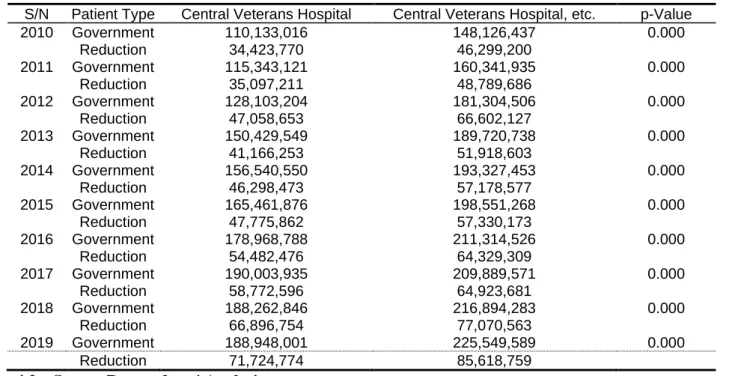
For the last 10 years (2010-2019), basic data on outpatient, hospitalization, and drug expenses for state-sponsored patients and reduced exemption patients at the Veterans Hospital were collected through the Korea Veterans Welfare and Medical Service. The data verification for the analysis of the relevant 'medical expenses' was divided into the Central Veterans Hospital and the Central Veterans Hospital based on the basic data, and a chi-square test was performed. After calculating the 'expected frequency' by year, the significance of the data was verified by deriving the p-value (p<0.05) through the CHITEST (observation frequency, expected frequency) function.
TABLE 1. CHITEST & p-value (Chi-square Test)
S/N Patient Type Central Veterans Hospital Central Veterans Hospital, etc. p-Value
2010 Government 110,133,016 148,126,437 0.000 Reduction 34,423,770 46,299,200 2011 Government 115,343,121 160,341,935 0.000 Reduction 35,097,211 48,789,686 2012 Government 128,103,204 181,304,506 0.000 Reduction 47,058,653 66,602,127 2013 Government 150,429,549 189,720,738 0.000 Reduction 41,166,253 51,918,603 2014 Government 156,540,550 193,327,453 0.000 Reduction 46,298,473 57,178,577 2015 Government 165,461,876 198,551,268 0.000 Reduction 47,775,862 57,330,173 2016 Government 178,968,788 211,314,526 0.000 Reduction 54,482,476 64,329,309 2017 Government 190,003,935 209,889,571 0.000 Reduction 58,772,596 64,923,681 2018 Government 188,262,846 216,894,283 0.000 Reduction 66,896,754 77,070,563 2019 Government 188,948,001 225,549,589 0.000 Reduction 71,724,774 85,618,759
Among the veterans and those covered by health insurance, the proportion of those aged 70 and over was overwhelmingly high in the veterans group, showing 67% of the veterans and 9% of the health insurance. Inpatient treatment costs for veterans medical care are on average 20% higher than health insurance and medical benefits for reasons such as ‘aging’ and ‘long-term hospitalization’.
In addition, the average outpatient treatment cost per session of veterans medicine was 13% higher than that of health insurance and medical benefits. As a result, it was found that the proportion of veterans and veterans over 70 years of age increased sharply by 25% and 17%, respectively, in the last 5 years, while the veteran medical expenses increased by 20%.
FIGURE 3 shows ‘Health insurance, Medical Benefits & Veterans Medical Expenses Increase’.
FIGURE 3. Health insurance, Medical Benefits & Veterans Medical Expenses Increase For the past 10 years (2010-2019), the government-sponsored patients at the Central Veterans Hospital, Busan Veterans Hospital, Gwangju Veterans Hospital, Daegu Veterans Hospital, and Daejeon Veterans Hospital _outpatient treatment income, state-funded patients_inpatient income, reduction patients_outpatient treatment income, reduction Patient_hospitalization income, exemption patient_pharmaceutical expense income, etc., 5 types of medical treatment income of 5 regional veterans hospitals were investigated. A one-way analysis of variance was conducted to verify the significance of the mean difference between three or more groups, and the p(<0.05) value was found to be significant at all levels, including year, region, and type. First of all, the year with the highest bias in the profit structure of regional veterans hospitals was 2017 (p=0.0004) and the lowest year was 2013 (p=0.0349). In addition, in the profit structure of the Veterans Hospital, the'regional' variable was the most affected year in 2019 and the least affected year was 2010. 11,957,038), Daegu (=10,168,015), Daejeon (=6,991,034). In that order, the order has not changed over the past 10 years.
TABLE 2. One-way ANOVA (2010-2019)
S/N Column 1 Column 2 Column 3 Column 4 Column 5 p-Value 2010 31,674,713 12,314,614 11,957,038 10,168,015 6,991,034 0.024447868 2011 33,034,588 13,772,160 12,790,546 10,468,642 7,522,199 0.031168515 2012 38,864,390 14,312,218 13,789,076 11,431,009 8,805,012 0.019860000 2013 41,627,589 14,628,530 14,511,357 12,298,945 9,639,988 0.034992168 2014 44,020,551 15,669,165 14,433,024 13,131,107 9,688,674 0.024753715 2015 46,179,744 15,792,099 14,738,975 12,930,988 10,613,559 0.020146912 2016 50,443,861 17,342,916 15,386,681 13,750,457 11,710,997 0.017405932 2017 56,432,702 16,561,195 16,130,846 13,708,385 11,033,898 0.000453108 2018 56,119,286 18,648,077 17,046,438 14,772,098 12,445,939 0.003938817 2019 57,868,791 19,183,194 17,904,712 15,656,034 14,377,395 0.002271661
4.3 Significance of the Analysis
In conclusion, the profit bias of veterans hospitals repeatedly raced the lowest (p=0.01986) and highest (p=0.03499) for the past five years (2010-2014) year by year, with the 'regional' variable being the most in the veterans hospital's profit structure It was identified as a major influence factor. On the other hand, for the last 5 years (2015-2019), the influence factors of the 'regional' variable every year were in 2015 (p=0.02015), 2016(p=0.01741), 2017(p=0.00045), and 2018(p=0.00394), in 2019(p=0.00227), a significant difference was confirmed at a very low level.
FIGURE 4 shows ‘Regional Bias Analysis of Revenue by Veterans Hospital’.
FIGURE 4. Regional Bias Analysis of Revenue by Veterans Hospital(p-value)
5. DISCUSSIONS AND CONCLUSION
The characteristics of the Veterans Hospital's revenue structure, as viewed through the regional and yearly revenue structure of the Veterans Hospital, have shown various aspects over the last 10 years. [8]. In particular, for 5 years from 2013 to 2017, the 'regional' variable was a direct positive (+) factor for the revenue of the veterans hospital, whereas the 'regional' variable was a direct positive factor for the revenue of the veterans hospital for the last two years after 2018. [9]. Revenue bias by region has improved, such as the weakening of the positive factor. This biased tendency of the profit structure ultimately acts as a negative factor in improving the quality level of veterans hospitals, and it is a situation that continuously seeks improvement measures. Therefore, a policy support strategy is urgently needed so that the recent weakening of the veteran hospital's profit structure bias is maintained in the future, and further efforts to overcome the peace of mind to improve the service quality of each region's veteran hospital are urgently needed.
ACKNOWLEDGEMENT
This work was supported by the Korea Sanhak Foundation (KSF) in 2020.
REFERENCES
[1] Health Insurance Review and Assessment Service, “Review Performance(2010-2019)”, 2020 [2] National Veterans Affairs Office, “Veterans Yearbook(2011-2019)”, 2020.
[3] Korea Veterans Welfare and Medical Corporation, “Veterans hospital treatment history(2010-2019)”, 2020.
[4] J.H. Kim, Young-Jin Go, Young-Jin Jung, Kyung-A Lee, Hyeon-Ji Bae, Eun-Young Park., “Measures to strengthen the efficiency of veterans medical services, ” National Veterans Affairs
Office, 2012.
[5] S.w. Lee, Manyong Han., “Utilization and Analysis of Big-data”, International Journal of Advanced Culture Technology Vol. 7, No. 4, p.246-254, 2019.
[6] Statistics How To. https://www.statisticshowto.com/probability-and-statistics/chi-square/ [7] How to do calculations in Excel. https://www.ablebits.com/office-addins-blog/2017/06/21/
[8] M.S. Lee, J.M. Kim., “The Effects of Health Promotion Program on Health belief, Health promoting Behavior and Quality of Life for Middle-aged Women: Based on Health Belief Model”, International Journal of Advanced Culture Technology Vol. 7, No. 3, p.246-254, 2019.
[9] B.H. Lee, J.G. Kim., “The Effect of Health Promotion Behavior on Emotional Happiness”, International Journal of Advanced Culture Technology Vol. 7, No. 1, p.246-254, 2019.