Rheumatoid arthritis (RA) is a chronic inflammatory disease primarily affecting joints and their adjacent structures that leads to joint damage and deformity.1 Treatment of RA seeks
to control both inflammation and pain and to reduce disabili-ty related to RA by the proper use of disease modifying anti-rheumatic drugs (DMARDs). Even though methotrexate re-mains a cornerstone in the treatment of RA, remarkable advances in the therapeutic regimens for RA have been made in the past decades. Particularly, biologics targeting inflamma-tory cytokines, such as tumor necrosis factor-alpha (TNF-α) and interleukin-6 (IL-6), that play a crucial role in RA patho-genesis2 have ushered in a new era of RA management. Treat-ment guidelines currently recommend the application of bio-logics to patients who fail to respond to conventional DMARDs,3 and the number of patients receiving biologics have substan-tially increased in recent years.4
Hepatitis B virus (HBV) infection is one of the most com-mon worldwide viral infections. Because chronic inflamma-tion by HBV can provoke cirrhosis, liver failure, and even he-patocellular carcinoma, HBV still remains as a major public Received: November 15, 2017 Revised: January 9, 2018
Accepted: January 22, 2018
Co-corresponding authors: Dr. Jun Yong Park, Division of Gastroenterology, De-partment of Internal Medicine, Yonsei University College of Medicine, Yonsei Liver Center, Severance Hospital, 50-1 Yonsei-ro, Seodaemun-gu, Seoul 03722, Korea. Tel: 82-2-2228-1988, Fax: 82-2-393-6884, E-mail: [email protected] and
Dr. Sang-Won Lee, Division of Rheumatology, Department of Internal Medicine, Institute for Immunology and Immunological Diseases, Yonsei University College of Medicine, 50-1 Yonsei-ro, Seodaemun-gu, Seoul 03722, Korea.
Tel: 82-2-2228-1987, Fax: 82-2-393-6884, E-mail: [email protected] •The authors have no financial conflicts of interest.
© Copyright: Yonsei University College of Medicine 2018
This is an Open Access article distributed under the terms of the Creative Com-mons Attribution Non-Commercial License (http://creativecomCom-mons.org/licenses/ by-nc/4.0) which permits unrestricted non-commercial use, distribution, and repro-duction in any medium, provided the original work is properly cited.
pISSN: 0513-5796 · eISSN: 1976-2437 Yonsei Med J 2018 May;59(3):452-456
https://doi.org/10.3349/ymj.2018.59.3.452
Safety of Tocilizumab in Rheumatoid Arthritis Patients
with Resolved Hepatitis B Virus Infection: Data from
Real-World Experience
Sung Soo Ahn
1, Seung Min Jung
1, Jason Jungsik Song
1, Yong-Beom Park
1, Jun Yong Park
2,3, and Sang-Won Lee
1,4 Divisions of 1Rheumatology and 2Gastroenterology, Department of Internal Medicine, Yonsei University College of Medicine, Seoul;3Yonsei Liver Center, Severance Hospital, Seoul;
4Institute for Immunology and Immunological Diseases, Yonsei University College of Medicine, Seoul, Korea.
To investigate whether the use of IL-6 receptor antagonist (tocilizumab) might be associated with hepatitis B virus (HBV) reacti-vation in rheumatoid arthritis (RA) patients, particularly in those with resolved HBV infection [HBV surface antigen (HBsAg) neg-ative and antibody to HBV core antigen (anti-HBc) positive, serologically]. HBsAg, anti-HBc, antibody to HBsAg (anti-HBs), and HBV DNA titers were measured in RA patients who had continuously received tocilizumab for more than 3 months. Patients were divided into two groups according to the presence of anti-HBc. Clinical and laboratory data, in addition to medications adminis-tered along with tocilizumab during the treatment duration with tocilizumab, were compared between the two groups. HBV re-activation was defined as the presence of HBV DNA in sera, and alterations in HBsAg, anti-HBc, and anti-HBs titers according to the use of tocilizumab were also evaluated. Fifteen of 39 patients (38.5%) had anti-HBc positivity, while 24 patients (61.5%) did not. There were no differences in demographic data, serologic classification, and variables related to tocilizumab between the an-ti-HBc-positive and -negative groups. Comparison of the medications administered along with tocilizumab treatment revealed no meaningful differences. None of the patients experienced reactivation of HBV. In addition, in 15 patients with resolved HBV infection, no alterations in HBsAg, anti-HBc, and anti-HBs titers were observed with the use of tocilizumab. Tocilizumab may be applied to RA patients safely with few concerns for HBV reactivation, particularly in those with resolved HBV infection.
health concern. Global epidemiologic studies now show that more than 2 billion individuals have been infected by HBV and more than 350 million people have chronic HBV infection.5 Recently, there have been increasing demands for screening for HBV infection in the field of rheumatology, as patients re-ceiving biologics are at risk of HBV reactivation.6,7 Among viral factors associated with HBV reactivation, chronic HBV infec-tion and high baseline HBV DNA are likely to be meaningful risk factors.6 In addition, HBV reactivation can occur in patients with resolved HBV infection, which is defined as HBV surface antigen (HBsAg) negative and antibody to HBV core antigen HBc) positive, regardless of antibody to HBsAg (anti-HBs).7,8 So far, HBV reactivation in RA patients has been mainly assessed in patients receiving TNF-α blockade, but rarely in those receiving IL-6 receptor antagonist (tocilizumab). Fur-thermore, the safety of tocilizumab in regards to HBV reacti-vation in resolved HBV infection remains unclear. Hence, in this study, we investigated whether the use of tocilizumab might be associated with HBV reactivation in RA patients, par-ticularly in those with resolved HBV infection.
We retrospectively reviewed the medical records of patients with RA receiving tocilizumab according to the following in-clusion criteria: 1) patients diagnosed with RA according to the 2010 American College of Rheumatology/European League Against Rheumatism classification criteria for RA9,10 at the Di-vision of Rheumatology, Yonsei University College of Medi-cine, Severance Hospital; 2) patients who had information on HBsAg, anti-HBc, and anti-HBs at the initiation of tocilizumab and who did not have HBsAg; 3) patients who were continu-ously receiving tocilizumab for more than 3 months; and 4) patients who provided blood samples for the cross-sectional analysis of HBsAg, anti-HBc, anti-HBs, and HBV DNA with in-formed consent forms at the time of study enrollment. This study was approved by the Institutional Review Board of Sev-erance Hospital, and was conducted in accordance with the principles set forth in the Declaration of Helsinki (IRB approval number 4-2017-0761).
We collected information on age, gender, and disease dura-tion as demographic data. Patients were classified as seroposi-tive and seronegaseroposi-tive RA according to the presence of rheuma-toid factor and anti-citrullinated protein antibodies. Regarding tocilizumab usage, information on DAS28-ESR (disease activi-ty score 28–erythrocyte sedimentation rate) on the initiation of tocilizumab, treatment duration, and the route of administra-tion were also obtained. We also reviewed laboratory data for aspartate aminotransferase (AST), alanine aminotransferase (ALT), ESR, and C-reactive protein (CRP), both at initiation of tocilizumab and at study enrollment.
We measured HBsAg, anti-HBc, and anti-HBs both at initia-tion of tocilizumab and at study enrollment. Serum HBV DNA titers were measured only at study enrollment. Reactivation of HBV was defined as a serum HBV DNA titer above the lower detection limit.11 Serum levels of HBsAg, HBc, and
anti-HBs were detected and interpreted using the Abbott Architect
i4000 immunoassay system (Abbott Diagnostics, Chicago, IL,
USA). Serum HBV DNA was measured by real-time PCR assay (cobas CAP/CTM System, Roche Molecular Diagnostics, Indi-anapolis, IN, USA) with a lower detection limit of 15 IU/mL.
We reviewed medications that were administered along with tocilizumab throughout the duration of tocilizumab treatment. We particularly calculated the cumulative dosages of gluco-corticoid and methotrexate administered during the treatment duration of tocilizumab. In addition, as it is known that HBV reactivation is more common within the first 6 months after the start of immunosuppressive therapies, we also calculated the cumulative dosage of both drugs for the initial 6 months after tocilizumab initiation.12
Continuous variables are presented as medians with inter-quartile ranges, and categorical variables are expressed as fre-quencies and percentages. Continuous variables were com-pared using the Mann-Whitney U test, and categorical data were compared using the Chi-squared test or Fisher’s exact test, as appropriate. Comparison of serum titers of HBsAg, anti-HBc, and anti-HBs at initiation of tocilizumab and those at study enrollment was performed using the Wilcoxon signed rank test. All statistical analyses were conducted using the SPSS pack-age for Windows, version 21 (IBM Corp., Armonk, NY, USA).
p-values <0.05 were considered statistically significant.
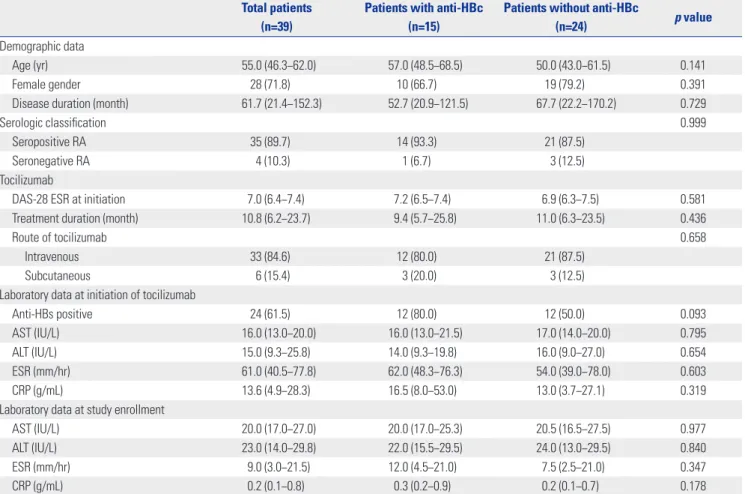
The baseline characteristics of patients are described in Table 1. The median age was 55.0, and 28 (71.8%) patients were fe-male. The median disease duration before the initiation of to-cilizumab was 61.7 months. Thirty-five (89.7%) patients were classified as seropositive RA, while only 4 patients were as sero-negative RA. Median DAS-28 ESR score at initiation of zumab was 7.0. The median treatment duration with tocili-zumab was 10.8 months.
Among the patients enrolled, 15 of 39 patients (38.5%) had anti-HBc. Since no patients had a history of chronic HBV in-fection, none received antiviral therapy for hepatitis B prophy-laxis. There were no differences in demographic data and se-rologic classification between patients with and without anti-HBc. Furthermore, variables related to tocilizumab did not differ between the two groups. In addition, patients with anti-HBc exhibited anti-HBs positivity more frequently than those without, although the difference was not significant (80.0% vs. 50.0%, p=0.093). Alterations in AST, ALT, ESR, and CRP over the duration of treatment with tocilizumab were not remark-able (Tremark-able 1).
To minimize the influence of other medications adminis-tered along with tocilizumab on HBV reactivation, we com-pared the frequencies of glucocorticoid and DMARDs and the cumulative dosages of glucocorticoid and methotrexate dur-ing the treatment duration of tocilizumab. Among the medi-cations administered, glucocorticoid was the most commonly used medication, followed by methotrexate and sulfasalazine in the both groups. We found no meaningful differences in
the frequencies of all medications between patients with and without anti-HBc. Furthermore, the cumulative dosages of both glucocorticoid and methotrexate and the cumulative dos-ages of both drugs within the first 6 months after tocilizumab initiation also did not differ (Table 2).
In this study, reactivation of HBV was defined as the presence of HBV DNA in sera. We measured HBV DNA at study enroll-ment in all 39 patients regardless of anti-HBc; however, we could find no patient in whom serum HBV DNA was detected. Therefore, we concluded that the use of tocilizumab more than Table 1. Characteristics of Patients with RA and Comparison of Variables between Patients with and without Anti-HBc
Total patients (n=39)
Patients with anti-HBc (n=15)
Patients without anti-HBc
(n=24) p value
Demographic data
Age (yr) 55.0 (46.3−62.0) 57.0 (48.5−68.5) 50.0 (43.0−61.5) 0.141
Female gender 28 (71.8) 10 (66.7) 19 (79.2) 0.391
Disease duration (month) 61.7 (21.4−152.3) 52.7 (20.9−121.5) 67.7 (22.2−170.2) 0.729
Serologic classification 0.999
Seropositive RA 35 (89.7) 14 (93.3) 21 (87.5)
Seronegative RA 4 (10.3) 1 (6.7) 3 (12.5) Tocilizumab
DAS-28 ESR at initiation 7.0 (6.4−7.4) 7.2 (6.5−7.4) 6.9 (6.3−7.5) 0.581 Treatment duration (month) 10.8 (6.2−23.7) 9.4 (5.7−25.8) 11.0 (6.3−23.5) 0.436
Route of tocilizumab 0.658
Intravenous 33 (84.6) 12 (80.0) 21 (87.5)
Subcutaneous 6 (15.4) 3 (20.0) 3 (12.5)
Laboratory data at initiation of tocilizumab
Anti-HBs positive 24 (61.5) 12 (80.0) 12 (50.0) 0.093
AST (IU/L) 16.0 (13.0−20.0) 16.0 (13.0−21.5) 17.0 (14.0−20.0) 0.795
ALT (IU/L) 15.0 (9.3−25.8) 14.0 (9.3−19.8) 16.0 (9.0−27.0) 0.654
ESR (mm/hr) 61.0 (40.5−77.8) 62.0 (48.3−76.3) 54.0 (39.0−78.0) 0.603
CRP (g/mL) 13.6 (4.9−28.3) 16.5 (8.0−53.0) 13.0 (3.7−27.1) 0.319
Laboratory data at study enrollment
AST (IU/L) 20.0 (17.0−27.0) 20.0 (17.0−25.3) 20.5 (16.5−27.5) 0.977
ALT (IU/L) 23.0 (14.0−29.8) 22.0 (15.5−29.5) 24.0 (13.0−29.5) 0.840
ESR (mm/hr) 9.0 (3.0−21.5) 12.0 (4.5−21.0) 7.5 (2.5−21.0) 0.347
CRP (g/mL) 0.2 (0.1−0.8) 0.3 (0.2−0.9) 0.2 (0.1−0.7) 0.178
Anti-HBc, positive antibody to HBV core antigen; RA, rheumatoid arthritis; DAS, disease activity score; ESR, erythrocyte sedimentation rate; Anti-HBs, antibody to HBsAg; AST, aspartate aminotransferase; ALT, alanine aminotransferase; CRP, C-reactive protein.
Values are expressed as the median (interquartile range) or number (percentage).
Table 2. Comparison of Medication Administered along with Tocilizumab between Patients with and without Anti-HBc
Medications Patients with anti-HBc (n=15) Patients without anti-HBc (n=24) p value
Glucocorticoid 14 (93.3) 21 (87.5) 0.999
Cumulative glucocorticoid dosage (mg)* 1015.0 (506.3−1760.0) 1295.0 (519.1−3073.8) 0.419 Cumulative glucocorticoid dosage within the first 6 months (mg)* 775.0 (340.0−905.0) 800.0 (452.5−1061.3) 0.523
Methotrexate 11 (73.3) 17 (70.8) 0.999
Cumulative methotrexate dosage (mg)† 557.1 (294.7−940.7) 689.6 (444.6−1156.8) 0.458
Cumulative methotrexate dosage within the first 6 months (mg)† 338.6 (266.1−490.0) 316.4 (240.0−379.8) 0.312
Leflunomide 0 (0.0) 2 (8.3) 0.514
Hydroxychloroquine 1 (6.7) 6 (25.0) 0.216
Sulfasalazine 3 (20.0) 7 (29.2) 0.711
Tacrolimus 1 (6.7) 2 (8.3) 0.999
Anti-HBc, positive antibody to HBV core antigen.
Values are expressed as the median (interquartile range) or number (percentage).
*The cumulative glucocorticoid dosage was represented in prednisolone equivalent dosage and was calculated in those treated with glucocorticoids, †The
3 months was not associated with HBV reactivation.
We also evaluated whether tocilizumab is associated with alterations in the titers of HBsAg, anti-HBc, and anti-HBs in 15 patients with resolved HBV infection. When we compared HBsAg, anti-HBc, and anti-HBs titers between at initiation of tocilizumab and at study enrollment, we could find no signifi-cant differences between the two (Fig. 1).
In this study, we investigated whether the use of tocilizumab might be associated with HBV reactivation in RA patients, par-ticularly in those with resolved HBV infection. We found that tocilizumab treatment with the median treatment duration of 9.4 months was not associated with HBV reactivation or the presence of HBV DNA in sera. Moreover, the use of tocilizumab did not contribute to alterations in HBsAg, HBc, and anti-HBs titers in patients with resolved HBV infection. There is discordance between our study and previous studies. Previ-ous studies reported that patients with autoimmune diseases accompanied by lower anti-HBs titer exhibit a higher rate of HBV reactivation13 and that TNF-α inhibitor treatment is asso-ciated with decreases in anti-HBs titers in patients with inflam-matory arthritis.14 However, in the present study, no patients with resolved HBV infection experienced HBV reactivation, and furthermore, alterations in the titers of variables related to HBV did not depend on the use of tocilizumab, unlike TNF-α inhibitor.
Worldwide, HBV infection is the most common cause of ch-ronic liver disease. South Korea is known as an endemic area of chronic HBV infection.15 Although successful implementation of national vaccination programs to eliminate HBV infection has shown progress in decreasing the prevalence of HBsAg positivity in the general population, South Korea is still classi-fied as an intermediate HBV endemic area.16 In regions with intermediate to high risk of HBV infection, the assessment of HBV reactivation following the use of biologics stands to be a clinically important issue, as RA patients often experience ele-vated liver enzymes during treatment. Because a majority of
RA patients are treated with a combination of medications, including glucocorticoids, DMARDs, and biologics, it is crucial to discriminate between viral reactivation and drug induced liver injury. The risk of HBV reactivation does not seem to be high in patients with resolved HBV infection,6 although evi-dence further indicates that biologics therapy could be associ-ated with HBV reactivation. In a recent systematic review, the estimated proportion of patients experiencing HBV reactiva-tion in those with resolved HBV infecreactiva-tion during TNF-α treat-ment was 1.7%.17 However, the risk of HBV reactivation in re-solved HBV infection due to the use of tocilizumab remains a debate: a literature review suggested that 8.6% of patients treat-ed with tocilizumab suffertreat-ed from HBV reactivation,18 while in a recent study, HBV reactivation was not reported in patients treated with tocilizumab.19,20 We assume that this discrepancy might be attributable to differences in both the definition of HBV reactivation and geographic and ethnic features. In this regard, data regarding the safety of tocilizumab in Korean pa-tients with RA regardless of resolved HBV infection would be needed; however, there are no data thereon. For these reasons, we deduced that tocilizumab may not participate in provok-ing HBV reactivation in Korean patients with RA regardless of anti-HBc positivity and that, furthermore, it may not contrib-ute to changes in the titers of variables related to HBV in pa-tients with resolved HBV infection.
The strength of this study is that it is the first to demonstrate the safety of tocilizumab in RA patients, particularly in those with resolved HBV infection, in Korea. Because anti-viral agents should be applied to all patients with chronic HBV infection before the use of biologics, in this study, we focused on HBV reactivation in patients with resolved HBV infection. However, our study has several limitations. First, we had no information on the presence of HBV DNA at initiation of tocilizumab due to the absence of HBsAg in all patients. Second, the number of patients treated with tocilizumab was relatively small with a short follow-up duration. This might have affected the nega-0.5 0.4 0.3 0.2 0.1 0.0 15 10 5 0 1000 800 600 400 200 200 150 100 50 0
HBsAg (Index) Anti-HBc (Index) Anti-HBs (IU/L)
− − − − − − − − − −
Before After Before After Before After
p=0.761 p=0.389 p=0.296
A B C
Fig. 1. Alterations in the titers of HBsAg (A), anti-HBc (B), and anti-HBs (C) in patients with resolved HBV infection. There were no meaningful differ-ences in the titers of HBsAg, anti-HBc, and anti-HBs in 15 patients with resolved HBV infection at initiation of tocilizumab and at study enrollment. HBsAg, HBV surface antigen; Anti-HBc, positive antibody to HBV core antigen; Anti-HBs, antibody to HBsAg; HBV, hepatitis B virus.
tive results that were observed in this study. In addition, it is unclear whether tocilizumab is more advantageous to TNF-α inhibitors in terms of HBV reactivation, especially in those with resolved HBV infection. Future studies with a larger num-ber of patients treated with tocilizumab will clarify the link be-tween the use of tocilizumab and HBV reactivation in RA pa-tients with resolved HBV infection.
In conclusion, the use of tocilizumab was not associated with HBV reactivation in RA patients, particularly in those with resolved HBV infection, in Korea. We suggest that tocilizumab may be safely applied in terms of HBV reactivation to RA pa-tients with HBsAg negativity and anti-HBc positivity, regard-less of anti-HBs.
ACKNOWLEDGEMENTS
This study was supported by a faculty research grant from Yon-sei University College of Medicine (6-2016-0145) to Sang-Won Lee.
This research was supported by Basic Science Research Pro-gram through the National Research Foundation of Korea (NRF) funded by the Ministry of Education (2017R1D1A1B03029050).
ORCID
Sung Soo Ahn https://orcid.org/0000-0002-9002-9880 Jun Yong Park https://orcid.org/0000-0001-6324-2224 Sang-Won Lee https://orcid.org/0000-0002-8038-3341
REFERENCES
1. Smolen JS, Aletaha D, McInnes IB. Rheumatoid arthritis. Lancet 2016;388:2023-38.
2. McInnes IB, Schett G. The pathogenesis of rheumatoid arthritis. N Engl J Med 2011;365:2205-19.
3. Smolen JS, Landewé R, Bijlsma J, Burmester G, Chatzidionysiou K, Dougados M, et al. EULAR recommendations for the manage-ment of rheumatoid arthritis with synthetic and biological dis-ease-modifying antirheumatic drugs: 2016 update. Ann Rheum Dis 2017;76:960-77.
4. Harrold LR, Peterson D, Beard AJ, Gurwitz JH, Briesacher BA. Time trends in medication use and expenditures in older patients with rheumatoid arthritis. Am J Med 2012;125:937.e9-15.
5. Trépo C, Chan HL, Lok A. Hepatitis B virus infection. Lancet 2014; 384:2053-63.
6. Loomba R, Liang TJ. Hepatitis B reactivation associated with im-mune suppressive and biological modifier therapies: current con-cepts, management strategies, and future directions.
Gastroenter-ology 2017;152:1297-309.
7. Hoofnagle JH. Reactivation of hepatitis B. Hepatology 2009;49(5 Suppl):S156-65.
8. Lee JI. Reactivation of hepatitis B virus in patients with rheumato-logic disease treated with biorheumato-logic disease modifying anti-rheu-matic drugs: screening and treatment. J Rheum Dis 2015;22:282-7. 9. Aletaha D, Neogi T, Silman AJ, Funovits J, Felson DT, Bingham CO
3rd, et al. 2010 rheumatoid arthritis classification criteria: an Amer-ican College of Rheumatology/European League Against Rheu-matism collaborative initiative. Arthritis Rheum 2010;62:2569-81. 10. Aletaha D, Neogi T, Silman AJ, Funovits J, Felson DT, Bingham CO
3rd, et al. 2010 rheumatoid arthritis classification criteria: an Amer-ican College of Rheumatology/European League Against Rheu-matism collaborative initiative. Ann Rheum Dis 2010;69:1580-8. 11. Nakamura J, Nagashima T, Nagatani K, Yoshio T, Iwamoto M,
Mi-nota S. Reactivation of hepatitis B virus in rheumatoid arthritis pa-tients treated with biological disease-modifying antirheumatic drugs. Int J Rheum Dis 2016;19:470-5.
12. Mochida S, Nakao M, Nakayama N, Uchida Y, Nagoshi S, Ido A, et al. Nationwide prospective and retrospective surveys for hepatitis B virus reactivation during immunosuppressive therapies. J Gas-troenterol 2016;51:999-1010.
13. Kato M, Atsumi T, Kurita T, Odani T, Fujieda Y, Otomo K, et al. Hep-atitis B virus reactivation by immunosuppressive therapy in pa-tients with autoimmune diseases: risk analysis in Hepatitis B sur-face antigen-negative cases. J Rheumatol 2011;38:2209-14. 14. Charpin C, Guis S, Colson P, Borentain P, Mattéi JP, Alcaraz P, et al.
Safety of TNF-blocking agents in rheumatic patients with serology suggesting past hepatitis B state: results from a cohort of 21 pa-tients. Arthritis Res Ther 2009;11:R179.
15. Yang BM, Kim CH, Kim JY. Cost of chronic hepatitis B infection in South Korea. J Clin Gastroenterol 2004;38(10 Suppl 3):S153-7. 16. Kim H, Shin AR, Chung HH, Kim MK, Lee JS, Shim JJ, et al. Recent
trends in hepatitis B virus infection in the general Korean popula-tion. Korean J Intern Med 2013;28:413-9.
17. Lee YH, Bae SC, Song GG. Hepatitis B virus (HBV) reactivation in rheumatic patients with hepatitis core antigen (HBV occult carri-ers) undergoing anti-tumor necrosis factor therapy. Clin Exp Rheu-matol 2013;31:118-21.
18. Mori S, Fujiyama S. Hepatitis B virus reactivation associated with antirheumatic therapy: risk and prophylaxis recommendations. World J Gastroenterol 2015;21:10274-89.
19. Lin CT, Huang WN, Hsieh CW, Chen YM, Chen DY, Hsieh TY, et al. Safety and effectiveness of tocilizumab in treating patients with rheumatoid arthritis - A three-year study in Taiwan. J Microbiol Immunol Infect 2017 Jul 1 [Epub]. https://doi.org/10.1016/j. jmii.2017.04.002.
20. Papalopoulos I, Fanouriakis A, Kougkas N, Flouri I, Sourvinos G, Bertsias G, et al. Liver safety of non-tumour necrosis factor inhibi-tors in rheumatic patients with past hepatitis B virus infection: an observational, controlled, long-term study. Clin Exp Rheumatol 2018;36:102-9.