Sociodemographic and health
behavioural factors associated with
access to and utilisation of eye care
in Korea: Korea Health and Nutrition
Examination Survey 2008
–2012
Tyler Hyungtaek Rim,1Moonjung Choi,1Jin Sook Yoon,1Sung Soo Kim1,2
To cite: Rim TH, Choi M, Yoon JS,et al.
Sociodemographic and health behavioural factors
associated with access to and utilisation of eye care in Korea: Korea Health and Nutrition Examination Survey 2008–2012. BMJ Open 2015;5:e007614.
doi:10.1136/bmjopen-2015-007614
▸ Prepublication history for this paper is available online. To view these files please visit the journal online (http://dx.doi.org/10.1136/ bmjopen-2015-007614). THR and MC contributed equally. Received 8 January 2015 Revised 23 April 2015 Accepted 11 May 2015 1Department of Ophthalmology, Severance Hospital, Institute of Vision Research, Yonsei University College of Medicine, Seoul, Korea
2Yonsei healthcare Big Data
based Knowledge Integration System Research Center, and Institute of Convergence Science, Yonsei University College of Medicine, Seoul, Korea
Correspondence to
Professor Sung Soo Kim; [email protected]
ABSTRACT
Objective:To determine the sociodemographic and health behavioural factors associated with access to and utilisation of eye care in Korea.
Design:Nationwide cross-sectional study
Methods:25 752 Koreans over the age of 30 were assessed from a national representative survey. We analysed independent variables of self-reporting eye clinic visits through multivariable analyses of
sociodemographic factors. The time since the last visit to an eye clinic was used to assess access to and utilisation of eye care.
Results:Of the 25 752 respondents, 8237 (32.0%) visited an eye clinic in the past year, 11 028 (42.8%) were seen more than 1 year ago, while 6487 (25.2%) had never seen an ophthalmologist. Eye clinic utilisation was statistically associated with older age, female sex, higher household income, higher education levels, living in an urban area, and having
comorbidities including diabetes and hypertension. Middle-aged men between 30 and 49 years were found to be less likely to receive eye care compared to the rest of the population, and the proportion that did plummeted after the financial crisis of 2007.
Conclusions:There is a substantial
sociodemographic disparity in eye care utilisation in Korea, and men with low financial income and education level are especially at risk. Use of eye care among middle-aged men has decreased since the global financial crisis that began in 2007, and therefore healthcare policies and public interventions should be targeted at vulnerable groups to promote access to medical care.
INTRODUCTION
There have been numerous epidemiological research studies on health disparities regard-ing accessibility and quality of care in various medicalfields. Many of these have dealt with inequalities due to racial and ethnic back-grounds,1and some have focused on minority
populations. However, reports on eye care utilisation have been published in only a few countries, including the USA, Canada and Australia.2 3 Visual impairment is a major public health concern because it not only decreases the quality of life4 by interfering with daily activities, increasing morbidity5and mortality,6 7and increasing suicidal ideation,8 but also causes a great financial burden, adding to the rapidly expanding healthcare expenditures. Although the asymptomatic nature of many eye diseases during early treat-able stages highlights the importance of timely examination, a previous study has shown that a substantial percentage of people do not seek eye care despite being at high risk for visual impairment.
The global economic crisis around 2007 had a significant impact on the Korean economy. Although the influence of the eco-nomic crisis on health is currently unknown, it is very likely that the economic recession has affected the health system. Involuntary
Strengths and limitations of this study ▪ To the best of our knowledge, this study is the
first to evaluate the association between eco-nomic crisis and eye clinic use based on a nationwide population-based survey.
▪ The economic recession that began in 2007 played a significant role in decreased use of eye care among middle-aged men, who are usually the primary providers of their household.
▪ The analyses are based on self-reported data, which are subject to recall bias. Although the study analysed the trend throughout time by using 5-year data of a national cross sectional survey which was conducted annually, it might be insufficient to completely explain a complex social phenomenon.
job loss may increase the risk of somatic illness and psy-chiatric disorders; however, other researches have empha-sised the positive effects of a contracting economy on the reduction in risky behaviour, such as driving and alcohol use.9This study aims to analyse realised access to eye care in Korea at a national level, explore the individual and contextual characteristics that may contribute to dispar-ities and barriers to care, and assess the effect of eco-nomic crisis on eye care utilisation.
METHODS Study design
A detailed description of the sampling, enumeration, visual acuity and ocular examination procedures has already been published.10 We obtained data from the Korea National Health and Nutrition Examination Survey conducted by the Korea Centre for Disease Control and Prevention (CDC) from July 2008 to December 2012, which is an ongoing nationwide cross-sectional epidemiological survey and examination of the non-institutionalised civilian population in South Korea. Annually, 4000 households in 200 enumeration districts were selected to represent the South Korean population using the stratified, multistage clustered sampling method based on the 2005 National Census ophthalmo-logical interviews, and records were collected from parti-cipants in July 2008. A detailed interviewer-administered questionnaire was conducted to collect relevant sociode-mographic and medical information. The Epidemiologic Survey Committee of the Korean Ophthalmologic Society verified the quality of the survey. All participants provided written informed consent. We followed the Declaration of Helsinki.
Economic crisis
In April 2007, New Century Financial Corp, a leading subprime mortgage leader,filed for bankruptcy, leading to the onset of a severe global recession.11The impact of the US subprime mortgage crisis on the world immedi-ately reflected on the Korean economy, and the KOSPI (Korea Stock Exchange Index) declined more rapidly than the Dow Jones Industrial Average index of the USA. Therefore, we considered that the economic recession in Korea began in 2007 and continued until 2008.
Outcome variable
Participants older than 30 years were asked when they were last administered an eye examination by an ophthal-mologist. Possible responses included ≤1 month, >1 month and ≤1 year, >1 year and ≤3 years, >3 years, or never. Using multivariable logistic analysis, the outcome measures for an association between eye clinic use and sociodemographic and health behavioural risk factors were defined as the last visit to the eye clinic being <1 year ago.
The Vision Screening Committee of AAPOS
(American Association for Pediatric Ophthalmology and Strabismus) recommends that screening should be
repeated every 1–2 years after age 5. The prevalence of myopia in young adults in their third and fourth decades of life is as high as 80% in Korea.12 The most recent eye examination guideline,13 published in 2011 by the Korean Ophthalmological Society, recommends regular screening for adults over 40 years of age, and it seems appropriate to set the ocular examination fre-quency to 1 or 2 years. Since the questionnaire in the KNHANES asked whether the participant received eye examination within the past 3 years or within 1 year, we defined the outcome measure as the last screening being <1 year ago. Many of the previous studies con-ducted in the USA used the same variable.14
Independent variables
The sociodemographic factors which were evaluated included age, sex, household income, education, having a spouse and residential area. The comorbidities, includ-ing diabetes mellitus and hypertension, and health behavioural factors, including lifetime smoking and abnormal alcohol use, were also analysed based on the self-report by a trained interviewer. Age was divided into decades (30–39, 40–49, 50–59, 60–69, and 70 and above). The income per adult equivalent was calculated by dividing the household income by the square root of number of people in the household.15 Education was grouped by the level of attainment (elementary school, middle school, high school, university or higher) and the residential area was categorised to either urban area or non-urban area (town or country). Abnormal alcohol use was defined as a score of 12 or more on the Alcohol Use Disorder Identification Test (AUDIT).16 Lifetime smokers included respondents who reported that they were current smokers and have smoked at least 100 cigarettes in their lifetime.17
Statistical analysis
The basic characteristics of the study population were reported for each of the variables by descriptive statistics. We used a two-step multidimensional approach to iden-tify the risk factors for underutilisation of eye care. ORs and 95% CIs were calculated using a univariable logistic regression analysis. A multivariable logistic regression analysis was used to determine independent risk factors. Multivariable logistic analyses were performed using those in the age group of 30–39 years as the reference group for age disparities, male for sex disparities, those with income of the lowest quintile for disparities accord-ing to income, those who received education up to the elementary school level for differences arising from edu-cational status, and having a spouse for evaluation of its relation to eye care utilisation. Urban area was used as a reference group for regional disparities. In order to evaluate the trends of screening pattern in each inde-pendent variable which were statistically significant in multivariable logistic analysis, the adjusted mean was cal-culated on the basis of the linear regression model after adjusting for other independent variables. For example,
when we calculated the adjusted mean of screening rate by age group in 2008, 2009, 2010, 2011 and 2012, we adjusted for other variables: sex, monthly house income, education, spouse, residential area, comorbidities and health behavioural factors in each year. All statistical tests were two-sided and performed with Stata/SE V.12.1 software (StataCorp, College Station, Texas, USA).
RESULTS Study cohort
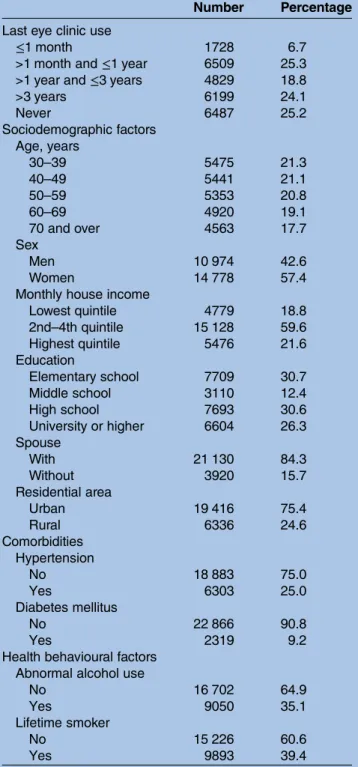
Of the 25 752 respondents, 1728 (6.7%) visited an eye clinic within 1 month, 6509 (25.3%) were seen more than 1 month ago but within the past year, 4829 (18.8%) visited an ophthalmologist more than a year ago but within the past 3 years, 6199 (24.1%) were seen more than 3 years ago, and 6487 (25.2%) had never visited an ophthalmologist. The characteristics of the study popula-tion are provided intable 1.
Eye care utilisation
The univariable and multivariable OR revealing relation-ships between the use of eye care and various individual and sociodemographic indicators is presented intable 2. Multivariable analysis was performed on outcome vari-ables of participants who did or did not receive an eye examination within 1 year. Age had positive correlation with eye care utilisation, and women were seen more than men. Household income (highest quintile) and education level (university or higher) were associated with increased eye care utilisation (table 2). The subjects living in urban areas were more likely to utilise eye care than those living in rural areas. Participants with hyper-tension or diabetes mellitus were more likely to visit ophthalmologists than those without the comorbidities. Aabnormal alcohol use and smoking did not have a sig-nificant association with eye care utilisation.
Trend in each sociodemographic factor
Figure 1delineates the trend of each variable from 2008 to 2012. The elderly (≥60 years of age) were not only more likely to seek eye care, but also the percentage of those who received an eye examination increased throughout the period. In contrast, there was a decreas-ing or at most a consistent trend in other age groups (30–59), notably between 2009 and 2010. Females were more likely to utilise eye care than males and the trend was generally increasing for females, whereas a sharp decline was noted between 2009 and 2010, and between 2011 and 2012, for males. As for the household income, there was a steep increase for those in the lowest quintile group and the 2nd–4th quintile group, despite a decreasing trend in the highest quintile group, espe-cially between 2009 and 2010. Those with the highest education attained at the elementary school level showed an increasing tendency to utilise eye care between 2008 and 2009, but it decreased rapidly between 2009 and 2010. Those without a spouse were
less likely to visit an eye clinic between 2008 and 2009. People living in the urban area were more likely to visit ophthalmologists, compared with people living in the rural area. Males aged between 30 and 59 years were categorised as the weak group, and when this group was compared with the other participants, not only were they less likely to utilise eye care, but there was a steep decline between 2009 and 2010, and between 2011 and 2012, which consequently led to a slowing down of the generally increasing tendency of eye care utilisation in
Table 1 The characteristic of the study population (n=25 752)
Number Percentage Last eye clinic use
≤1 month 1728 6.7
>1 month and≤1 year 6509 25.3 >1 year and≤3 years 4829 18.8
>3 years 6199 24.1 Never 6487 25.2 Sociodemographic factors Age, years 30–39 5475 21.3 40–49 5441 21.1 50–59 5353 20.8 60–69 4920 19.1 70 and over 4563 17.7 Sex Men 10 974 42.6 Women 14 778 57.4
Monthly house income
Lowest quintile 4779 18.8 2nd–4th quintile 15 128 59.6 Highest quintile 5476 21.6 Education Elementary school 7709 30.7 Middle school 3110 12.4 High school 7693 30.6 University or higher 6604 26.3 Spouse With 21 130 84.3 Without 3920 15.7 Residential area Urban 19 416 75.4 Rural 6336 24.6 Comorbidities Hypertension No 18 883 75.0 Yes 6303 25.0 Diabetes mellitus No 22 866 90.8 Yes 2319 9.2
Health behavioural factors Abnormal alcohol use
No 16 702 64.9
Yes 9050 35.1
Lifetime smoker
No 15 226 60.6
the Korean population (figure 2). The screening rate for males between the ages of 30 and 39 gradually decreased over time.
DISCUSSION
According to the guidelines on comprehensive eye examination published by the American Academy of Ophthalmology,18 a yearly examination is recommended for those over the age of 65 years. Patients with diabetes or risk factors for glaucoma should be seen every 2– 4 years between the ages of 40 and 54 years and every 1– 3 years between the ages of 55 and 64 years. However, despite such importance, less than one-third of the parti-cipants studied received eye care within the past year, and a quarter had never had an eye examination. Eye
care utilisation was associated with age, female sex, household income, education level, residential area and comorbidities. Furthermore, this study unveiled a vulner-able group of the population: men aged between 30 and 59 years were less likely to utilise eye care after the finan-cial crisis.
Sociodemographic factors and eye care
Studies on the association of sociodemographic factors and eye care utilisation have previously been conducted mostly in the USA. Zhang et al14reported that age, edu-cational level, income, insurance, sex, diabetes and ocular disease were associated with eye care. A study on American women found that age, education, region and race were associated with having an eye examination Table 2 Factors associated with use of eye clinic—multivariable analysis (n=25 752)
Within one year Never been
Univariable OR Multivariable OR 95% CI p Value Sociodemographic factors Age, years 30–39 1.0 (ref) 1.0 (ref) 40–49 1.2 1.3 (1.2 to 1.4) <0.01 50–59 1.4 1.5 (1.3 to 1.6) <0.01 60–69 1.9 2.1 (1.9 to 2.4) <0.01 70 and over 1.9 2.2 (1.9 to 2.4) <0.01 Sex
Men 1.0 (ref) 1.0 (ref)
Women 1.2 1.2 (1.1 to 1.3) <0.01
Monthly house income
Lowest quintile 1.0 (ref) 1.0 (ref)
2nd–4th quintile 0.8 1.0 (0.9 to 1.1) 0.87
Highest quintile 0.9 1.1 (1.0 to 1.3) <0.01
Education
Elementary school 1.0 (ref) 1.0 (ref)
Middle school 0.9 1.1 (1.0 to 1.2) 0.19
High school 0.7 1.1 (1.0 to 1.2) 0.04
University or higher 0.8 1.3 (1.2 to 1.4) <0.01
Spouse
With 1.0 (ref) 1.0 (ref)
Without 1.2 1.0 (0.9 to 1.1) 0.94
Residential area
Urban 1.0 (ref) 1.0 (ref)
Rural 0.8 0.8 (0.7 to 0.8) <0.01 Comorbidities Hypertension No 1.0 (ref) 1.0 (ref) Yes 1.5 1.2 (1.1 to 1.3) <0.01 Diabetes mellitus No 1.0 (ref) 1.0 (ref) Yes 1.7 1.4 (1.3 to 1.5) <0.01
Health behavioural factors Abnormal alcohol use
No 1.0 (ref) 1.0 (ref)
Yes 1.0 1.0 (0.9 to 1.0) 0.42
Lifetime smoker
No 1.0 (ref) 1.0 (ref)
within the past 2 years.19 Age, sex, ability to speak English, education, insurance, having a usual place for care, having a regular provider of care, a greater number of comorbidities, visual impairment and lower vision-specific quality of life scores were associated with eye care utilisation in Latinos living in America.20 In a study of Americans aged over 65 years, race, visual impairment, education, age, diabetes and driving ability were associated with ophthalmological examination.21 Numerous other studies published elsewhere, including Canada22 and Australia,2 3 reported similar findings on the association of sociodemographic factors and eye care utilisation.
The increasing trend of eye care utilisation with age, as revealed in table 2, is likely to reflect on the growing demand for eye care because the elderly are at a higher risk of developing age-related eye diseases and condi-tions. Koreans generally retire from work in their mid-60s; since the elderly are less likely to be engaged in economic activities, they are more likely to have time
available for healthcare activities as well as the need for medical services compared to younger people. On the other hand, people in their 30s or 40s who are finan-cially active are less likely to utilise eye care due to time constraints and absence of need. The significant differ-ence in eye care utilisation between males and females coincides with our results from a previous study23on the screening of diabetic retinopathy, in which females were four times more likely to receive eye examination than males. The household income was not a barrier to eye care because of the national health insurance system in Korea. Those with the lowest quintile income were more likely to receive eye care than those in the highest income group, and the difference of the effect size was small (OR=1.1). Regarding sex, females had a higher screening rate than males, which may be due to the fact that in Korea fewer women have occupations compared to men, and therefore they have more spare time in which to be screened. Education level had a positive cor-relation with eye care, and those who graduated from Figure 1 Adjusted mean of screening rate trend of each sociodemographic factor from 2008 to 2012 in subgroups including (A) age, (B) gender, (C) income, (D) education, (E) spouse and (F) residential area. The adjusted mean was calculated on the basis of the linear regression model after adjusting for other independent variables. For example, when we calculated the adjusted mean of screening rate by age group in 2008, 2009, 2010, 2011 and 2012, we adjusted for other variables: sex, monthly house income, education, spouse, residential area, hypertension, diabetes mellitus and health behavioural factors in each year.
high school and university were more likely to receive eye examination than those with the highest education level attained at elementary school (OR 1.1 and 1.3, respectively). The emphasis on eye screening for the less educated group should be encouraged to avoid social inequality. As for the question of residential area, people in urban areas were more likely to use eye care than those in rural areas. This is most likely due to the lack of access to healthcare in rural areas, and the fact that low-educated people are more likely to live in rural areas even after adjusting for education level in the analysis. People with comorbidities including hypertension and diabetes are more likely to utilise medical care for the management of their conditions, and therefore are more likely to be encouraged to receive regular eye examinations. Patients with diabetes, especially, are fre-quently referred by internists to visit ophthalmologists for screening of diabetic retinopathy. Considering the effect of sociodemographic factors associated with eye care utilisation overall, males with low education level residing in rural areas are most vulnerable to not receiv-ing routine eye examination.
Economic crisis
The association of each factor with eye care utilisation should be carefully analysed in relation to the economic crisis. Although the need for eye care is generally less in younger people, the financial matter should also be taken into consideration since the decreasing trend between 2009 and 2010 may be attributed to the finan-cial crisis in 2007. The eye care utilisation rate was lower in the male population overall, and the decreasing trend between 2009 and 2010 was prominent in this subgroup (figure 1B and figure 2). This could be due to the fact that males are more likely to be engaged in financial activities than females. The high income group showed the highest eye care utilisation rate compared to other groups, but at the same time they were most susceptible
to the economic recession. Education level had a posi-tive correlation with eye care. Overall, the eye care util-isation of male, high-income group, people in their thirties, the low-educated and rural residents declined after the economic crisis.
The disparity between the urban and rural areas could be due to factors other than the economic crisis, such as accessibility and income. However, since the decreasing trend between 2009 and 2010 was proven in most of the sociodemographic factors studied, it can be safely con-cluded that it is likely to be due to thefinancial crisis in 2007–2008. Financially, males in their 30s and 40s are most active, and therefore they are most vulnerable to the economic crisis. The impact is likely to increase if they have either a low level of education or high income.
A few reasons that could explain such a phenomenon are lack of time, indifference andfinancial burden. The fact that the decreasing tendency of eye care utilisation in this group was most remarkable between 2009 and 2010 implies that the global financial crisis at the time, leading to high unemployment rates and unstable eco-nomic situations, could have hindered access to care.
Owing to Korea’s national public health insurance and affordable healthcare costs, health insurance was a variable that was not considered to be as much a barrier to eye care as it was in many other countries.24 In fact, the 2006–2009 Behavioural Risk Factor Surveillance System surveys by the CDC reported that eye care costs and lack of insurance (39.8%) or absence of need (34.6%) were the most common reasons given for not seeking eye care.25 In countries like the USA, where the national health data are primarily collected by race,26 many studies have included race and ethnicity as dependent variables. However, the lack of multicultural-ism in Korea rendered such trials impossible. Therefore, we focused instead on the sociodemographic and indi-vidual factors to analyse disparities in eye care. Risk Figure 2 Unadjusted mean of screening rate in the weak group (males aged 30–59) versus other. (A) The graph compares the trend in eye care utilisation between the weak group versus others. The trend shows an increasing tendency overall, but slowed down between 2009 and 2010, which is likely to be due to the plummeting trend of the weak group classified as men aged between 30 and 59 years. The screening rate of men between ages 30 and 59 years (B and C) after 2009 gradually decreased over time.
factors should be taken into consideration when promot-ing education programmes and campaigns targeted at weak social groups that are vulnerable to both eye care and health examination.
A longitudinal analysis has revealed that persons with more regular eye examinations were less likely to experi-ence a decline in vision or functional status.27Since one of the top two reasons for individuals not seeking eye care is perceived absence of need, possible solutions to inad-equate eye care utilisation may include public health inter-ventions aimed at heightening awareness. Previous studies that reported success in increasing eye care utilisation after an eye survey28 and an eye health promotion cam-paign29 hinted at the importance of shaping policies and developing targeted interventions to disseminate effective public health messages. Securing access to and use of medical services by resolving the regional disparity in the availability of ophthalmologists will be necessary to help resolve sociodemographic disparities in eye care, as access to a regular source of care alone has been shown to miti-gate health status disparities.30 Implementing these mea-sures should reduce disparities in healthcare quality based on patients’ individual and socioeconomic status and facili-tate progress towards eliminating health disparities.
This study has several limitations. KNHANES is an annu-ally conducted cross-sectional study, and therefore although the association between variables can be con-cluded, the causal relationships cannot be defined. The decreasing trend after the global economic crisis in 2007 can be estimated by evaluating a 5-year trend of each vari-able, but again the exact correlation cannot be deter-mined. However, the decrease in eye care utilisation in middle-aged men, who are the lead contributors to the national economy, after thefinancial crisis was unequivo-cal. Further observation and evaluation on the change in health behaviour after economic recession over longer period of time are needed to provide more solid evidence. Also, the analyses were based on self-reported data, which are subject to recall bias. It is likely to be inaccurate espe-cially when reporting for income in times of economic fluctuations because of the tendency to hide their income. The retrospective questions regarding eye clinic visits may be imprecise especially in the elderly due to memory loss. However, the decreasing trend in the high income group after thefinancial crisis seemed to be distinct from that in the other groups, and the elderly were more likely to receive eye care than the young population; therefore, the recall bias of the self-reported data is likely to have little effect on the results. Lastly, the health behaviour of Koreans may be different from those in other countries, since the Korean health system provides universal insur-ance coverage and affordable medical costs.
CONCLUSION
We observed that sociodemographic inequity was evident with more eye clinic visits being associated with older age groups, female sex, higher education, higher
household income and urban residence. Middle-aged men were especially vulnerable to financial hardships and the screening rate was still low even after the passage of several years since the economic crisis in 2007–2008. Increasing public education and improving access to eye care through targeted interventions will play an important role in improving utilisation rates and consequently reducing visual impairment.
Contributors THR and MC wrote the manuscript and interpreted the results. THR and JSY performed the statistical analysis. SSK conceived of the study and participated in its design and coordination, while SSK and JSY helped to draft the manuscript. All authors read and approved the final manuscript.
Funding This research was supported by a grant of the Korea Health Technology R&D Project through the Korea Health Industry Development Institute (KHIDI), funded by the Ministry of Health & Welfare, Republic of Korea (Grant number: HI13C1485).
Competing interests None declared.
Ethics approval Institutional Review Board of the Korea Centre for Disease Control and Prevention.
Provenance and peer review Not commissioned; externally peer reviewed.
Data sharing statement The Korea National Health and Nutrition Examination Survey (KNHANES) is a nationally representative survey conducted by the Ministry of Health and Welfare, which provides data on vision status, healthcare use and other sociodemographic factors. The results and statistics of KNHANES are readily available at http://knhanes.cdc.go.kr.
Open Access This is an Open Access article distributed in accordance with the Creative Commons Attribution Non Commercial (CC BY-NC 4.0) license, which permits others to distribute, remix, adapt, build upon this work non-commercially, and license their derivative works on different terms, provided the original work is properly cited and the use is non-commercial. See: http:// creativecommons.org/licenses/by-nc/4.0/
REFERENCES
1. Shavers VL, Shavers BS. Racism and health inequity among Americans. J Natl Med Assoc 2006;98:386–96.
2. Bylsma GW, Le A, Mukesh BN, et al. Utilization of eye care services by Victorians likely to benefit from eye care.Clin Experiment Ophthalmol2004;32:573–7.
3. Wang JJ, Mitchell P, Smith W. Use of eye care services by older Australians: the Blue Mountains Eye Study.Aust N Z J Ophthalmol
1999;27:294–300.
4. Brown MM, Brown GC, Sharma S, et al. Quality of life associated with visual loss: a time tradeoff utility analysis comparison with medical health states.Ophthalmology2003;110:1076–81. 5. Lee DJ, Gomez-Marin O, Lam BL, et al. Visual impairment and
morbidity in community-residing adults: the national health interview survey 1986–1996.Ophthalmic Epidemiol2005;12:13–17. 6. Lee DJ, Gomez-Marin O, Lam BL, et al. Visual acuity impairment
and mortality in US adults.Arch Ophthalmol2002;120:1544–50. 7. McCarty CA, Nanjan MB, Taylor HR. Vision impairment predicts
5 year mortality.Br J Ophthalmol2001;85:322–6.
8. Rim TH, Lee CS, Lee SC, et al. Influence of visual acuity on suicidal ideation, suicide attempts and depression in South Korea.
Br J Ophthalmol 2015. Published Online First: 2 Mar 2015. doi:10.1136/bjophthalmol-2014-306518
9. Catalano R. Health, medical care, and economic crisis.N Engl J Med2009;360:749–51.
10. Yoon KC, Mun GH, Kim SD, et al. Prevalence of eye diseases in South Korea: data from the Korea national health and nutrition examination survey 2008–2009.Korean J Ophthalmol
2011;25:421–33.
11. Reinhart V. A year of living dangerously: the management of the financial crisis in 2008.J Econ Perspect2011;25:71–90. 12. Kim EC, Morgan IG, Kakizaki H, et al. Prevalence and risk factors
for refractive errors: Korean National Health and Nutrition Examination Survey 2008–2011.PLoS ONE2013;8:e80361. 13. Korean Ophthalmological Society, Ministry of Health and Welfare,
go.kr/CDC/cms/cmsFileDownload.jsp?fid=3030&cid=21844& fieldName=attachGrp&index=10
14. Zhang XZ, Saaddine JB, Lee PP, et al. Eye care in the United States—do we deliver to high-risk people who can benefit most from it?Arch Ophthalmol2007;125:411–18.
15. Deaton A, Lubotsky D. Mortality, inequality and race in American cities and states.Soc Sci Med2003;56:1139–53.
16. Kim JS, Oh MK, Park BK, et al. Screening criteria of alcoholism by alcohol use disorders identification test (AUDIT) in Korea. J Korean Fam Med 1999;20:1152–9.
17. Centers for Disease Control and Prevention (CDC). Cigarette smoking among adults—United States 1992 and changes in the definition of current cigarette smoking. MMWR Morb Mortal Wkly Rep 1994;43:342–6.
18. American Academy of Ophthalmology. Preferred practice patterns: comprehensive adult medical eye evaluation. Secondary Preferred practice patterns: comprehensive adult medical eye evaluation. 2011. http://one.aao.org/CE/PracticeGuidelines/PPP_Content.aspx? cid=64e9df91-dd10-4317-8142-6a87eee7f517
19. Schaumberg DA, Christen WG, Glynn RJ, et al. Demographic predictors of eye care utilization among women.Med Care
2000;38:638–46.
20. Morales LS, Varma R, Paz SH, et al. Self-reported use of eye care among Latinos: the Los Angeles Latino Eye Study.Ophthalmology
2010;117:207–15.e1.
21. Orr P, Barron Y, Schein OD, et al. Eye care utilization by older Americans: the SEE project. Salisbury Eye Evaluation.
Ophthalmology1999;106:904–9.
22. Jin YP, Trope GE. Eye care utilization in Canada: disparity in the publicly funded health care system.Can J Ophthalmol
2011;46:133–8.
23. Rim THT, Byun IH, Kim HS, et al. Factors associated with diabetic retinopathy and nephropathy screening in Korea: the Third and Fourth Korea National Health and Nutrition Examination Survey (KNHANES III and IV).J Korean Med Sci2013;28:814–20. 24. Zhang X, Lee PP, Thompson TJ, et al. Health insurance
coverage and use of eye care services.Arch Ophthalmol
2008;126:1121–6.
25. Centers for Disease Control and Prevention. Reasons for not seeking eye care among adults aged≥40 years with moderate-to-severe visual impairment—21 States, 2006–2009. MMWR Morb Mortal Wkly Rep 2011;60:610–13.
26. Williams DR. Race/ethnicity and socioeconomic status: measurement and methodological issues.Int J Health Serv1996;26:483–505. 27. Sloan FA, Picone G, Brown DS, et al. Longitudinal analysis of the
relationship between regular eye examinations and changes in visual and functional status.J Am Geriatr Soc2005;53:1867–74.
28. Fong CS, Wang JJ, Rochtchina E, et al. Survey effect on use of eye care by older persons with correctable visual impairment.
Ophthalmic Epidemiol2009;16:249–53.
29. Muller A, Keeffe JE, Taylor HR. Changes in eye care utilization following an eye health promotion campaign.Clin Experiment Ophthalmol2007;35:305–9.
30. Politzer RM, Yoon J, Shi L, et al. Inequality in America: the contribution of health centers in reducing and eliminating disparities in access to care.Med Care Res Rev2001;58:234–48.