© Korean Powder Metallurgy Institute 727
-1. Introduction
This study investigates the reactive sintering of Ti and Al for the obtaining of TiAl[i]. Different sintering cycles were employed to study the influence of the SHS reaction on the final material. After previous works [ii,iii,iv] showing the benefits of mechanical alloying [v,vi] on TiAl formation, Ti and Al powders were high-energy milled (HEM) to compare its behavior during sintering versus conventionally blended powders.
2. Experimental and Results
Elemental Ti (<45 µm) and Al (-90 +45 µm) powders with a purity of 99,7% and 99% respectively were used as starting powders. Pressing and sintering were performed with blended as received elemental powders and also with powders processed by high-energy milling. Materials obtained by adding HEM powder to the blended powders were also studied. Both milling and blending processes were carried out with a 40 wt.% Al – 60 wt.% Ti proportion to obtain the TiAl composition. Blending was conducted in a turbula for 30 minutes, and high-energy milling in a planetary mill Fritsh Pulverissette using Co-WC vessel and balls, under argon atmosphere. The processing parameters were as follows: balls with diameter of 10mm, the ratio of balls to powder 10:1 in weight, and the rotating speed was set as 400 rpm. Blended powders were uniaxially pressed at 400MPa, while HEM-powders were isostatically pressed (300MPa-5min) due to the difficulty encountered in uniaxial pressing. Compacts were submitted to different thermal cycles, all of them performed in a high vacuum furnace (10-4 mbar). Different thermal cycles were carried out to study the diffusion processes and sintering behavior
of the materials. These cycles are intended to achieve the diffusion of Ti and Al at temperatures below the SHS ignition temperature. Different pre-sintering cycles were performed at low temperatures before the sintering cycle. The pre-sintering stage is intended to promote diffusion of Al atoms into Ti particles, forming intermetallic areas (TiAl, TiAl3, etc) that isolate elemental powder particles and thereby avoiding the ignition of SHS reaction. Subsequently, during the sintering stage the densification of the material should proceed unimpeded. The heating and cooling rates were set to 5ºC/min in all heat cycles.
A microstructural study was performed by scanning electron microscopy (SEM), and the phases were identified with the aid of Energy Dispersive X-Ray Spectroscopy (EDX) and X-Ray Diffraction (XRD).
Blended powders. Three pre-sintering temperatures were
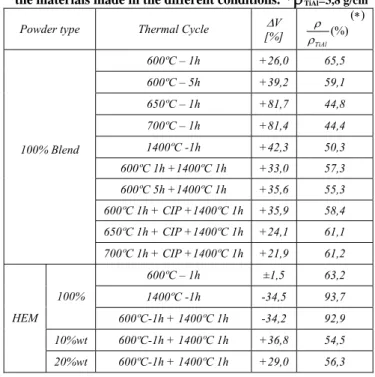
used: 600ºC, 650ºC and 700ºC, which are close to the SHS ignition temperature of the Ti-Al system (645ºC±5ºC) [vii]. The results obtained from the blended powder showed that materials treated at 600ºC for 60 minutes had a different behavior than materials treated at 650ºC and 700ºC, where the latter two showed more dimensional changes than the samples treated at 600ºC (see Table 1). In all cases, the samples were found to swell up during the pre-sintering treatment. Densification of these materials will be probably hindered by this fact. It was observed that as diffusion took place, aluminum diffused into Ti particles and intermetallics formed in the periphery of Ti particles by reaction of both elements, leaving a high amount of porosity in the places of the former Al particles. This phenomenon of porosity generation is known as ‘Kirkendall effect’, observed in this system by some authors [8].
2006 POWDER METALLURGY World Congress
C02-03-3
Influence of High-energy Milling and Sintering Cycle on Obtaining of TiAl from
Elemental Ti and Al Powders
P.G.Esteban1,a, E.Gordo1,b, E.M. Ruiz-Navas1,c 1
Department of Materials Science and Engineering, Universidad Carlos III de Madrid, Avda. de la Universidad, 30, 28911 Leganés (Spain)
a
[email protected], [email protected], [email protected]
Abstract
The present work studies the influence of high-energy milling (HEM) and sintering cycle of Ti and Al powders on the obtainment of TiAl. This study shows that HEM modifies the diffusion processes during the sintering stage. The samples were obtained by cold uniaxial and isostatic pressing, pre-sintered at different temperatures, and heated up to the sintering temperature. This study also shows the effect of powder additions processed by HEM on the sintering behavior of elemental Ti and Al powders.
© Korean Powder Metallurgy Institute 728
-Table 1.Values of volume change and finalrelative densities of the materials made in the different conditions.(*)
ρ
TiAl=3,8 g/cm3
Powder type Thermal Cycle ∆V
[%] (%) TiAl ρ ρ (∗) 600ºC – 1h +26,0 65,5 600ºC – 5h +39,2 59,1 650ºC – 1h +81,7 44,8 700ºC – 1h +81,4 44,4 1400ºC -1h +42,3 50,3 600ºC 1h +1400ºC 1h +33,0 57,3 600ºC 5h +1400ºC 1h +35,6 55,3 600ºC 1h + CIP +1400ºC 1h +35,9 58,4 650ºC 1h + CIP +1400ºC 1h +24,1 61,1 100% Blend 700ºC 1h + CIP +1400ºC 1h +21,9 61,2 600ºC – 1h ±1,5 63,2 1400ºC -1h -34,5 93,7 100% 600ºC-1h + 1400ºC 1h -34,2 92,9 10%wt 600ºC-1h + 1400ºC 1h +36,8 54,5 HEM 20%wt 600ºC-1h + 1400ºC 1h +29,0 56,3
Samples were also sintered starting with a pre-sintering stage of 1 hour at 600ºC followed by 1 hour at 1400ºC. The microstructure obtained showed a high amount of interconnected porosity revealing the difficulty for being sintered. Rising the pre-sintering time up to 5h, no major changes were observed in the microstructure. An intermediate pressing stage (by cold isostatic pressing) between the pre-sintering and sintering steps, did not actually improved the densification of the materials. As long as Al particles remained after the presintering step, little improvements were found. The values of volume change and relative density for samples after the different sintering cycles are shown in Table 1.
Influence of high-energy milling (HEM). Sintered
materials from powder processed by HEM showed a shrinkage value of about 35% after sintering, and their microstructures showed lower porosity compared to materials made from blended powders. Three phases appeared in the microstructures: TiAl, Al2O3 and AlTi2C. There appeared a very small quantity of porosity, with a pore size generally lower than the size of Al2O3. Furthermore, the pore size of these materials (generally smaller than 10µm) was smaller than the pores of the materials made from blended powder.
To study the influence of additing HEM powder on blended powders, 10 wt.% and 20 wt.% of HEM powder were added to the blended powders, pressed uniaxially at 700MPa, and sintered. These materials showed similar dimensional change and porosity than that obtained from blended powders under the same processing conditions.
3. Summary
Sintered materials made from blended elemental powders showed porous microstructures and a great swelling during sintering (between 20% and 40%). Porosity seems to be caused by the Kirkendall effect and by the SHS reaction between Ti and Al. The pre-sintering stage produced the diffusion of Al in Ti, and below the SHS ignition temperature, the Kirkendall effect seemed to be the responsible of the swelling. Re-pressing after the pre-sintering stage, did not seem to contribute to lowering the amount of porosity in the sintered materials, although the pore morphology becomes more rounded.
The high-energy milling process produced powder suitable for producing materials with high densities (94% aprox.), and volume shrinkage values around 35%. However the sintered material contained some amount of Al2O3 and AlTi2C in the microstructures, what makes the process in the present study suitable for the manufacture of composite materials, but not for pure TiAl.
The addition of high-energy milled powder contents (up to 20 wt.%) to the blended powders did not seem to enhance the densification of the blended powders.
4. References
[1] W.J. Zhang, B.V. Reddy, S.C. Deevi, Physical properties of TiAl-base alloys, Scripta Materalia 45 (2001), 645-651
[2] Prajina Bhattacharya, Pascal Bellon, Robert S. Averback, Stephen J. Hales, Nanocrystalline TiAl powders synthesized by high-energy ball milling: effects of milling parameters on yield and contamination, Journal of Alloys and Compounds 368 (2004) 187–196
[3] C. Suryanarayana, Guo-Hao Chen, Abdulbaset Frefer and F. H. Froes , Structural evolution of mechanically alloyed Ti-Al alloys, Materials Science and Engineering A, 158, (1992) 93-101
[4] C.Suryanarayana, R. Sundaresan and F. H. Froes, TiAl formation by mechanical alloying, Materials Science and Engineering A, 150 (1992) 117-121
[5] C.Suryanarayana, Mechanical alloying and milling, Progress in Materials Science, 46 (2001) 1-184
[6] D.L. Zhang, Processing of advanced materials using high-energy mechanical milling,49 (2004) 537-560 [7] N. Bertolino, M.Monagheddu, A.Tacca, P.Giuliani, C.
Zanotti, Ignition mechanism in combustion synthesis of Ti-Al and Ni-Ti systems, Intermetallics 11 (2003) 41-49
[8] M.Dahms, Formation of titanium aluminides by heat treatment of extruded elemental powders, Materials Science and Engineering A 110 (1989) L5-L8