DC 그리드 연계 된 효율적인 DC-DC 승압 컨버터
이바둘라예브 안바르, 박성준
전남대학교 전기공학과
An Efficient Step-Up DC-DC Converter for DC Grid Applications
Ibadullaev Anvar
1, Jung-Sun Park
Chonnam National University
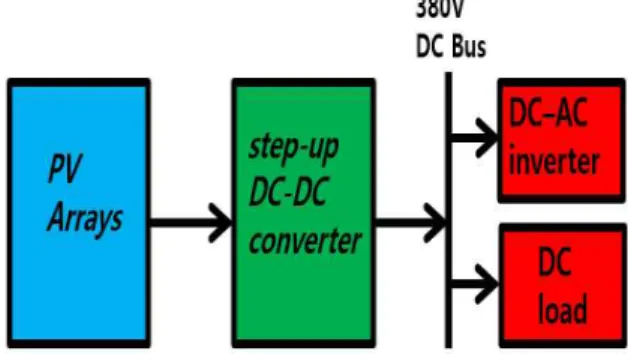
Fig. 1 A typical voltage step-up converter connection circuit.
Fig 2. Circuit configuration of the proposed topology.
ABSTRACT
In recently days using distributed power generation systems constructed with boost type dc-dc converters is being extremely popularized because of the rising need of environment friendly energy generation power systems. In this paper a new constructed An efficient Step-Up DC-DC Converter for DC Grid Applications s proposed to boost a low level DC voltage(36-80V) to high DC bus (380V) level. When comparing to other step-up converters, the proposed topology has a reduced number of switching devices, can make high quality power with lower input current ripple and has wider input DC voltage range. Finally, the performance of the proposed topology is presented by simulation results with 350W hardware prototype.
1. INTRODUCTION
The increasing energy crisis due to fossil fuel sources for power generation has resulted in an increased demand on renewable sources of energy. A solar based power generations could play the most important role in solving the energy crisis but requires some solutions that can work in weak sun conditions.
The method for harvesting solar energy is to connect solar panels in series or parallel to get required voltage and power levels[1-2]. This method has some limitations in terms of efficiency and reliability. DC-AC grid-tied inverter which is connected to PV panels require at least 320V DC to inject solar harvested power to AC grid. If there is a sun-rich conditions, PV panel arrays can produce high DC voltages, but in the worst climate conditions PV panel arrays cannot make the required DC voltage. Thus there is a need a some power converter which lifts PV voltage to meet the optimum voltage level. Fig. 1 shows a typical solar power generation system connecting PV panel with DC Grid. Many PV panels employing step-up DC-DC converters have included the switched-inductor and switched-capacitor type boost topologies [3-4]. These types of converters are able to produce high voltage output without using any
isolated transformers. However, the large number of components, especially power semiconductors, can reduce the efficiency and reliability of the system.
In this paper an efficient solar power optimizer for single phase grid-tied PV modules is proposed to make a high gain DC voltage level. The proposed topology has many advantages, such that decreased stress voltage for active and passive elements, wider input voltage range, continuous input current and simple control method. Comparing to another step-up converters, the proposed topology can create high voltage gain in lowered duty cycle with low power losses.
91
c)
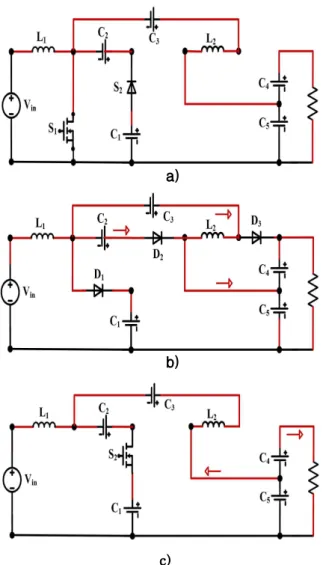
Fig. 3. Switching operating modes of the proposed topology. a) mode; b) mode; c)
mode.
c)
Fig. 4. Simulation results of the proposed topology under CCM condition. a)(red),(blue) and
(green); b)(red),(blue) and (green); c)
(red),
(blue) and(green). a)
b)
a)
b)
2. THE CIRCUIT CONFIGURATION
The proposed topology circuit configuration is presented in Fig. 2. As seen, two switches, three diodes, two inductors and five capacitors are used to make the hardware structur e. Two switches operate in the same duty value, but their PWM signals have phase shifting. Output DC voltage can be made by summing two output capacitors voltage.
3. OPERATING PRINCIPLES OF THE PROPOSED TOPOLOGY
The proposed topology operation can be divided into three modes under CCM operation as shown in Fig. 3(a), 3(b) and 3(c). In () mode and inductors, and
capacitors are charged. The other capacitors are discharged. In mode both the switches are switched off. In this mode capacitor is charged through inductor.
Output load voltage is formed by summing ,
and capacitors voltages. In the next mode
capacitor voltage divided through , and capacitors.
The load is supplied by summing and capacitors voltages. Applying KVL at all three switching modes the following equations can be obtained :
(1) (2) (3) (4) where is voltage gain and is output voltage of
the proposed topology.
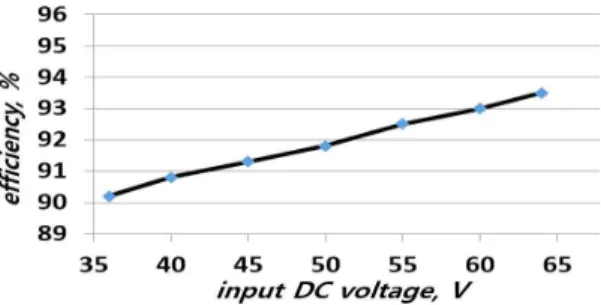
-Fig. 5 Power efficiency graph in variable input DC voltage values.
(4) equation shows that duty value of the proposed topology should be in [ ] interval.
4. SIMULATION RESULTS
In order to verify the performance of the proposed topology the simulation was carried out using PSIM 9.1 software tool. Simulation parameters are that : =36V, = 380V, = 350W, = 30kHz, all the capacitors
have 820 capacitance and .
Fig. 3 shows the simulation results when input DC voltage is 36V. It is obvious that drain-source voltage of switches have been decreased and input current ripple in desirable range. It can be noticed that the output voltage is formed by summing output and capacitors voltages
as seen from Fig. 3(a). Fig. 5 shows the measured efficiency plot of the proposed topology when = 350W
at different input condition.
5. CONCLUSIONS
A new topology of an efficient step-up DC-DC converter for DC Grid applications is proposed in this paper for renewable power sources. All the elements stress voltages are decreased to optimum value and operating dut value is limited in desirable value, so the efficiency of the proposed topology is increased. And also control method of the proposed topology is simple. It has been verified from the simulation experiments that the proposed topology can obtain the theoretical voltage gain.
REFERENCES
[1] A. Priyadarshi, P. K. Kar, and S. B. Karanki, “Switched Capacitor based High Gain DC-DC Converter Topology for Multiple Voltage Conversion Ratios with Reduced Output Impedance,” Journal of Power Electronics, Vol. 19, No. 3, pp. 676-690, 2019, May. [2] M. Forouzesh, Yam P. Siwakoti, Saman A. Gorji, F.
Blaalberg and B. Lehman, “Step-up DC-DC Converters: A Comprehensive Review of Voltage-Boosting Techniques, Topologies and Applications”, IEEE Transactions on Power Electronics, Vol. 32, No. 12, pp.
9143-9178, 2017, Dec.
[3] S.-Z. Chen, Z. Wang, S. S. Yu, G. Zhang, and Y. Zhang, “A Novel Alternative to Traditional nHSLC: An n-Switched-Cell Based Approach to High-Step-up Converters,” IEEEAccess, Digital Object Identifier 10.1109/ACCESS.2019.2935753.
[4] J. Liu, Sh. Cheng, A. Shen, “A High Efficiency Two-stage Inverter for Photovoltaic Grid-connected Generation Systems,” Journal of Power Electronics, Vol. 17, No. 1, pp. 200-211, Jan. 2017.