Research Article
Effect of Garnet Characteristics on Abrasive Waterjet Cutting of
Hard Granite Rock
Tae-Min Oh,
1Gun-Wook Joo,
2Yohan Cha,
3and Gye-Chun Cho
41Assistant Professor, Department of Civil and Environmental Engineering, Pusan National University (PNU), Busan 46241,
Republic of Korea
2Researcher, The 4thR&D Institute-3rdDirectorate, Agency for Defense Development, Daejeon 34186, Republic of Korea
3Ph.D. Candidate, Department of Civil and Environmental Engineering,
Korea Advanced Institute of Science and Technology (KAIST), Daejeon 34141, Republic of Korea
4Professor, Department of Civil and Environmental Engineering, Korea Advanced Institute of Science and Technology (KAIST),
Daejeon 34141, Republic of Korea
Correspondence should be addressed to Gye-Chun Cho; [email protected]
Received 2 October 2018; Revised 24 January 2019; Accepted 3 February 2019; Published 12 March 2019 Academic Editor: Giosu`e Boscato
Copyright © 2019 Tae-Min Oh et al. This is an open access article distributed under the Creative Commons Attribution License, which permits unrestricted use, distribution, and reproduction in any medium, provided the original work is properly cited. Abrasive waterjet cutting technology has come back into use in the field of rock excavation (such as for tunneling) due to the need for precision construction with low vibration. Because the abrasive particles play an important role in efficient erosion during the cutting process, the abrasive characteristics strongly affect the rock cutting performance. In this study, rock cutting tests were performed with five different coarse (40 mesh) garnets to explore the effect of the abrasive feed rate, physical properties, and particle size distribution on rock cutting performance. In addition, garnet particle disintegration was investigated with garnet characteristics for the abrasive waterjet. The test results indicate that the particle size distribution, garnet purity, specific gravity, and hardness are the most important parameters for rock cutting performance. This study offers better understanding of coarse garnet performance and efficiency according to the garnet characteristics. This should provide assistance in selection of the garnet needed to achieve the desired performance for hard rock cutting.
1. Introduction
The abrasive waterjet represents a suitable method that has specific benefits for the cutting, drilling, and turning process [1]. The abrasive waterjet technology is applied for rock excavation and drilling and for demolition of concrete structures. It is important because it can be used in the form of an efficient automated system that minimizes thermal and mechanical damage near the erosion zone due to its low vibration during excavation [2–4]. In hard material cutting, abrasive particles play an important role in the efficient erosion of a target material [5, 6]. Abrasive particles are accelerated within a high-velocity waterjet stream, and erosion of the target material occurs due to continuous impact of the high-speed abrasive particles.
Garnet materials are a group of complex silicate minerals that are often used as abrasives for waterjet cutting. In the
garnet classification scheme based on composition, garnets are grouped into two solid-solution series: pyralspite and ugrandite [7]. The pyralspite series includes almandine (Fe rich), pyrope (Mg rich), and spessartine (Mn rich). The ugrandite series includes grossularite (Ca rich), andradite (Ca-Fe-Ti rich), and uvarovite (Ca-Cr rich).
Abrasive is characterized by its mineral composition (including garnet purity), particle shape, surface texture, hardness, specific gravity, and particle size distribution [8, 9]. There have been a number of studies on waterjet cutting, for example, at a short standoff distance with fine garnet for cutting thin materials and on the effect of the hardness of abrasive for cutting soft, brittle material (i.e., ceramics) [10]. In addition, the effect of the particle size of almandine garnet was explored in rock cutting tests: the higher the content of larger particles was, the better the cutting performance was [11]. Abrasive particles with
Volume 2019, Article ID 5732649, 12 pages https://doi.org/10.1155/2019/5732649
internal cracks were found to significantly worsen the in-fluence of the rock cutting performance [9].
Garnet with coarse particles (e.g., 40 mesh) has been increasingly used to achieve efficient waterjet cutting of hard rock. The larger abrasive particles can cut deeper and faster when the water flow is sufficiently high and large enough nozzles are provided in the field; the cutting efficiency with 40 mesh garnet is much better than 80 mesh garnet. How-ever, further investigation into the influence of the prop-erties of coarse abrasives on hard rock cutting performance is still needed for field applications. This is because most previous studies used only fine abrasive particles (e.g., less than 80 mesh) for more delicate cutting processes (e.g., precision machining).
A long standoff distance (e.g., 200 mm) is also required for field cutting (excavation) applications because of the uneven surface of the rock. Moreover, at short standoff distances (e.g., 10 mm), a nozzle head can easily be broken by collision with protruding rock. Cutting efficiency at the longer standoff distance causes results different from those at short standoff distances. This is because spreading of the jet leads to dissipative energy losses that eventually cause the energy of the jet to be insufficient for eroding the target material [12].
The aims of this study were to provide better un-derstanding of coarse garnet performance and efficiency according to the garnet characteristics at a long standoff distance and to provide assistance to those selecting abra-sives for hard rock cutting performance in construction fields. In this study, performance according to the charac-teristics of garnet abrasives was explored for cutting intact granite specimens. Cutting efficiency was analyzed using data on the abrasive feed rate, physical properties, and particle size distribution at long standoff distance (i.e., 200 mm).
2. Experimental Program
2.1. Test Setup. The rock cutting tests were performed using
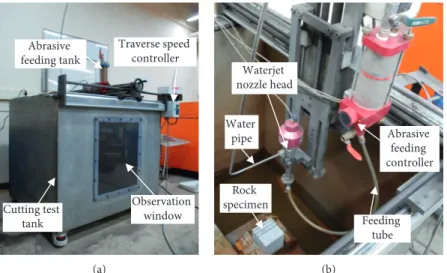
a high pressure waterjet pump (50 HP intensifier pump). The pump generated water pressure up to 412 MPa and water flow rate up to 6 L/min. In the rock cutting test, water pressure was fixed at 250 MPa, and the water flow rate was set as 2.59 L/min (inner diameter of the orifice: 0.33 mm). For the constant cutting procedure, the nozzle was moved in one direction at the speed of 10 mm/s. The standoff distance, between the tip of the focusing tube and the target surface of the specimens, was kept constant at 200 mm; when the standoff distance is more than 300 mm, the cutting performance can be decreased for this waterjet system. The test setup of the abrasive waterjet is shown in Figure 1.
Abrasives were fed into a high-speed waterjet stream by the Venturi suction effect. The feed rate of the abrasive was adjusted using an air control valve installed on the abrasive tank. The abrasives were supplied through the feeding tube (inner diameter 6 mm) from the abrasive tank. The abra-sives were mixed with the jet stream in a mixing chamber and projected onto the target material through the focusing
tube. The focusing tube selected was 1.27 mm in inner diameter and 101.6 mm in length. A schematic illustration of rock cutting with an abrasive waterjet is shown in Figure 2.
2.2. Preparation of Specimen and Abrasive. Intact granite
specimens of a type predominant in the Republic of Korea were sampled at a quarry site in the Hwang-Deung region. The prepared rock specimens were cubic blocks (100 × 100 × 100 mm). The physical properties of the rock specimens measured included density, porosity, absorption ratio, uniaxial compressive strength, tensile strength, and P-wave velocity. According to the ISRM classification, the specimens were classified as very strong rock (R5). The physical properties of the rock specimens are summarized in Table 1.
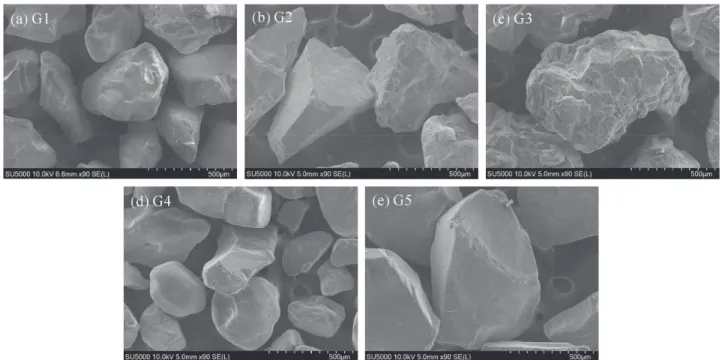
Five different garnet products (all 40 mesh) were ordered from abrasive suppliers in five different countries (India, Mongolia, China, Australia, and the United States of America). However, it was hard to discover in detail, the locations of the garnet mining in each country. XRD (X-ray diffraction) tests were performed to analyze the mineral composition and garnet purity. Scanning electron micros-copy (SEM) was used to observe the particle surface texture and particle shape; Figure 3 presents an SEM image of some garnet particles. Sieve analysis (ASTM D422) was performed to verify the particle size and distribution. Specific gravity values were measured according to the ASTM D854 stan-dard. Mohs hardness information was obtained from the abrasive suppliers. The characteristics of the test garnet abrasives are summarized in Table 2.
2.3. Cutting Test Procedure. To analyze the effect of the
abrasive feed rate on cutting performance, the feed rate was initially adjusted (and checked regularly) to a fixed value of 5.4 ± 0.4 g/s and was increased approximately two times to 10.7 ± 0.8 g/s. In addition, to eliminate the particle size effect, all the garnet particles were passed through a 40 mesh sieve to obtain particles of uniform size (0.425 mm). These filtered abrasive particles of uniform size were used for the cutting experiment.
After each cutting procedure, removal volume, cutting depth, and cutting width were measured to reveal cutting performances. Here, removal volume is defined as the volume excavated after cutting 100 mm. This was de-termined by pouring water into the open space and mea-suring it.
3. Analysis of Garnet Characteristics
3.1. Mineral Composition. Regarding the garnet abrasives,
those in the pyralspite series are broadly used as commercial abrasives because they show higher erosion performance than the members of the ugrandite series. Vaˇsek et al. [9] reported that cutting efficiency with almandine (pyralspite series) for rock specimens was better than with grossularite and andradite (ugrandite series). Almandine garnet is the principal abrasive for industrial uses because of its high
specific gravity and hardness [13, 14]. However, spessartine and pyrope (pyralspite series) have also been used as industrial-grade garnet abrasives [7].
All the garnet samples were determined to be members of the pyralspite series through mineral composition anal-ysis, more specifically, almandine and spessartine. XRD analysis results showed that the Indian garnet (G1) was pyrope; the Mongolian (G2) and Australian garnets (G4)
were almandine; and the Chinese (G3) and American (G5) garnets were spessartine.
The chemical composition of garnet within the pyr-alspite series is generally described as [A3B2(SiO4)], in
which A is a divalent metal (Ca, Fe, Mg, or Mn) and B is a trivalent metal (Al, Cr, Fe, or Mn) [14]. The specific chemical composition of almandine, pyrope, and spes-sartine is [Fe3Al2(SiO4)3], [Mg3Al2(SiO4)3], and
[Mn3Al2(SiO4)3], respectively. The purity of the garnet
mineral compositions was 99.8% for G1, 95.4% for G2, 65.6% for G3, 97.9% for G4, and 90.3% for G5. Table 2 lists the mineral composition and specific formulas of the ex-perimental garnets.
3.2. Specific Gravity. The magnitude of kinetic (impact)
energy is determined by the density and velocity of the abrasive particles at a specific time. Higher specific gravity (i.e., density) of the particles improves their cutting per-formance. To generate greater impact energy on the target material, abrasives of higher specific gravity are required, assuming the water flow rate is sufficient [12].
According to the specifications of the International Organization for Standardization [15], the specific gravity of garnet ranges from 3.5 to 4.2. In this study, the specific gravity of the garnets used ranged from 3.66 to 4.05. The garnets G1 and G4 had specific gravities >4.0 (4.05 for G1 and 4.02 for G4). G2 garnet had specific gravity of 3.85. The
Table 1: Properties of the rock specimen.
Property Value
Rock type Granite
Density (kN/m3) 25.8
Porosity (%) 0.68
Absorption ratio (%) 0.25
Uniaxial compressive strength (MPa) 208.5
Tensile strength (MPa) 10.2
P-wave velocity (m/s) 3394 Observation window Traverse speed controller Abrasive feeding tank Cutting test tank (a) Rock specimen Abrasive feeding controller Waterjet nozzle head Feeding tube Water pipe (b)
Figure 1: Test setup for abrasive waterjet rock cutting: (a) cutting test tank with a traverse speed controller; (b) rock cutting test setup in the cutting test tank.
Standoff distance Rock specimen Cutting depth Focusing tube Abrasive supply High-speed water Jet stream Mixing chamber Orifice nozzle Cutting width Abrasive Jet traverse motion
Figure 2: Schematic illustration of rock cutting using an abrasive waterjet.
spessartine garnets had lower specific gravity (3.66 for G3 and 3.74 for G5) than the other types did.
3.3. Hardness. For efficient rock erosion, sufficient hardness
of the abrasive material is required. At the least, the hardness of the abrasive must be greater than the hardness of the target rock specimen. An efficiency improvement of the waterjet removal process occurs when the hardness ratio (abrasive/workpiece) is 1.0∼1.1 [10]. Beyond the proper abrasive hardness ratio (i.e., >1.1), a further increment in hardness does not substantially improve removal perfor-mance when using an abrasive waterjet.
According to the IOS [15] specifications, Mohs hardness of the garnet abrasive should exceed 6.5. The range of Mohs hardness of the garnets used in this study was 6.5–8.5, which
meets the IOS specifications. G5 abrasive was the hardest (7.5–8.5), while G3 was the softest (7.5–7.8).
Generally, the hardness of rock is less than 6.5 on the Mohs scale because rock is generally a mixture of various minerals [16]. The maximum theoretical hardness of granite rock can be 7.0 if the rock consists only of quartz minerals. Quartz has the greatest hardness (Mohs 7.0) among the minerals composed of granite rock.
3.4. Particle Shape and Surface Condition. The shape of the
abrasive particles can influence the material removal regime in solid-particle erosion. The removal mechanisms are de-termined by particle shape: microploughing for spherical particles and microcutting for angular particles [17]. How-ever, regarding its influence on hard rock, microcutting action
Figure 3: SEM images of garnet particles: (a) G1, (b) G2, (c) G3, (d) G4, and (e) G5.
Table 2: Characteristics of garnets.
Garnet symbol G1 G2 G3 G4 G5
Type Pyrope garnet Almandine garnet Spessartine garnet Almandine garnet Spessartine garnet
Formula Mg3Al2(SiO4)3 Fe3Al2(SiO4)3 Mn3Al2(SiO4)3 Fe3Al2(SiO4)3 Mn3Al2(SiO4)3
Mineral composition
(i) Pyrope (99.8%) (i) Almandine (95.4%) (i) Spessartine (65.6%) (i) Almandine
(97.9%) (i) Spessartine (90.3%)
(ii) Calcite (0.2%) (ii) Quartz (2.9%) (ii) Hornblende (14.0%) (ii) Calcite (1.7%) (ii) Hornblende (9.7%)
(iii) Magnetite (1.7%) (iii) Augite (10.3%) (iii) Quartz (0.4%)
(iv) Albite (6.5%) (v) Rutile (3.6%) Specific gravity (—) 4.05 3.85 3.66 4.02 3.74 Hardness (Mohs) 8.0 7.5–7.8 6.5–7.5 7.5–8.0 7.5–8.5 Mean particle size (mm) 0.340 0.505 0.475 0.280 0.510 Coefficient of uniformity (—) 1.95 1.22 3.03 1.45 1.20
contributes but does not play a major role, in the erosion process. This is because of brittle failure behavior, in which the action of stress waves generated by the particle impact is more likely to fracture the more brittle material [18].
Bad conditions of abrasive particles (e.g., cracks or de-fects) can decrease their cutting performance [9]. Particles of G1 and G4 included diverse shapes represented by com-binations of polygonal angular grains and abraded round grains (Figures 3(a) and 3(d)). In addition, the primary surface of garnet particles was observed to be almost round in G1 and G4. Particles of G2 were observed in various shapes: some particles were polygonal, and some were ir-regular, with surfaces that were smooth or rough (Figure 3(b)). Particle shapes of G3 were observed to be sharp-edged and polygonal with very rough surfaces. After crushing, the surfaces of new particles were rough and jagged. The particles also showed damage in the form of fine networks of cracks (Figure 3(c)). Particles of G5 were polyhedral particles (Figure 3(e)). Moreover, the crushing of primary particles generated new angular particles, and new surfaces were exposed by separation of stable parts at natural fracture cracks.
3.5. Particle Size and Distribution. Even though the products
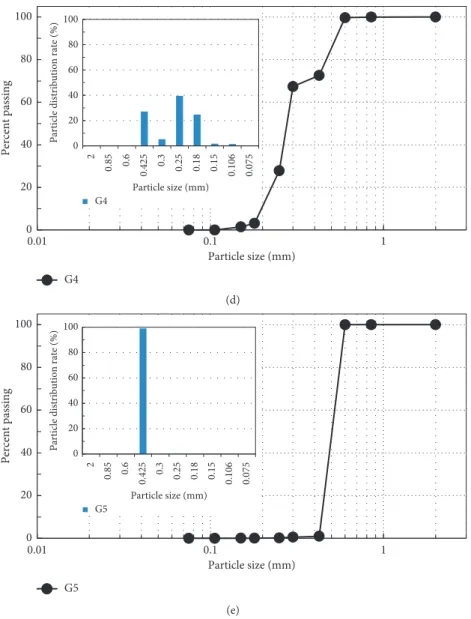
were labeled as 40 mesh as provided by the abrasive sup-pliers, the particle size distributions were found to differ. Using sieve analysis, particle size distributions were analyzed for each garnet sample. The results of the particle size distribution analysis are shown in Figure 4. The coefficient of uniformity decreases with increase in the uniformity of particle size (i.e., 1.00 is the lowest value and indicates a perfectly uniform distribution). The results showed that G2 and G5 had almost uniform particle size; their coefficients of uniformity were the lowest (1.22 for G2 and 1.20 for G5). G4 also had a good uniformity level (1.45). G1 had a higher value (1.95) than G2, G4, and G5. Meanwhile, for G3, the co-efficient of uniformity was the highest (3.03). This means that G3 was composed of particles in a variety of sizes. Uniform particle size is advantageous for smoother flow in the abrasive tube [19].
Mean particle size (D50) is an important factor for
de-termining the cutting performance because larger particles have greater kinetic (impact) energy. For this reason, cutting performance tends to increase with increase in the particle size of abrasives, up to a peak value [17, 20]. The size dis-tribution results showed that G2 and G5 had large values of
D50 (0.505 and 0.510 mm, respectively) because they had
higher levels of uniformity in particle size, compared with most of the other garnets (G1, G3, and G4). Meanwhile, G4 had the lowest value (0.280 mm) for mean particle size. The mean particle sizes and coefficients of uniformity are listed in Table 2.
4. Rock Cutting Results and Analysis
The cutting performance indexes used included the removal volume, cutting depth, and cutting width. Among these indexes, the removal volume is the most useful index for
estimating the overall erosion performance. Figure 5 shows the removal values according to garnet type at the fixed feed rate of 10.7 g/s. Cutting with G4 garnet achieved the largest removal volume. The comparison result shows better per-formance in the order G3 < G1 < G2 < G5 < G4. In the performance comparison between G4 (best performance) and G3 (worst performance) at the 10.7 g/s of abrasive feed rate, the removal volume with G4 (9.0 cm3) was 56.4% larger than with G3 (5.7 cm3).
In the comparison of cutting depth according to the garnet type, the cutting depths were obtained at the fixed abrasive feed rate (Figure 6). The cutting depth for G4 was the deepest (12.0 mm). The cutting results for G5 and G1 were both good (G5: 11.4 mm and G1: 11.2 mm), while the cutting depths were shallower for G3 (9.4 mm) and G2 (9.0 mm). The deepest cutting depth with G4 was 33.1% larger than the shallowest depth with G2.
In the comparison of cutting width (Figure 6), the cutting result with G5 had the greatest width (13.8 mm), while G4 had a width of 12.3 mm. Meanwhile, the cutting results with G2 and G3 were lesser widths (G2: 11.5 mm and G3: 11.8 mm). The greatest cutting width for G5 was 20.3% larger than the least width for G2.
4.1. Abrasive Feed Rate Effects. As the number of particles fed
into the jet stream increases, the kinetic energy of the abrasive jet increases until a critical feed rate is reached. If the critical feed rate is exceeded, the kinetic energy is re-duced by the high momentum transfer needed to accelerate more abrasive particles [12].
For the waterjet system used in these experiments, if the abrasive feed rate exceeded 12.0 g/s, the abrasive-feeding condition was changed to an oversupply state (i.e., higher than the critical feed rate). Considering the appropriate feed rate, the abrasive feed rate was initially set at 5.4 g/s; then, the feed rate was increased by two times (10.7 g/s) to explore the effects of the abrasive feed. Figure 5 shows changes in the removal volume according to the abrasive feed rate. When the abrasive feed rate was increased two times from 5.4 to 10.7 g/s (near 100%), the removal volumes increased by only 20.5–37.0%, except for the G3 garnet. This result indicates that cutting performance was clearly improved but that the efficiency could not reach the expected values for most of the garnets.
Given the experimental data, it seems likely that the better performing garnet may work with lower efficiency sensitivity according to the increasing feed rate. For ex-ample, the removal volume with G4 (the best performing garnet) increased only by 20.5% with increase in the abrasive feed rate (5.4 ⟶ 10.7 g/s), whereas the removal volume with G2 (the medium performance garnet) in-creased by 37.0%. Meanwhile, G3 (the worst performing garnet) showed dramatic increase in the removal volume (109.9%) due to increase in the abrasive feed rate. These results indicate that the use of larger amounts is advan-tageous for increasing the cutting performance efficiency of poorer quality garnet (e.g., G3) than for high quality garnet (e.g., G4).
0 20 40 60 80 100 0.01 0.1 1 Percent passing Particle size (mm) G1 0 20 40 60 80 100
Particle distribution rate (%)
Particle size (mm) G1 2 0.85 0.6 0.425 0.3 0.25 0.18 0.15 0.106 0.075 (a) G2 0 20 40 60 80 100 0.01 0.1 1 Percent passing Particle size (mm) 0 20 40 60 80 100
Particle distribution rate (%)
Particle size (mm) G2 2 0.85 0.6 0.425 0.3 0.25 0.18 0.15 0.106 0.075 (b) 0 20 40 60 80 100 0.01 0.1 1 Percent passing Particle size (mm) G3 0 20 40 60 80 100
Particle distribution rate (%)
Particle size (mm) G3 2 0.85 0.6 0.425 0.3 0.25 0.18 0.15 0.106 0.075 (c) Figure 4: Continued.
4.2. Physical Property Effects. To explore the effects of
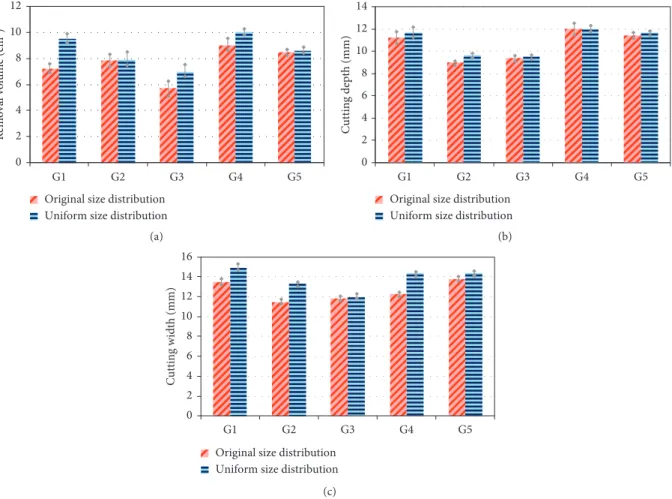
only the physical properties (i.e., specific gravity and hardness), all the abrasive particles were passed through a 40 mesh sieve to obtain particles of uni-form size (0.425 mm). The cutting peruni-formance results (i.e., volume, depth, and width) with uniform particle size at the constant abrasive feed rate (10.7 g/s) are shown in Figure 7. The performance was found to be more efficient in the order G3 < G2 < G5 < G1 < G4 based on the removal volume (Figure 7(a)) and cutting depth (Figure 7(b)). The cutting performance with G4 showed the greatest re-moval volume (10.0 cm3) and cutting depth (12.0 mm); meanwhile, the cutting results with G3 showed the lowest performance of removal volume (7.0 cm3) and cutting depth (9.5 mm). The highest performance of G4 showed efficiency of 42.9% better for removal volume and 26.3% for cutting depth, compared with the lowest performance of G3. G4 0 20 40 60 80 100 0.01 0.1 1 Percent passing Particle size (mm) 0 20 40 60 80 100
Particle distribution rate (%)
Particle size (mm) G4 2 0.85 0.6 0.425 0.3 0.25 0.18 0.15 0.106 0.075 (d) 0 20 40 60 80 100 0.01 0.1 1 Percent passing Particle size (mm) G5 0 20 40 60 80 100
Particle distribution rate (%)
Particle size (mm) G5
2
0.85 0.6 0.425 0.3 0.25 0.18 0.15 0.106 0.075
(e)
Figure 4: Particle size distributions according to the garnet type.
0 2 4 6 8 10 G1 G2 G3 G4 G5 Removal volume, V (cm 3) 5.4 g/s 10.7 g/s 28% 37% 109.9% 20.5% 27.8%
Figure 5: Comparison of removal volume: the removal volume at 5.4 g/s of the abrasive feed rate and removal volume at 10.7 g/s of abrasive feed rate.
For the cutting width results, G1 showed the highest cutting width (14.9 mm). G4 and G5 garnet types also showed good width results (G4: 14.3 mm and G5: 14.4 mm) (Figure 7(c)). Meanwhile, G3 showed the lowest width result (12.0 mm) and worse efficiency (19.4%) in cutting width, compared with G1.
Because the removal volume index is suitable for esti-mating the overall cutting performance, the removal volume
data with uniform-size abrasive (0.425 mm) can be used to directly compare the effects from the physical properties of the abrasives (garnet mineral purity, specific gravity, and hardness). Figure 8 shows the relationship between removal volume and (a) garnet purity, (b) specific gravity, and (c) hardness (averaged) of the abrasives. When the relationships were assumed to be exponential functions, the relationships were well matched (Figure 8). For all garnet types, the
0 5 10 15 G1 G2 G3 G4 G5 (mm) Cutting depth Cutting width
Figure 6: Comparison of cutting depth and width results at 10.7 g/s of abrasive feed rate.
0 2 4 6 8 10 12 G1 G2 G3 G4 G5 Removal volume (cm 3)
Original size distribution Uniform size distribution
(a) 0 2 4 6 8 10 12 14 G1 G2 G3 G4 G5 Cutting depth (mm)
Original size distribution Uniform size distribution
(b) Cutting width (mm) 0 2 4 6 8 10 12 14 16 G1 G2 G3 G4 G5
Original size distribution Uniform size distribution
(c)
Figure 7: Cutting performance comparison between original size distribution and uniformed size distribution (0.425 mm): (a) removal volume; (b) cutting depth; (c) cutting width.
removal volume tended to increase with increase in the garnet purity, specific gravity, and hardness. Given the experimental data, it seems that G1 and G4 garnets have the best properties for achieving high removal performance; meanwhile, G3 garnet has to be considered a low quality abrasive.
In the analysis of G3 (the worst performer), the garnet purity seems to be important for effectiveness of an abrasive. Normally, impurities in the garnet mineral reduce the cutting performance [8]. G3 garnet has significant quantities of other minerals (purity just 65.6%); thus, it showed worse cutting performance than the other types of garnet (the purities of the other garnets were in the range 90.3–99.8%). In addition, given the physical property data, specific gravity and hardness were also shown to be important parameters for improving the cutting efficiency. G3 garnet had the lowest specific gravity (4.02) and lowest level of hardness (7.0 average) among the abrasive types (Table 2). Meanwhile, G1 and G4 showed much better cutting per-formance due to their high specific gravity and hardness.
4.3. Particle Size Distribution Effects. In the comparison of
performance between the original size distribution and uniform size distribution of abrasive particles, all the rock cutting results with uniform abrasive size showed better performance for all erosion indexes (volume, depth, and width) than with abrasives of varied size (i.e., size distribution
as provided), as shown in Figure 7. It seems likely that the homogenous size distribution of particles minimizes colli-sions between particles in the high-speed jet stream.
Efficiency in volume removal increased 32.3% for G1, 1.1% for G2, 21.9% for G3, 11.4% for G4, and 1.4% for G5 after switching to abrasive particles of uniform size. These results indicate that uniform abrasive particles erode the target material more efficiently, and the cutting efficiency is directly related to the cutting cost in the field.
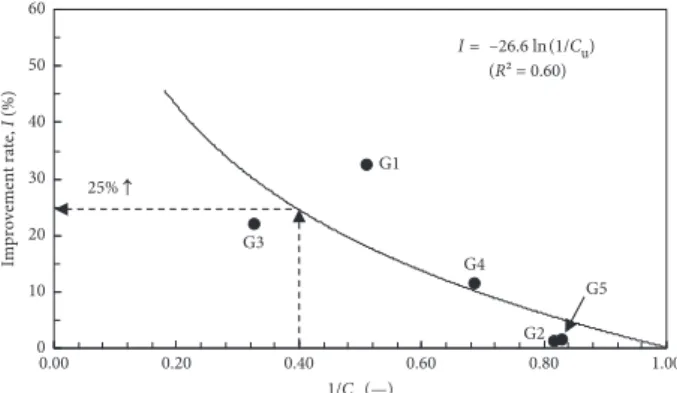
It was especially observed in Figure 7 that the increment of performance depends on the original distribution of the abrasive particle size. In this study, the rate of increase in the removal volume due to the uniform-size effect is defined as the improvement rate [%]. In addition, the uniformity index of abrasive size is defined to be 1/Cu, which has the range 0-1.
When the size distribution of an abrasive is perfectly uni-form, 1/Cuis equal to “1.” Decreasing 1/Cumeans increasing
the dispersion of the size distribution (decreasing unifor-mity). If an abrasive is originally composed of particles of similar size, performance in the removal volume will not be much changed by the uniformity effect because there would not be much change in the particle size distribution.
Because of the limited experimental data sets in this study, it is difficult to determine the exact relationship be-tween the increment rate and 1/Cu. However, the
re-lationship can be shown to be a reasonable match (R2�0.60) when the relationship between the increment rate and 1/Cu
is assumed to be a logarithmic function (Figure 9). In this
0 5 10 15 50 60 70 80 90 100 Removal volume (cm 3) Garnet purity (%) y = 0.39x0.69 (R2= 0.69) G3 (Spessartine) G1 (Pyrope) G4 (Almandine) G5 (Spessartine) G2 (Almandine) (a) 0 5 10 15 3.4 3.6 3.8 4 4.2 Removal volume (cm 3) Specific gravity (—) y = 0.19x2.83 (R2= 0.76) G3 G5 G2 G4 G1 (b) 0 5 10 15 6.6 6.8 7 7.2 7.4 7.6 7.8 8 8.2 8.4 Removal volume (cm 3) Hardness (Mohs) y = 0.13x2.06 (R2= 0.62) G3 G2 G4 G1 G5 (c)
relationship, if 1/Cubecomes 0.4, approximately 25%
per-formance improvement can be expected when the abrasive is used with particles of uniform size.
5. Abrasive Crush Characteristics
Verifying the crush characteristics (size distribution change) is important when considering abrasive recycling after hard rock cutting for cost savings in the cutting process. For this reason, these test results regarding crush characteristics should help future studies to find the best recycling rate of garnet, even though recycling experiments were not in-cluded in this study.
Particles are crushed by the kinetic energy of their impact against the hard target surface; thus, the crush characteristics depend on the physical characteristics of the abrasives and the target rock. The diameter reduction for garnet particles is caused by internal cracks during abrasive waterjet cutting [21]. In addition, the crush characteristics of abrasive particles are also affected by the inner shape of the mixing chamber and by interaction with the high-speed waterjet [22].
Because the same rock specimens and same nozzle head (provides the inner shape of the mixing chamber) were used for the experiments, only the physical characteristics of the abrasive were considered to analyze the abrasive crush characteristics. The crush characteristics of the abrasive particles were analyzed based on variation of the size dis-tribution and mean particle size. The variation in the size distribution between the inlet abrasive particles and outlet abrasive particles after cutting was analyzed using the uniformity index (1/Cu) and mean particle size (D50).
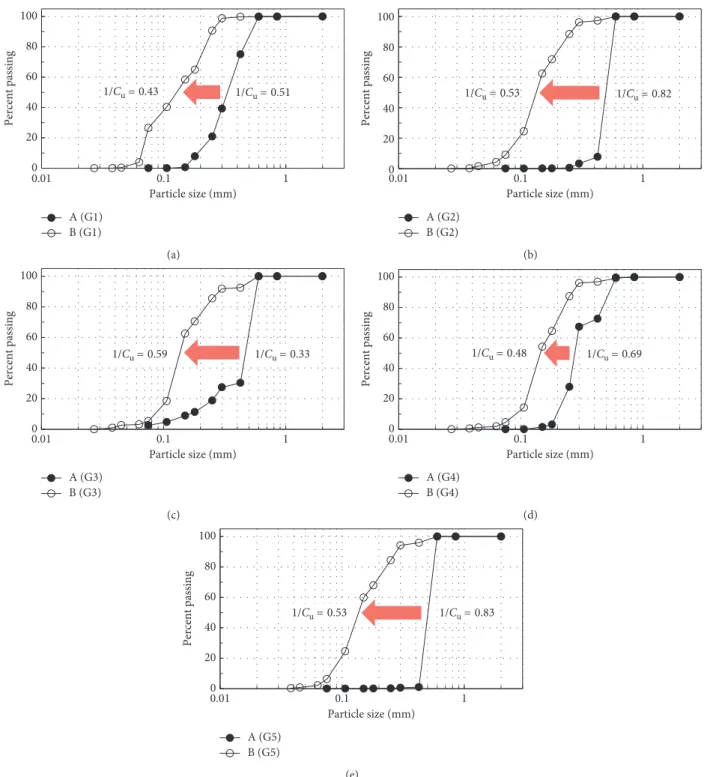
5.1. Variation of Size Distribution. Figure 10 shows
com-parison of the particle size distribution of inlet abrasive particles (case A) and outlet abrasive particles (case B) after rock cutting. For the uniformity index (1/Cu), the size
distributions of G1, G2, G4, and G5 were changed to be more dispersive (better distributed). The uniformity index was changed from 0.51 to 0.43 for G1, 0.82 to 0.53 for G2, 0.69 to 0.48 for G4, and from 0.83 to 0.53 for G5 (Figure 10).
Meanwhile, the size distribution of G3 was rather uni-form, and the original uniformity index (0.33) increased to
0.59 after rock cutting. This reverse phenomenon might be explained by the fact that the G3 garnets had defects on the particle surfaces and a low uniformity index, originally. Very rough surfaces with fine networks of cracks were more clearly observed with G3 than for the other garnet types (Figure 3).
Of special interest is that the overall uniformity index changed to similar values (0.43–0.59 for case B) for all abrasive types; the average uniformity index for all types was estimated to be 0.51 with a standard deviation of 0.06.
5.2. Variation of Mean Particle Size. The mean particle size
for all the abrasive types was smaller after hard rock cutting, compared with the inlet abrasive size (Figure 11). Abrasive particles are fractured by impact at the natural cracks that create preferred planes for breaking up in the cutting process. Based on the mean particle size (D50), the particle
size significantly dropped by 61.8% for G1, 72.3% for G2, 70.5% for G3, 46.4% for G4, and 72.5% for G5. The ex-perimental results after cutting indicate that the mean particle sizes tended to become similar after the particles were crushed, as shown in Figure 11. The average mean particle size for all abrasive types was 140.0 μm with a standard deviation of 6.3 μm.
6. Conclusions
Waterjet cutting tests were performed with garnets from five different origins to explore the effects of the abrasive feed rate, physical properties, and particle size distribution. This study can help others make reasonable choices about garnet abrasives when waterjet cutting is applied for cutting hard granite rock at long standoff distance. In addition, it can help those conducting future studies to analyze the recycling rate according to the garnet types. The main findings are as follows:
(i) Australian garnet (G4) shows the best performance for removal volume; Chinese garnet (G3) showed the worst performance for removal volume. The removal volume with G4 (9.0 cm3) was 56.4% larger than the performance with G3 (5.7 cm3) under the same test conditions. This result indicates that performance can differ even though the coarse
0 10 20 30 40 50 60 0.00 0.20 0.40 0.60 0.80 1.00 Improvement rate, I (%) 1/Cu (—) 25% G1 G4 G3 G5 G2 I = –26.6 ln(1/Cu) (R² = 0.60)
garnets used look similar, due to their geometric properties (particle size and shape) and physical properties (specific gravity and hardness).
(ii) Under a fixed particle size distribution condition, garnet purity, specific gravity, and hardness are important parameters for determining the cutting efficiency for hard rock. The cutting performance increases with increase in the garnet purity, specific gravity, and hardness.
(iii) When the original particle distribution was changed to particles of uniform size (for all garnet types), the cutting efficiency indicated by removal volume increased in the range 1.1–32.3% due to effects of the artificially uniform size. The increment rates depend on the coefficient of uniformity of the original particle distribution.
(iv) The particle size of the garnet abrasives decreased 46.4–72.5% due to their breaking up during the
0 20 40 60 80 100 0.01 0.1 1 Particle size (mm) 1/Cu= 0.51 1/Cu= 0.43 A (G1) B (G1) Percent passing (a) 1/Cu= 0.82 1/Cu= 0.53 0 20 40 60 80 100 0.01 0.1 1 Particle size (mm) A (G2) B (G2) Percent passing (b) 1/Cu= 0.33 1/Cu= 0.59 A (G3) B (G3) 0 20 40 60 80 100 0.01 0.1 1 Percent passing Particle size (mm) (c) 1/Cu= 0.48 1/Cu= 0.69 Particle size (mm) A (G4) B (G4) Percent passing 0 20 40 60 80 100 0.01 0.1 1 (d) 1/Cu= 0.53 1/Cu= 0.83 A (G5) B (G5) Percent passing 0 20 40 60 80 100 0.01 0.1 1 Particle size (mm) (e)
Figure 10: Change of particle size distribution after rock cutting (A: condition before cutting, B: condition after cutting) for the five garnet types.
cutting process. Analysis of the variation in particle size for all garnet types after the rock cutting process showed that the mean particle sizes were reduced to a similar size of 140.0 μm. Moreover, the uniformity index values also changed to similar values (0.51).
Data Availability
The experimental data (figures and tables) used to support the findings of this study are included within the article.
Conflicts of Interest
The authors declare that they have no conflicts of interest.
Acknowledgments
This research was supported by a grant (19SCIP-B105148-05) from the Construction Technology Research Program funded by the Ministry of Land, Infrastructure, and Transport of the Korean government.
References
[1] P. Hlav´aˇcek, J. C´arach, S. Hloch et al., “Sandstone turning by abrasive waterjet,” Rock Mechanics and Rock Engineering, vol. 48, no. 6, pp. 2489–2493, 2015.
[2] Y. Lu, J. Tang, Z. Ge, B. Xia, and Y. Liu, “Hard rock drilling technique with abrasive water jet assistance,” International
Journal of Rock Mechanics and Mining Sciences, vol. 60,
pp. 47–56, 2013.
[3] T.-M. Oh, G.-C. Cho, and I.-T. Ji, “Effects of free surface using waterjet cutting for rock blasting excavation,” Journal of
Korean Tunnelling and Underground Space Association,
vol. 15, no. 1, pp. 49–57, 2013, in Korean.
[4] J.-G. Kim and J.-J. Song, “Abrasive water jet cutting methods for reducing blast-induced ground vibration in tunnel ex-cavation,” International Journal of Rock Mechanics and
Mining Sciences, vol. 75, pp. 147–158, 2015.
[5] A. W. Momber, “Wear of rocks by water flow,” International
Journal of Rock Mechanics and Mining Sciences, vol. 41, no. 1,
pp. 51–68, 2004.
[6] T.-M. Oh and G.-C. Cho, “Characterization of effective pa-rameters in abrasive waterjet rock cutting,” Rock mechanics
and Rock Engineering, vol. 47, no. 2, pp. 745–756, 2014.
[7] J. G. Evans, P. R. Moyle, J. D. Bliss, and K. R. Long, US
Industrial Garnet, US Department of the Interior, US
Geo-logical Survey, Reston, VA, USA, 2006.
[8] J. L. Ohman, “Abrasives: their characteristics and effect on waterjet cutting,” in Proceedings of Seventh American Waterjet
Conference, pp. 363–374, WJTA, Seattle, WA, USA, August
1993.
[9] J. Vaˇsek, P. Martinee, J. Foldyna, and L. Hlav´aˇc, “Influence of properties of garnet on cutting process,” in Proceedings of 7th
American Waterjet Conference, pp. 375–387, Seattle, WA,
USA, August 1993.
[10] S. Wada and Y. Kumon, “Wear of Si3N4ceramics by abrasive
water jet,” Journal of the Ceramic Society of Japan, vol. 101, no. 1175, pp. 830–834, 1993.
[11] J. Foldyna, P. Martinec, and L. Sitek, “Testing of mineral types of abrasives for abrasive water jet cutting,” in Proceedings of
2001 WJTA American Waterjet Conference, pp. 291–303,
Minneapolis, MN, USA, August 2001.
[12] T.-M. Oh and G.-C. Cho, “Rock cutting depth model based on kinetic energy of abrasive waterjet,” Rock Mechanics and Rock
Engineering, vol. 49, no. 3, pp. 1059–1072, 2016.
[13] R. S. Carmichael, Practical Handbook of Physical Properties of
Rocks and Minerals, University of Iowa, Iowa City, IA, USA,
1989.
[14] P. W. Harden, “Garnet,” in Industrial Minerals Handy Book
IV; A Guide to Markets, Specifications, and Minerals-A Global Geology, pp. 186–192, Industrial Minerals Information Ltd.,
London, UK, 2002.
[15] International Organization for Standardization, Preparation
of Steel Substrates Prior to the Application of Paints and Re-lated Products—Surface Preparation Methods—Part Two: Abrasives for Blast Cleaning, International Organization for
Standardization, Geneva, Switzerland, 1992.
[16] G. West, “Rock abrasiveness testing for tunnelling,”
In-ternational Journal of Rock Mechanics and Mining Sciences & Geomechanics Abstracts, vol. 26, no. 2, pp. 151–160, 1989.
[17] S. Bahadur and R. Badruddin, “Erodent particle character-ization and the effect of particle size and shape on erosion,”
Wear, vol. 138, no. 1-2, pp. 189–208, 1990.
[18] A. W. Momber and R. Kovacevic, Principles of Abrasive Water
Jet Machining, Springer Science & Business Media, Berlin,
Germany, 1998.
[19] G. W. Joo, T. M. Oh, and G. C. Cho, “Influencing factors for abrasive flow rate and abrasive flow quality of abrasive in-jection waterjet systems for tunnel excavation,” Journal of
Korean Tunnelling and Underground Space Association,
vol. 16, no. 4, pp. 417–430, 2014, in Korean.
[20] M. K. Kulekci, “Processes and apparatus developments in industrial waterjet applications,” International Journal of
Machine Tools and Manufacture, vol. 42, no. 12, pp. 1297–
1306, 2002.
[21] A. Nag, J. ˇSˇcuˇcka, P. Hlavacek et al., “Hybrid aluminium matrix composite AWJ turning using olivine and Barton garnet,” International Journal of Advanced Manufacturing
Technology, vol. 94, no. 5–8, pp. 2293–2300, 2018.
[22] L. M. Hlav´aˇc, I. M. Hlav´aˇcov´a, P. Jandaˇcka et al., “Commi-nution of material particles by water jets—influence of the inner shape of the mixing chamber,” International Journal of
Mineral Processing, vol. 95, no. 1–4, pp. 25–29, 2010.
0 100 200 300 400 500 600 G1 G2 G3 G4 G5
Mean particle size,
D50 (μ m) A B A B A B A B A B
A: Condition before cutting B: Condition after cutting
Figure 11: Mean particle size comparison before and after cutting for the five garnet types.
International Journal of
Aerospace
Engineering
Hindawi www.hindawi.com Volume 2018Robotics
Journal of Hindawi www.hindawi.com Volume 2018 Hindawi www.hindawi.com Volume 2018Active and Passive Electronic Components VLSI Design Hindawi www.hindawi.com Volume 2018 Hindawi www.hindawi.com Volume 2018
Shock and Vibration
Hindawi
www.hindawi.com Volume 2018
Civil Engineering
Advances inAcoustics and VibrationAdvances in
Hindawi
www.hindawi.com Volume 2018 Hindawi
www.hindawi.com Volume 2018
Electrical and Computer Engineering Journal of Advances in OptoElectronics Hindawi www.hindawi.com Volume 2018
Hindawi Publishing Corporation
http://www.hindawi.com Volume 2013 Hindawi www.hindawi.com
The Scientific
World Journal
Volume 2018 Control Science and Engineering Journal of Hindawi www.hindawi.com Volume 2018 Hindawi www.hindawi.com Journal ofEngineering
Volume 2018Sensors
Journal of Hindawi www.hindawi.com Volume 2018 Machinery Hindawi www.hindawi.com Volume 2018 Modelling & Simulation in Engineering Hindawi www.hindawi.com Volume 2018 Hindawi www.hindawi.com Volume 2018 Chemical EngineeringInternational Journal of Antennas and
Propagation International Journal of Hindawi www.hindawi.com Volume 2018 Hindawi www.hindawi.com Volume 2018 Navigation and Observation International Journal of Hindawi www.hindawi.com Volume 2018