Taehyung Park, Sukhwan Yoon, Jongwon Jung, and Tae-Hyuk Kwon*
Cite This:Environ. Sci. Technol. 2020, 54, 15355−15365 Read Online
ACCESS
Metrics & More Article Recommendations*
sı Supporting InformationABSTRACT: This study explored the feasibility of biosurfactant amendment in modifying the interfacial characteristics of carbon dioxide (CO2) with rock minerals under high-pressure conditions for GCS. In particular, while varying the CO2phase and the rock mineral, we quantitatively examined the production of biosurfactants by Bacillus subtilis and their effects on interfacial tension (IFT) and wettability in CO2−brine−mineral systems. The results demonstrated that surfactin produced by B. subtilis caused the reduction of CO2−brine IFT and modified the wettability of both quartz and calcite minerals to be more CO2-wet. The production yield of
surfactin was substantially greater with the calcite mineral than with the quartz mineral. The calcite played the role of a pH buffer, consistently maintaining the brine pH above 6. By contrast, an acidic condition in CO2−brine−quartz systems caused the
precipitation of surfactin, and hence surfactin lost its ability as a surface-active agent. Meanwhile, the CO2-driven mineral dissolution and precipitation in CO2−brine−calcite systems under a non-equilibrium system altered the solid substrates, produced surface
roughness, and caused contact angle variations. These results provide unique experimental data on biosurfactant-mediated interfacial properties and wettability in GCS-relevant conditions, which support the exploitation of in situ biosurfactant production for biosurfactant-aided CO2injection.
1. INTRODUCTION
Geologic carbon storage (GCS) is widely considered as one of the promising strategies to reduce the atmospheric concen-tration of carbon dioxide (CO2).1In GCS, CO2is injected and
stored in deep geologic formations, such as depleted oil and gas reservoirs or deep saline aquifers. When injecting CO2, the
interfacial properties between CO2, brine, and rock-forming
minerals, particularly CO2−brine interfacial tension (IFT) and
wettability of CO2on rock minerals, play significant roles in
determining the CO2 invasion patterns in brine-saturated
porous media and hence the mobility, injectivity, and storage capacity of CO2.2−6 The capillarity induced by small pores of target formations often causes thin and fastfingering patterns of CO2invasion, leaving high residual brine; this implies low storage efficiency. Injection of immiscible CO2 into brine-saturated porous media requires high injection pressure to overcome the capillary pressure by small pores. Not causing
fluid-driven fracture or formation damage, control of the injection pressure often leads to low injectivity associated with a low injection rate. In such cases, the use of synthetic chemical surfactants, e.g., Alipal CD-128 and Surfonic POA-25R2, as additives during CO2 injection has proved effective in enhancing CO2 storage capacity and injectivity by reducing the capillary pressure of CO2and increasing pore-scale sweep efficiency.5,7−10
Biosurfactants have recently garnered significant interest as eco-friendly alternatives to the chemical surfactants due to Received: August 28, 2020
Revised: October 31, 2020 Accepted: November 2, 2020 Published: November 13, 2020
Downloaded via KOREA ADVANCED INST SCI AND TECHLGY on December 2, 2020 at 02:19:57 (UTC).
their biocompatibility, biodegradability, and innocuous na-ture.11−13 Several microorganisms can produce and excrete biosurfactants en masse, including strains affiliated to Bacillus, Rhodococcus, and Pseudomonas genera.11,14,15Furthermore, the presence of one of these organismal groups, Bacillus spp., has been discovered in GCS sites containing supercritical CO2(or scCO2),16 even though scCO2 is regarded as a sterilization
agent for microorganisms.17−19These recent findings support the feasibility of utilizing biosurfactant-producing micro-organisms to enhance CO2injectivity and storage, referred to
as biosurfactant-aided GCS.20 However, one question crucial for its implementationto what extent the interfacial proper-ties of CO2−brine−mineral systems can be altered by in situ bacterial biosurfactant production under GCS-relevant con-ditionsremains unanswered. Particularly, most of the pilot-scale GCS projects have been operated under high-pressure environments, where CO2is present either in the supercritical
or liquid phase (e.g., 90 °C and 18 MPa in In Salah CO2 Storage Project, Algeria; 85 °C and 10 MPa in CO2CRC Otway Project, Australia; 59°C and 15 MPa in Frio Brine Pilot Project; and 60 °C and 15 MPa in Weyburn-Midale Carbon Dioxide Project, Canada).21−24 Therefore, evaluation of the feasibility of biosurfactant-aid GCS requires reliable exper-imental data obtained in high-pressure environments asso-ciated with supercritical or liquid CO2.
The wettability of fluids on rock minerals has a profound effect on multiphase fluid flows in porous media. In GCS, it is the CO2 wettability on rock minerals competing against the
brine wettability. Physicochemical interactions among the rock minerals, CO2, and connate brine significantly affect the CO2
wettability on rock minerals.25The environmental factors such as pressure, temperature, salinity, and pH also have impacts on the interfacial properties of rock minerals, such as calcite, quartz, and mica.4,26−30 However, only a limited number of studies have been conducted on in situ bacterial alteration of the interfacial properties and wettability of CO2−brine− mineral systems. The earlier study by the authors examined a single model system with quartz as the mineral substrate, which is the only reported study on the effect of the biosurfactant on alterations in the IFT and wettability of a CO2−brine−quartz system at the in situ reservoir conditions.31 However, the previous study was limited to the quartz mineral, and thus it hardly took account of the CO2−mineral geochemical reaction, as quartz has the lowest reactivity among the silica mineral group. In addition, it lacked the in situ monitoring of biosurfactant concentration and pH. Underlying mechanisms of wettability changes coupled with biosurfactant production and CO2-driven geochemical reactions remain poorly understood.
Therefore, this study investigates the effect of mineralogy and CO2−mineral geochemical reactions on microbially
mediated interfacial properties under GCS-relevant high-pressure environments. Emphasis is given to CO2-driven
geochemical reactions by comparing calcite, one of the representative carbonate minerals, with quartz. We monitored the growth and biosurfactant production of Bacillus subtilis strain ATCC 21332 in the presence of high-pressure liquid CO2(10 MPa and 28 °C) and scCO2(10 MPa and 37 °C)
while measuring real-time in situ surfactant concentration and pH. At the same time, we examined the associated changes to CO2−brine IFT and CO2 wettability on quartz and calcite
substrates at the reactor conditions emulating GCS reservoirs. The functionality of biosurfactants was further examined with
different minerals at varying pH conditions. This study provides fundamental but unique experimental data on in situ bacterial alteration of interfacial properties and wettability associated with the geochemical reaction between high-pressure CO2 and different rock minerals. These results are expected to contribute to assessing the feasibility of using in situ bacterial biosurfactant production for engineered CO2 injection and enhanced CO2storage in the deep subsurface.
2. MATERIALS AND METHODS
2.1. Medium Preparation and Culture Conditions for B. subtilis. Bacillus spp. are facultative anaerobes, commonly found in soil and aquatic environments. Notably, the presence of Bacillus spp. has been detected in GCS sites16owing to their resilience to extreme environments, such as extreme pH range from 2 to 12, salinity up to 6%, high pressure up to 150 MPa, and high temperature up to 55°C conditions, partly thanks to their capability to form endospores.31,32 Furthermore, the biosurfactants produced from Bacillus spp. have previously been reported to be effective in reducing surface tension in extreme environments,33−39such as temperature up to 70°C, pH range of 7−12, and salinity less than 4%.33Therefore, one of the strains belonging to this genus, B. subtilis strain ATCC 21332, was selected as the model biosurfactant-producing bacterium in this study.
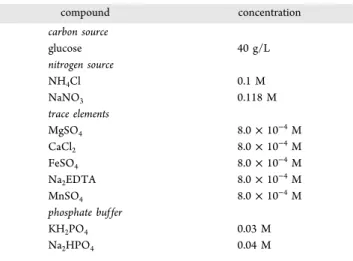
B. subtilis strain ATCC 21332 was acquired from American Type Culture Collection, resuscitated in 250 mL of nutrient broth (Difco, BD, Franklin Lakes, NJ), and preserved as frozen glycerol stocks (50% v/v) in a −80 °C freezer. Before each experiment, a frozen stock culture was resuscitated and aerobically cultivated in the nutrient broth at 37°C. Part of this starter culture (1% v/v) was transferred to the fresh nutrient broth. After 20−24 h of incubation at 37 °C, 4 mL of freshly cultivated culture containing ∼3 × 10⁷ cfu/mL of bacterial load was used as an inoculum for the biosurfactant effectiveness assays in specially designed high-pressure vessels.15 The mineral salt medium containing carbon (glucose), nitrogen (nitrate and ammonium), and trace elements (manganese, potassium, iron, etc.) was used in these assays (Table 1).40The medium wasfilter-sterilized with a 0.2 μm syringe filter immediately before use. This mineral salt medium was used as the brine phase in this study, and its salinity was∼1.6 wt %.
Table 1. Composition of the Mineral Salt Medium
compound concentration carbon source glucose 40 g/L nitrogen source NH4Cl 0.1 M NaNO3 0.118 M trace elements MgSO4 8.0× 10⁻⁴M CaCl2 8.0× 10⁻⁴M FeSO4 8.0× 10⁻⁴M Na2EDTA 8.0× 10⁻⁴M MnSO4 8.0× 10⁻⁴M
phosphate buf fer
KH2PO4 0.03 M
2.2. Mineral Substrates. In this study, two minerals, quartz and calcite, were selected as representative rock minerals. Optical grade square quartz plates (Hanjin Quartz, Seoul, South Korea) were used without pretreatment. A natural calcite sample (Iceland Spar) was obtained from Ward’s Natural Science (Rochester, NY) for this study. The calcite sample was cut into pieces with a diamond cutter and ground with #400, #800, #1000, and #1500 diamond disks. Then, the surface was polished with 3 and 1 μm diamond compounds. The calcite surfaces were carefully smoothened to minimize the contact angle hysteresis due to surface roughness. The surface roughness profile analysis of the quartz and calcite minerals before and after the experiments were carried out using time-of-flight secondary ion mass spectrometry (TOF-SIMS 5, IONTOF GmbH, Munster, Germany). The optical profiles indicated that the average surface roughness (Ra; the surface heights measured across the microscopic peaks and valleys of the substrates) of the quartz and calcite substrates were 12.5 and 33.3 nm over an area of 315μm × 236 μm on average, respectively. We washed the mineral substrates with acetone and then submerged them in ethanol for sterilization. Prior to use, the substrates were washed with autoclaved deionized water.
2.3. Experiment Setup. A reactor system has been previously devised for monitoring IFT and contact angle (CA) during cultivation of biosurfactant-producing bacteria at high temperature and pressure conditions.15,31 The high-pressure view cell was made of 304 stainless steel with an inner volume of 40 cm3and equipped with two transparent quartz
disks, which enabled visual observation of CO2 droplets for
IFT and CA measurements. The high-pressure view cell was first filled with the mineral salt medium (brine), and a CO2
pendant droplet was generated through a capillary tube with an outer diameter of 1.59 mm for IFT measurements (panel A in
Figure 1). For CA measurements on each mineral substrate, a CO2 sessile droplet was generated on the mineral substrate
(panel B in Figure 1). The time-lapsed changes in the morphology of this CO2droplet were monitored using a digital
camera (Canon EOS 100D, Tokyo, Japan) equipped with a macro lens (Canon 100 mm 2.8f, Tokyo, Japan).
A high-pressure syringe pump (500HP, Teledyne Isco, Lincoln, NE) was used to feed brine into the view cell through a transfer vessel to control the fluid pressure. One K-type
thermocouple and one pressure transducer (PX302, Omega, Norwalk, CT) connected to a data logger (34970A, Keysight, Santa Rosa, CA) measured the temperature and pressure inside the view cell every 10 s. At the same time, one glass-based high-pressure pH probe (Corr Instruments, Carson City, NV) connected to a pH meter (Orion Star A215, Thermo Fisher Scientific, Waltham, MA) logged the brine pH in the view cell every 10 s.
2.4. Experiment Procedure and Data Reduction. The experiments were carried out with two mineral substrates, each at two different pressure and temperature (P/T) conditions: 28°C and 10 MPa with liquid CO2and 37°C and 10 MPa
with scCO2. In total, we conducted four experiments with
cultivation of the model bacteria B. subtilis and production of the biosurfactant. These P/T conditions were chosen to emulate different CO2 phases (liquid and supercritical CO2) expected at deep geologic formations targeted in GCS practices. It was estimated that the CO2 solubility in saline
water having the same salinity as our brine (∼1.6 wt %) was 1.28 mol/L at 28°C and 10 MPa and 1.19 mol/L at 37 °C and 10 MPa.
All wetting parts of the view cell and the pH probes were sterilized with 70% ethyl alcohol for more than 12 h. The rest of the parts, including tubes, fittings, and the transfer vessel were autoclaved at 121°C before use. For the cultivation of B. subtilis strain ATCC 21332, 4 mL of the freshly cultivated inoculum culture wasfirst introduced to the view cell, and the rest of the inner volume was carefully filled with the fresh mineral salt medium (brine). This incoming brine displaced the air inside the view cell through the topfluid port, and the fluid pressure in the cell was elevated to 10 MPa. The temperature inside the view cell was adjusted to the target values using a coil-type electric heating jacket (Hankook Electric Heater, Daejeon, South Korea). The system was then stabilized for∼30 min, such that P/T of the fluid inside the view cell was equilibrated before the experiment.
A CO2pendant droplet was generated every 4−6 h over the course of bacterial growth, and the time-lapse images of the droplet were acquired until the droplet dissolved into the brine. The curvature of a CO2pendant droplet was delineated
from an acquired image, and the axisymmetric shape of a CO2 drop was thenfitted to the Young−Laplace equation as a first-order approximation using the low-bond axisymmetric drop
shape analysis (LBADSA) method.41 Using the LBADSA method, the IFT value between CO2 and water is obtained
considering the whole drop profile. The pendant droplets with curvature radii in the range of 0.5−0.8 mm at the drop apex were selected and analyzed to produce consistent IFT estimation.41
The measurements of the CA were taken along with the pendant droplet observations with the same time intervals of IFT measurements. We acquired the CA of CO2−brine−
minerals from the time-lapse images of sessile droplets.42 In specific, we measured the contact angle (CA) of brine in the CO2−brine−mineral systems. The CA values less than 90° and
more than 90° indicate water-wet and CO2-wet conditions, respectively. For consistency in the CA estimation, we only chose the sessile droplets that satisfied the following conditions: either the diameter less than 5 mm or the droplet volume less than 15 cm3, the Bond number less than 0.9, and
the difference between the left- and right-side contact angles less than 0.2°.30,43 The Bond number is a dimensionless number, which is defined as the ratio of the gravitational force to the interfacial tension force (or capillary force).44 A high Bond number indicates that the gravitational force is predominant over the interfacial tension in determining the shape of the droplet, whereas a low Bond number indicates that the interfacial tension dominates over the gravitational force.44As the dissolved CO2concentration in the brine phase
approaches its solubility over the course of each experimental run, the rate of CO2 dissolution slows down, and hence the
lifetime of the droplets increases. In our study, we observed that the lifetime of the pendant droplets and sessile droplets ranged from several minutes to tens of minutes.
In addition, 1 mL of brine was sampled at the same time when each image was acquired. Thefluid sample of 1 mL was extracted using a needle inside the vessel. The tip of the needle was located in close vicinity to the mineral substrate.15,31After this sampling, the fresh brine feed by the high-pressure syringe pump immediately restored the fluid pressure to the level before sampling. The extracted samples were immediately filter-sterilized and stored at −20 °C for further chemical analyses. These filter-sterilized brine samples were used to identify changes in the concentration of surfactin dissolved in the aqueous phase.
The experiment was halted when no further changes to IFT and CA were observed; each experimental run lasted for
approximately 120 h. In total, we conducted four experimental runs with culturing B. subtilis: two runs with the quartz mineral for liquid CO2 and scCO2 and two runs with the calcite
mineral for liquid CO2and scCO2.
We conducted two sets of abiotic control experiments in the absence of biomass and bacterial biosurfactants. First, an abiotic control experiment was conducted to identify the effect of surface reactions driven by CO2 dissolution, such as
adsorption, calcite dissolution, and mineral reprecipitation, on CO2wettability on the calcite surface. In this abiotic control test, the CA in a liquid CO2−brine−calcite system was
monitored in the presence of liquid CO2at 28°C and 10 MPa.
Second, we carried out another abiotic control test to examine whether the brine pH would affect the CA because CO2 dissolution lowers the brine pH during experiments. Accordingly, CA on quartz and calcite was measured at different brine pH values.
We conducted a separate set of batch experiments to explore the pH-dependent functionality of surfactin. The purified surfactin standard was diluted in deionized water (DIW) to the final concentration of 200 mg/L. The pH of this solution was controlled with 0.5 N hydrochloric acid. Thereby, the surfactin solutions with pH varying from 3 to 6 were prepared, and their absorption characteristics in the range of 400−4000 cm−1were obtained using Fourier transform infrared spectroscopy (FT-IR; Nicolet iS50, Thermo Fisher Scientific, Waltham, MA) with the attenuated total reflectance (ATR) module.
2.5. Analytical Methods. The surfactin concentrations of thefilter-sterilized fluid samples were quantified using reverse-phase high-performance liquid chromatography (HPLC; LC-20AD Prominence HPLC, Shimadzu, Kyoto, Japan), equipped with a reverse-phase C18 column (Shim-pack GIS, 250 mm× 4.6 mm; Shimadzu, Kyoto, Japan). A 1:4 v/v mixture of 3.8 mM trifluoroacetic acid and acetonitrile was used as the mobile phase. The mobile phaseflow rate was set to 1 mL/min and the oven temperature to 40°C. Surfactin was quantitatively detected at 205 nm under this operating condition. The calibration curve was constructed with the surfactin standard (Sigma-Aldrich, St. Louis, MO).
The surface morphology of the mineral substrates before and after the experiments was analyzed using field emission scanning electron microscopy (FE-SEM, SU 8230, Hitachi, Tokyo, Japan) and a three-dimensional (3D) optical profiler. For SEM imaging after the experiments, the mineral substrates
Figure 2.pH, surfactin concentration, interfacial tension (IFT), and contact angle measurements in (a) brine−liquid CO2−quartz systems at 28 °C and 10 MPa and (b) brine−supercritical CO2(scCO2)−quartz systems at 37 °C and 10 MPa. The previous study results by Park et al. that are superimposed herein support the repeatability of our biological test.
were pretreated tofix microbial cells.45Briefly, each substrate was first rinsed with the phosphate-buffered saline (PBS) solution (0.15 M, pH = 7.4) and then submerged in 3 vol % glutaraldehyde containing the PBS solution for 5 h at 4 °C. The substrate was again rinsed with the PBS solution and dehydrated with 25, 50, 70, 95, and 100% ethanol solutions for 10 min each. Herein, the PBS solution functions as a physiological buffer, which maintains the osmotic concen-tration and pH consistently and protects cells from being damaged. Besides, it washes the residual nutrients or metabolites away from the solid substrates.
The substrate was then air-dried and coated with platinum for SEM imaging. The FE-SEM was equipped with energy-dispersive X-ray spectroscopy (EDS), which enabled the identification of the elemental compositions on sample surfaces.
3. RESULTS AND DISCUSSION
Hereafter, let us denote the interfacial tension between liquid CO2 and brine as IFTl‑CO2, the interfacial tension between
scCO2 and brine as IFTscCO2, the contact angle of brine in contact to quartz in liquid CO2as CAq‑l‑CO2, the contact angle
of brine in contact to quartz in scCO2as CAq‑scCO2, the contact angle of brine in contact to calcite in liquid CO2as CAc‑l‑CO2,
and the contact angle of brine in contact to calcite in scCO2as CAc‑scCO2.
3.1. Surfactin Production and Wettability Modi fica-tion with Quartz.Figure 2shows the changes in CO2−brine
IFT, CO2−brine−quartz contact angle, fluid pH, and surfactin concentration over the course of B. subtilis strain ATCC 21332 growth at 27°C (liquid CO2) and 37°C (scCO2) at 10 MPa. In both cases, B. subtilis starts producing surfactin after∼16 to 18 h, and the maximum surfactin concentration of∼50 to 60 mg/L is achieved at 40−50 h after inoculation. The changes in IFTl‑CO2 and CAq‑l‑CO2 are consistent with the surfactin production after 18 h elapsed. The IFTl‑CO2 value decreases from 30.5 to 12.8 mN/m and the CAq‑l‑CO2 value increases from 17 to 61° after ∼40 h of incubation, and thereafter both values stayed constant until∼60 h elapsed. In the experiment with scCO2, the surfactin production causes a gradual
reduction in IFTscCO2 from 34.1 to 19.4 mN/m and an increase in CAq‑scCO2from 36 to 52° during the first 40 h. The
IFT and CA values reach plateaus as the surfactin concentration exceeds∼40 to 50 mg/L with liquid CO2 and
∼50 to 60 mg/L with scCO2, respectively. Accordingly, the
critical micelle concentration (CMC) of surfactin in this system is estimated to be∼40 to 60 mg/L. Besides, the abiotic control test result shows that the pH lowering from 7 to 4 causes only minimal changes in CAq‑l‑CO2and CAq‑scCO2by less than ∼2 to 3° (Figure S1). Therefore, this confirms that the observed wettability modifications are mainly attributed to the surfactin produced by B. subtilis.
The results reveal that B. subtilis can produce surfactin sufficiently to exceed CMC in the presence of high-pressure CO2. The produced surfactin effectively lowers CO2−brine
IFT and modifies the quartz substrate to be more CO2-wet. It
is confirmed that the surfactin concentration directly affects the alterations in IFT and CA, and the phase of CO2, either liquid or supercritical, has only a minimal effect on IFT, contact angle, and surfactin production in the presence of the quartz substrate.
Surfactin is an anionic lipopeptide surfactant composed of seven α-amino acids for a negatively charged peptidic hydrophilic head and a hydrophobic tail with a β-hydroxy fatty acid chain.46,47 Our results show that the surfactin produced by B. subtilis reduces the capillary factor by 79% in a liquid CO2−brine−quartz system and 57% in a scCO2−brine−
quartz system. Herein, the IFT and the contact angle determine the capillary factor as γ·cos θ, where γ is the IFT between CO2 and brine andθ is the contact angle of CO2−
brine−mineral. On the other hand, surfonic POA-25R2, one of the synthetic chemical surfactants, is estimated to reduce the capillary factor by∼95% under the condition comparable to our case.7The surfonic POA-25R2 is a nonionic surfactant that is specifically synthesized to have a chain of hydrophilic polyoxyethylene and CO2-philic polyoxypropylene chains. The biosurfactants, including surfactin, are mostly anionic surfac-tants and have the hydrophobic parts composed of fatty acids. By comparison, the chemically synthesized nonionic surfac-tants have greater affinity to CO2 than the anionic
biosurfactants. Nevertheless, it is noteworthy that bacteria can readily produce biosurfactants in situ in deep subsurface environments. Exploitation of such in situ bacterial production prevents surfactants from the adsorption loss on unwanted mineral surfaces and facilitates effective transport into target regions, which provides benefits over ex situ chemically synthesized surfactants.
Figure 3.(a) Fourier transform infrared (FT-IR) attenuated total reflection (ATR) spectra of surfactin containing water at different pH values and (b) the results at the wavenumber in the range of 1300−1500 cm−1. Note that the bands at 1450 and 1377 cm−1indicate aliphatic chains (−CH3 and−CH2).
3.2. Deterioration of Surfactin in Low pH Environ-ments. The fluid−rock interactions play the main role in determining the fluid pH in the system. In general, the fluid pH gradually decreases owing to the CO2 dissolution into brine when CO2 is injected into brine-saturated rocks. This
lowered pH affects the surfactin production. In the run with liquid CO2, the dissolution of liquid CO2 droplets causes a
rapid drop in the brine pH for thefirst ∼20 h, and thereafter the pH is gradually leveled off at 4.0 (Figure 2a). In the run with scCO2, the dissolution of scCO2droplets reduces thefluid
pH down to 4.4 (Figure 2b). Peculiarly, it is observed that the surfactin concentration gradually decreases with a lowered pH of less than∼4.5, which causes increases in IFT and declines in CA in both runs with liquid CO2 and scCO2. On the other
hand, the result also reveals that even with the decomposition of surfactin, the modified interfacial properties stay unchanged for the period that the dissolved surfactin concentration is higher than the CMC. However, the continued reduction in dissolved surfactin concentration to less than the CMC causes an increase in the IFT and a decrease in CA, as shown at∼80 h inFigure 2a and at∼70 h inFigure 2b.
These results imply that strong acidic environments with a pH less than 4.5 can degrade the effectiveness of surfactin as a surface-active agent, possibly due to the pH-dependent solubility of surfactin. It has been reported that the surfactin solubility decreases with a decrease in the pH.48 Surfactin consists of a peptide loop of seven amino acids and a hydrophobic fatty acid. In acidic environments with excessive protons, protonation of surfactin can cause the ionization of carboxyl groups of amino acid sidechains, resulting in solubility reduction in an aqueous phase. Thereby, the precipitated surfactin loses its emulsification capability.49,50 Our observa-tion is consistent with the works by Bahry et al. and Al-Wahaibi et al., in which the surfactin at pH 2−4 showed less efficiency in reducing surface tension than that at pH 6− 12.33,34
The additional FT-IR analyses on pH-controlled surfactin solutions corroborate this explanation, as shown inFigure 3. The surfactin solutions at pH 4−6 show the FT-IR peaks at 1450 and 1377 cm−1, which indicate the presence of aliphatic chains (−CH3and−CH2−). However, the solution prepared
at pH 3 shows no peak due to the lowered surfactin solubility in water (Figure 3b). This has a significant implication that the
exploitation of surfactin and any other biosurfactant with the same solubility behavior should consider its pH environment to be exposed for enhanced GCS because the injected CO2can
readily lower the porefluid pH and the precipitated surfactin hardly serves its function as a surface-active agent.
3.3. Surfactin Production and Wettability Modi fica-tion with Calcite.Figure 4shows the changes in IFT and CA values in the calcite system at 27°C with liquid CO2and at 37
°C with scCO2 at 10 MPa. The buffering effect of calcite
maintains the brine pH above 6 in both cases with liquid CO2
and scCO2, contrary to the case with a quartz substrate. Even
in the presence of scCO2, B. subtilis strain ATCC 21332 grows
at a similar rate and produces surfactin to a similar amount to the run with liquid CO2. Over the courses of cultivation that
last ∼120 h, the surfactin is produced to the maximum concentration of 96 mg/L in the run with liquid CO2and 97
mg/L in the run with scCO2. As a result, IFTl‑CO2 decreases
from 31.4 to 12.3 mN/m within 40 h and stays constant afterward, and IFTscCO2is reduced from 35.4 to 18.4 mN/m
and leveled off as well. Simultaneously, the CAc‑l‑CO2 value
increases from 38.5 to∼54°, and the CAc‑scCO2value increases
from 41 to∼60°. Based on the plateaus of IFT and CA curves, the CMC values are approximated to be 40−60 mg/L, which is consistent with the observed values with the quartz substrate. It is worth noting that the amounts of surfactin produced in the calcite system are significantly higher than those in the quartz system by almost double. This is mainly attributed to the different pH conditions for B. subtilis strain ATCC 21332 growth, associated with the mineral dissolution in CO2 -saturated water. The dissolution and precipitation reactions of calcite continuously occur in CO2-saturated water to reach a chemical equilibrium in the CO2−brine−calcite system, as a
pH-buffer effect. High-pressure CO2dissolves in brine, which
brings an acidic environment with bicarbonate and carbonate ions (HCO3− and CO32−). The calcite mineral substrate
supplies calcium ions (Ca2+). Therefore, a buffer reaction associated with calcite dissolution and precipitation maintains thefluid pH higher than 6. Our results reveal that the presence of calcite promotes surfactin production and facilitates the modification of interfacial properties due to the buffering capacity of calcite through mineral dissolution and precip-itation.
Figure 4.pH, surfactin concentration, interfacial tension (IFT), and contact angle measurements in (a) brine−liquid CO2−calcite systems at 28 °C and 10 MPa and (b) brine−supercritical CO2(scCO2)−calcite systems at 37 °C and 10 MPa. The contact angle plotted with the circle symbol is the average angle of the four droplets, and the error bars indicate the variance of those four measurements. In (a), the result of the abiotic control test (dotted lines) is included, and it shows a minimal variation in the contact angle of brine−liquid CO2−calcite, while the brine pH decreases consistently due to CO2dissolution.
Meanwhile,Figure 4shows the result of the abiotic control test, in which CAc‑l‑CO2was monitored during CO2dissolution.
The result confirms that the CO2-driven abiotic surface reactions, such as dissolution and reprecipitation of calcite, only cause a change in CAc‑l‑CO2less than 5°, which is much less than the observed wettability changes by bacterial biosurfactant. In addition, we also confirm that the brine pH in the range of 7−8 has no or minimal effect on CO2 wettability, by less than 1° (Figure S1).
3.4. Effect of Surface Roughness on Contact Angle. Significant fluctuations in CA values are clearly observed after ∼30 to 40 h elapsed in the runs with the calcite substrates (Figure 4). The CA values consistently increase during thefirst
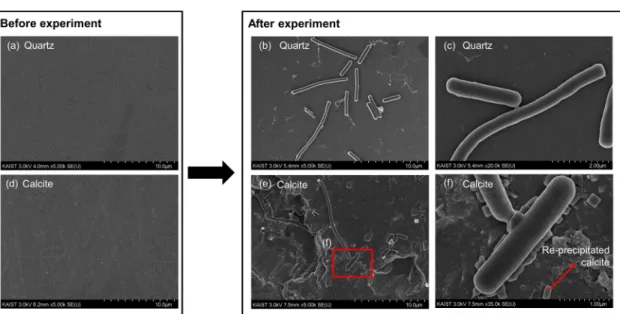
40 h. But soon, after 30−40 h elapsed, the CA fluctuations become greater. It is found that the mineral dissolution/ precipitation reactions roughen the substrate surfaces and hence causes significant contact angle hysteresis and variation. The mineral surfaces of both quartz and calcite substrates are initiallyflat and smooth, as shown inFigure 5a,d. The surface roughness Rais 12.5 nm for the quartz substrate and 33.3 nm for the calcite substrate before the experiments (see Figure S2). The quartz surfaces are still flat and smooth with a minimal change in surface roughness to 19.5 nm even after the exposure to scCO2 with bacterial growths (Figures 5b,c and S2b). This is due to the low reactivity of quartz with CO2. By contrast, the calcite surfaces clearly show the severe changes in
Figure 5.Scanning electron microscope (SEM) images of (a) the quartz substrate before and (b, c) after the experiment and the calcite substrate (d) before and (e, f) after the experiment. After the tests, the substrates were post-treated for B. subtilis cellfixation.
Figure 6.Contact angle analyses of (a) liquid CO2and (b) supercritical CO2(scCO2) droplets on the CO2−brine−calcite phase. The average contact angles of the droplets are represented with cross symbols, and the contact angles of four droplets analyzed during CO2dissolution (when receding) are represented with circles. Error bars indicate the asymmetry in the droplet profile, i.e., the difference between the left and right sides of the droplet. (c) The lifetime of a single droplet on the calcite surface at 4 h without contact angle variation (A) and those at 118 h having contact angle variation (B) as CO2recedes on the roughened calcite surface during dissolution. Note that only the droplets having a Bond number (b0) lower than 0.9 were selected for the analyses.
surface roughness upon the exposure to scCO2 throughout experiments, as shown inFigure 5e,f. It is noted that thefluid− rock interactions between CO2 and calcite minerals signi
fi-cantly altered the calcite mineral surface and increased the surface roughness to 215.9 nm after the experimental run (see
Figure S2).
Also, the SEM-EDS analysis confirms that the solid crystals precipitated on the calcite surfaces are composed of oxygen and calcium ions (Figure S3), which reveals the reprecipitation of the calcite crystals possibly due to the locally concentrated calcium ions near the calcite substrate. This demonstrates that the precipitation, as well as the dissolution of calcite crystals, actively occurs on the calcite surfaces, and these nanosized crystal particles on the surface cause unstable wetting of CO2 droplets.51,52 Moreover, the facilitated nucleation of calcite crystals on bacterial cell surfaces of B. subtilis is clearly observed, as shown in Figure 5f. This corroborates the evidence supporting the previousfinding that calcite nucleation preferably takes place on microbial cells because the negatively charged cells serve as nucleation sites.53
Figure 6depicts the evolution of the contact angle of CO2
droplets on calcite surfaces while monitoring the sessile droplets over their lifetimes until complete dissolution into the brine. The CA difference between the left and right sides of a droplet indicates the degree of asymmetry in the droplet profile. This left- versus right-side CA difference is less than 2° at the beginning of the runs with liquid CO2 and scCO2 (Figure 6a,b). However, the CA difference increases to more than 5° after ∼40 to 50 h passed; the most significant difference is observed to be 20° at 107 h elapsed in the run with liquid CO2. As any imperfection of a mineral surface,
including chemical/physical heterogeneities, can lead to the changes in contact angle and wettability,54−56these severe CA fluctuations are again due to the roughened surfaces of the calcite substrates caused by active mineral dissolution and precipitation reactions. This is also consistent with the previous studies, which describe the impact of the surface roughness on the contact angle hysteresis using the theoretical models, such as Cassie−Baxter and Wenzel models.57,58 In addition, there is a possibility that adsorbed and deposited bacterial cells on a mineral surface also have an effect on the contact angle hysteresis.
It is presumed that the geochemical brine−CO2−mineral
reactions unavoidably take place in geologic CO2 storage in carbonate-rich reservoirs. The bacterial surfactant modifies the rock carbonate mineral surfaces to be more CO2-wet, whereas thefluid−rock interaction can produce rough mineral surfaces and cause a wide distribution of contact angles in brine−CO2−
mineral systems. The dissolution of calcite in carbonate reservoirs naturally releases calcium and carbonate ions and thus increases the pore fluid salinity. Also, the presence of electrolytes in brine facilitates the calcite dissolution; the higher ionic strength leads to the more active and faster rate of calcite dissolution.59,60Moreover, the microbial cells can serve as nucleation sites for calcite precipitation in a porous medium. The pore water chemistry, fluid−rock interactions, bacterial growth, biosurfactant production, and contact angles are mutually related. CO2-driven dissolution of calcite increases the salinity and ionic strength of the porefluid, which in turn could affect the biosurfactant yield.28,61,62 Therefore, these coupled processes are expected to eventually alter the CO2
wettability and transport in such carbonate-rich reservoirs.
4. IMPLICATIONS TO FIELD IMPLEMENTATION OF BIOSURFACTANT-AIDED GCS
This study demonstrates that the biosurfactant microbially produced in situ modifies the wettability of rock minerals from water-wet to CO2-wet while reducing the CO2−brine IFT. Such combined modification in IFT and wettability reduces the capillary factor. The reduced capillary factor enhances the efficiency in displacing or sweeping brine by invading CO2 (i.e., sweeping efficiency). Thereby, this implies an increase in CO2storage capacity per unit volume of a porous medium and
improvements in the permeability and the injectivity of CO2. Our results confirm that B. subtilis strain ATCC 21332 can grow and effectively produce surfactin in the presence of high-pressure liquid CO2and scCO2 under GCS-relevant
environ-ments. This corroborates several laboratory studies, which have demonstrated that Bacillus spp. are one of the unique spp. resilient to scCO2.
16,63
Introduction of liquid/scCO2into deep
reservoirs inevitably lowers the pH of porefluids due to CO2 dissolution in brine, whereas scCO2sterilizes nearly all bacteria
because scCO2 decreases intracellular pH, defects enzyme
functionalities, interrupts protein synthesis, causes cellular desiccation, and eventually leads to the cell death.17−19,64 Therefore, caution should be exercised that biomediated GCS may only be limited to specific species, such as Bacillus spp. In the recent study by Peet et al., only a diverse set of Bacillus spp., not various genera, has been isolated from GCS sites, i.e., Frio-2 site, TX, USA; King Island site, CA; and Otway Basin site, Australia.16 Accordingly, metagenomics analysis of the fluid samples from a GCS-candidate reservoir is required to evaluate its potential for biomediated GCS practices. Injection of properly designed nutrients in the presence of indigenous and active Bacillus spp. can stimulate bacterial growth and surface modification as an effective way to enhance GCS.
Our experiment results also reveal the limited applicability of biosurfactants associated with low solubility under low-pH environments. The rock-forming mineralogy plays a substantial role in determining pH throughfluid−CO2−mineral reactions.
Thefluid pH appears to be one of the most significant factors affecting the productivity and solubility of lipopeptide surfactin produced by Bacillus spp. In quartz-dominant formations, it is expected that CO2 injection significantly lowers the
equili-brium pH in an aqueous phase and thus profoundly affects both the surfactin yield and the solubility. Therefore, forfield implementation, whether it is biostimulation or bioaugmenta-tion, it would be more feasible to stimulate bacterial production of surfactin before CO2 injection in quartz-dominant rock formations. A strategy for biostimulation involves the injection of properly designed nutrients to stimulate the growth of indigenous species capable of biosurfactant production. A bioaugmentation strategy would involve the injection of bacterial inoculum and nutrients for biosurfactant production. Once a certain level of surfactin production is achieved in the treated region, CO2 injection would follow. However, even after the successful in situ production of surfactin, there is a risk that its surface activity is impeded by low solubility in a low pH condition, as injected CO2can lower the pH less than 4. It is worth pointing out that such biosurfactant-driven wettability modification can be transient in quartz-dominant formations. Accordingly, CO2
invasion facilitated by the modified mineral wettability can be limited to the edge of a CO2plume. Therefore, it is concluded
long-biosurfactant-producing bacteria, the wetting behavior of CO2 on such rough surfaces still warrants further investigation under environmental conditions emulating GCS reservoirs.
Besides, reservoir rocks in natural geologic formations are typically found to contain other various organic/inorganic substrates and minerals, such as clays. Herein, we only examined the single mineral system with quartz or calcite. The presence of other minerals not only can have considerable
effects on the pore fluid pH, bacterial growth, and
biosurfactant production but can also change the wettability alteration and correspondingfluid transport property. There-fore, site-specific experiments emulating the target GCS reservoir rock conditions will be required to access the actual
efficacy of the suggested biomediated GCS for field
implementation.
In this study, we highlight the exploitation of in situ bacterial biosurfactant production for biosurfactant-aided CO2injection. One of the advantages is that this technology does not require additional facilities forfluid injection. Prior to CO2injection, bacterial inoculums, nutrients, and substrates can be readily injected using the facility prepared for CO2 injection into a target geologic formation. In addition, control of in situ bacterial biosurfactant production also provides an additional advantage over the direct injection of ex situ produced surfactants, whether it is chemically synthesized or microbially produced. The surfactant produced ex situ and injected afterward can accompany the adsorption loss of surfactant, as the injected surfactant can be readily adsorbed on the unwanted mineral surfaces before being delivered to a target region if the target region is far from the injection point. By contrast, the in situ biosurfactant production at a specific region can be achieved with an effective transport strategy that delivers the inoculums and/or nutrients to the very target location. From the economic perspective, the cost of preparing nutrients and substrates is the major constituent for the overall cost of biosurfactant production.66,67Although biosurfactants are still expensive compared to chemical surfactants, in situ microbial production of biosurfactants may provide an economically viable option over the use of chemically synthesized surfactants. In addition, the cost reduction and cost competitiveness for efficient biosurfactant production can be achieved through diverse efforts of using renewable substrates such as inexpensive components33,68−70or optimiz-ing the nutrient components.69,71,72
■
ASSOCIATED CONTENT*
sı Supporting InformationThe Supporting Information is available free of charge at
https://pubs.acs.org/doi/10.1021/acs.est.0c05772.
EDS (PDF)
■
AUTHOR INFORMATIONCorresponding Author
Tae-Hyuk Kwon − Department of Civil and Environmental Engineering, Korea Advanced Institute of Science and Technology (KAIST), Daejeon 34141, Korea; orcid.org/ 0000-0002-1610-8281; Phone: +82-42-350-3628; Email:[email protected]; Fax: +82-42-869-3610 Authors
Taehyung Park − Department of Civil and Environmental Engineering, Korea Advanced Institute of Science and Technology (KAIST), Daejeon 34141, Korea
Sukhwan Yoon − Department of Civil and Environmental Engineering, Korea Advanced Institute of Science and Technology (KAIST), Daejeon 34141, Korea; orcid.org/ 0000-0002-9933-7054
Jongwon Jung − School of Civil Engineering, Chungbuk National University, Chungbuk 28644, Korea Complete contact information is available at:
https://pubs.acs.org/10.1021/acs.est.0c05772
Notes
The authors declare no competingfinancial interest.
■
ACKNOWLEDGMENTSThis research was supported by a grant (19CTAP-C151917-01) from the Technology Advancement Research Program (TARP) funded by the Ministry of Land, Infrastructure and Transport of Korean Government and by the National Research Foundation of Korea (NRF) grant funded by the Korean government (MSIT) (No. 2020R1A2C4002358).
■
REFERENCES(1) Bergman, P. D.; Winter, E. M. Disposal of carbon dioxide in aquifers in the US. Energy Convers. Manage. 1995, 36, 523−526.
(2) Ingham, D. B.; Pop, I. Transport Phenomena in Porous Media; Elsevier, 1998.
(3) Chalbaud, C.; Robin, M.; Lombard, J.; Martin, F.; Egermann, P.; Bertin, H. Interfacial tension measurements and wettability evaluation for geological CO2storage. Adv. Water Resour. 2009, 32, 98−109.
(4) Chiquet, P.; Daridon, J.-L.; Broseta, D.; Thibeau, S. CO2/water interfacial tensions under pressure and temperature conditions of CO2 geological storage. Energy Convers. Manage. 2007, 48, 736−744.
(5) Bernard, G. C.; Holm, L.; Harvey, C. P. Use of surfactant to reduce CO2 mobility in oil displacement. Soc. Pet. Eng. J. 1980, 20, 281−292.
(6) Cao, S. C.; Dai, S.; Jung, J. Supercritical CO2 and brine displacement in geological carbon sequestration: Micromodel and
pore network simulation studies. Int. J. Greenhouse Gas Control 2016, 44, 104−114.
(7) Kim, S.; Santamarina, J. C. Engineered CO2injection: The use of surfactants for enhanced sweep efficiency. Int. J. Greenhouse Gas Control 2014, 20, 324−332.
(8) Worthen, A. J.; Parikh, P. S.; Chen, Y.; Bryant, S. L.; Huh, C.; Johnston, K. P. Carbon dioxide-in-water foams stabilized with a mixture of nanoparticles and surfactant for CO2 storage and utilization applications. Energy Procedia 2014, 63, 7929−7938.
(9) Park, Y.-C.; Kim, S.; Lee, J. H.; Shinn, Y. J. Effect of reducing irreducible water saturation in a near-well region on CO2 injectivity and storage capacity. Int. J. Greenhouse Gas Control 2019, 86, 134− 145.
(10) Wellington, S.; Vinegar, H. In CT Studies of Surfactant-Induced CO2 Mobility Control, SPE 60th Annual Technical Conference and Exhibition, LasVegas, NV, 1985.
(11) Finnerty, W. R. Biosurfactants in environmental biotechnology. Curr. Opin. Biotechnol. 1994, 5, 291−295.
(12) Ron, E. Z.; Rosenberg, E. Natural roles of biosurfactants. Environ. Microbiol. 2001, 3, 229−236.
(13) Sulaimani, H.; Wahaibi, Y.; Bahry, S.; Elshafie, A.; Al-Bemani, A.; Joshi, S. Residual-oil recovery through injection of biosurfactant, chemical surfactant, and mixtures of both under reservoir temperatures: induced-wettability and interfacial-tension effects. SPE Reservoir Eval. Eng. 2012, 15, 210−217.
(14) Soberón-Chávez, G.; Maier, R. M. Biosurfactants. In Micro-biology Monographs; Springer, 2011; Vol. 20.
(15) Park, T.; Jeon, M.-K.; Yoon, S.; Lee, K. S.; Kwon, T.-H. Modification of interfacial tension and wettability in oil-brine-quartz system by in situ bacterial biosurfactant production at reservoir conditions: Implications to microbial enhanced oil recovery. Energy Fuels 2019, 33, 4909−4920.
(16) Peet, K. C.; Freedman, A. J.; Hernandez, H. H.; Britto, V.; Boreham, C.; Ajo-Franklin, J. B.; Thompson, J. R. Microbial growth under supercritical CO2. Appl. Environ. Microbiol. 2015, 81, 2881− 2892.
(17) Zhang, J.; Davis, T. A.; Matthews, M. A.; Drews, M. J.; LaBerge, M.; An, Y. H. Sterilization using high-pressure carbon dioxide. J. Supercrit. Fluids 2006, 38, 354−372.
(18) Spilimbergo, S.; Bertucco, A. Non-thermal bacterial inactivation with dense CO2. Biotechnol. Bioeng. 2003, 84, 627−638.
(19) Freedman, A. J.; Tan, B.; Thompson, J. R. Microbial potential for carbon and nutrient cycling in a geogenic supercritical carbon dioxide reservoir. Environ. Microbiol. 2017, 19, 2228−2245.
(20) Kwon, T.-H.; Park, T. Geological Storage System of Carbon Dioxide and Process for Geological Storage of Carbon Dioxide. U.S. Patent US16/052,7812019.
(21) Riding, J.; Rochelle, C. The IEA Weyburn CO2Monitoring and Storage Project: Final Report of the European Research Team; British Geological Survey, 2005.
(22) Boreham, C.; Underschultz, J.; Stalker, L.; Kirste, D.; Freifeld, B.; Jenkins, C.; Ennis-King, J. Monitoring of CO2 storage in a depleted natural gas reservoir: Gas geochemistry from the CO2CRC Otway Project, Australia. Int. J. Greenhouse Gas Control 2011, 5, 1039−1054.
(23) Preisig, M.; Prévost, J. H. Coupled multi-phase thermo-poromechanical effects. Case study: CO2injection at In Salah, Algeria. Int. J. Greenhouse Gas Control 2011, 5, 1055−1064.
(24) Mayer, B.; Shevalier, M.; Nightingale, M.; Kwon, J.-S.; Johnson, G.; Raistrick, M.; Hutcheon, I.; Perkins, E. Tracing the movement and the fate of injected CO2 at the IEA GHG Weyburn-Midale CO2 Monitoring and Storage project (Saskatchewan, Canada) using carbon isotope ratios. Int. J. Greenhouse Gas Control 2013, 16, S177−S184.
(25) Wang, S.; Edwards, I. M.; Clarens, A. F. Wettability phenomena at the CO2−brine−mineral interface: implications for geologic carbon sequestration. Environ. Sci. Technol. 2013, 47, 234−241.
(26) Espinoza, D. N.; Santamarina, J. C. Water-CO2-mineral systems: Interfacial tension, contact angle, and
diffusionImplica-tions to CO2 geological storage. Water Resour. Res. 2010, 46, No. W07537.
(27) Bikkina, P. K. Contact angle measurements of CO2−water− quartz/calcite systems in the perspective of carbon sequestration. Int. J. Greenhouse Gas Control 2011, 5, 1259−1271.
(28) Saraji, S.; Piri, M.; Goual, L. The effects of SO2contamination, brine salinity, pressure, and temperature on dynamic contact angles and interfacial tension of supercritical CO2/brine/quartz systems. Int. J. Greenhouse Gas Control 2014, 28, 147−155.
(29) Jafari, M.; Jung, J. Direct measurement of static and dynamic contact angles using a random micromodel considering geological CO2sequestration. Sustainability 2017, 9, No. 2352.
(30) Jafari, M.; Jung, J. The change in contact angle at unsaturated CO2-water conditions: Implication on geological carbon dioxide sequestration. Geochem., Geophys., Geosyst. 2016, 17, 3969−3982.
(31) Park, T.; Joo, H.-W.; Kim, G.-Y.; Kim, S.; Yoon, S.; Kwon, T.-H. Biosurfactant as an Enhancer of Geologic Carbon Storage: Microbial Modification of Interfacial Tension and Contact Angle in Carbon dioxide/Water/Quartz Systems. Front. Microbiol. 2017, 8, No. 1285.
(32) Nicholson, W. Roles of Bacillus endospores in the environment. Cell. Mol. Life Sci. 2002, 59, 410−416.
(33) Al-Bahry, S.; Al-Wahaibi, Y.; Elshafie, A.; Al-Bemani, A.; Joshi, S.; Al-Makhmari, H.; Al-Sulaimani, H. Biosurfactant production by Bacillus subtilis B20 using date molasses and its possible application in enhanced oil recovery. Int. Biodeterior. Biodegrad. 2013, 81, 141−146. (34) Al-Wahaibi, Y.; Joshi, S.; Al-Bahry, S.; Elshafie, A.; Al-Bemani, A.; Shibulal, B. Biosurfactant production by Bacillus subtilis B30 and its application in enhancing oil recovery. Colloids Surf., B 2014, 114, 324−333.
(35) Cooper, D. G.; Goldenberg, B. G. Surface-active agents from two Bacillus species. Appl. Environ. Microbiol. 1987, 53, 224−229.
(36) Javaheri, M.; Jenneman, G. E.; McInerney, M. J.; Knapp, R. M. Anaerobic production of a biosurfactant by Bacillus licheniformis JF-2. Appl. Environ. Microbiol. 1985, 50, 698−700.
(37) Liu, Q.; Lin, J.; Wang, W.; Huang, H.; Li, S. Production of surfactin isoforms by Bacillus subtilis BS-37 and its applicability to enhanced oil recovery under laboratory conditions. Biochem. Eng. J. 2015, 93, 31−37.
(38) Pornsunthorntawee, O.; Arttaweeporn, N.; Paisanjit, S.; Somboonthanate, P.; Abe, M.; Rujiravanit, R.; Chavadej, S. Isolation and comparison of biosurfactants produced by Bacillus subtilis PT2 and Pseudomonas aeruginosa SP4 for microbial surfactant-enhanced oil recovery. Biochem. Eng. J. 2008, 42, 172−179.
(39) Rangarajan, V.; Clarke, K. G. Towards bacterial lipopeptide products for specific applicationsa review of appropriate down-stream processing schemes. Process Biochem. 2016, 51, 2176−2185.
(40) Cooper, D.; Macdonald, C.; Duff, S.; Kosaric, N. Enhanced production of surfactin from Bacillus subtilis by continuous product removal and metal cation additions. Appl. Environ. Microbiol. 1981, 42, 408−412.
(41) Daerr, A.; Mogne, A. Pendent_drop: an imagej plugin to measure the surface tension from an image of a pendent drop. J. Open Res. Software 2016, 4, No. e3.
(42) Stalder, A.; Kulik, G.; Sage, D.; Barbieri, L.; Hoffmann, P. A snake-based approach to accurate determination of both contact points and contact angles. Colloids Surf., A 2006, 286, 92−103.
(43) Kaveh, N. S.; Rudolph, E.; Van Hemert, P.; Rossen, W.; Wolf, K.-H. Wettability evaluation of a CO2/water/bentheimer sandstone system: contact angle, dissolution, and bubble size. Energy Fuels 2014, 28, 4002−4020.
(44) Berry, J. D.; Neeson, M. J.; Dagastine, R. R.; Chan, D. Y.; Tabor, R. F. Measurement of surface and interfacial tension using pendant drop tensiometry. J. Colloid Interface Sci. 2015, 454, 226− 237.
(45) Cen, L.; Neoh, K.; Kang, E. Antibacterial activity of cloth functionalized with N-alkylated poly (4-vinylpyridine). J. Biomed. Mater. Res., Part A 2004, 71A, 70−80.
200−206.
(51) Munshi, A.; Singh, V.; Kumar, M.; Singh, J. Effect of nanoparticle size on sessile droplet contact angle. J. Appl. Phys. 2008, 103, No. 084315.
(52) Gao, L.; McCarthy, T. J. Contact angle hysteresis explained. Langmuir 2006, 22, 6234−6237.
(53) Stocks-Fischer, S.; Galinat, J. K.; Bang, S. S. Microbiological precipitation of CaCO3. Soil Biol. Biochem. 1999, 31, 1563−1571.
(54) Nakae, H.; Inui, R.; Hirata, Y.; Saito, H. Effects of surface roughness on wettability. Acta Mater. 1998, 46, 2313−2318.
(55) Lin, F.; Li, D. The effect of surface heterogeneity on the drop size dependence of contact angles. Chem. Eng. Sci. 1995, 50, 2633− 2639.
(56) Extrand, C. Contact angles and hysteresis on surfaces with chemically heterogeneous islands. Langmuir 2003, 19, 3793−3796.
(57) Cassie, A. Contact angles. Discuss. Faraday Soc. 1948, 3, 11−16. (58) Wenzel, R. N. Surface roughness and contact angle. J. Phys. Chem. A 1949, 53, 1466−1467.
(59) Zuddas, P.; Mucci, A. Kinetics of calcite precipitation from seawater: II. The influence of the ionic strength. Geochim. Cosmochim. Acta 1998, 62, 757−766.
(60) Sjöberg, E. A fundamental equation for calcite dissolution kinetics. Geochim. Cosmochim. Acta 1976, 40, 441−447.
(61) Guimarães, C. R.; Pasqualino, I. P.; da Mota, F. F.; de Godoy, M. G.; Seldin, L.; de Castilho, L. V. A.; Freire, D. M. G. Surfactin from Bacillus velezensis H2O-1: Production and physicochemical character-ization for postsalt applications. J. Surfactants Deterg. 2019, 22, 451− 462.
(62) Davis, D.; Lynch, H.; Varley, J. The production of surfactin in batch culture by Bacillus subtilis ATCC 21332 is strongly influenced by the conditions of nitrogen metabolism. Enzyme Microb. Technol. 1999, 25, 322−329.
(63) Mitchell, A. C.; Phillips, A. J.; Hamilton, M. A.; Gerlach, R.; Hollis, W. K.; Kaszuba, J. P.; Cunningham, A. B. Resilience of planktonic and biofilm cultures to supercritical CO2. J. Supercrit. Fluids 2008, 47, 318−325.
(64) Kirk, M. F. Variation in energy available to populations of subsurface anaerobes in response to geological carbon storage. Environ. Sci. Technol. 2011, 45, 6676−6682.
(65) Bastrzyk, A.; Fiedot-Toboła, M.; Polowczyk, I.; Legawiec, K.; Płaza, G. Effect of a lipopeptide biosurfactant on the precipitation of calcium carbonate. Colloids Surf., B 2019, 174, 145−152.
(66) Geetha, S. J.; Banat, I. M.; Joshi, S. J. Biosurfactants: Production and potential applications in microbial enhanced oil recovery (MEOR). Biocatal. Agric. Biotechnol. 2018, 14, 23−32.
(67) Banat, I. M.; Satpute, S. K.; Cameotra, S. S.; Patil, R.; Nyayanit, N. V. Cost effective technologies and renewable substrates for biosurfactants’ production. Front. Microbiol. 2014, 5, No. 697.
(68) Makkar, R. S.; Cameotra, S. S.; Banat, I. M. Advances in utilization of renewable substrates for biosurfactant production. AMB Express 2011, 1, No. 5.
(69) Joshi, S.; Bharucha, C.; Desai, A. J. Production of biosurfactant and antifungal compound by fermented food isolate Bacillus subtilis 20B. Bioresour. Technol. 2008, 99, 4603−4608.