Transl Clin Pharmacol
TCP
http://dx.doi.org/10.12793/tcp.2016.24.4.1752016;24(4):175-182
Pharmacokinetics and safety profiles of tadalafil/
tamsulosin HCl fixed-dose combination capsule
under fasted and fed condition in healthy
volun-teers
Byung Hak Jin
1,2, Byung Won Yoo
2, Eun Sil Oh
1, Seungwon Yang
3,4, Jina Jung
5and Min Soo Park
1,2,6*
1Department of Pharmaceutical Medicine and Regulatory Sciences, College of Medicine and Pharmacy, Yonsei University, Incheon 21983, Korea, 2Department of Clinical Pharmacology and Clinical Trials Center, Severance Hospital, College of Medicine, Yonsei University, Seoul 03722, Korea, 3Department of Pharmacy, College of Pharmacy, Yonsei University, Incheon 21983, Korea, 4Yonsei Institute of Pharmaceutical Sciences, College of Pharmacy, Yonsei University, Incheon 21983, Korea, 5Clinical Research Team, Hanmi Pharmaceutical Co.,Ltd., Seoul 05545, Korea, 6Department of Pediatrics, College of Medicine, Yonsei University, Seoul 03722, Korea *Correspondence: M.S. Park; Tel: +82-2-2228-0270, Fax: +82-2-2227-7890, E-mail: [email protected]
Co-administration of tadalafil and tamsulosin HCl in patients with benign prostate hyperplasia and erectile dysfunction is increasing in clinical settings. Development of fixed-dose combination (FDC) of tadalafil and tamsulosin HCl could contribute to improving patients’ adherence and treatment ef-ficacy. We evaluated the pharmacokinetics and safety profiles of a newly developed fixed-dose com-bination capsule of tadalafil 5 mg/tamsulosin HCl 0.4 mg in comparison with co-administration of each formulation in healthy volunteers under fasted and fed conditions. Two randomized, open-label, single-dose, two-way, crossover studies were completed in 29 subjects under fasted condition, and 33 subjects under fed condition. Serial blood sample collection for PK analysis was conducted up to 72 hours after dosing, and PK parameters were calculated using non-compartmental analysis. Geometric mean ratios and 90% confidence intervals of the Cmax and AUClast were used to evaluate
comparative bioavailability. In both fasted and fed condition studies, the bioequivalence was estab-lished. The most common adverse drug reactions were orthostatic hypotension and headache with no statistical difference between treatment groups. All subjects with orthostatic hypotension recov-ered at follow-up test. Although changes in vital signs from baseline were statistically significant, there were no subjects with systolic blood pressure < 90 mmHg and there were no clinically mean-ingful signs or symptoms associated. FDC of tadalafil and tamsulosin HCl can be an alternative to co-administration of individual drugs for providing better compliance. Changes in blood pressure should be kept in mind when tadalafil and tamsulosin HCl are co-administered in clinical settings.
Introduction
Benign prostatic hyperplasia (BPH) is the proliferation of smooth muscle and epithelial cells in prostatic tissue resulting in lower urinary tract syndrome (LUTS).[1,2] Garraway et al. reported that the prevalence of BPH was 25.3% in total 699
sub-jects aged between forty and seventy and tended to increase as the age increased.[3,4] Erectile Dysfunction (ED) is defined as difficulty in gaining or keeping erected state enough to enjoy sex life.[5,6] LUTS is known as an independent risk factor of ED.[6] Suggested pathophysiologic mechanisms of LUTS and ED are decrease in nitric oxide synthase/nitric oxide production and overactivity of sympathetic nervous system.[7] Clinical studies have shown the prevalence of BPH in ED patients was as high as 72.2-85.2%.[6,8]
Tamsulosin hydrochloride (HCl) is a strong inhibitor of al-Received 19 Aug 2016 Revised 29 Nov 2016 Accepted 29 Nov 2016 Keywords pharmacokinetics, tadalafil, tamsulosin HCl, fixed-dose combination pISSN: 2289-0882 eISSN: 2383-5427 ORIGINAL ARTICLE
Copyright © 2016 Translational and Clinical Pharmacology
It is identical to the Creative Commons Attribution Non-Commercial License (http://creativecommons.org/licenses/by-nc/3.0/).
This paper meets the requirement of KS X ISO 9706, ISO 9706-1994 and ANSI/NISO Z.39.48-1992 (Permanence of Paper).
TCP
Transl Clin PharmacolPharmacokinetics and safety of tadalafil/tamsulosin HCl FDC
pha-1 adrenoreceptor in the urogenital system and has been used in the treatment of dysuria caused by BPH.[9] Tadalafil inhibits phosphodiesterase-5 and increases nitric oxide activity which in turn increases penile blood flow resulting in enhance-ment of the erectile function.[10,11] Tadalafil also acts on the smooth muscle in urogenital system and reduces LUTS in patients with BPH. U.S. Food and Drug Administration also ap-proved tadalafil for treating signs and symptoms of patients who are comorbid with both BPH and ED in 2011.[12] The signs and symptoms of detrusor overactivity and LUTS were im-proved with concomitant therapy with tadalafil and tamulosin HCl without the difference in safety in previous studies. There was also improvement in signs or symptoms related with ED accompanied with the LUTS in the treatment group that both tadalafil and tamsulosin HCl were used.[13,14] Thus, co-prescription of tadalafil and tamsulosin HCl is increasing. Based on these findings, the development of fixed-dose combination (FDC) of tadalafil and tamsulosin HCl can be justified with the expectation of improving patients’ adherence and treatment efficacy, especially in old aged patients with high incidence of BPH and ED.
We evaluated the pharmacokinetics and safety profiles of a newly developed tadalafil/tamsulosin HCl FDC capsule (HCP1303, Hanmi Pharmaceutical Co. Seoul, Korea) and com-pared with concomitant administration of individual drugs under fasted and fed conditions. Studies under both conditions were conducted considering the food effect of tamsulosin HCl in previous study.[9]
Methods
Subjects
Healthy male volunteers who were aged between 19 and 50 years, weighed at least 55 kg, and had body mass index between 18.5 and 25.0 kg/m2 were enrolled. Subjects agreed, voluntarily
signed the informed consent forms and went through screen-ing procedures such as past medical history, physical examina-tion, and laboratory assessments including hematology, blood chemistry, serology and urine drug screening. Subjects with the following criteria were excluded: a history of clinically signifi-cant hypersensitivity reaction to drugs or foods, with a genetic problem such as galactose intolerance, a history of gastrointesti-nal diseases which would affect the absorption of investigatiogastrointesti-nal drugs, positive results on a urine drug screening or serology test, with an orthostatic hypotension, ocular disorders includ-ing cataract, priapism, cardiovascular disorders or a history of micturition syncope. The study participants were not allowed to take any prescription drugs or herbal medicines for 2 weeks pri-or to the study drug administration, npri-or any over-the-counter drugs or dietary supplements for 1 week prior to the study drug administration. The participants were also refrained from con-suming alcohol, caffeinated beverages, and grapefruit products, as well as smoking, during the studies.
Study Design
Two clinical trials with the identical design were conducted independently either under fasted or fed condition. Both stud-ies were as designed randomized, open-label, single-dose, two-treatment, two-period, crossover. A total of 30 participants in the fasted condition study and 36 participants in the fed condition study were randomized and assigned to one of the two treatment sequences (test drug - reference drug, or refer-ence drug - test drug). Because there was a previous report that showed increased coefficient of variation (CV) value in AUClast
of tamsulosin HCl in fed state compared with fasted state, the sample size was increased in the fed study.[9] Each treatment period was separated by a 7-day washout period that was over five-fold longer than the previously reported terminal half-lives of tamsulosin HCl and tadalafil.[12,15]
These studies were approved by the Institutional Review Board of Severance Hospital, Yonsei University College of Medicine, Seoul, Korea. Studies were conducted in accordance with the principles of the Declaration of Helsinki and Good Clinical Practice and were approved by the Ministry of Food and Drug Safety.
Treatment and administration
The treatments consisted of a single oral dose of test drug [tadalafil 5 mg/tamsulosin HCl 0.4 mg FDC capsule (Hanmi Pharmaceutical Co., Seoul, Korea)] and reference drugs [tadalafil 5 mg tablet (Cialis®, Eli Lilly Korea) and tamsulosin HCl 0.4 mg capsule (Hanmi Pharmaceutical Co., Seoul, Korea) co-administered].
In the fasted condition study, all participants were kept fasted overnight for at least 10 hours and received one of the two treat-ments as per the randomization schedule. In the fed condition study, all participants were kept fasted overnight for at least 10 hours and were allowed to have high-fat meals (at least total 900 kcal, at least 35 percent fat) 30 minutes prior to the administra-tion of investigaadministra-tional products and then were given the study drugs. The composition of high-fat meal was decided based on the guidance for food effect bioavailability of sustained-release products issued by the Ministry of Food and Drug Safety (MFDS).[16] Fluid intake was prohibited for 1 hour before and after administration of investigational products. Lunch and din-ner were provided about 4 hours and 10 hours after administra-tion of investigaadministra-tional products, respectively.
Blood sample collection and analysis
Serial blood samples were collected in anti-coagulated EDTA-K2 tubes at 0 (pre-dose), 0.5, 1, 1.5, 2, 2.5, 3, 4, 4.5, 5, 6, 7, 8, 10, 12, 24, 36, 48 and 72 h after dosing in the fasting condition study, and at 0 (pre-dose), 0.5, 1, 1.5, 2, 2.5, 3, 4, 5, 5.5, 6, 6.5, 7, 8, 10, 12, 24, 36, 48 and 72 h in the fed condition study to as-sess plasma tadalafil and tamsulosin HCl concentrations. Blood sampling points were determined considering Tmax and
TCP
Transl Clin Pharmacol
Byung Hak Jin, et al.
were modified in the fed study because food intake delayed the Tmax of tamsulosin HCl.[9] Samples were centrifuged for eight minutes at 4°C, 1800 g and stored below -70°C until analysis. Plasma concentrations of tadalafil were measured using ultra-performance liquid chromatography tandem mass spectrom-etry (UPLC-MS/MS). The linear calibration ranges were 1–500 ng/ml in tadalafil and 0.2–100 ng/ml in tamsulosin HCl. The coefficient of variation (CV) represents overall precision of the tadalafil and tamsulosin HCl assay was below 20.0% for LLOQ and 15.0% for other upper concentrations for calibration. Plas-ma concentrations of both tadalafil and tamsulosin HCl were analyzed by BioInfra Co., (Suwon, Korea).
Pharmacokinetic data assessment
PK parameters were evaluated using a non-compartmental model of Phoenix® WinNonlin® software version 6.4 (Certara, St.Louis, MO, USA). Cmax and Tmax were determined directly
from the observed values. The area under the curve from the time of dosing to the last measurable concentration (AUClast)
was calculated using the linear trapezoidal method for ascend-ing concentrations and the log trapezoidal method for descend-ing concentrations. The terminal elimination rate constant (λz)
was estimated by linear regression of the terminal portion of the log-transformed plasma concentrations-to-time profile. The AUC from the last dosing time extrapolated to infinity (AUCinf)
was calculated by AUClast + Clast/λz, where Clast represents the last
measurable concentration.
Safety and tolerability assessments
Safety and tolerability were evaluated throughout the study. The assessments included monitoring of all adverse events based on physical examinations, vital signs, 12 lead electrocar-diograms, routine hematology, serum chemistry, urinalysis, and orthostatic hypotension tests. Subjects were instructed to notify the study physician and/or nurses of any adverse events that occurred during the study. All AEs reported by subjects or detected in assessments were recorded and the investigators de-termined their relationship to the treatment.
Statistical analysis
Descriptive statistics were provided for baseline demographics, PK parameters and safety data by sequence group or treatment group. Baseline demographics of the treatment sequences were evaluated with Student’s t-test using the IBM SPSS Statistics software version 23.0 (SPSS Incorporated, Chicago, IL, USA). To compare the PK parameters (AUClast and Cmax) between
treatments, a general linear mixed effects model was developed using log-transformed data with period, sequence, and treat-ment as fixed effects and subjects nested within sequence as a random effect. The geometric mean ratio (GMR) and its 90% confidence interval (CI) of the AUClast and the Cmax between the
FDC and co-administration of individual drugs were calculated, and the bioequivalence was demonstrated when the 90% CI
en-tirely fell within the conventional bioequivalence range of 0.8-1.25. The incidence of major anticipated adverse drug reactions (ADRs) was statistically compared between treatment groups using chi-square test or McNemar’s test using the IBM SPSS Statistics software version 23.0 (SPSS Incorporated, Chicago, IL, USA). Changes in systolic blood pressure (SBP) and diastolic blood pressure (DBP) from baseline were compared between treatment groups using repeated mixed effects model.
Results
Demographics
A total of 31 subjects were enrolled in the fasted condition study. Two subjects withdrew consent during the study due to personal reasons, and 29 subjects completed the study and were included in the PK analysis. A total of 30 subjects who received at least one dose of any investigational products were included in the safety analysis. In the fed condition study, a total of 36 subjects were enrolled. One subject was removed from the study due to poor adherence before administration of any investiga-tional products. Two subjects withdrew consent at the end of period 1 due to personal reasons. As a result, 33 subjects in total completed the study, but there was a subject whose pre-dose concentration at period 2 was higher than 5% of Cmax, so 32
subjects were included in the PK analysis. A total of 35 subjects who received at least one dose of any investigational products were included in the safety analysis. Baseline demographics were similar and showed no statistical difference between se-quence groups in both studies. The demographic information of study subjects was summarized in Table 1.
Pharmacokinetics
Bioequivalence in the fasted and fed condition studies
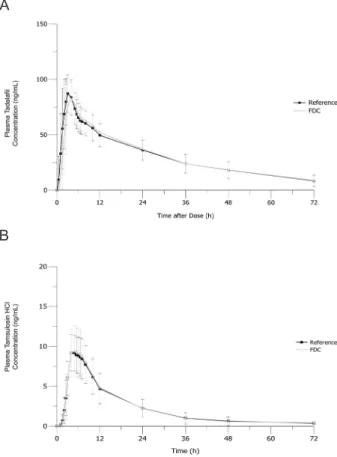
PK parameters and the plasma concentration-time profiles of tadalafil and tamsulosin HCl in the fasted condition study are shown in Table 2 and Figure 1, respectively. A single oral dose of tadalafil and tamsulosin HCl as the fixed-dose combination and the co-administration of individual drugs were bioequivalent. The GMRs (90% CI) of AUClast and Cmax between the test and
the reference formulation of tadalafil were 0.98 (0.93–1.03) and 0.99 (0.92–1.07). Similarly the values were 1.03 (0.98–1.09) and 1.02 (0.96–1.08) for tamsulosin HCl, respectively. Furthermore, other PK parameters, including Tmax, AUCinf, t1/2, Vd/F and CL/
F were also comparable between the two treatments.
PK parameters and the plasma concentration-time profiles of tadalafil and tamsulosin HCl in the fed condition study are shown in Table 2 and Figure 2, respectively. Single oral dose of tadalafil and tamsulosin HCl as the fixed-dose combination and the co-administration of individual drugs were bioequivalent. The GMRs (90% CI) of AUClast and Cmax between the test and
the reference formulation of tadalafil were 0.99 (0.95–1.03) and 0.95 (0.91–1.00). The values were 0.99 (0.94–1.05) and 1.02
TCP
Transl Clin Pharmacol(0.96–1.09) for tamsulosin HCl. Other PK parameters, includ-ing Tmax, AUCinf, t1/2, Vd/F and CL/F were also comparable
be-tween the two treatments.
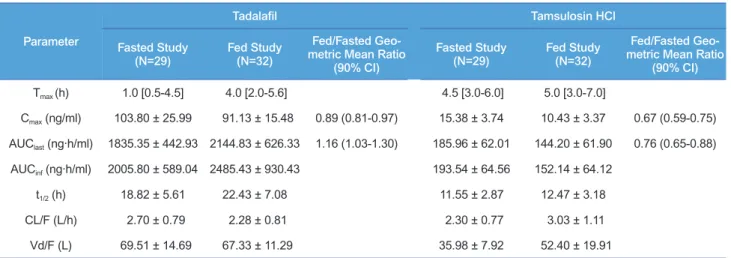
Post hoc cross-study evaluation of food effect on FDC
Post hoc evaluation of food effect on FDC was conducted using the same statistical method to assess the bioequivalence because both studies were performed in healthy male volunteers with
the same design, used the same analytical methods although both studies were not specifically designed to be compared. The results are summarized in Table 3. Tmax of both tadalafil and
tamsulosin HCl were delayed under fed condition compared to fasted condition. AUClast of tadalafil under the fed condition was
increased by 16% compared to those under the fasted condition. However, AUClast of tamsulosin HCl was decreased by 24%
un-der fed condition compared to fasted condition. Cmax of tadalafil
Variables Fasted Study Fed Study
T-R (N=15) R-T (N=15) P-value T-R (N=17) R-T (N=18) P-value
Age (years) 24.5 ± 4.3 24.9 ± 3.5 0.82 27.0 ± 5.7 30.9 ± 6.5 0.07
Height (cm) 175.1 ± 4.8 175.5 ± 5.8 0.52 176.2 ± 5.2 174.7 ± 4.5 0.84
Weight (kg) 67.7 ± 6.0 69.1 ± 5.4 0.84 70.0 ± 4.9 70.4 ± 6.6 0.37
BMI (kg/m2) 22.0 ± 1.8 22.4 ± 1.7 0.59 22.5 ± 1.1 23.0 ± 1.7 0.29
Table 1. Demographics of study participants
Notes: Data are summarized as arithmetic mean ± standard deviation. P-values were derived by Student’s t-test. T-R, FDC followed by concomitant administration of individual drugs; R-T, concomitant administration of individual drugs followed by FDC
Figure 2. Plasma concentration-time profiles for (A) tadalafil, (B) tam-sulosin HCl in fed condition study as a fixed-dose combination or con-comitant administration of individual drugs. Data are shown as mean ± SD. FDC, fixed-dose combination; Reference, concomitant administra-tion of individual drugs.
B A
Figure 1. Plasma concentration-time profiles for (A) tadalafil, (B) tamsulosin HCl in fasted condition study as a fixed-dose combination or concomitant administration of individual drugs. Data are shown as mean ± SD. FDC, fixed-dose combination; Reference, concomitant administration of individual drugs.
A
B
TCP
Transl Clin Pharmacol
Byung Hak Jin, et al.
Study T ype P arameter Tadalafil Tamsulosin HCl FDC R eference Geometric Mean R atio a (90% CI) FDC R eference Geometric Mean R atio a (90% CI) Fasted condition study (N=29) T max (h) 1.0 [0.5-4.5] 1.5 [0.5-4.5] 4.5 [3.0-6.0] 4.5 [3.0-6.0] C max (ng/ml) 103.80 ± 25.99 103.33 ± 21.24 0.99 (0.92-1.07) 15.38 ± 3.74 15.20 ± 4.12 1.02 (0.96-1.08) AUC last (ng∙h/ml) 1835.35 ± 442.93 1877.44 ± 469.36 0.98 (0.93-1.03) 185.96 ± 62.01 180.46 ± 61.64 1.03 (0.98-1.09) AUC inf (ng∙h/ml) 2005.80 ± 589.04 2078.39 ± 695.02 193.54 ± 64.56 188.83 ± 66.68 t 1/2 (h) 18.82 ± 5.61 19.56 ± 7.18 11.15 ± 2.87 12.45 ± 3.91 CL/F (L/h) 2.70 ± 0.79 2.63 ± 0.76 2.30 ± 0.77 2.37 ± 0.80 Vd/F (L) 69.51 ± 14.69 68.84 ± 1 1.55 35.98 ± 7.92 39.75 ± 10.27
Fed condition study
(N=32) T max (h) 4.0 [2.0-5.6] 2.75 [1.0-5.0] 5.0 [3.0-7.0] 5.0 [3.0-7.1] C max (ng/ml) 91.13 ± 15.48 95.94 ± 18.54 0.95 (0.91-1.00) 10.43 ± 3.37 10.03 ± 2.46 1.02 (0.96-1.09) AUC last (ng∙h/ml) 2144.83 ± 626.33 2146.43 ± 553.55 0.99 (0.95-1.03) 144.20 ± 61.90 144.24 ± 60.00 0.99 (0.94-1.05) AUC inf (ng∙h/ml) 2485.43 ± 930.43 2459.07 ± 777.79 152.14 ± 64.12 153.45 ± 61.06 t 1/2 (h) 22.43 ± 7.08 22.62 ± 6.19 12.47 ± 3.18 14.09 ± 10.19 CL/F (L/h) 2.28 ± 0.81 2.22 ± 0.66 3.03 ± 1.1 1 2.94 ± 0.97 Vd/F (L) 67.33 ± 1 1.29 68.22 ± 12.31 52.40 ± 19.91 56.54 ± 36.22 Table 2. Pharmacokinetic parameters of tadalafil and tamsulosin HCl after a single
oral administration given
as fixed-dose combination or concomitant administration of individual drugs in both studies
Notes: Data are summarized as arithmetic mean ± standard deviation except for
T
max
, for which median [min-max] is presented.
a
Geometric mean ratio of fixed-dose combination to concomitant
administration
Abbreviations: CI, confidence interval;
T max , time to C max ; C max
, the maximum concentration of drug;
AUC
last
, area under the plasma concentration-time curve from the time of dosing to the last
measurable
concentration; AUC
inf
, area under the plasma concentration-time curve from dosing time extrapolated to infinity; t
1/2
, elimination half-life; CL/F
, apparent clearance; Vd/F
, apparent
TCP
Transl Clin PharmacolTable 4. The incidence of common adverse drug reactions
Adverse Drug Reaction Treatment Fasted Study Fed Study Total P-value#
Orthostatic hypotension FDC Reference 8/30 (26.7%) 7/29 (24.1%) 3/34 (8.8%) 4/34 (11.8%) 11/64 (17.2%) 11/63 (17.5%) 0.059 Total* 12/30 (40.0%) 6/35 (17.1%) Headache FDC Reference 3/30 (10.0%) 2/29 (6.9%) 2/34 (5.9%) 4/34 (11.8%) 5/64 (7.8%) 6/63 (9.5%) 0.659 Total* 4/30 (13.3%) 6/35 (17.1%) Dizziness FDC Reference 0/30 0/29 1/34 (2.9%) 1/34 (2.9%) 1/64 (1.6%) 1/64 (1.6%) 0.999 Total* 0/30 2/35(5.7%)
Notes: the number of subjects with ADRs / total subjects (percentage). P-values were derived by chi-square test. *Subjects whose ADRs occurred in both treatment groups were counted once. #Statistical difference in the incidence of ADRs between studies in fixed-dose combination group was
esti-mated.
under fed condition was similar to those in fasted condition. On the other hand, Cmax of tamsulosin HCl under the fed condition
was 33% lower than the fasted condition. Safety
Adverse events
The number of subjects included in the safety analysis set (the number of subjects who administered at least 1 dose of investi-gational products) was 30 in the fasted condition study and 35 in the fed condition study. A total of 24 AEs were reported by
15 subjects (50.0%) in the fasted condition study, and 30 AEs reported by 17 subjects (48.6%) in the fed condition study. AE profiles were similar for the FDC capsule and the co-adminis-tration of individual drugs in each of the fasted and fed condi-tion studies. All AEs were mild or moderate in severity, and there were no deaths, serious AEs (SAEs), or withdrawals due to AEs.
AEs reported after administration of investigational prod-ucts were generally consistent with the known safety profile of tadalafil tablet and tamsulosin HCl capsule. Orthostatic hypotension and headache were the most common AEs. Other
Parameter
Tadalafil Tamsulosin HCl
Fasted Study
(N=29) Fed Study(N=32)
Fed/Fasted Geo-metric Mean Ratio
(90% CI)
Fasted Study
(N=29) Fed Study(N=32)
Fed/Fasted Geo-metric Mean Ratio
(90% CI) Tmax (h) 1.0 [0.5-4.5] 4.0 [2.0-5.6] 4.5 [3.0-6.0] 5.0 [3.0-7.0] Cmax (ng/ml) 103.80 ± 25.99 91.13 ± 15.48 0.89 (0.81-0.97) 15.38 ± 3.74 10.43 ± 3.37 0.67 (0.59-0.75) AUClast (ng∙h/ml) 1835.35 ± 442.93 2144.83 ± 626.33 1.16 (1.03-1.30) 185.96 ± 62.01 144.20 ± 61.90 0.76 (0.65-0.88) AUCinf (ng∙h/ml) 2005.80 ± 589.04 2485.43 ± 930.43 193.54 ± 64.56 152.14 ± 64.12 t1/2 (h) 18.82 ± 5.61 22.43 ± 7.08 11.55 ± 2.87 12.47 ± 3.18 CL/F (L/h) 2.70 ± 0.79 2.28 ± 0.81 2.30 ± 0.77 3.03 ± 1.11 Vd/F (L) 69.51 ± 14.69 67.33 ± 11.29 35.98 ± 7.92 52.40 ± 19.91
Table 3. Comparison of pharmacokinetic parameters of tadalafil and tamsulosin HCl after a single oral administration as a fixed-dose combination capsule in the fasted and fed conditions
Notes: Data are summarized as arithmetic mean ± standard deviation except for Tmax, for which median [min-max] is presented.
Abbreviations: CI, confidence interval; Tmax, time to Cmax; Cmax, the maximum concentration of drug; AUClast, area under the plasma
concentration-time curve from the concentration-time of dosing to the last measurable concentration; AUCinf, area under the plasma concentration-time curve from dosing time
extrapolated to infinity; t1/2, elimination half-life; CL/F, apparent clearance; Vd/F, apparent volume of distribution
TCP
Transl Clin Pharmacol
AEs were epigastric discomfort in fasted study, and dizziness (including postural dizziness), paresthesia, sinus pain, increased creatinine phosphokinase and nasal congestion in fed study. The number of subjects with orthostatic hypotension was similar between treatment groups in both studies (Table 4). Although the number of subjects with orthostatic hypotension seemed different for the FDC between fasted and fed conditions, the difference analyzed with chi-square test was not statistically sig-nificant (p-value = 0.059). The durations of orthostatic hypoten-sion were transient in all cases and there was no subject whose orthostatic hypotension remained at the follow-up test.
Changes in vital signs
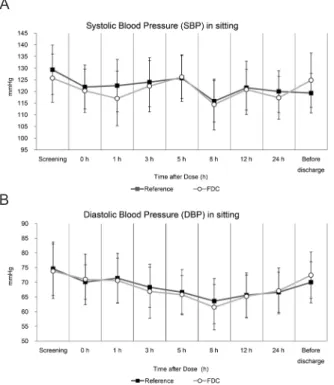
SBP did not increase or decrease over time in both studies. In the fasted study, the mean DBP in sitting position decreased maximally at 8 h after dosing by 8.1 mmHg compared with the baseline (pre-dose). The maximum decrease in the mean DBP was 14.7 mmHg and occurred 3 hours after dosing in the fed study (Fig. 3 and 4). Considering the mechanisms of action of tadalafil and tamsulosin HCl, this effect could be anticipated with the investigational products. Additionally, physiological effect due to keeping in bed-rested state and restricted physical activity could be considered for another reason. Although the change of DBP from baseline was statistically significant in both studies, the decrease was not judged to be clinically significant
because there were no symptom and sign related to the changes of DBP. SBP and DBP had started to bounce back up from eight hours after dosing and stabilized to the baseline values in both studies. Other changes of vital signs could be explained with physiological effect due to restricted physical activity and diur-nal variation. There were no statistically significant differences in vital signs between treatment groups in both studies.
Discussion
These studies were designed to evaluate the bioequivalence between FDC capsule of tadalafil 5 mg and tamsulosin HCl 0.4 mg to the co-administration of individual drugs in fasted and fed conditions respectively. The analysis of PK parameters in these two studies demonstrated that the FDC is pharmacoki-netically comparable to the concomitant administration of each drug in fasted and fed condition, showing that the GMR and its 90% CI for FDC and concomitant administration of individual drugs falling entirely within the bioequivalence range (0.8–1.25). Other PK parameters of FDC were also pharmacokinetically comparable to those of concomitant administration of indi-vidual drugs.
Food affected the extent of exposure of tamsulosin HCl. Com-paring with fasted condition, the Cmax of tamsulosin HCl in fed
condition decreased by 32% in FDC and the AUClast decreased by 24% in FDC. These results of FDC were quite similar with
Byung Hak Jin, et al.
Figure 4. Changes in (A) systolic blood pressure, (B) diastolic blood pressure over time in fed condition study. Data are shown as mean ± SD. R, concomitantly administrated as individual drugs; T, adminis-tered as a fixed-dose combination
B A
Figure 3. Changes in (A) systolic blood pressure, (B) diastolic blood pressure over time in fasted condition study. Data are shown as mean ± SD. R, concomitantly administrated as individual drugs; T, adminis-tered as a fixed-dose combination
B A
TCP
Transl Clin Pharmacolthe published data about fed condition study of tamsulosin HCl in which the Cmax decreased by 41% and the AUClast decreased
by 24% under fed condition.[9] Our study showed that food increases slightly the variability in the exposure of tamsulosin HCl, which was demonstrated by AUCinf (intra-subject CV of
AUCinf: 13% in fed study vs. 11% in fasted study). On the other
hand, Cmax and AUClast of tadalafil in FDC under fasted and fed
conditions were not within bioequivalence range. The result was conflicting with that of the previous study that tadalafil can be taken regardless of food.[12]
FDC capsule also showed comparable safety profile to the con-comitant administration of each drug. Orthostatic hypotension is an adverse event that is mechanistically associated with α1-
antagonists such as tamsulosin HCl. The incidence of orthostat-ic hypotension was not different between FDC and individual drug administration in both studies (Table 4). The overall inci-dence of orthostatic hypotension was 40.0% in the fasted study and 17.1% in the fed study. This difference can be explained by the food effect on the exposure of tamsulosin HCl. However, there were no manifest symptoms or signs related to orthostatic hypotension, nor any subjects with SBP <90 mmHg in standing position. Although headache and dizziness were reported, these AEs were not associated with orthostatic hypotension in our studies. Although it has been reported that tamsulosin HCl, a selective antagonist of α1A-adrenoceptors, which are not present
in the blood vessels, shows less frequent orthostatic hypotension than conventional α1- antagonists,[17-19] our results show that administering tamsulosin HCl after meal is preferred to taking in fasted state in order to prevent orthostatic hypotension. Our results also showed hypotensive potential of concomitant administration of tadalafil and tamsulosin HCl, but SBP was relatively less influenced than DBP, and dizziness, a symptom related to the decrease of DBP, was reported in 2 subjects (5.8%) only in fed study. Because it has been known that the exposure of tadalafil is not affected by fed condition and our analysis was post-hoc comparison of the two individual studies, pla-cebo controlled systematic design of clinical trials is required to reveal the influence of tadalafil and tamsulosin HCl on the changes of vital signs and orthostatic hypotension. Although there were no subjects with a standing SBP <90 mmHg and no syncope following co-administration of investigational products was reported, paying attention to the changes of vital sign when tadalafil and tamsulosin HCl are co-prescribed in old-aged pa-tients is desirable.
There is a limitation of this article. Both studies were con-ducted individually, not designed as crossover studies, therefore the result of evaluating statistically food effect could not be con-cluded corroboratively. Designing adequate study is required for more accurate evaluation for the food effect of FDC on pharma-cokinetics and safety.
Acknowledgements
Both studies were supported by Hanmi Pharmaceutical Corp, Seoul, Korea.
Studies were supported by Global Center of Excellence in Clinical Trials (HI14C1062), Yonsei University Health System funded by Ministry of Health & Welfare, Korea.
Conflict of interest
The authors have no conflicts of interest to disclose.
References
1. Auffenberg GB, Helfand BT, McVary KT. Established medical therapy for benign prostatic hyperplasia. Urol Clin North Am 2009;36:443-59, v-vi. 2. Lee C, Kozlowski JM, Grayhack JT. Intrinsic and extrinsic factors controlling
benign prostatic growth. Prostate 1997;31:131-138.
3. Garraway WM, Collins GN, Lee RJ. High prevalence of benign prostatic hy-pertrophy in the community. Lancet 1991;338:469-471.
4. Park HK, Park H, Cho SY, Bae J, Jeong SJ, Hong SK, et al. The prevalence of benign prostatic hyperplasia in elderly men in Korea: A community-based study. Kor J Urol 2009;50:843-847.
5. Bae WJ, Sohn DW, Kim SD, Kim SJ, Hong SH, Lee JY, et al. The correlation between cardiovascular risk factors and penile hemodynamic parameters in men with erectile dysfunction. Kor J Urol 2009;50:689-693.
6. Braun M, Wassmer G, Klotz T, Reifenrath B, Mathers M, Engelmann U. Epi-demiology of erectile dysfunction: results of the 'Cologne Male Survey'. Int J Impot Res 2000;12:305-311.
7. McVary KT, Roehrborn CG, Kaminetsky JC, Auerbach SM, Wachs B, Young JM, et al. Tadalafil relieves lower urinary tract symptoms secondary to benign prostatic hyperplasia. J Urol 2007;177:1401-1407.
8. Oh SY, Min KS, Choi SH. Effects of prostate volume and lower urinary tract symptoms on erectile function. Kor J Urol 2007;48:24-28.
9. U. S. Food and Drug Administration. Flomax Capsules, 0.4mg Prescribing Information. Accessed 20 June 2016. http://www.accessdata.fda.gov/drug-satfda_docs/label/2005/020579s016lbl.pdf.
10. Montorsi F, Verheyden B, Meuleman E, Jünemann KP, Moncada I, Valiquette L, et al. Long-term safety and tolerability of tadalafil in the treatment of erectile dysfunction. Eur Urol 2004;45:339-344; discussion 344-345.
11. McMahon CG. Treatment of erectile dysfunction with chronic dosing of tadalafil. Eur Urol 2006;50:215-217.
12. U. S. Food and Drug Administration. CIALIS Highlights of Prescribing Infor-mation. Accessed 20 June 2016. http://www.accessdata.fda.gov/drugsatfda_ docs/label/2011/021368s20s21lbl.pdf.
13. Bechara A, Romano S, Casabé A, Haime S, Dedola P, Hernández C, et al. Comparative efficacy assessment of tamsulosin vs. tamsulosin plus tadalafil in the treatment of LUTS/BPH. Pilot study. J Sex Med 2008;5:2170-2178. 14. Reges R, Regadas R, Moraes F, Manoel O, Jamacaru F, Vagnaldo F, et al.
The association of tamsulosin and daily tadalafil for the treatment of lower urianry tract symptoms is safe and effective? J Urol 2012;187:e507. 15. Forgue ST, Patterson BE, Bedding AW, Payne CD, Phillips DL, Wrishko RE,
et al. Tadalafil pharmacokinetics in healthy subjects. Br J Clin Pharmacol 2006;61:280-288.
16. World Health Organization. Guidelines for registration of fixed-dose combina-tion medicinal products, in WHO Technical Report Series. 2005.
17. Chapple CR. Selective alpha 1-adrenoceptor antagonists in benign prostatic hyperplasia: rationale and clinical experience. Eur Urol 1996;29:129-144. 18. de Mey C. Cardiovascular effects of alpha-blockers used for the treatment of
symptomatic BPH: impact on safety and well-being. Eur Urol 1998;34 Suppl 2:18-28; discussion 47.
19. Yasukawa K, Swarz H, Ito Y. Review of orthostatic tests on the safety of tam-sulosin, a selective alpha1A-adrenergic receptor antagonist, shows lack of orthostatic hypotensive effects. J Int Med Res 2001;29:236-251.