볼트 연결부 모니터링을 위한 다채널 무선 임피런스 센서노트와
EMI인터페이스의 성능 분석
Performance evaluation of EMI interface and multi-channel wireless
impedance sensor node for bolted connection monitoring
윙 칵 유이*∙이 포 영**∙김 정 태***
Nguyen, Khac-Duy∙Lee, Po-Young∙Kim, Jeong-Tae
*
Abstract
In this paper, performance of EMI interface and multi-channel wireless impedance sensor node is evaluated for SHM on bolted connection. To achieve the objective, following approaches are implemented. Firstly, an interface washer is designed to monitor loosened bolt through the variation in EMI of interface washer due to change in preload in bolt. Secondly, a multi-channel wireless impedance sensor node based on Imote2 platform is designed for automated and cost-efficient impedance-based SHM on bolted connections. Finally, performance of the multi-channel wireless impedance sensor node and the interface washer are experimentally validated for a lab-scale bolted connection model. A damage monitoring method using RMSD index of EMI signatures is utilized to examine the strength of each individual bolted connection.
keywords : Wireless impedance sensor node, Imote2, AD5933, interface washer, bolted connection..
1. Introduction
Bolted connection is important part of many kinds of structure such as steel bridge, pipeline system, and tower. Unfortunately, bolted connection has potential damage types such as relaxation in connection components, reduction of stress fields, and fatigue cracks in bolt holes. These damages could cause failure of bolted connection, reduction of load carrying capacity and so far lead to severe disasters. Therefore, structural health monitoring (SHM) on bolted connection becomes a key issue to ensure the safety and serviceability of a structure.
Recently, impedance-based SHM is found to be very promising to capture small damage at limited region like bolted connection. To deal with the method, a PZT patch is surface-bonded onto structure to monitor variation in electro-mechanical impedance (EMI) of PZT-structure system (Liang et al., 1996). Conventionally, EMI of PZT-structure system is measured by a bulky and costly impedance analyzer. To
* * 부경대학교 해양공학과 박사과정 [email protected]
** 부경대학교 해양공학과 석사과정 [email protected]
* *** 부경대학교 해양공학과 교수 [email protected]
reduce the cost associated with the wired system as well as to have a more convenient SHM system, wireless impedance sensor node has been developed by many researchers (Mascarenas et al., 2007; Park et at, 2010).
In this paper, performance of EMI interface and multi-channel wireless impedance sensor node is evaluated for SHM on bolted connection. To achieve the objective, following approaches are implemented. Firstly, an interface washer is designed to monitor loosened bolt through the variation in EMI of interface washer due to change in preload in bolt. Secondly, a multi-channel wireless impedance sensor node based on Imote2 platform is designed for automated and cost-efficient impedance-based SHM on bolted connections. Finally, performance of the multi-channel wireless impedance sensor node and the interface washer are experimentally validated for a lab-scale bolted connection model. A damage monitoring method using RMSD index of EMI signatures is utilized to examine the strength of each individual bolted connection.
2. EMI interface washer for loosened bolt monitoring
Generally, in order to monitor loosened bolts in bolted connection, a PZT patch is usually attached on connection splice to capture the change in mechanical behavior of the connection due to loosening of bolt. However, because of large stiffness of the connection splice, the effective frequency range dealt with this method is very high, more than 100 kHz, which is over the measurable frequency band of the AD5933 impedance chip integrated in impedance sensor node (1kHz-100kHz). Moreover, it is very hard to detect which bolt loosened since loosening of any bolt in the connection results in EMI changes.
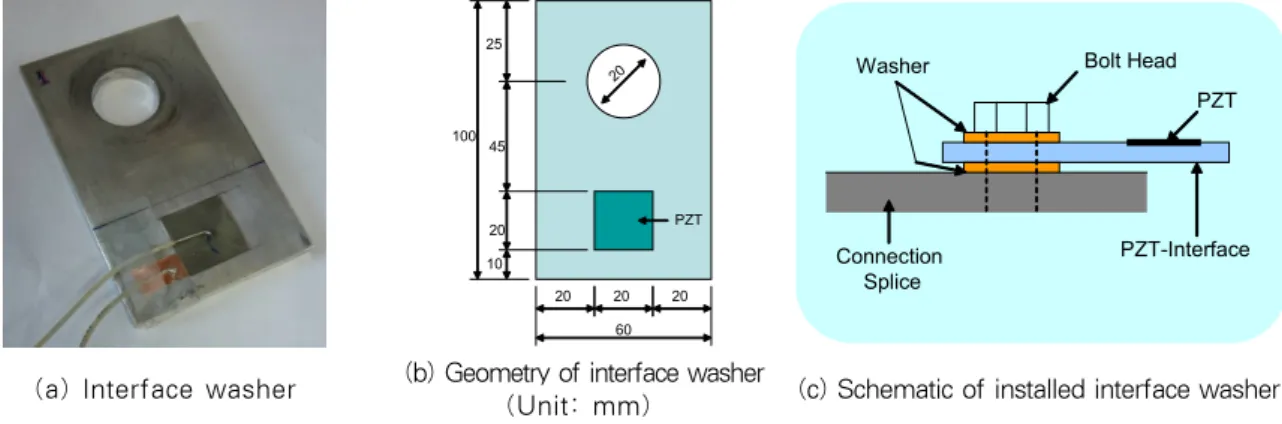
An EMI-interface washer is designed to overcome the above-mentioned issues. As shown in Fig. 1(a), the interface washer is a thin plate, on which a PZT patch is surface-bonded. The interface washer is made of aluminum for low mechanical impedance. The geometries of the interface washer and the PZT patch are given in Fig. 1(b). Schematic of the interface washer in bolted connection is described in Fig. 1(c). Theoretically, the interface washer behaves like a cantilever plate with an imperfectly fixed boundary. Any change in bolt preload is represented by the changes in boundary condition and stress field of the interface washer, which in turn affects the EMI from the PZT patch.
60 45 20 10 25 100 20 20 20 20 PZT PZT Bolt Head Washer PZT-Interface Connection Splice
(a) Interface washer (b) Geometry of interface washer
(Unit: mm) (c) Schematic of installed interface washer
Fig. 1. EMI-Interface washer for compressive force monitoring in bolted connection
3. Multi-channel impedance sensor node
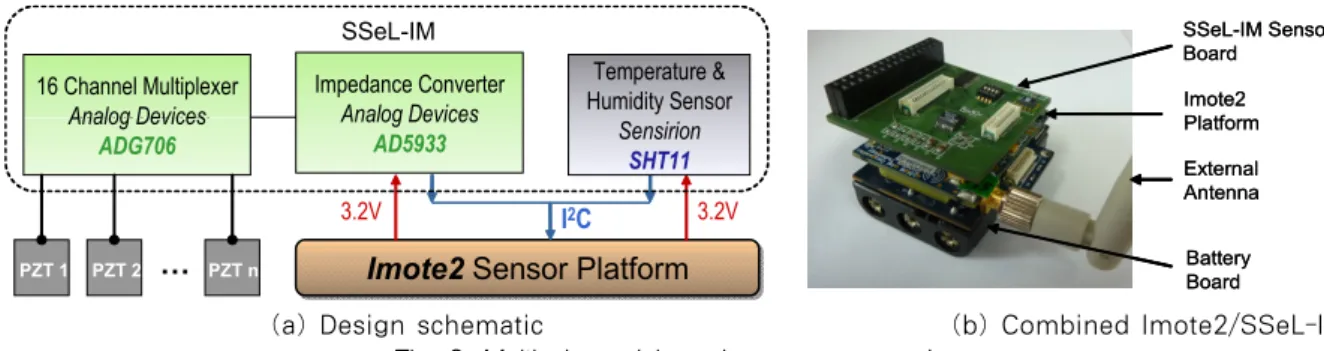
Recently, Imote2 sensor platform has shown the excellent performance in wireless SHM network. The large memory and high speed of Imote2 allows it enable for advanced complicated smart SHM techniques. In this study, we propose a multi-channel impedance sensor board so called SSeL-IM based on Imote2 platform. The design schematic of the Imote2/SSeL-IM sensor node is given in Fig. 2(a). The Imote2 platform is utilized for controlling impedance measurement and wireless communication by the on-board microcontroller PXA27x and wireless radio CC2420. The core component of the sensor node is the AD5933 impedance chip which was first used by Mascarenas et al (2007) for measuring EMI signatures up to 100 kHz. The AD5933 impedance chip has the following embedded multi-functional circuits: function generator, digital-to-analog (D/A) converter, current-to-voltage amplifier, anti-aliasing filter, A/D converter, and discrete Fourier transform (DFT) analyzer. In this design, the ADG706 multiplexer is integrated into SSeL-IM board to allow a single sensor node to measure EMI from up to sixteen PZT sensors. An SHT11 sensor is also integrated into SSeL-IM board to monitor environmental temperature and humidity. The prototype of Imote2/SSeL-IM sensor node is shown in Fig. 2(b).
Imote2 Sensor Platform Imote2 Sensor Platform Impedance Converter Analog Devices AD5933 Impedance Converter Analog Devices AD5933 I2C 3.2V Temperature & Humidity Sensor Sensirion SHT11 Temperature & Humidity Sensor Sensirion SHT11 3.2V 16 Channel Multiplexer Analog Devices ADG706 16 Channel Multiplexer Analog Devices ADG706 … PZT 1 PZT 2 PZT n SSeL-IM SSeL-IM Sensor Board Imote2 Platform Battery Board External Antenna SSeL-IM Sensor Board Imote2 Platform Battery Board External Antenna
(a) Design schematic (b) Combined Imote2/SSeL-IM
Fig. 2. Multi-channel impedance sensor node 4. Experimental evaluation
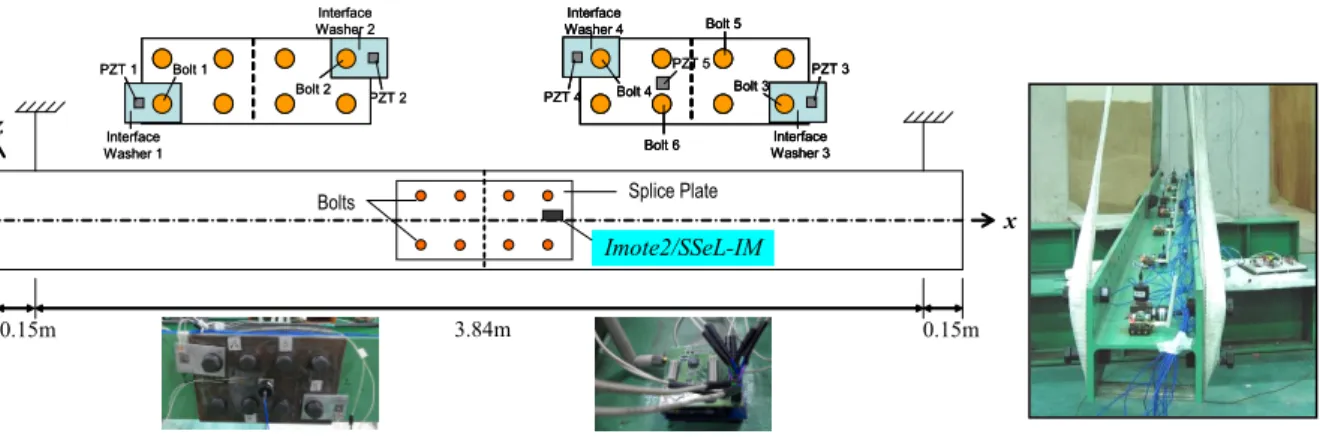
Performance of the system of EMI-interface washer and wireless multi-channel impedance sensor node was verified by a lab scale bolted connection. Figure 3 shows a steel girder with bolted connection at middle of the girder. Four EMI-interface washers were installed into four bolts #1, #2, #3, and #4. Another PZT patch with the same size (PZT 5) was bonded directly on a connection splice to monitor the connection strength as the conventional way. An Imote2/SSeL-IM was placed at the bolted connection to measure EMI from five PZTs. A torque wrench was used to tighten the bolts and to control the bolt torques. The damage scenarios are outlined in Table 1.
Figure 4(a) illustrates typical EMI signatures from PZT 4 for the healthy and several damaged states. As can be seen, the EMI is sensitive to loosening of Bolt 4, indicating by left shifting of resonance frequencies. By employing root mean square deviation (RMSD) of EMI as damage indication, loosening of Bolt 1-4 was successfully indicated by the correspondent EMI-interface washers. Meanwhile, PZT 5 on the connection splice could not indicate any loosened bolt.
3.84m 0.15m Splice Plate x 0.15m Bolts z Imote2/SSeL-IM PZT 1 Interface Washer 1 PZT 2 Interface Washer 2 Bolt 1 Bolt 2 PZT 1 Interface Washer 1 PZT 2 Interface Washer 2 Bolt 1 Bolt 2 PZT 3 Interface Washer 3 PZT 4 Interface Washer 4 Bolt 4 Bolt 3 Bolt 5 Bolt 6 PZT 5 PZT 3 Interface Washer 3 PZT 4 Interface Washer 4 Bolt 4 Bolt 3 Bolt 5 Bolt 6 PZT 3 Interface Washer 3 PZT 4 Interface Washer 4 Bolt 4 Bolt 3 Bolt 5 Bolt 6 PZT 5
Fig. 3. Experimental setup for steel girder with boted connection Table 1. Damage scenarios of bolt loosening
Case Description Case Description
D1 All bolts fastened to 160 N.m D5 Bolt 6 loosened by 40 N.m
D2 Bolt 1 loosened by 40 N.m D6 Bolt 3 loosened by 40 N.m
D3 Bolt 2 loosened by 40 N.m D7 Bolt 4 loosened by 40 N.m
D4 Bolt 1&2 retightened, Bolt 5 loosened by 40 N.m D8 Bolt 5, 6, 3, 4 retightened to 160 N.m
10 15 20 25 30 35 40 45 50 0 100 200 300 400 Reference Bolt 5 Bolt 5,6 Bolt 5,6,3 Bolt 5,6,3,4 PZT 4 Frequency (kHz) Im pedanc e – R eal P ar t ( O hm )
Reference Bolt 1 Bolt 1+2 Bolt 5 Bolt 5+6 Bolt 5+6+3 Bolt 5+6+3+4 Refastened 0 0.05 0.1 0.15 0.2 0.25 RM S D PZT 1 PZT 2 PZT 3 PZT 4 PZT 5 Bolt 1 Bolt 1 Bolt 2 Bolt 3 Bolt 3 Bolt 4
(a) Impedance signatures from PZT 4 (b) RMSD index
Fig. 4. Impedance-based monitoring resuls Acknowledment
Graduate students participated in this study were supported by the 2nd Stage Brain Korea 21 (BK21) Program of Korean Government.
References
Liang, C., Sun, F.P., Rogers,C.A. (1994), “An impedance method for dynamic analysis of active material systems”, Journal of Vibration Acoustics-Trans ASME, 116(1): 120-128.
Mascarenas, D.L., Todd, M.D., Park, G., and Farrar, C.R. (2007), “Development of an Impedance-based Wireless Sensor Node for Structural Health Monitoring”, Smart Materials and Struct. 16: 2137-2145.
Park, J.H., Kim, J.T., Hong, D.S., Mascarenas, D. and Lynch, J.P. (2010), “Autonomous smart sensor nodes for global and local damage detection of prestressed concrete bridges based on accelerations and impedance measurements”, Smart Structures and Systems 6: 711-730.