한국정밀공학회 2013년도 춘계학술대회논문집
1. Introduction
Superplastic forming is an ideal process for manu-facturing complex shaped parts with fine grained materials. It has been used extensively for producing light weight components for aircraft mostly with Ti alloys. Also, superplastic formed components show enhanced performance and reliability over mechan-ically joined parts while lowering overall manufactur-ing cost by reducmanufactur-ing the need for extensive weldmanufactur-ing or other joining methods. It also can simplify the component design and manufacturing process by ac-companying diffusion bonding process.
High temperature deformation and bonding charac-teristic of INCONEL 718 alloy sheet with the grain size of 15㎛was investigated in order to get enough information on processing condition of blow forming and diffusion bonding process.
2. Blow forming
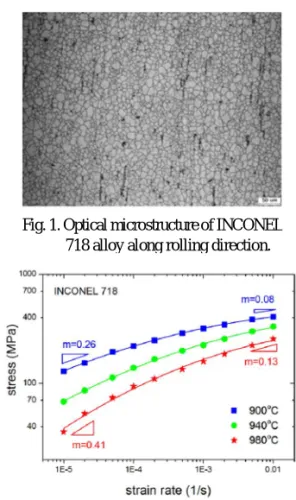
In the present study, INCONEL 718 alloy sheet with the grain size of 15㎛was used as shown in Fig. 1. Stress-strain rate curves at the temperature between 900 and 980℃were collected using strain rate jump test in order to investigate the optimum condition for blow forming, which is usually known as m>0.5. Even though the relatively small grain size, strain rate sensitivity as shown in Fig. 2 was determined as 0.08~0.4, which was much lower than 0.5 that has been known to be a requirement for stable super-plastic deformation. Also, blowing into cylindrical cavity was tried to investigate biaxial formability of INCONEL 718 alloy. Blow formability which was determined using maximum forming height was well
corresponded with tensile elongation, which again showed the limited values compared with other small grained superplastic materials. Also, blow formed specimen showed the severe cavitation which sug-gested a difficult grain boundary sliding which is considered as one of dominant deformation mecha-nisms of small grained materials at high temperature.
Fig. 1. Optical microstructure of INCONEL 718 alloy along rolling direction.
Fig. 2 Stress-strain rate curves of INCONEL 718
It is noteworthy that longer forming time induced
인코넬
718
합금의 고온성형 및 접합공정 연구
High Temperature Blow Forming And Bonding of INCONEL 718 Alloy
*#
권용남
1,
홍성석
2,
김홍규
2*
#Y.-N. Kwon
1([email protected]) , S. S. Hong
2, H. G. Kim
2 1한국기계연구원 부설 재료연구소,2국방과학연구소
Key words : INCONEL 718, blow forming, diffusion bonding
한국정밀공학회 2013년도 춘계학술대회논문집
precipitation of Nb-containing particles which subsequently resulted in lowering formability of INCONEL 718 at the elevated temperature.
Fig. 3 Elongation of INCONEL 718 with the grain size of 15㎛
Fig.4 Blow forming result INCONEL 718 sheet with different pressure at 950℃
Fig. 5 Microstructure after blow forming shows severe cavitation
3. Diffusion bonding
Diffusion bonding of INCONEL 718 alloy sheet was tried with variation of temperature, time and pressure. Also, bonding surface was modified with plating Ni-P layer with the thickness of about 10㎛. Fig. 6 shows bonded layer after diffusion bonding at 940℃for 1hr. This processing condition brought out a perfect bonding except a few cavities along the original surface of each sheet. Generally, Ni-P coated sheet was bonded with lower pressure as well as in lower temperature. Bonding time did not seem to give much effect on bonding strength.
Fig. 6 Bonding layer of INCONEL718 showed perfect bonding.
Fig. 7 Bonding strength of INCONEL718 tested with ingle shear test
4. Conclusion
Blow forming and diffusion bonding characteristics of INCONEL 718 alloy sheet with the grain size of 15㎛was investigated in this study. Even though the grain size was not small enough, a component can be made by blow forming and diffusion bonding.