BRIEF ARTICLE
Role of surgical resection for multiple hepatocellular
carcinomas
Sung Hoon Choi, Gi Hong Choi, Seung Up Kim, Jun Yong Park, Dong Jin Joo, Man Ki Ju, Myoung Soo Kim, Jin Sub Choi, Kwang Hyub Han, Soon Il Kim
© 2013 Baishideng. All rights reserved. doi:10.3748/wjg.v19.i3.366
Sung Hoon Choi, Gi Hong Choi, Dong Jin Joo, Man Ki Ju, Myoung Soo Kim, Jin Sub Choi, Soon Il Kim, Department of Surgery, Yonsei University College of Medicine, Seoul 120-752, South Korea
Seung Up Kim, Jun Yong Park, Kwang Hyub Han, Depart-ment of Internal Medicine, Yonsei University College of Medi-cine, Seoul 120-752, South Korea
Author contributions: Choi SH, Choi GH and Choi JS de-signed the research, analyzed the data, performed the study and wrote the paper; Choi JS reviewed the study population data; Kim SU, Park JY, Joo DJ, Ju MK, Kim MS, Han KH and Kim SI collected the data.
Correspondence to: Jin Sub Choi, MD, PhD, Department of Surgery, Yonsei University Health System, 50 Yonsei-ro, Seo-daemoon-gu, Seoul 120-752, South Korea. [email protected] Telephone: +82-2-22282122 Fax: +82-2-3138289
Received: May 13, 2012 Revised: December 3, 2012 Accepted: December 15, 2012
Published online: January 21, 2013
Abstract
AIM: To clarify the role of surgical resection for mul-tiple hepatocellular carcinomas (HCCs) compared to transarterial chemoembolization (TACE) and liver trans-plantation (LT).
METHODS: Among the HCC patients who were man-aged at Yonsei University Health System between Janu-ary 2003 and December 2008, 160 patients who met the following criteria were retrospectively enrolled: (1) two or three radiologically diagnosed HCCs; (2) no ra-diologic vascular invasion; (3) Child-Pugh class A; (4) main tumor smaller than 5 cm in diameter; and (5) platelet count greater than 50 000/mm3. Long-term
outcomes were compared among the following three treatment modalities: surgical resection or combined ra-diofrequency ablation (RFA) (n = 36), TACE (n = 107), and LT (n = 17). The survival curves were computed using the Kaplan-Meier method and compared with
a log-rank test. To identify the patients who gained a survival benefit from surgical resection, we also inves-tigated prognostic factors for survival following surgical resection. Multivariate analyses of the prognostic fac-tors for survival were performed using the Cox propor-tional hazard model.
RESULTS: The overall survival (OS) rate was signifi-cantly higher in the surgical resection group than in the TACE group (48.1% vs 28.9% at 5 years, P < 0.005). LT had the best OS rate, which was better than that of the surgical resection group, although the difference was not statistically significant (80.2% vs 48.1% at 5 years, P = 0.447). The disease-free survival rates were also significantly higher in the LT group than in the surgical resection group (88.2% vs 11.2% at 5 years, P < 0.001). Liver cirrhosis was the only significant prognostic factor for poor OS after surgical resection. Clinical liver cirrhosis rates were 55.6% (20/36) in the resection group and 93.5% (100/107) in the TACE group. There were 19 major and 17 minor resections. En bloc resection was performed in 23 patients,
multi-site resection was performed in 5 patients, and com-bined resection with RFA was performed in 8 patients. In the TACE group, only 34 patients (31.8%) were recorded as having complete remission after primary TACE. Seventy-two patients (67.3%) were retreated with repeated TACE combined with other therapies. In patients who underwent surgical resection, the 16 patients who did not have cirrhosis had higher 5-year OS and disease-free survival rates than the 20 patients who had cirrhosis (80.8% vs 25.5% 5-year OS rate, P = 0.006; 22.2% vs 0% 5-year disease-free survival rate, P = 0.048). Surgical resection in the 20 patients who had cirrhosis did not provide any survival benefit when compared with TACE (25.5% vs 24.7% 5-year OS rate, P = 0.225). Twenty-nine of the 36 patients who underwent surgical resection experienced recur-rence. Of the patients with cirrhosis, 80% (16/20) were within the Milan criteria at the time of recurrence
after resection.
CONCLUSION: Among patients with two or three HCCs, no radiologic vascular invasion, and tumor diameters ≤ 5 cm, surgical resection is recommended only in those without cirrhosis.
© 2013 Baishideng. All rights reserved.
Key words: Hepatocellular carcinoma; Hepatectomy; Liver transplantation; Chemoembolization; Cirrhosis Choi SH, Choi GH, Kim SU, Park JY, Joo DJ, Ju MK, Kim MS, Choi JS, Han KH, Kim SI. Role of surgical resection for multiple hepatocellular carcinomas. World J Gastroenterol 2013; 19(3): 366-374 Available from: URL: http://www.wjg-net.com/1007-9327/full/v19/i3/366.htm DOI: http://dx.doi. org/10.3748/wjg.v19.i3.366
INTRODUCTION
Surgical resection is the established treatment modality for hepatocellular carcinoma (HCC) in patients with pre-served liver function, and surgical outcomes have been greatly improved with mortality rates of 0%-6.4% and excellent 5-year survival rates of more than 50%[1-3].
However, for patients with multiple HCCs, unfavorable disease-free and overall survival (OS) rates following sur-gical resection have led to the contraindication of surgi-cal treatment. This contraindication is reflected in the guidelines suggested by the American Association for the Study of Liver Disease[4] and the European
Associa-tion for the Study of the Liver[5] based on the Barcelona
Clinic Liver Cancer (BCLC) staging system. Thus, liver transplantation is recommended as the best option for patients with multiple HCCs, but a worldwide shortage of donor organs greatly limits the application of this recommendation. Therefore, although multidisciplinary strategies are used in the treatment of multiple HCCs, multiple HCCs still pose a therapeutic challenge and are a matter of debate.
Currently, the main treatment modality for multiple HCCs is transarterial chemoembolization (TACE). Al-though several expert centers have recently reported en-couraging durable long-term outcomes of surgical resec-tion for multiple HCCs (50%-60% at 5 years) in patients with well-preserved liver function[6,7], few comparative
studiesof surgical resection and liver transplantation (LT). ACE have been reported[8,9]. Therefore, we designed
this study to clarify the role of surgery for multiple HCCs by comparing the long-term outcomes following surgical resection, TACE, and LT and investigating prognostic factors in patients who underwent surgical resection.
MATERIALS AND METHODS
Patient evaluation and follow-up
We analyzed a single-institution database of 3928
pa-tients who received their initial treatments for HCCs at Yonsei University Health System, Seoul, South Korea between January 2003 and December 2008. The In-stitutional Review Board of Yonsei University Health System approved this study. Of the patients who under-went surgical resection (n = 304), TACE (n = 854), and
LT (n = 45), the patients who met the following criteria
were enrolled in this retrospective, single-cohort study: (1) two or three radiologically diagnosed HCCs; (2) no radiologic vascular invasion; (3) Child-Pugh class A; (4) main tumor smaller than 5 cm in diameter; and (5) a platelet count greater than 50 000/mm3. Small satellite
nodules found in the resected specimen were not in-cluded in this study.
The cutoff value of tumor size for therapeutic deci-sion making is a debated issue. The 7th edition of can-cer staging of the American Joint Committee on Cancan-cer describes main tumor size greater than 5 cm in multiple tumors as an independent prognostic factor for sur-vival[10]. Additionally, a study comparing the
pathologi-cally proven necrosis rate following TACE reported the following frequencies of complete necrosis according to tumor size: 66.7%, 30% and 0% for ≤ 3.0 cm, 3.1-5.0 cm, and > 5.0 cm, respectively[11]. Although TACE has
been performed as palliative care for larger HCCs, the OS rates of patients with tumors larger than 5 cm in diameter are very poor[12,13]. In addition to tumor size,
the presence of vascular involvement of the tumor is a significant prognostic factor for poor outcome. The 5-year survival rates among patients with tumors with and without macroscopic vascular invasion are signifi-cantly different (48% ± 3% vs 14% ± 5%, P < 0.001)[14].
Therefore, patients with a tumor ≥ 5 cm in diameter or with macroscopic vascular involvement were excluded from this study because those patients were unsuitable for curative therapy.
Ultimately, we included 36 patients who underwent surgical resection or combined resection with radio-frequency ablation (RFA), 107 patients who received TACE, and 17 patients who underwent LT, and we compared long-term outcomes following the respective treatments.
Patients were evaluated preoperatively by abdominal ultrasonography (US), computed tomography (CT), mag-netic resonance imaging (MRI), and hepatic angiography, if indicated. All patients were assessed using alpha-feto-protein (AFP), alpha-feto-protein induced by vitamin K absence or antagonist Ⅱ (PIVKA Ⅱ), hepatitis B surface antigen, anti-hepatitis C viral antibody, liver biochemistry, coagu-lation test, and indocyanine green retention rate at 15 min (ICG R15).
The selection of therapeutic options was determined by the anatomical locations of the tumors, liver function-al reserve, and patient preference. TACE was generfunction-ally considered when the tumor was ineligible for complete surgical removal, low remnant liver volume was expected after resection, or the patients declined operative
inter-vention. The patients who had an available liver donor underwent LT.
Eradicating all of the multifocal tumors required a multimodality approach using not only en-bloc resection
but also separate multi-site resection or resection com-bined with RFA. All of the patients who underwent sur-gical resection were routinely assessed by intra-operative US. The effectiveness and safety of combined hepa-tectomy with RFA for multi-site HCCs were reported by Choi et al[15], and our previous work has also shown
comparable results between en-bloc resection and multi-site resection or combination hepatectomy with RFA[16].
Separate multi-site resection or resection plus RFA was performed for the multifocal tumors ineligible for en-bloc resection because of bilobar involvement or when there was not enough hepatic function reserve after en-bloc resection. Wedge resection was considered for
super-ficial tumors, and RFA was performed for tumors less than 3 cm in diameter that were located deep in the liver. The median follow-up period for the patients who underwent surgical resection was 38.6 mo (range: 1-94 mo). Surveillance after treatment was conducted with regular monitoring of AFP, PIVKA Ⅱ, and US or CT every three to six months. Suspicious intrahepatic recur-rence was confirmed by MRI, hepatic angiography, or image-guided fine-needle biopsy, if needed.
To identify the patients who gained a survival benefit from surgical resection, we also investigated prognostic factors for survival following surgical resection. Twelve clinical variables recorded at the time of diagnosis were analyzed. The variables included age at diagnosis; sex; se-rum albumin; alanine aminotransferase (ALT) and aspar-tate aminotransferase levels; ICG R15; serum AFP level; clinical liver cirrhosis; main tumor size and number of tumors on preoperative image studies; lobar distribution of the tumor; and type of operation.
Clinically diagnosed liver cirrhosis was defined as follows: (1) history of overt complications of liver cir-rhosis, such as ascites, variceal bleeding, and hepatic encephalopathy; (2) evidence of clinical portal hyperten-sion, including esophageal or gastric varices, or spleno-megaly (maximal diameter > 12 cm) with platelet count < 100 000 mm3; and (3) liver morphology suggesting
the presence of cirrhosis on preoperative image studies, including hypertrophy of the left lobe and/or caudate lobe, relative volume reduction of the right lobe, nodu-larity of the liver surface, presence of regenerative or dysplastic nodules, or the presence of a portosystemic shunt[17-19]. All of the analysis in the current study were
performed using a clinical diagnosis of liver cirrhosis to evaluate its clinical usefulness. Minor resection was de-fined as hepatectomy of two or fewer liver segments.
Statistical analysis
Continuous variables are presented as the mean ± SD and were compared by Student’s t test. Categorical
vari-ables are expressed as frequencies with percentages and were compared by the χ2 test. Cumulative overall and
disease-free survival rates were computed by the Kaplan-Meier method, and differences between the survival curves were compared using a log-rank test.Multivariate analyses of the prognostic factors for survival were per-formed using the Cox proportional hazard model and included the factors that had P values less than 0.1 upon
univariate analysis. Statistical analyses were performed using SPSS 15 for Windows (SPSS Inc., Chicago, IL, United States). Statistical significance was set at a P value
less than 0.05.
RESULTS
Clinical characteristics of the surgical resection group and TACE group
The patients who underwent TACE were older and had lower platelet counts, higher ALT levels, and a higher rate of clinical liver cirrhosis than those in the resection group. Clinical liver cirrhosis rates were 55.6% (20/36) in the resection group and 93.5% (100/107) in the TACE group. Surgical resection was performed more frequently in patients with larger diameter tumors (Table 1).
Operative procedures in the surgical resection group and additional treatments in the TACE group
Table 2 lists the operative procedures and combined treat-ments with RFA in the resection group. There were 19 and 17 major and minor resections, respectively. En bloc
resection was performed in 23 patients, multi-site tion was performed in 5 patients, and combined resec-tion with RFA was performed in 8 patients. In the TACE group, only 34 patients (31.8%) were recorded as having complete remission after primary TACE. Seventy-two patients (67.3%) were retreated with repeated TACE, one patient was retreated with repeated TACE and intra-arterial chemotherapy, two patients were retreated with RFA, two patients were retreated with radiation therapy, one patient was retreated with percutaneous ethanol injection, two patients were retreated with intra-arterial chemotherapy and systemic chemotherapy, two patients were retreated with intarterial chemotherapy and ra-diation therapy, and five patients were retreated with hol-mium therapy.
Long-term outcomes according to treatment modality
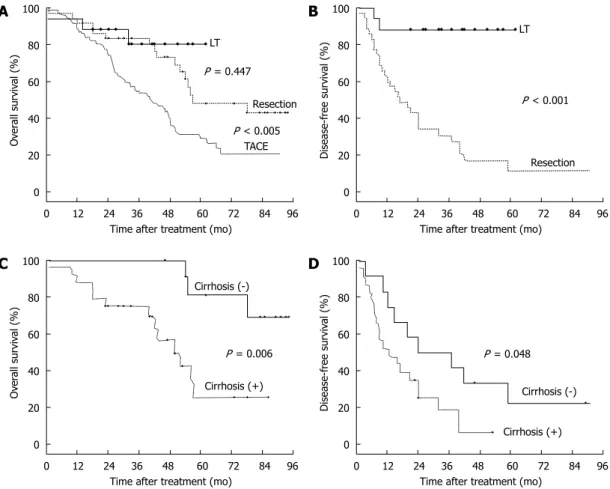
The OS rate was significantly higher in the surgical re-section group than in the TACE group (48.1% vs 28.9%
at 5 years, P < 0.005) (Figure 1A). LT had the best OS
rate, which was better than that of the surgical resec-tion group, although the difference was not statistically significant (80.2% vs 48.1% at 5 years, P = 0.447) (Figure
1A). The disease-free survival rates were also significantly higher in the LT group than in the surgical resection group (88.2% vs 11.2% at 5 years, P < 0.001) (Figure 1B).
Table 2 Operative procedures in the resection group Table 1 Clinical characteristics of the surgical resection
patients vs the transarterial chemoembolization patients
Variable Surgical resection
(n = 36) (n = 107)TACE P value Age (yr) 54.3 ± 8.6 61.2 ± 9.3 < 0.001 Gender (male:female) 34:2 86:21 0.047 Platelet (k/mm3) 153.4 ± 53.9 121.0 ± 51.8 0.002 Albumin (g/dL) 4.05 ± 0.50 3.93 ± 0.48 0.203 ALT (IU/L) 36.4 ± 15.8 59.0 ± 40.4 0.001 AST (IU/L) 41.2 ± 25.8 53.2 ± 44.7 0.130 HBsAg 28 (77.8) 67 (62.6) 0.099
Clinical liver cirrhosis 20 (55.6) 100 (93.5) < 0.001
Tumor number 0.549
2 30 (83.3) 90 (84.1)
3 6 (16.7) 17 (15.9)
Main tumor size (cm) 0.005
< 3 19 (52.8) 17 (47.2)
≥ 3 29 (27.1) 78 (72.9)
AFP > 1000 IU/mL 2 (5.6) 8 (7.5) 0.696
Data are expressed as absolute n (%) or mean ± SD. M: Male; F: Female; TACE: Transarterial chemoembolization; ALT: Alanine aminotransferase (reference range, 5-46 IU/L); AST: Aspartate aminotransferase (reference range, 13-34 IU/L); HBsAg: Hepatitis B surface antigen; AFP: α-fetoprotein.
Degree of resection Operative procedure Number of patients (n = 36)
Major resection Extended right hepatectomy 1
(n = 19) Right hepatectomy only 12
+ wedge resection 1
+ RFA 1
Left hepatectomy only 1
+ wedge resection 1
Central bisectionectomy only 2
Minor resection Left lateral sectionectomy only 3
(n = 17) + RFA 1 Sectionectomy only 2 + wedge resection 2 + RFA 2 Bisegmentectomy only 1 + wedge resection 1 + RFA 2 Segmentectomy only 1 + RFA 1
Wedge resection + RFA 1
Figure 1 The overall and disease-free survival curves according to treatment modality and presence of liver cirrhosis in surgical resection patients. A: The 1-,
3- and 5-year overall survival (OS) rates were 94.1%, 80.2% and 80.2%, respectively, in the liver transplantation (LT) group; 91.7%, 83.3% and 48.1%, respectively, in the resection group; and 88.7%, 55.6% and 28.9%, respectively, in the transarterial chemoembolization (TACE) group. The OS rate was significantly higher in the surgi-cal resection group than in the TACE group (P < 0.005). LT showed the best OS rate (better than the surgisurgi-cal resection group, but not statistisurgi-cally significant, P = 0.447); B: The 1-, 3- and 5-year disease-free survival rates were 88.2%, 88.2% and 88.2% in the LT group and 60%, 30.3% and 11.2% in the resection group, respectively. The disease-free survival rates were also significantly higher in the transplantation group than in the surgical resection group (P < 0.001); C: The 1-, 3- and 5-year OS rates were 100%, 100% and 80.8% in patients without cirrhosis (-) and 87.5%, 75% and 25.5% in patients with cirrhosis (+), respectively (P = 0.006); D: The 1-, 3- and 5-year disease-free survival rates were 75.0%, 50.0% and 22.2% in patients without cirrhosis (-) and 52.3%, 18.7% and 0% in patients with cirrhosis (+), respectively (P = 0.048).
0 12 24 36 48 60 72 84 96 Time after treatment (mo)
100 80 60 40 20 0 Ov er al l surviv al (%) LT Resection TACE P = 0.447 P < 0.005 0 12 24 36 48 60 72 84 96 Time after treatment (mo)
100 80 60 40 20 0 Disease-f ree surviv al (%) LT Resection P < 0.001 0 12 24 36 48 60 72 84 96 Time after treatment (mo)
100 80 60 40 20 0 Ov er al l surviv al (%) Cirrhosis (+) Cirrhosis (-) P = 0.006 0 12 24 36 48 60 72 84 96 Time after treatment (mo)
100 80 60 40 20 0 Disease-f ree surviv al (%) Cirrhosis (+) Cirrhosis (-) P = 0.048 A B C D
En bloc resection (n = 23); multi-site resection (n = 5); resection plus radio-frequency ablation (RFA) (n = 8).
Prognostic factors for OS in patients who underwent surgical resection
Cirrhosis was the only significant prognostic factor for poor OS after resection in both the univariate (P = 0.023)
and multivariate analyses (P = 0.034, odds ratio = 0.552,
95%CI: 0.105-0.915) (Table 3). Clinically diagnosed liver cirrhosis was correlated with pathological cirrhosis with a positive predictive value of 100%, a negative predictive value of 75%, a sensitivity of 83.3%, and a specificity of 100%.
Long-term outcomes of patients who underwent surgical resection according to the presence of cirrhosis
The 1-, 3- and 5-year OS rates were 100%, 100% and 80.8%, respectively, in 16 patients without cirrhosis, and 87.5%, 75% and 25.5%, respectively, in 20 patients with cirrhosis (P = 0.006) (Figure 1C). The disease-free 1-, 3-
and 5-year survival rates were 75.0%, 50% and 22.2%, re-spectively, in patients without cirrhosis and 52.3%, 24.9% and 0%, respectively, in patients with cirrhosis (P = 0.048)
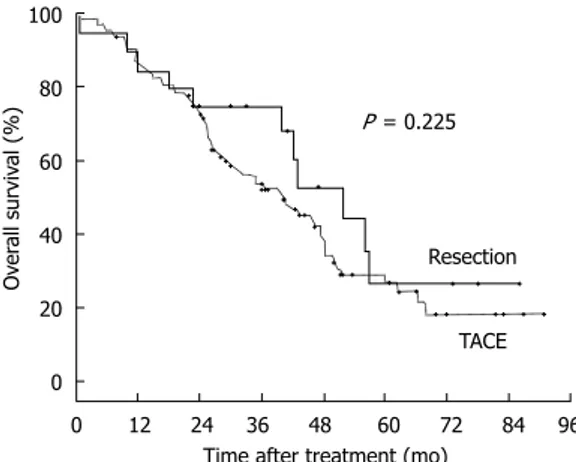
(Figure 1D). The OS rates were not different between the surgical resection group and the TACE group among the patients with cirrhosis (87.5%, 75.0% and 25.5% vs
91.8%, 61.7% and 24.7% at 1-, 3- and 5-year, respectively,
P = 0.225) (Figure 2).
Recurrence pattern after surgical resection
Twenty-nine of the 36 patients who underwent surgical resection experienced recurrence.Of the 29 patients with recurrence, 1 (4%) had a marginal recurrence on the resec-tion margin, 21 (84%) had intra-hepatic recurrences, and 3 (12%) had extra-hepatic recurrences with one in the lung and two in bone. All of the patients with marginal and intra-hepatic recurrence were retreated by TACE. Chemo-therapy, radiation Chemo-therapy, and a clinical trial were used to treat extra-hepatic recurrences. Notably, of the patients with cirrhosis, 80% (16/20) were within the Milan criteria at the time of recurrence after resection.
DISCUSSION
Our study demonstrates that surgery for patients with multiple HCCs is recommendedin patients without cir-rhosis. Our data revealed that the survival of patients who underwent surgical resection was better than that of patients who received TACE. However, the survival of patients with HCCs was affected not only by HCC itself, but also by underlying liver disease. The majority of patients (93.5%, 100/107) who received TACE had liver cirrhosis. Therefore, when the survival of the pa-tients in the surgical resection group was compared with the TACE group according to the presence of cirrhosis, surgical resection showed no survival benefit in cirrhotic patients.
To confirm the efficacy of surgical resection for mul-Table 3 Prognostic factors for overall survival in surgical
re-section patients
Variable Patients
(n = 36) 1-yr OS 3-yr OS 5-yr OS valueP
Age (yr) 0.146 ≤ 60 27 88.9% 81.5% 42.3% > 60 9 100% 88.9% 66.7% Gender 0.245 Male 34 91.2% 82.4% 45.1% Female 2 100% 100% 100% Serum albumin (g/dL) 0.642 ≤ 3.5 10 90.0% 60.0% 48.0% > 3.5 26 92.3% 87.7% 46.1% ALT (IU/L) 0.593 ≤ 50 27 92.6% 81.5% 53.7% > 50 9 88.9% 71.1% 23.7% AST (IU/L) 0.87 ≤ 50 31 90.3% 80.6% 52.4% > 50 5 100% 100% 50.0% ICG R 15 (%) 0.992 ≤ 14 25 92.0% 84.0% 47.1% > 14 9 88.9% 77.8% 58.3% α-fetoprotein 0.471 ≤ 1000 IU/mL 32 90.6% 81.3% 47.3% > 1000 IU/mL 4 100% 100% 50.0% Cirrhosis 0.023 No 16 100% 93.8% 69.9% Yes 20 85.0% 75.0% 26.5%
Main tumor size (cm) 0.629
< 3.0 17 94.1% 86.3% 43.1%
≥ 3.0 19 89.5% 73.7% 52.6%
Number of tumors 0.061
2 31 90.3% 80.6% 40.7%
3 5 100% 100% 100%
Lobar distribution of tumors 0.892
One lobes 24 91.7% 83.3% 49.4%
Two lobe 12 91.7% 83.3% 48.6%
Operation type 0.568
En bloc resection 23 91.3% 82.6% 43.4%
Multiple resection or combined with RFA
13 92.3% 84.6% 57.1%
OS: Overall survival; RFA: Radiofrequency ablation; ALT: Alanine ami-notransferase; AST: Aspartate amiami-notransferase; ICG R 15: Indocyanine green retention rate at 15.
0 12 24 36 48 60 72 84 96 Time after treatment (mo)
100 80 60 40 20 0 Ov er al l surviv al (%) Resection TACE P = 0.225
Figure 2 Overall survival curves of surgical resection and transarterial chemoembolization in patients with liver cirrhosis. Among patients with
cir-rhosis, the overall survival (OS) rates were not different between the surgical resection group and the transarterial chemoembolization (TACE) group (25.5%
tiple HCCs, its superiority over non-surgical treatment (TACE) should be proven. A recent retrospective cohort study by Ho et al[8] reported that hepatectomy yields
bet-ter survival than TACE even in patients with multiple HCCs in various stages. The authors compared the prognosis of the patients according to stages in differ-ent staging systems; however, as the authors note, their study had several weaknesses. Although each staging system represents the prognosis of the patients who have HCC, and in particular, the BCLC system accounts for portal hypertension and the bilirubin level in addi-tion to the Child-Pugh classificaaddi-tion in staging, the liver function status in each stage encompasses a wide range and the prognosis in the subgroups of each stage differs significantly[20]. Additionally, the patients in each stage
of their study were heterogeneous. Therefore, it is un-clear whether the degree of underlying liver disease was evenly distributed between the compared groups. In our study, we limited the inclusion criteria to patients with platelet counts greater than 50 000/mm3 in addition to a
Child-Pugh A classification to exclude patients who had severely advanced liver cirrhosis, for whom surgery is contraindicated due to likely postoperative deterioration of liver function and poor prognosis[17,21].
Liver cirrhosis is a well-known potent predictive fac-tor for OS in patients with HCC[14,22,23], as shown in our
patient cohort. According to our analysis, the survival rates of cirrhotic patients with multiple HCCs who underwent surgical resection were extremely disappointing. The 5-year OS rate of the patients with cirrhosis was 25.5%, which was significantly worse than that of the patients without cirrhosis (69.3%, P = 0.006) (Figure 1C and D).
Further-more, the outcomes of surgical resection and TACE in the patients with cirrhosis were not different (Figure 2). Therefore, surgical resection for multiple HCCs would be beneficial in patients without cirrhosis, but it remains de-batable in patients with cirrhosis.
Despite the fact that surgical resection for multiple HCCs showed acceptable OS rates in our study as well as in several other publications[6-8,22,24], a high recurrence
rate is a major drawback of surgical resection as a cura-tive therapy. According to our data, the 5-year disease-free survival rates were 0% in patients with cirrhosis and 22.2% in non-cirrhotic patients. Thus, our single cohort study demonstrated that LT might be the pre-ferred treatment option to offer the chance of a cure for multiple HCCs; the OS and disease-free survival rates were 80.2% and 88.2%, respectively (Figure 1A and B). However, in addition to inevitable immuneesuppressive therapy, which has an adverse oncologic effect, the scar-city of liver donors is another great obstacle to the wide application of LT.
Which loco-regional therapy is superior as a bridge to LT is an issue because of the long waiting time on the transplant list, which results in patients progressing and falling outside the transplant criteria. According to Ll-ovet et al[25], approximately 10% of patients are dropped
from the transplant list during the waiting period because of tumor progression or liver failure. TACE and RFA have been studied in detail and widely used as a bridge therapy in several transplant centers, but the efficacy of these modalities has not yet been established[26-28].
Recently, Belghiti et al[29] proposed three different roles
of resection for HCC prior to LT: (1) As a primary ther-apy, resection can delay or avoid transplantation and can be followed by salvage transplantation for recurrence and deteriorated liver function; (2) As an initial therapy, resec-tion can provide pathologic informaresec-tion about the whole specimen, which enables selection of the best candidates for transplantation; and (3) As a bridge therapy, resection can offer the best control of HCC in patients listed for LT through the possibility of downstaging and provid-ing detailed pathologic information. In addition to these benefits, liver resection can provide superior control and a good survival rate[29,30]. Furthermore, several studies
re-port that 60%-80% of patients who recur after resection for HCC are still amenable to transplantation, and these results are not different between patients with solitary and oligonodular primary HCCs[22,31,32]. Our results also
showed that 80% of the recurred patients with cirrhosis following resection were within the Milan criteria. Thus, surgical resection for cirrhotic patients with multiple HCCs might be performed as a bridge to LT. Surgical resection as a bridge is justified by the improved safety of liver surgery and no survival impairment in the event of subsequent LT[31].
Recent studies demonstrated that salvage LT does not compromise the operative morbidity and mortality com-pared with primary LT[31,33,34]. In contrast, Adam et al[35]
reported that secondary LT is associated with a higher operative morbidity and mortality; they also argued that patients treated by resection when they were initially transplantable had a higher recurrence rate with more frequent extrahepatic metastasis and vascular invasion, which impair the transplantability and long-term survival of the patients. Therefore, it is too early to conclude whether resection can be performed as bridge therapy. Nevertheless, these efforts to use the limited number of donor organs effectively are necessary, as is further inves-tigation of this issue.
We did not analyze the outcomes according to the types of multiple HCCs in the present study because our data included patients who received resection combined with RFA, which did not allow for pathologic analysis. Discrimination of intrahepatic metastasis (IM) and de novo multicentric (MC) HCCs may be important because
generally, IMs that have acquired metastatic ability ex-hibit more aggressive biologic behavior[36,37] and thus
in-fluence therapeutic strategy decisions. According to the guidelines of the Liver Cancer Study Group of Japan[38],
IM is diagnosed if the tumors definitely originated from portal vein tumor thrombi, if the tumors arose in mul-tiple satellite nodules surrounding a main tumor, or if a satellite tumor near the main tumor shows similar or
poorer histological differentiation than the main tumor. Otherwise, multiple HCCs that do not meet these con-ditions are deemed de novo MC tumors. Although these
conventional pathological criteria are convenient, they are relatively subjective. Currently, the most precise method to determine the origin of HCC is DNA clonal analysis[39,40], and clinical differentiation between IM and
MC is not possible preoperatively. If a credible diagnosis could be possible for preoperative distinction of the ori-gin of multiple nodules, it might be helpful for the selec-tion of therapy.
In conclusion, surgical resection for HCCs with two or three radiologically identified tumors, no radiologic vascular invasion, and diameters less than 5 cm is rec-ommended for patients without cirrhosis but debat-able for patients with cirrhosis. LT might be the best treatment option for patients with multiple HCCs. The retrospective design and the small number of cases are limitations of this-single cohort study. Therefore, further multi-center trials and randomized, controlled, prospective studies are needed, especially to examine the role of surgical resection in cirrhotic patients with multiple HCCs.
COMMENTS
Background
Although surgical resection is the established treatment modality for hepato-cellular carcinoma (HCC) in patients with preserved liver function, however, for patients with multiple HCCs, unfavorable disease-free and overall survival (OS) rates following surgical resection have led to the contraindication of surgi-cal treatment. Therefore, although multidisciplinary strategies are used in the treatment of multiple HCCs, multiple HCCs still pose a therapeutic challenge and are a matter of debate. There has been a lack of studies for the efficacy of surgical resection in patients with multiple HCCs.
Research frontiers
The survival of patients with HCCs was affected not only by HCC itself but also by underlying liver disease. Some studies have reported the superiority of sur-gical resection for multiple HCCs over non-sursur-gical treatment. However, long-term outcomes of the patients according to not only stage but also the degree of underlying liver disease may help to select a proper treatment modality.
Innovations and breakthroughs
Their study demonstrates that surgery for patients with multiple HCCs is recom-mended in patients without clinical cirrhosis. When the survival of the patients in the surgical resection group was compared with the transarterial chemoemboli-zation group according to the presence of cirrhosis, surgical resection showed no survival benefit in cirrhotic patients. This study is worthy because the surgi-cal outcomes of the patients with multiple HCCs were compared according to the degree of underlying liver disease.
Applications
Liver cirrhosis is a well-known potent predictive factor for OS in patients with HCC. According to the analysis, the survival rates of cirrhotic patients with multiple HCCs who underwent surgical resection were extremely disappointing. Therefore, surgical resection for multiple HCCs is recommended for patients without cirrhosis but still debatable for patients with cirrhosis. Further multi-center trials and randomized, controlled, prospective studies are needed.
Peer review
This study provides clinical outcomes of surgical resection for multiple HCCs compared with the transarterial chemoembolization and liver transplantation. This issue is still debatable in patients with cirrhosis. The retrospective design and the small number of cases are limitations of this study.
REFERENCES
1 Wu CC, Cheng SB, Ho WM, Chen JT, Liu TJ, P’eng FK. Liver
resection for hepatocellular carcinoma in patients with cir-rhosis. Br J Surg 2005; 92: 348-355 [PMID: 15672423 DOI: 10.1002/bjs.4838]
2 Esnaola NF, Mirza N, Lauwers GY, Ikai I, Regimbeau JM,
Belghiti J, Yamaoka Y, Curley SA, Ellis LM, Nagorney DM, Vauthey JN. Comparison of clinicopathologic characteristics and outcomes after resection in patients with hepatocel-lular carcinoma treated in the United States, France, and Japan. Ann Surg 2003; 238: 711-719 [PMID: 14578734 DOI: 10.1097/01.sla.0000094436.34556.ac]
3 Fan ST, Lo CM, Liu CL, Lam CM, Yuen WK, Yeung C,
Wong J. Hepatectomy for hepatocellular carcinoma: toward zero hospital deaths. Ann Surg 1999; 229: 322-330 [PMID: 10077043]
4 Bruix J, Sherman M. Management of hepatocellular
carci-noma. Hepatology 2005; 42: 1208-1236 [PMID: 16250051 DOI: 10.1002/hep.20933]
5 Bruix J, Sherman M, Llovet JM, Beaugrand M, Lencioni
R, Burroughs AK, Christensen E, Pagliaro L, Colombo M, Rodés J. Clinical management of hepatocellular carcinoma. Conclusions of the Barcelona-2000 EASL conference. Euro-pean Association for the Study of the Liver. J Hepatol 2001;
35: 421-430 [PMID: 11592607]
6 Ishizawa T, Hasegawa K, Aoki T, Takahashi M, Inoue Y,
Sano K, Imamura H, Sugawara Y, Kokudo N, Makuuchi M. Neither multiple tumors nor portal hypertension are surgical contraindications for hepatocellular carcinoma.
Gastroenterology 2008; 134: 1908-1916 [PMID: 18549877 DOI:
10.1053/j.gastro.2008.02.091]
7 Ng KK, Vauthey JN, Pawlik TM, Lauwers GY, Regimbeau
JM, Belghiti J, Ikai I, Yamaoka Y, Curley SA, Nagorney DM, Ng IO, Fan ST, Poon RT. Is hepatic resection for large or multinodular hepatocellular carcinoma justified? Results from a multi-institutional database. Ann Surg Oncol 2005; 12: 364-373 [PMID: 15915370 DOI: 10.1245/ASO.2005.06.004]
8 Ho MC, Huang GT, Tsang YM, Lee PH, Chen DS, Sheu
JC, Chen CH. Liver resection improves the survival of pa-tients with multiple hepatocellular carcinomas. Ann Surg
Oncol 2009; 16: 848-855 [PMID: 19159983 DOI: 10.1245/
s10434-008-0282-7]
9 Schumacher PA, Powell JJ, MacNeill AJ, Buczkowski AK,
Erb SR, Ho SG, Scudamore CH, Steinbrecher UP, Weiss A, Yoshida E, Chung SW. Multimodal therapy for hepatocel-lular carcinoma: a complementary approach to liver trans-plantation. Ann Hepatol 2010; 9: 23-32 [PMID: 20308719] 10 Edge SB, Compton CC. The American Joint Committee on
Cancer: the 7th edition of the AJCC cancer staging manual and the future of TNM. Ann Surg Oncol 2010; 17: 1471-1474 [PMID: 20180029 DOI: 10.1245/s10434-010-0985-4]
11 Takayasu K. Chemoembolization for unresectable hepa-tocellular carcinoma in Japan. Oncology 2010; 78 Suppl 1: 135-141 [PMID: 20616596 DOI: 10.1159/000315242]
12 Takayasu K, Arii S, Ikai I, Omata M, Okita K, Ichida T, Mat-suyama Y, Nakanuma Y, Kojiro M, Makuuchi M, Yamaoka Y. Prospective cohort study of transarterial chemoemboliza-tion for unresectable hepatocellular carcinoma in 8510 pa-tients. Gastroenterology 2006; 131: 461-469 [PMID: 16890600 DOI: 10.1053/j.gastro.2006.05.021]
13 Herber SC, Otto G, Schneider J, Schuchmann M, Düber C, Pitton MB, Kummer I, Manzl N. Transarterial chemoembo-lization in patients not eligible for liver transplantation: sin-gle-center results. AJR Am J Roentgenol 2008; 190: 1035-1042 [PMID: 18356452 DOI: 10.2214/AJR.07.2755]
14 Vauthey JN, Lauwers GY, Esnaola NF, Do KA, Belghiti J,
COMMENTS
Mirza N, Curley SA, Ellis LM, Regimbeau JM, Rashid A, Cleary KR, Nagorney DM. Simplified staging for hepato-cellular carcinoma. J Clin Oncol 2002; 20: 1527-1536 [PMID: 11896101 DOI: 10.1200/JCO.20.6.1527]
15 Choi D, Lim HK, Joh JW, Kim SJ, Kim MJ, Rhim H, Kim YS, Yoo BC, Paik SW, Park CK. Combined hepatectomy and radiofrequency ablation for multifocal hepatocellular carci-nomas: long-term follow-up results and prognostic factors.
Ann Surg Oncol 2007; 14: 3510-3518 [PMID: 17653800 DOI:
10.1245/s10434-007-9492-7]
16 Cho MS, Choi GH, Kim DH, Kang CM, Choi JS, Park YN, Lee WJ. Long-term outcomes after multiple-site resection or combined resection and radiofrequency ablation in patients with multiple hepatocellular carcinoma. Korean J HBP Surg 2009; 13: 227-234
17 Choi GH, Park JY, Hwang HK, Kim DH, Kang CM, Choi JS, Park YN, Kim do Y, Ahn SH, Han KH, Chon CY, Lee WJ. Predictive factors for long-term survival in patients with clinically significant portal hypertension following resec-tion of hepatocellular carcinoma. Liver Int 2011; 31: 485-493 [PMID: 21382158 DOI: 10.1111/j.1478-3231.2010.02436.x] 18 Kim do Y, Kim SU, Ahn SH, Park JY, Lee JM, Park YN,
Yoon KT, Paik YH, Lee KS, Chon CY, Han KH. Usefulness of FibroScan for detection of early compensated liver cir-rhosis in chronic hepatitis B. Dig Dis Sci 2009; 54: 1758-1763 [PMID: 19005758 DOI: 10.1007/s10620-008-0541-2]
19 Brancatelli G, Federle MP, Ambrosini R, Lagalla R, Carri-ero A, Midiri M, Vilgrain V. Cirrhosis: CT and MR imaging evaluation. Eur J Radiol 2007; 61: 57-69 [PMID: 17145154 DOI: 10.1016/j.ejrad.2006.11.003]
20 Grieco A, Pompili M, Caminiti G, Miele L, Covino M, Al-fei B, Rapaccini GL, Gasbarrini G. Prognostic factors for survival in patients with early-intermediate hepatocellular carcinoma undergoing non-surgical therapy: comparison of Okuda, CLIP, and BCLC staging systems in a single Italian centre. Gut 2005; 54: 411-418 [PMID: 15710992 DOI: 10.1136/gut.2004.048124]
21 Ratti L, Pozzi M, Bosch J. Pathophysiology of portal hyper-tension in HCV-related cirrhosis. Putative role of assess-ment of portal pressure gradient in Peginterferon-treated patients. Dig Liver Dis 2005; 37: 886-893 [PMID: 16172033 DOI: 10.1016/j.dld.2005.04.029]
22 Poon RT, Fan ST, Lo CM, Liu CL, Wong J. Long-term survival and pattern of recurrence after resection of small hepatocellular carcinoma in patients with preserved liver function: implications for a strategy of salvage transplanta-tion. Ann Surg 2002; 235: 373-382 [PMID: 11882759] 23 Dalla Valle R, Borie D, Hannoun L, Botta GC. Surgical
treatment of hepatocellular carcinoma in cirrhosis. Dig Liver
Dis 2000; 32: 346-356 [PMID: 11515634]
24 Wang BW, Mok KT, Liu SI, Chou NH, Tsai CC, Chen IS, Yeh MH, Chen YC. Is hepatectomy beneficial in the treat-ment of multinodular hepatocellular carcinoma? J
For-mos Med Assoc 2008; 107: 616-626 [PMID: 18678545 DOI:
10.1016/S0929-6646(08)60179-5]
25 Llovet JM, Fuster J, Bruix J. Intention-to-treat analysis of sur-gical treatment for early hepatocellular carcinoma: resection versus transplantation. Hepatology 1999; 30: 1434-1440 [PMID: 10573522 DOI: 10.1002/hep.510300629]
26 Decaens T, Roudot-Thoraval F, Bresson-Hadni S, Meyer C, Gugenheim J, Durand F, Bernard PH, Boillot O, Boudjema K, Calmus Y, Hardwigsen J, Ducerf C, Pageaux GP, Dharancy S, Chazouilleres O, Dhumeaux D, Cherqui D, Duvoux C. Impact of pretransplantation transarterial chemoemboliza-tion on survival and recurrence after liver transplantachemoemboliza-tion for hepatocellular carcinoma. Liver Transpl 2005; 11: 767-775 [PMID: 15973710 DOI: 10.1002/lt.20418]
27 Graziadei IW, Sandmueller H, Waldenberger P, Koenig-srainer A, Nachbaur K, Jaschke W, Margreiter R, Vogel W. Chemoembolization followed by liver transplantation for hepatocellular carcinoma impedes tumor progression while on the waiting list and leads to excellent outcome. Liver
Transpl 2003; 9: 557-563 [PMID: 12783395 DOI: 10.1053/
jlts.2003.50106]
28 Lu DS, Yu NC, Raman SS, Lassman C, Tong MJ, Britten C, Durazo F, Saab S, Han S, Finn R, Hiatt JR, Busuttil RW. Per-cutaneous radiofrequency ablation of hepatocellular carci-noma as a bridge to liver transplantation. Hepatology 2005;
41: 1130-1137 [PMID: 15841454 DOI: 10.1002/hep.20688]
29 Belghiti J. Resection and liver transplantation for HCC. J
Gastroenterol 2009; 44 Suppl 19: 132-135 [PMID: 19148807
DOI: 10.1007/s00535-008-2250-1]
30 Arii S, Yamaoka Y, Futagawa S, Inoue K, Kobayashi K, Kojiro M, Makuuchi M, Nakamura Y, Okita K, Yamada R. Results of surgical and nonsurgical treatment for small-sized hepatocellular carcinomas: a retrospective and na-tionwide survey in Japan. The Liver Cancer Study Group of Japan. Hepatology 2000; 32: 1224-1229 [PMID: 11093728 DOI: 10.1053/jhep.2000.20456]
31 Belghiti J, Cortes A, Abdalla EK, Régimbeau JM, Prakash K, Durand F, Sommacale D, Dondero F, Lesurtel M, Sau-vanet A, Farges O, Kianmanesh R. Resection prior to liver transplantation for hepatocellular carcinoma. Ann Surg 2003; 238: 885-92; discussion 892-3 [PMID: 14631225 DOI: 10.1097/01.sla.0000098621.74851.65]
32 Cha CH, Ruo L, Fong Y, Jarnagin WR, Shia J, Blumgart LH, DeMatteo RP. Resection of hepatocellular carcinoma in pa-tients otherwise eligible for transplantation. Ann Surg 2003;
238: 315-321; discussion 321-323 [PMID: 14501497 DOI:
10.1097/01.sla.0000086548.84705.ef]
33 Del Gaudio M, Ercolani G, Ravaioli M, Cescon M, Lauro A, Vivarelli M, Zanello M, Cucchetti A, Vetrone G, Tuci F, Ra-macciato G, Grazi GL, Pinna AD. Liver transplantation for recurrent hepatocellular carcinoma on cirrhosis after liver resection: University of Bologna experience. Am J
Trans-plant 2008; 8: 1177-1185 [PMID: 18444925 DOI: 10.1111/
j.1600-6143.2008.02229.x]
34 Cherqui D, Laurent A, Mocellin N, Tayar C, Luciani A, Van Nhieu JT, Decaens T, Hurtova M, Memeo R, Mallat A, Duvoux C. Liver resection for transplantable hepatocel-lular carcinoma: long-term survival and role of secondary liver transplantation. Ann Surg 2009; 250: 738-746 [PMID: 19801927 DOI: 10.1097/SLA.0b013e3181bd582b]
35 Adam R, Azoulay D, Castaing D, Eshkenazy R, Pascal G, Hashizume K, Samuel D, Bismuth H. Liver resection as a bridge to transplantation for hepatocellular carcinoma on cirrhosis: a reasonable strategy? Ann Surg 2003; 238: 508-518; discussion 518-519 [PMID: 14530722 DOI: 10.1097/01. sla.0000090449.87109.44]
36 Okusaka T, Okada S, Nose H, Ishii H, Nakasuka H, Na-kayama H, Nagahama H, Yoshimori M, Shimada K, Yama-moto J, Takayama T, Kosuge T, Yamasaki S, SakaYama-moto M, Hirohashi S. The prognosis of patients with hepatocellular carcinoma of multicentric origin. Hepatogastroenterology 1996; 43: 919-925 [PMID: 8884314]
37 Wang J, Li Q, Sun Y, Zheng H, Cui Y, Li H, Zhou H, Hao X. Clinicopathologic features between multicentric occurence and intrahepatic metastasis of multiple hepatocellular car-cinomas related to HBV. Surg Oncol 2009; 18: 25-30 [PMID: 18640032 DOI: 10.1016/j.suronc.2008.05.009]
38 Ueno S, Sakoda M, Kubo F, Hiwatashi K, Tateno T, Baba Y, Hasegawa S, Tsubouchi H. Surgical resection versus radiofrequency ablation for small hepatocellular carci-nomas within the Milan criteria. J Hepatobiliary Pancreat
Surg 2009; 16: 359-366 [PMID: 19300896 DOI: 10.1007/
s00534-009-0069-7]
39 Hodges KB, Cummings OW, Saxena R, Wang M, Zhang S, Lopez-Beltran A, Montironi R, Nour H, Cheng L. Clonal origin of multifocal hepatocellular carcinoma. Cancer 2010;
116: 4078-4085 [PMID: 20564142 DOI: 10.1002/cncr.25258]
40 Nakata T, Seki N, Miwa S, Kobayashi A, Soeda J, Nimura Y, Kawasaki S, Miyagawa S. Identification of genes associated with multiple nodules in hepatocellular carcinoma using cDNA microarray: multicentric occurrence or intrahepatic metastasis? Hepatogastroenterology 2008; 55: 865-872 [PMID: 18705285]
P- Reviewer Eghtesad B S- Editor Gou SX L- Editor A E- Editor Xiong L