© Korean Powder Metallurgy Institute 1000 -1. Introduction
Al-Si-Fe based bulk alloys produced from gas atomized powders have been developed to use them as an engine piston material in the field of automobile parts manufacturing [1]. A controlled forging gives many benefits to make a near net shaped product in terms of precision control of mold, punch, applied pressure, processing time and the amount of lubricant [2-3]. However, the sintering step performed at temperatures above 0.8Tm (Tm: melting temperature, K) before the controlled forging step gives rise to grain growth and coarsening of dispersoids [4]. In order to solve this problem, one can consider two different methods in relation to microstructure control. One is a processing development without sintering stage. The other one is to decrease a eutectic reation temperature by alloying. For the former way, we chose cold compaction and subsequent hot forigng process. For the latter way, we have employed Cu and Mg alloying to decrease a eutectic temperature and therefore can control grain growth and coarsening of dispersoids in the present alloys. In this study we focused on the correlations between microstructure and mechanical property of the present alloys prepared by powder metallurgy processing together with hot forging without applying a sintering stage.
2. Experimental and Results
The alloy powders of Al-10Si-5Fe-1Zr (wt%) and Al-10Si-5Fe-4Cu-2Mg-1Zr (wt%) were produced using gas atomization method, respectively. The powders were then
cold compacted under the pressure to produce a pre-form. To make a bulk alloy hot forging was carried out in the temperature range of 653~845K and at an initial strain rate of 10-2/s.
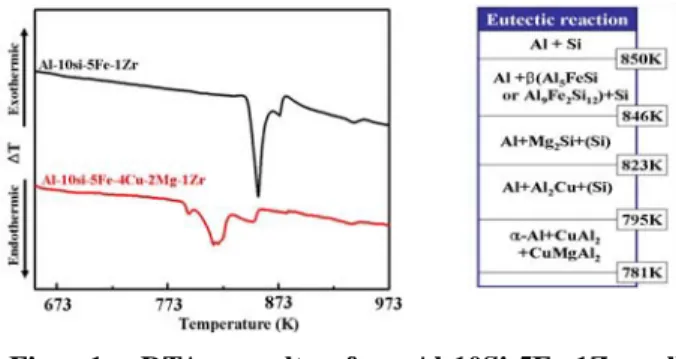
Fig. 1 shows the DTA results for the pre-compacted alloys together with various eutectic reactions. In Al-10Si-5Fe-1Zr alloy the eutectic reaction can be defined as follows; Al+Al5FeSi+Si⇔L at 849K. In
Al-10Si-5Fe-4Cu-2Mg-1Zr alloy three different eutectic reactions, Al+CuAl2 +CuMgAl2 ⇔ L at 781K,
Al+CuAl2+Si ⇔ L at 795K, Al+Mg2Si ⇔ L at 823K were
expected from the careful analysis of DTA curve.
The formation temperature of liquid phase and melting temperature in Al-10Si-5Fe-4Cu-2Mg-1Zr alloy were lower than those measured in Al-10Si-5Fe-1Zr alloy. This could be attributed to the effect of Cu and Mg alloying. Therefore,
2006 POWDER METALLURGY World Congress
PB03-W-02
Effect of Cu and Mg on Forging Property and Mechanical Behavior of
Powder Forged Al-Si-Fe Based Alloy
Dong-Suk Lee1,a
, Taek-Kyun Jung1,b, Mok-Soon Kim1.c and Won-Yong Kim2,d
1
School of Materials Science and Engineering, Inha University, 253 Yonghyun-dong, Nam-gu, Incheon 402-751, Korea
2
Advanced Materials R&D Center, Korea Institute of Industrial Technology, 994-32 Dongchun-dong, Yeonsu-gu, Incheon 406-130, Korea
a
[email protected], [email protected] Abstract
Two atomized alloy powders were pre-compacted by cold and subsequently hot forged at temperatures ranging from 653K to 845K. The addition of Cu and Mg causes a decrease in the eutectic reaction temperature of Al-10Si-5Fe-1Zr alloy from 841K to 786K and results in a decrease of flow stress at the given forging temperature. TEM observation revealed that in addition to Al-Fe based intermetallics, Al2Cu and Al2CuMg intermetallics appeared. The volume fraction of intermetallic dispersoids increased by the addition of Cu and Mg. Compressive strength of the present alloys was closely related to the volume fraction of intermetallic dispersoids.
Keywords : Al-Si-Fe alloy, powder forging, mechanical behavior
Fig. 1. DTA results for Al-10Si-5Fe-1Zr alloy, Al-10Si-5Fe-4Cu-2Mg-1Zr alloy and possible eutectic reactions depending on temperatures
© Korean Powder Metallurgy Institute 1001
-bulk Al-10Si-5Fe-4Cu-2Mg-1Zr alloy could be fabricated at slighty lower temperature compared to Al-10Si-5Fe-1Zr alloy.
Fig. 2 shows the forging flow stress curves for both alloys processed at temperatures ranging from 653K to 845K and at an initial strain rate of 10-2/s. Basically, both
alloys show a similar flow behavior. With increasing forging temperature flow stresses of both alloys decreased. The flow stress of Cu and Mg-added alloy shows lower value than Al-10Si-5Fe-1Zr alloy. Therefore it is noted that Cu and Mg additions have a role to accerate a diffusion activity in the present alloy. This might be directly related to the improvement of forgeablity. In flow curves, a rapid increase of flow stress at high strain was due to additional friction stress between the mold and samples.
0.0 0.1 0.2 0.3 0.4 0.5 0.6 0.7 0 50 100 150 200 250 300 350 Tr u e s tr e ss (M P a ) True strain 845K 797K 753K 723K 653K 0.0 0.1 0.2 0.3 0.4 0.5 0.6 0.7 0 50 100 150 200 250 300 350 797K 753K 723K 653K Tr u e str e ss ( M P a ) True strain
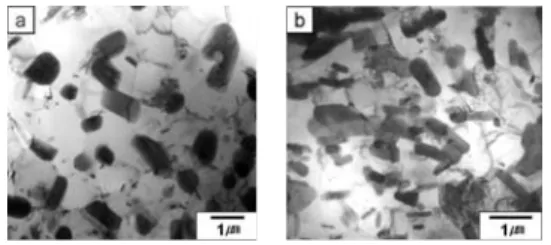
Fig. 3 shows TEM images for both samples forged at 797K. Apparently, no large difference in microstructure was seen but higher volume fraction of dispersoids and relatively homogeneous distribution of particles were characterized to display the effect of Cu and Mg alloying as compared in Fig. 5(a) and (b).
Further, the average particle size of Cu and Mg-added alloy was measured to be smaller than that alloy without Cu and Mg alloying. This might be closely related to the occurrence of thermally stable phases Al2CuMg and the
Al2Cu. Consequently, these microstructural features
together with lowering eutectic temperature seem to have a positive role in improving forgeability of the present alloy system.
Fig. 4 shows the variations of compressive yield strength and compressive plastic strain at room temperature for both
alloys forged at various temperatures. The compressive yield strength decreased continuously with increasing forging temperature for both alloys. Interestingly, the compressive yield strength of Cu and Mg-added alloy showed higher values than that alloy without Cu and Mg alloying through the forging temperatures investigated. The higher strength at room temperature of Cu and Mg-added alloy might be responsible for the higher volume fraction of fine intermetallic dispersoids compared to that alloy without Cu and Mg additions. On the other hand the compressive plastic strain of the Cu and Mg-added alloy was measured to be lower than that obtained in the Cu and Mg unalloyed alloy.
650 700 750 800 850 0 100 200 300 400 500 600 700 800 C o mpr e s s iv e y iel d s tr engt h ( M Pa) Forging temperature (K) Al-10Si-5Fe-1Zr Al-10Si-5Fe-4Cu-2Mg-1Zr 650 700 750 800 850 0 5 10 15 20 25 30 35 40 45 50 Co mp re ssi ve p la s ti c s tr a in ( % ) Forging temperature (K) Al-10Si-5Fe-1Zr Al-10Si-5Fe-4Cu-2Mg-1Zr 3. Summary
We have successfully fabricated Al-10Si-5Fe based alloys with and without Cu and Mg alloying by powder metallurgy process and subsequent hot forging without an intermediate sintering stage. Cu and Mg alloying into the Al-10Si-5Fe alloy was effective to enhance forgeability in terms of lowering eutectice temperature and refinement in microstructure. The compressive yield strength of Cu and Mg-added alloy was higher than Al-10Si-5Si alloy. Finely distributed intermetallic dispersoids and their higher volume fraction are responsible for the higher strength of Cu and Mg-added alloy.
4. Acknowledgement
This work was supported by INHA UNIVERSITY Research Grant.
5. References
1. H.S. Cho, H.G. Jeong, M.S. Kim and H. Yamagata: Scripta Mater. Vol. 42 (2000), p. 221.
2. H. Yamagata and T. Koike: J. Japan Inst. Light Metals Vol. 48 (1998), p. 52.
3. H. Yamagata: Mater. Sci. Forum Vol. 305/306 (1999), p. 739.
4. K. Matsuura, M. Kudoh: Mater. Chem. Phys. Vol.81 (2003), p.393
Fig. 2. Forging flow stress curves for Al-10Si-5Fe-1Zr alloy (a) and Al-10Si-5Fe-4Cu-2Mg-1Zr alloy (b) forged at various temperatures and at an initial strain rate of 10-2/s
Fig. 3. TEM images for Al-10Si-5Fe-1Zr alloy (a) and Al-10Si-5Fe-4Cu-2Mg-1Zr alloy (b), forged at 797K
Fig. 4. Forging temperature dependence of compressive yield strength and compressive plastic strain for both bulk alloys