Enantioselective Synthesis of a Novel Thiazoline Core as a Potent
Peroxisome Proliferator-Activated Receptor
δ Agonist
Su-Jeong Lee,
†Mallesham Samala,
‡Seo Yeon Woo,
†Dongyup Hahn,
§Dayoung Kim,
∥Tara Man Kadayat,
†Kyungjin Jung,
†Jina Kim,
†Dong-Su Kim,
†Sugyeong Kwon,
†Shinae Kim,
†,⊥Kyung-Hee Kim,
†Sang-Jip Nam,
∥Sung Jin Cho,
*
,†and Jungwook Chin
*
,††New Drug Development Center, Daegu-Gyeongbuk Medical Innovation Foundation, Daegu 41061, Republic of Korea ‡College of Pharmacy, Kangwon National University, Chuncheon, Gangwon-do 24341, Republic of Korea
§School of Food Science and Biotechnology, and⊥College of Pharmacy, Kyungpook National University, Daegu 41566, Republic of
Korea
∥Department of Chemistry and Nano Science, Global Top 5 Program, Ewha Womans University, Seoul 03760, Republic of Korea
*
S Supporting InformationABSTRACT: The convergent and enantioselective synthesis of a highly potent human peroxisome proliferator-activated receptor delta agonist is presented. More specifically, the thiazoline structure, which constitutes the biosynthetically distinctive core structure of pulicatin (a secondary metabolite of symbiotic bacteria), was synthesized from a commercially available and inexpensive chiral pool ofL-threonine.
1. INTRODUCTION
Pulicatin A is a secondary metabolite that was recently isolated from the cone snail-associated symbiotic bacteria, Streptomyces sp. CP32, and possesses a relatively simple but unique stereogenic 5-methyl-arylthiazoline core (seeFigure 1).1 Two similar core structures, namely the aryldihydrothiazole and the arylthiazole cores, are also present within the pulicatin series and are of particular importance in the discovery of novel bioactive scaffolds, as the symbiotic Streptomyces sp. CP32 isolated from Conus pulicarius biosynthesizes small-molecule
allelochemicals as a defensive mechanism in marine bioenviron-ments.2−4
In addition, a further class of arylthiazole derivatives, namely the anithiactins (Figure 1), was identified from a different marine source, and the total syntheses of anithiactins A−C were investigated as part of the ongoing research into the discovery of novel secondary metabolites from the marine-derived Streptomyces sp.5,6
In the context of drug targets, the nuclear receptor peroxisome proliferator-activated receptor delta (PPARδ) has recently received attention as a re-emerging target for the treatment of diseases, such as metabolic syndromes,7−12as its activation alters glucose and lipid metabolism through tran-scriptional regulation and results in beneficial pharmacological effects.13,14For example, Endurobol (GW501516, 1, Figure 1) is a well-known effective and potent PPARδ agonist, which is currently in late-phase clinical trials.15−18Because of its highly selective and potent activity compared to other PPARδ agonists, the development of novel synthetic routes toward target 1 and its analogs has received growing attention to allow its use in both structural and biological studies.19−23Indeed, our group previously reported one of the shortest synthetic routes toward compound 1 and generated a series of different analogs with the aim of discovering novel agonists.20
Received: November 1, 2017
Accepted: January 29, 2018
Published: February 15, 2018 Figure 1.Structures of pulicatins A, C, D, E, and F, anithiactins A−C,
and PPARδ agonists 1 and 2.
Article
Cite This:ACS Omega 2018, 3, 1970−1976
copying and redistribution of the article or any adaptations for non-commercial purposes.
Downloaded via EWHA WOMANS UNIV on October 25, 2019 at 00:29:41 (UTC).
2. RESULTS AND DISCUSSION
During the course of our studies into the investigation of marine-derived natural products24 and synthetic agonists toward PPARδ, where we aimed to develop safer and more effective drug leads, we discovered that the bioactive natural products pulicatins C−F and anithiactins A−C (seeFigure 1) contain the same phenylthiazole core structure as PPARδ agonist 1.
We also found that pulicatin A contains a biosynthetically distinctive thiazoline structure, which is essentially the enantiospecifically reduced form of the 5′-methylthiazole moiety. Thus, inspired by the fact that these thiazoline and thiazole analogs are produced from the same biological system, we designed a novel scaffold consisting of the stereogenic 4,5-dihydrothiazole core. More specifically, during our investiga-tions into novel anti-obesity drugs, we synthesized 2 based on the structure of 1.
Previously, the synthesis of a series of optically pure 2-aryl-4,5-dihydrothiazole analogs without the 5-methyl substituent was carried out using aryl nitriles and methyl cysteine as the starting materials, and the antibacterial activities of these compounds were examined.25 However, to date, neither the enantiospecific synthesis of the 2-aryl-5-methyl-4,5-dihydro-thiazole core nor the extended scaffold 2 has been explored.
Thus, we herein present thefirst enantiospecific synthesis of the highly potent PPARδ agonist 2 containing the novel thiazoline scaffold, in addition to the preliminary in vitro pharmacological studies of this compound toward PPAR subtypes.
From a synthetic point of view, the main challenge in the preparation of 2 involves the construction of the two thiazoline stereocenters. We therefore began the synthesis of 2 from L
-threonine (Scheme 1), a readily available and cheap amino acid. Thus, one of the two stereocenters in the final product originates from L-threonine, whereas the other is constructed
during the formation of the thiazoline ring using either diethylaminosulfur trifluoride (DAST) or methyl N-carbamate (Burgess reagent).
As indicated in Scheme 1, the initial stage of preparation involved acetonide protection of N-(tert-butoxycarbonyl)-L
-threonine methyl ester with 2,2-dimethoxypropane (DMP) in the presence of a catalytic amount of boron trifluoride diethyl etherate (BF3·Et2O) in CH2Cl2 at room temperature to give oxazolidine 3 in 91% yield. The ester group of 3 was then reduced by LiBH4 in a mixture of tetrahydrofuran (THF)/
methanol to afford alcohol 4 in 84% yield.26 A subsequent Appel reaction of the hydroxy group of 4 with CBr4and PPh3
in CH2Cl2gave brominated product 5 in 41% yield.
The coupling of 5 with 4-mercapto-2-methylphenol was then carried out in the presence of Cs2CO3in acetonitrile at room
temperature over 12 h to give 6 in 61% yield. Etherification of the resulting phenol group with ethyl bromoacetate in the presence of Cs2CO3 in acetonitrile then afforded 7 in 96%
yield. Subsequent deprotection of both acetonide and Boc groups of 7 was achieved in a single step using excess trifluoroacetic acid (TFA) in dimethylformamide (DMF) at 50 °C over 24 h followed by column chromatographic purification, to give alcohol-amine 8 in 64% yield.27 Subsequently, the introduction of a thioamide group into 8 was carried out using 2-(4-(tri fluoromethyl)phenylcarbonothioyl)isoindoline-1,3-dione (11) in the presence of N,N-diisopropylethylamine (DIPEA) in CH2Cl2to give the desired thioamide 9 in 43%
yield.28
To complete the novel synthesis of 2, formation of the thiazoline ring from 9 was performed using DAST in CH2Cl2at
−78 °C over 2 h to provide the corresponding thiazoline 10 in 79% yield.29Use of Burgess reagent in the place of DAST was also possible in this step to give thiazoline 10 in 64% yield;30 however, a longer reaction time and a higher temperature were required. Finally, saponification of 10 using 2 M LiOH in a mixture of THF/water provided the desired product 2 as a pale yellow solid in 91% yield. Thus, the first enantiospecific synthesis of the novel scaffold 2 was accomplished over nine steps in an overall yield of 3.6%. Further details regarding the synthetic route and characterization of thefinal product can be found in theSupporting Information.
We also compared the stereochemistry of some additional products based on that of compound 2 (seeFigure 2below). To synthesize a substance exhibiting the same stereochemical structure, L-threonine methyl ester hydrochloride was treated
Scheme 1. Preparation of 2
with triethylamine (TEA) and 11 in CH2Cl2 at room
temperature to give thioamide 12 in 50% yield (Scheme 2). Subsequently, the thiazoline ring was generated using DAST in CH2Cl2to give the cyclized product 13 in 69% yield.
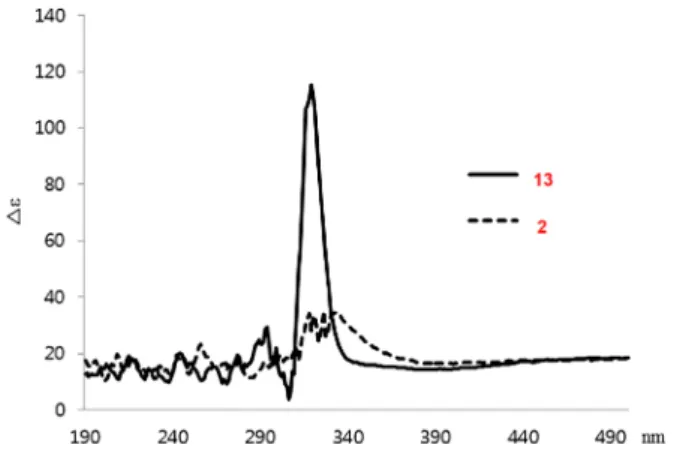
Thus, the absolute configurations of thiazolines 2 and the single isomer of 13 were determined by measuring the specific optical rotations of the two products and carrying out circular dichroism (CD) experiments (Figure 2). The obtained results were compared with the literature value for a similar compound bearing the (4R,5S)-pulicatin A configuration (see Figure 1).1 The 1H-1H correlated spectroscopy (COSY), nuclear Over-hauser effect spectroscopy (NOESY), and1H-13C heteronuclear
multiple bond correlation (HMBC) nuclear magnetic reso-nance (NMR) spectra of compound 2 (see the Supporting Informationand Figure 3) were also recorded to confirm the stereochemistry of this product.
The biological activities of the two key scaffolds, that is, GW501516 (1) and the synthesized 2, were then examined through screening of their agonist activities toward PPARδ. As shown in the Supporting Information, the novel scaffold 2
displayed highly potent human peroxisome proliferator-activated receptor delta (hPPARδ) activity (EC50 = 6.2 nM)
in a cell-based cotransfection assay.
3. CONCLUSIONS
We successfully synthesized the novel hPPARδ agonist 2 in a convergent and enantioselective manner using a chiral pool of
L-threonine, a naturally occurring amino acid, as the starting
material. The developed synthetic protocol for the preparation of the thiazoline structure involved simple and high-yielding chemical transformations. Following preliminary in vitro pharmacological studies, we could also conclude that scaffold 2 displayed highly potent hPPARδ activity. Further inves-tigation into the preparation of synthetic derivatives of 2 and related structure−activity relationship studies are ongoing, and the results will be reported in due course, with the aim of developing a novel hPPARδ agonist for medicinal purposes.
4. EXPERIMENTAL SECTION
4.1. General. All reactions were monitored by thin-layer chromatography (TLC), performed using 0.2 mm silica gel plates (Merck 60 F254) and visualized by UV light (254 nm)
and stain solutions, such as KMnO4 and p-anisaldehyde, with heating. Medium pressure liquid chromatography (MPLC) was carried out on a CombiFlash Rf system with RediSep Rf using flash column cartridges packed with silica gel. The purity of the target compounds was determined to be >95% by analytical high-performance liquid chromatography using dual different wavelength UV detector (254 and 280 nm). NMR spectra were recorded on a Bruker spectrometer at 400 MHz for1H and 100 MHz for 13C. Chemical shifts (δ) were reported in parts per
million (ppm) relative to tetramethylsilane as an internal standard, and coupling constants were expressed in hertz. Infrared (IR) spectra were obtained using a Shimadzu IRAffinity-1 spectrometer, and mass spectra were measured with a JEOL JMS 700 high-resolution mass spectrometer (HRMS) at the Korean Basic Science Institute (Daegu). Melting points were determined using MP90 Melting Point System with open capillaries, and optical rotations were measured on an AutoPOL I automatic polarimeter. CD spectra were obtained using a Jasco J-810 spectropolarimeter.
4.2. Materials. Commercially available reagent grade chemicals, such as N-(tert-butoxycarbonyl)-L-threonine methyl
ester andL-threonine methyl ester hydrochloride, were used as
received without further purification unless noted otherwise. 4.3. Synthetic Procedure: Preparation of 2 (Scheme 1). 4.3.1. 3-(tert-Butyl) 4-Methyl (4S,5R)-2,2,5-Trimethylox-azolidine-3,4-dicarboxylate (3). To a solution of N-(tert-butoxycarbonyl)-L-threonine methyl ester (5 g, 21.44 mmol) in
CH2Cl2(11 mL) were added DMP (5.3 mL, 42.9 mmol) and
boron trifluoride diethyl etherate (0.14 mL, 1.072 mmol), and the resulting mixture was allowed to stir at room temperature for 3 h. After this time, the reaction mixture was extracted with CH2Cl2(50 mL) and sat. NaHCO3(50 mL). The organic layer
was then separated, washed with brine (50 mL), and dried over anhydrous MgSO4. Following filtration and concentration to
give crude residue, purification was by MPLC using hexane/ ethyl acetate (9:1) as the eluant to give the desired product 3 as a colorless liquid (5.331 g, 91%), which was a mixture of two conformers (major/minor = 65:35); 1H NMR (400 MHz, CDCl3):δ 4.19−4.11 (m, 1H), 3.98 and 3.90 (minor: d, J = 7.7 Hz, major: d, J = 7.9 Hz, 1H), 3.76 (s, 3H), 1.64 and 1.56
Figure 2.Experimental CD spectra of compounds 2 and 13.
Scheme 2. Preparation of Pulicatin Derivative 13
Figure 3.Key HMBC, COSY, and NOESY correlations for compound 2.
(major: s, minor: s, 3H), 1.58 (s, 3H), 1.48 (s, 3H), 1.39 and 1.38 (major: s, minor: s, 9H); 13C NMR (100 MHz, CDCl3) major conformer: δ 171.2, 150.9, 95.0, 80.2, 73.7, 66.1, 52.1, 28.1, 26.4, 23.9, 18.7, minor conformer:δ 170.7, 151.8, 94.4, 80.7, 73.4, 65.9, 52.3, 28.2, 27.7, 24.8, 18.9; FTIR (neat): 2982, 2936, 1757, 1712, 1380, 1367, 1259, 1202, 1172, 1131, 859 cm−1. 4.3.2. tert-Butyl (4R,5R)-4-(Hydroxymethyl)-2,2,5-trimethy-loxazolidine-3-carboxylate (4). To a solution of 3-(tert-butyl)-4-methyl (4S,5R)-2,2,5-trimethyloxazolidine-3,4-dicarboxylate 3 (5.242 g, 19.18 mmol) in THF/MeOH (4:1) (64 mL) was added LiBH4 (0.836 g, 38.4 mmol) at 0 °C. The reaction
mixture was then allowed to warm to room temperature and stirred for 2 h. Following complete consumption of the starting material (as determined by TLC), the reaction mixture was quenched using sat. NaHCO3(10 mL) prior to extracting with
ethyl acetate (50 mL) and sat. NaHCO3 (40 mL). The
combined organic layers were then washed with brine (50 mL), dried over MgSO4,filtered, and concentrated to give the crude
product. Finally, the obtained residue was purified by MPLC using hexane/ethyl acetate (8:2) as the eluant to give the desired product 4 as a colorless oil (3.971 g, 84%).1H NMR
(400 MHz, CDCl3): δ 4.98 (br s, 1H), 3.72−3.62 (m, 3H), 3.56−3.47 (m, 1H), 1.57 (s, 3H), 1.49 (s, 9H), 1.46 (s, 3H), 1.34 (d, J = 6.0 Hz, 3H); 13C NMR (100 MHz, CDCl 3): δ 154.2, 93.9, 81.1, 71.9, 67.1, 64.6, 28.3, 27.8, 25.8, 18.1; FTIR (neat): 3438, 2979, 2936, 1696, 1671, 1405, 1367, 1257, 1176, 1090, 1064 cm−1. 4.3.3. tert-Butyl (4S,5R)-4-(Bromomethyl)-2,2,5-trimethy-loxazolidine-3-carboxylate (5). To a solution of tert-butyl (4R,5R)-4-(hydroxymethyl)-2,2,5-trimethyloxazolidine-3-car-boxylate 4 (3.90 g, 15.9 mmol) in CH2Cl2(16 mL) were added
CBr4(5.27 g, 15.9 mmol) and PPh3(4.17 g 15.9 mmol) at 0
°C. The reaction mixture was then allowed to warm to room temperature and stirred continuously for 4 h. After this time, the reaction mixture was directly absorbed onto silica gel and purified by MPLC using hexane/ethyl acetate (20:1) as the eluant to give the desired product 5 as a colorless liquid (2 g, 41%), which is a mixture of two conformers;1H NMR (400
MHz, CDCl3): δ 4.21−4.15 (m, 1H), 3.85−3.48 (m, 3H), 1.62−1.49 (m, 15H), 1.36 (d, J = 6.2 Hz, 3H);13C NMR (100 MHz, CDCl3) major conformer:δ 152.0, 93.8, 80.5, 74.0, 63.2, 31.8, 28.3, 27.2, 26.3, 19.7, minor conformer: δ 151.2, 94.6, 80.3, 74.5, 63.1, 32.5, 28.3, 26.8, 26.8, 20.1; FTIR (neat): 2979, 2935, 1696, 1392, 1366, 1259, 1172, 1127, 1089, 863 cm−1. 4.3.4. tert-Butyl (4S,5R)-4-(((4-Hydroxy-3-methylphenyl)-thio)methyl)-2,2,5-trimethyl-oxazolidine-3-carboxylate (6). To a stirred solution of 4-mercapto-2-methylphenol (0.366 g, 2.61 mmol) in CH3CN (7 mL) was added Cs2CO3(0.850 g,
2.61 mmol) followed by a solution of tert-butyl (4S,5R)-4-(bromomethyl)-2,2,5-trimethyloxazolidine-3-carboxylate 5 (0.731 g, 2.372 mmol) in CH3CN (5 mL). After stirring the
reaction mixture at room temperature overnight, the solvent was evaporated from the mixture, and the mixture was poured into water (30 mL) prior to extracting with ethyl acetate (2× 50 mL). The combined organic layers were then dried over anhydrous MgSO4, filtered, and concentrated. The obtained residue was purified by MPLC using hexane/ethyl acetate (9:1) as the eluant to give the desired product 6 as a white solid (0.53 g, 61%), which was a mixture of two conformers (major/minor = 54:46). mp 110−111 °C; 1H NMR (400 MHz, CDCl3): δ
7.20−7.14 (m, 2H), 6.70 and 6.59 (minor: d, J = 7.5 Hz, major: d, J = 7.8 Hz, 1H), 5.97 and 5.59 (major: s, minor: s, 1H),
4.33−4.19 (m, 1H), 3.71 and 3.58 (major: s, minor: d, J = 5.6 Hz, 1H), 3.36 and 3.19 (major: d, J = 12.8 Hz, minor: d, J = 12.4 Hz, 1H), 3.01 and 2.88 (major: dd, J = 11.2, 9.9 Hz, minor: dd, J = 11.5, 10.4 Hz, 1H), 2.20 and 2.17 (minor: s, major: s, 3H), 1.61 and 1.58 (minor: s, major: s, 3H), 1.52 (s, 3H), 1.46−1.36 (m, 12H); 13C NMR (100 MHz, CDCl3) major conformer: δ 153.7, 152.2, 134.3, 130.3, 124.9, 124.8, 115.5, 93.8, 80.6, 74.8, 62.8, 36.5, 28.6, 28.3, 27.2, 20.6, 15.7, minor conformer: δ 153.9, 151.6, 135.4, 131.4, 125.0, 124.8, 115.5, 94.5, 80.0, 75.3, 62.6, 38.4, 28.3, 27.6, 27.0, 21.3, 15.7; FTIR (neat): 3381, 2989, 1672, 1598, 1492, 1398, 1234, 1146,
1117, 1046, 822 cm−1; HRMS (EI): calcd for [M]+
C19H29NO4S, 367.1817; found, 367.1815.
4.3.5. tert-Butyl (4S,5R)-4-(((4-(2-Ethoxy-2-oxoethoxy)-3- methylphenyl)thio)methyl)-2,2,5-trimethyloxazolidine-3-car-boxylate (7). To a solution of tert-butyl (4S,5R)-4-(((4- hydroxy-3-methylphenyl)thio)methyl)-2,2,5-trimethyloxazoli-dine-3-carboxylate 6 (1.545 g, 4.20 mmol) in CH3CN (21 mL)
was added Cs2CO3 (2.055 g, 6.31 mmol) followed by ethyl
bromoacetate (0.56 mL, 5.04 mmol, dropwise). After stirring the reaction mixture at room temperature for 1 h, it was diluted with water (30 mL) and extracted with ethyl acetate (2× 30 mL). The organic layers were then combined, washed with brine (50 mL), dried over MgSO4, filtered, and concentrated.
The obtained residue was purified by MPLC using hexane/ ethyl acetate (6:1) as the eluant to give the desired product 7 as a colorless oil (1.84 g, 96%), which was a mixture of two conformers (major/minor = 52:48); 1H NMR (400 MHz,
CDCl3):δ 7.24−7.20 (m, 2H), 6.62 (d, J = 8.0 Hz, 1H), 4.60
(s, 2H), 4.28−4.19 (m, 3H), 3.69 and 3.57 (minor: s, major: s, 1H), 3.39 and 3.22 (minor: d, J = 12.7 Hz, major: d, J = 12.7 Hz, 1H), 3.08 and 2.88 (minor: dd, J = 10.7, 9.5 Hz, major: dd, J = 10.9, 10.6 Hz, 1H), 2.25 (s, 3H), 1.60 and 1.56 (major: s, minor: s, 3H), 1.51 (s, 3H), 1.46−1.28 (m, 15H);13C NMR (100 MHz, CDCl3) major conformer: δ 168.7, 155.7, 151.4, 134.8, 130.5, 128.3, 126.2, 111.6, 94.4, 79.8, 75.3, 65.6, 62.3, 61.2, 38.0, 28.3, 27.5, 26.9, 21.2, 16.0, 14.0, minor conformer:δ 168.8, 155.0, 152.0, 133.0, 128.5, 128.1, 127.0, 111.8, 93.6, 80.0, 74.6, 65.6, 62.6, 61.2, 35.4, 28.5, 28.3, 27.1, 20.4, 16.0, 14.0; FTIR (neat): 2980, 2933, 1762, 1696, 1491, 1387, 1366, 1303, 1258, 1186, 1141, 1088, 734 cm−1; HRMS (EI): calcd for [M]+
C23H35NO6S, 453.2185; found, 453.2187.
4.3.6. Ethyl 2-(4-(((2S,3R)-2-Amino-3-hydroxybutyl)thio)-2-methylphenoxy)acetate (8). To a solution of tert-butyl (4S,5R)-4-(((4-(2-ethoxy-2-oxoethoxy)-3-methylphenyl)thio)-methyl)-2,2,5-trimethyloxazolidine-3-carboxylate 7 (0.227 g, 0.5 mmol) in DMF (2.5 mL) was added dropwise TFA (0.77 mL, 10 mmol). After stirring the reaction mixture at 50°C for 24 h, it was diluted with water (20 mL) and extracted with ethyl acetate (2× 30 mL). The organic layers were then combined, dried over anhydrous Na2SO4,filtered, and concentrated. The
obtained residue was purified by MPLC using dichloro-methane/methanol (9:1) as the eluant to give the desired product 8 as a colorless gum (0.1 g, 64%); 1H NMR (400
MHz, (CD3)2SO):δ 7.96 (s, 2H), 7.29 (s, 1H), 7.24 (d, J = 8.4 Hz, 1H), 6.84 (d, J = 8.4 Hz, 1H), 5.51 (br s, 1H), 4.81 (s, 2H), 4.16 (q, J = 7.0 Hz, 2H), 3.94−3.88 (m, 1H), 3.16−3.11 (m, 1H), 3.03−2.98 (m, 1H), 2.94−2.85 (m, 1H), 2.18 (s, 3H), 1.20 (t, J = 7.0 Hz, 3H), 1.11 (d, J = 6.3 Hz, 3H);13C NMR (100 MHz, (CD3)2SO): δ 169.1, 155.8, 133.9, 130.3, 127.8, 125.1, 112.7, 65.4, 64.6, 61.1, 55.5, 34.7, 20.2, 16.3, 14.4; FTIR (neat): 3419, 3139, 2984, 2930, 1594, 1490, 1305, 1212, 1136, ACS Omega
1030, 800, 723 cm−1; HRMS (EI): calcd for [M]+
C15H23NO4S, 313.1348; found, 313.1346.
4 . 3 . 7 . E t h y l 2 ( 4 ( ( ( 2 S , 3 R ) 3 H y d r o x y 2 ( 4
-( t r i
fluoromethyl)phenylthioamido)butyl)thio)-2-methylphenoxy)acetate (9). To a stirred solution of ethyl 2( 4 2( 2( 2( 2 S , 3 R ) 2 a m i n o 3 h y d r o x y b u t y l ) t h i o ) 2 -methylphenoxy)acetate 8 (0.1 g, 0.319 mmol) in anhydrous CH2Cl2 (1 mL) was added DIPEA (0.06 mL, 0.351 mmol)
followed by a solution of 2-(4-(tri
fluoromethyl)-phenylcarbonothioyl)isoindoline-1,3-dione 11 (0.118 g, 0.351 mmol) in CH2Cl2(0.6 mL) at 0°C. The reaction mixture was
allowed to warm to room temperature, and stirring was continued for 4 h. After this time, the solvent was evaporated from the reaction mixture, and the obtained crude residue was purified by MPLC using hexane/ethyl acetate (4:1) as the eluant to give the desired product 9 as a yellow oil (0.070 g,
43%); 1H NMR (400 MHz, CDCl 3): δ 8.01 (d, J = 8.3 Hz, 1H), 7.68 (d, J = 8.2 Hz, 2H), 7.60 (d, J = 8.3 Hz, 2H), 7.29 (d, J = 1.7 Hz, 1H), 7.24 (dd, J = 8.4, 2.2 Hz, 1H), 6.57 (d, J = 8.4 Hz, 1H), 4.78−4.73 (m, 1H), 4.56 (s, 2H), 4.47−4.39 (m, 1H), 4.25 (q, J = 7.1 Hz, 2H), 3.36−3.24 (m, 2H), 2.55 (s, 1H), 2.22 (s, 3H), 1.29 (t, J = 7.1 Hz, 3H), 1.25 (d, J = 6.4 Hz, 3H);13C NMR (100 MHz, CDCl3):δ 197.7, 168.7, 155.6, 144.6, 133.8, 132.5 (q,2JCF= 32.6 Hz), 129.7, 128.6, 126.9, 125.7, 125.3 (q, 3J CF = 3.7 Hz), 123.6 (q,1JCF= 270.7 Hz), 111.7, 67.2, 65.4, 61.3, 59.6, 35.7, 20.9, 16.0, 14.0; FTIR (neat): 3443, 3366, 2977, 2930, 1740, 1492, 1413, 1325, 1189, 1131, 1068, 1015,
911, 849, 733 cm−1; HRMS (EI): calcd for [M]+
C23H26F3NO4S2, 501.1255; found, 501.1258.
4.3.8. Ethyl 2-(2-Methyl-4-((((4R,5S)-5-methyl-2-(4-(tri fluoromethyl)phenyl)-4,5-dihydrothiazol-4-yl)methyl)-thio)phenoxy)acetate (10). To a solution of ethyl 2-(4-(((2S,3R)-3-hydroxy-2-(4-(tri fluoromethyl)phenylthioamido)-butyl)thio)-2-methylphenoxy)acetate 9 (0.073 g, 0.146 mmol) in anhydrous CH2Cl2 (1 mL) was added DAST (0.077 mL,
0.582 mmol) dropwise at−78 °C, and the reaction mixture was stirred at−78 °C for 2 h. After this time, the reaction mixture was diluted with CH2Cl2 (30 mL) and quenched with sat. NaHCO3(5 mL). The organic layer was then washed with sat.
NaHCO3 (20 mL), brine (20 mL), dried over anhydrous Na2SO4, filtered, and concentrated. The crude residue was
purified by MPLC using hexane/ethyl acetate (9:1) as the eluant to give the desired product 10 as a yellow oil (0.056 g,
79%); 1H NMR (400 MHz, CDCl 3): δ 7.91 (d, J = 8.1 Hz, 2H), 7.64 (d, J = 8.2 Hz, 2H), 7.32 (d, J = 1.7 Hz, 1H), 7.28 (dd, J = 8.4, 2.2 Hz, 1H), 6.65 (d, J = 8.4 Hz, 1H), 4.62 (s, 2H), 4.41−4.35 (m, 1H), 4.26 (q, J = 7.1 Hz, 2H), 4.13−4.06 (m, 1H), 3.68 (dd, J = 13.3, 5.9 Hz, 1H), 3.16 (dd, J = 13.3, 9.8 Hz, 1H), 2.28 (s, 3H), 1.31−1.27 (m, 6H);13C NMR (100 MHz, CDCl3):δ 168.8, 166.5, 155.7, 136.5, 134.5, 132.7 (q, 2JCF = 32.2 Hz), 130.3, 128.5, 128.4, 126.3, 125.3 (q,3J CF= 3.8 Hz), 123.7 (q,1JCF= 270.9 Hz), 111.7, 78.2, 65.6, 61.3, 48.2, 35.4, 16.5, 16.1, 14.1; FTIR (neat): 2970, 2930, 1761, 1595, 1490, 1409, 1326, 1188, 1130, 1067, 1016, 976, 849, 618 cm−1; HRMS (EI): calcd for [M]+C
23H24F3NO3S2, 483.1150; found,
483.1152.
4 . 3 . 9 . 2 ( 2 M e t h y l 4 ( ( ( ( 4 R , 5 S ) 5 m e t h y l 2 ( 4 -(tri fluoromethyl)phenyl)-4,5-dihydrothiazol-4-yl)methyl)-thio)phenoxy)acetic acid (2). To a stirred solution of ethyl 2-(2-methyl-4-((((4R,5S)-5-methyl-2-(4-(tri fluoromethyl)-phenyl)-4,5-dihydrothiazol-4-yl)methyl)thio)phenoxy)acetate 10(34 mg, 0.070 mmol) in THF/H2O (1:1) (0.7 mL) at 0°C was added dropwise 2 M LiOH (0.105 mL, 0.211 mmol). The
reaction mixture was then stirred at room temperature until TLC indicated that the reaction had reached completion (∼1 h). After this time, the reaction mixture was diluted with water (1 mL), acidified with sat. NH4Cl (10 mL) to give a pH of 5,
and extracted with ethyl acetate (3 × 20 mL). The organic layers were then combined, dried over anhydrous Na2SO4,
filtered, and concentrated. The obtained residue was purified by MPLC using dichloromethane/methanol (10:1) as the eluant to give the desired product 2 as a pale yellow solid (29.6 mg, 91%); mp 88−90 °C; [α]D21−15.7 (c 0.166, CHCl3);1H NMR (400 MHz, (CD3)2SO):δ 7.93 (d, J = 8.0 Hz, 2H), 7.84 (d, J = 8.1 Hz, 2H), 7.32 (s, 1H), 7.27 (d, J = 8.3 Hz, 1H), 6.76 (d, J = 8.4 Hz, 1H), 4.52 (s, 2H), 4.35−4.30 (m, 1H), 4.23−4.18 (m, 1H), 3.51 (dd, J = 13.1, 7.1 Hz, 1H), 3.23 (dd, J = 13.0, 8.0 Hz, 1H), 2.17 (s, 3H), 1.22 (d, J = 6.4 Hz, 3H);13C NMR (100 MHz, (CD3)2SO):δ 165.4, 156.3, 136.8, 133.9, 131.6 (q,2JCF= 31.6 Hz), 130.3, 129.0, 127.4, 126.2 (q,3J CF= 3.7 Hz), 125.4, 124.3 (q,1JCF= 270.7 Hz), 112.5, 78.5, 66.4, 48.6, 35.2, 29.4, 16.9, 16.4; FTIR (neat): 2923, 2852, 2360, 1592, 1490, 1409, 1323, 1230, 1168, 1127, 1066, 1015, 975, 845 cm−1; HRMS (EI): calcd: for [M]+ C
21H20F3NO3S2, 455.0837; found,
455.0836.
4.3.10. 2-(4-(Tri fluoromethyl)phenylcarbonothioyl)-isoindoline-1,3-dione (11). To a stirred solution of 4-(trifluoromethyl)benzothioamide (3.0 g, 14.6 mmol) in THF (30 mL) at 0−5 °C were added K2CO3(3.1 g, 21.9 mmol) and phthaloyl dichloride (2.53 mL, 17.5 mmol, dropwise). The resulting reaction mixture was stirred at 0−5 °C for 3 h, then diluted with water (20 mL) and ethyl acetate (30 mL). The organic layer was separated, washed with brine (20 mL), dried over anhydrous Na2SO4, and concentrated. The resulting crude
compound was purified by MPLC using hexane/ethyl acetate (8:2) as the eluant to give the desired product 11 as a purple solid (3.8 g, 78%); mp 125−126 °C; 1H NMR (400 MHz, CDCl3):δ 8.01 (dd, J = 5.5, 3.0 Hz, 2H), 7.90−7.85 (m, 4H), 7.64 (d, J = 8.2 Hz, 2H); 13C NMR (100 MHz, CDCl3): δ 200.1, 164.6, 145.0, 135.5, 134.0 (q, 2JCF = 32.5 Hz), 130.9, 128.5, 125.4 (q,3JCF = 3.6 Hz), 124.7, 123.5 (q,1JCF= 271.1 Hz); FTIR (neat) 2917, 1790, 1729, 1288, 1120, 1070, 1017, 871, 847, 789, 717 cm−1; HRMS (EI): calcd for [M]+
C16H8F3NO2S, 335.0228; found, 335.0228.
4.4. Synthetic Procedure: Preparation of Pulicatin D e r iv a t iv e 1 3 (S c h em e 2) . 4 . 4 . 1. M e t h y l ( 4 -(Trifluoromethyl)phenylcarbonothioyl)-L-threoninate (12).
To a stirred solution ofL-threonine methyl ester hydrochloride
(0.170 g, 1 mmol) in anhydrous CH2Cl2 (5 mL) was added TEA (0.31 mL, 2.2 mmol) followed by a solution of 2-(4-(trifluoromethyl)phenylcarbonothioyl)isoindoline-1,3-dione 11 (0.369 g, 1.1 mmol) in CH2Cl2(5 mL) at 0°C. The reaction
mixture was then allowed to warm to room temperature, and stirring was continued at this temperature for 3 h. After this time, the solvent was evaporated from the reaction mixture, and the obtained crude residue was purified by MPLC using hexane/ethyl acetate (3:1) as the eluant to give the desired product 12 as a yellow oil (0.166 g, 50%);1H NMR (400 MHz, CDCl3):δ 8.21 (d, J = 7.9 Hz, 1H), 7.90 (d, J = 8.1 Hz, 2H), 7.67 (d, J = 8.2 Hz, 2H), 5.45 (dd, J = 8.6, 2.2 Hz, 1H), 4.61− 4.55 (m, 1H), 3.83 (s, 3H), 2.08 (d, J = 4.2 Hz, 1H), 1.35 (d, J = 6.4 Hz, 3H);13C NMR (100 MHz, CDCl 3):δ 199.3, 170.3, 144.3, 132.8 (q, 2J CF = 32.4 Hz), 127.2, 125.5 (q, 3JCF = 3.6 Hz), 123.6 (q,1J CF = 271.0 Hz), 68.0, 63.1, 52.9, 20.3; FTIR (neat): 3385, 3317, 2956, 1739, 1734, 1521, 1413, 1325, 1130, ACS Omega
1068, 1016, 910, 850 cm−1; HRMS (EI): calcd for [M]+
C13H14F3NO3S, 321.0646; found, 321.0649.
4.4.2. Methyl (4R,5S)-5-Methyl-2-(4-(tri fluoromethyl)-phenyl)-4,5-dihydrothiazole-4-carboxylate (13). To a solu-tion of methyl (4-(trifluoromethyl)phenylcarbonothioyl)-L
-threoninate 12 (0.159 g, 0.495 mmol) in anhydrous CH2Cl2
(3.3 mL) was added DAST (0.262 mL, 1.979 mmol) dropwise at−78 °C, and the reaction mixture was stirred at −78 °C for 2 h. After this time, the reaction mixture was allowed to warm to room temperature, and stirring was continued for 1 h. After completion of the reaction, the reaction mixture was diluted with CH2Cl2(30 mL) and quenched with sat. NaHCO3 (10
mL). The organic layer was then washed with sat. NaHCO3(20 mL), brine (30 mL), dried over anhydrous Na2SO4, filtered,
and concentrated. The crude residue was purified by MPLC using hexane/ethyl acetate (9:1) as the eluant to give the desired product 13 as a pale yellow solid (0.104 g, 69%); mp 60−62 °C; [α]D21−58.5 (c 0.156, CHCl3);1H NMR (400 MHz, CDCl3):δ 8.00 (d, J = 8.0 Hz, 2H), 7.67 (d, J = 8.0 Hz, 2H), 5.16 (d, J = 7.6 Hz, 1H), 4.32−4.25 (m, 1H), 3.85 (s, 3H), 1.30 (d, J = 6.9 Hz, 3H);13C NMR (100 MHz, CDCl 3):δ 169.7, 168.8, 136.0, 133.2 (q,2JCF= 32.6 Hz), 128.8, 125.4 (q,3JCF= 3.7 Hz), 123.6 (q,1J CF= 270.9 Hz), 81.7, 52.3, 47.6, 18.2; FTIR (neat): 2929, 1749, 1599, 1323, 1195, 1169, 1144, 1064, 1018, 919, 846 cm−1; HRMS (EI): calcd for [M]+ C
13H12F3NO2S,
303.0541; found, 303.0544.
4.5. In Vitro Transfection Assay. The monkey kidney cells, CV-1, were cultured in Dulbecco’s modified Eagle’s medium (DMEM) supplemented with 10% resin-charcoal-stripped fetal bovine serum (FBS), 100 U/mL penicillin, and 100 g/mL streptomycin in a humidified incubator (5% CO2in air) at 37°C. CV-1 cells were seeded at 6 × 10³ cells per well in 96-well culture plates and then grown to 70% confluence before transfection. The cells were washed with serum-free medium and then transfected with a plasmid mixture containing human PPAR expression vector, β-galactosidase, and TK-PPRE-Luc vector by SuperFect reagent (QIAGEN). The 24 h post-transfected cells were washed with serum-free DMEM and incubated with freshly delipidated 5% FBS DMEM supplemented with either compounds or DMSO vehicle for 24 h. After incubation, cell lysates were obtained using cell lysis buffer, and a luciferase activity was determined upon substrate addition using a Microlumat Plus Luminometer (Berthold). The luciferase activity was normalized with B-galactosidase
activity using an ONPG buffer. All of the assays were performed in triplicate.
■
ASSOCIATED CONTENT*
S Supporting InformationThe Supporting Information is available free of charge on the
ACS Publications websiteat DOI:10.1021/acsomega.7b01689. NMR and high-resolution electron impact mass spec-trometry data of all compounds and in vitro activities of compound 2 (PDF)
■
AUTHOR INFORMATIONCorresponding Authors
*E-mail: [email protected]. Phone: +82-53-790-5226. Fax: +82-53-790-5219 (S.J.C.).
*E-mail: [email protected]. Phone: +82-53-790-5257. Fax: +82-53-790-5219 (J.C.).
ORCID
Dong-Su Kim:0000-0003-0388-4633
Sung Jin Cho:0000-0002-4786-8830
Jungwook Chin:0000-0001-6060-0508 Author Contributions
S.-J.L., M.S, and S.Y.W. contributed equally to this work. The manuscript was written through contributions of all authors. All authors have given approval to the final version of the manuscript.
Notes
The authors declare no competingfinancial interest.
■
ACKNOWLEDGMENTSThis research was supported by the National Research Foundation of Korea (NRF) funded by the Korean government (Ministry of Science and ICT) (NRF-2017R1C1B1005599) and also was supported by a grant of the Korea Health Technology R&D Project through the Korea Health Industry Development Institute (KHIDI), funded by the Ministry of Health and Welfare, Republic of Korea (grant number: HI16C1501).
■
REFERENCES(1) Lin, Z.; Antemano, R. R.; Hughen, R. W.; Tianero, M. D.; Peraud, O.; Haygood, M. G.; Concepcion, G. P.; Olivera, B. M.; Light, A.; Schmidt, E. W. J. Nat. Prod. 2010, 73, 1922.
(2) Schmidt, E. W. Nat. Chem. Biol. 2008, 4, 466. (3) Piel, J. Nat. Prod. Rep. 2009, 26, 338. (4) Piel, J. Nat. Prod. Rep. 2004, 21, 519.
(5) Kim, H.; Yang, I.; Patil, R. S.; Kang, S.; Lee, J.; Choi, H.; Kim, M.-S.; Nam, S.-J.; Kang, H. J. Nat. Prod. 2014, 77, 2716.
(6) Lee, J.; Kim, H.; Lee, T. G.; Yang, I.; Won, D. H.; Choi, H.; Nam, S.-J.; Kang, H. J. Nat. Prod. 2014, 77, 1528.
(7) Willson, T. M.; Brown, P. J.; Sternbach, D. D.; Henke, B. R. J. Med. Chem. 2000, 43, 527.
(8) Duval, C.; Chinetti, G.; Trottein, F.; Fruchart, J.-C.; Staels, B. Trends Mol. Med. 2002, 8, 422.
(9) Vosper, H.; Khoudoli, G. A.; Graham, T. L.; Palmer, C. N. A. Pharmacol. Ther. 2002, 95, 47.
(10) Fruchart, J.-C.; Duriez, P.; Staels, B. Curr. Opin. Lipidol. 1999, 10, 245.
(11) Berger, J.; Moller, D. E. Annu. Rev. Med. 2002, 53, 409. (12) Monsalve, F. A.; Pyarasani, R. D.; Delgado-Lopez, F.; Moore-Carrasco, R. Mediators Inflammation 2013, 2013, 549627.
(13) Akiyama, T. E.; Meinke, P. T.; Berger, J. P. Curr. Diabetes Rep. 2005, 5, 45.
(14) Luquet, S.; Gaudel, C.; Holst, D.; Lopez-Soriano, J.; Jehl-Pietri, C.; Fredenrich, A.; Grimaldi, P. A. Biochim. Biophys. Acta, Mol. Basis Dis. 2005, 1740, 313.
(15) Kopelman, P. G. Nature 2000, 404, 635.
(16) Spiegelman, B. M.; Flier, J. S. Cell 2001, 104, 531.
(17) Steppan, C. M.; Bailey, S. T.; Bhat, S.; Brown, E. J.; Banerjee, R. R.; Wright, C. M.; Patel, H. R.; Ahima, R. S.; Lazar, M. A. Nature 2001, 409, 307.
(18) Evans, R. M.; Barish, G. D.; Wang, Y.-X. Nat. Med. 2004, 10, 355.
(19) Wei, Z.-L.; Kozikowski, A. P. J. Org. Chem. 2003, 68, 9116. (20) Ham, J.; Kang, H. Tetrahedron Lett. 2005, 46, 6683.
(21) Pereira, R.; Gaudon, C.; Iglesias, B.; Germain, P.; Gronemeyer, H.; de Lera, A. R. Bioorg. Med. Chem. Lett. 2006, 16, 49.
(22) Brown, A. D.; Davis, R. D.; Fitzgerald, R. N.; Glover, B. N.; Harvey, K. A.; Jones, L. A.; Liu, B.; Patterson, D. E.; Sharp, M. J. Org. Process Res. Dev. 2009, 13, 297.
(23) Sharma, A. K.; Sk, U. H.; He, P.; Peters, J. M.; Amin, S. Bioorg. Med. Chem. Lett. 2010, 20, 4050.
(24) Kim, H.; Chin, J.; Choi, H.; Baek, K.; Lee, T.-G.; Park, S. E.; Wang, W.; Hahn, D.; Yang, I.; Lee, J.; Mun, B.; Ekins, M.; Nam, S.-J.; Kang, H. Org. Lett. 2013, 15, 100.
(25) Tan, F.; Shi, B.; Li, J.; Wu, W.; Zhang, J. Molecules 2015, 20, 20118.
(26) Jaouadi, M.; Martinez, J.; Castro, B.; Barcelo, G.; Sennyey, G.; Senet, J.-P. J. Org. Chem. 1987, 52, 2364.
(27) Palomo, C.; Cossio, F. P.; Cuevas, C.; Lecea, B.; Mielgo, A.; Roman, P.; Luque, A.; Martinez-Ripoll, M. J. Am. Chem. Soc. 1992, 114, 9360.
(28) Brain, C. T.; Hallett, A.; Ko, S. Y. J. Org. Chem. 1997, 62, 3808. (29) Gaumont, A.-C.; Gulea, M.; Levillain, J. Chem. Rev. 2009, 109, 1371.
(30) Li, G.; Warner, P. M.; Jebaratnam, D. J. J. Org. Chem. 1996, 61, 778.