
A Study on the Design of an Efficient Audit Model in the Area of Information
System Testing Activities
1
Hee Wan Kim,
2Yong Gyu Jung
1
Prof., Division of Computer Science & Engineering, Sahmyook Univ., Korea
2Prof., Dept. of Medical IT, Eulji Univ., Korea
[email protected], [email protected]
Abstract
In the case of an agile-based project, it was inadequate to perform a comprehensive inspection and evaluation on the establishment and operation of an information system by performing audit only with the audit and inspection elements provided by the existing information system audit and inspection system. In particular, in the case of the test activity area, it was necessary to improve the test activity audit check items to comprehensively check the agile-based development process by applying the existing audit system. To this end, a test activity improvement check model of the agile methodology audit model was presented by applying the repetition concept, a characteristic of the agile methodology. In order to empirically verify the model of this study, a survey was conducted for auditors and designers/developers who have experience in performing agile-based projects and auditing information systems.
As a result of the questionnaire on the integrated test and system test in the test stage, more than 70% of the respondents were found to be suitable. More than 80% of the respondents judged that it was appropriate as a result of the questionnaire on "improvement and regression test progress according to integrated test and system test results" and "integrated test and functional actions of components and subsystems".
Keywords: information system audit, test activity, audit check items, agile methodology, audit model
1. INTRODUCTION
Agile Methodology is to combine developer interactions with diverse customer needs, software that works rather than comprehensive documentation, cooperation with customers rather than contract negotiations, and more value in responding to change than sticking to plans. It has achieved greater results than the existing traditional methodology. In order to ensure that high-quality products developed by these various methodologies can be delivered to customers in a timely manner, the information system audit is mandated, efforts are made to improve the information system through recommendations on the efficiency and stability of the information system. In addition, the National Information Society Agency (from December 22, 1999) provided an information system audit and inspection system in accordance with the information system audit standards, providing audit and inspection elements to systematically conduct audit, thereby supporting the establishment of a successful information system. However, in the case of an agile-based project, when audit is performed, supervision is performed only with the audit and inspection elements provided by the existing information system audit and inspection system, and it is insufficient for comprehensive inspection and evaluation of the establishment and operation of the information system. In
IJACT 21-3-29
Manuscript received: February 4, 2021 / revised: February 16, 2021/ accepted: February 25, 2021 Corresponding Author: [email protected]
Tel:+82-31-740-7178, Fax: +82-31-740-7435
particular, much of the system development area (SD) can be applied to the audit, but in the case of the test activity area, the existing audit system is applied, so the test activity check items to comprehensively check the agile-based development process are essential. Until recently, studies related to testing activities from the viewpoint of information system supervision have mainly been a model to comprehensively check the development and management process from the viewpoint of methodology. In addition, researches on the development of information systems for agile methodology have been continuously conducted, but there are few studies on information system audit and testing activities. The difference of this study is based on the above discussion, examining the characteristics and main factors of the agile methodology in the aspect of the existing supervision, and derived the characteristics of the agile methodology to derive detailed inspection items for each stage of testing activities.
2. RELATED WORK
2.1 Agile methodologyAgile methodology is a lighter model than plan-oriented software development methodology, and appeared in the 2000s with the goal of responding flexibly and agilely to system changes in the development process. This waterfall model is a methodology developed to solve problems where initial determined requirements are incomplete and communication between users and developers is difficult. It is an effort to change it to a lighter form and improve communication [1].
2.2 Key Agile Processes and Procedures
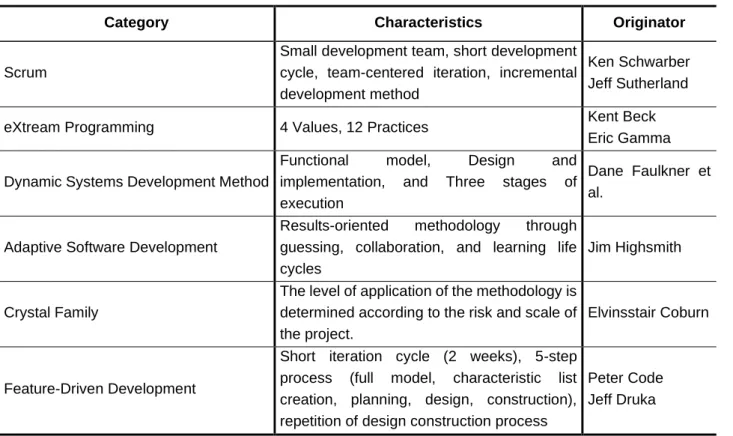
Agile methodologies entailed a variety of names, tactics, and action abbreviations, but the goal was always towards the problem of producing highly reliable software faster. These agile methodologies are listed below.
Table 1. Types and characteristics of agile methodology
Category Characteristics Originator
Scrum
Small development team, short development cycle, team-centered iteration, incremental development method
Ken Schwarber Jeff Sutherland
eXtream Programming 4 Values, 12 Practices Kent Beck
Eric Gamma Dynamic Systems Development Method
Functional model, Design and
implementation, and Three stages of execution
Dane Faulkner et al.
Adaptive Software Development
Results-oriented methodology through guessing, collaboration, and learning life cycles
Jim Highsmith
Crystal Family
The level of application of the methodology is determined according to the risk and scale of the project.
Elvinsstair Coburn
Feature-Driven Development
Short iteration cycle (2 weeks), 5-step process (full model, characteristic list creation, planning, design, construction), repetition of design construction process
Peter Code Jeff Druka
The dynamic system development methodology is rooted in RAD (Rapid Application Development), which is an iterative and incremental process model that uses prototypes for each development stage, and the crystal family method is also an iterative and incremental development method. This process emphasizes the tuning of products and methodologies at the beginning and in the middle of the iteration, and application of the project can improve not only the system output, but also the process, and documentation is made at the project level. And lean development is a method that applies the principle of lean manufacturing method to software development [2].
2.3 Necessity of testing activities audit
Existing information system test activity proceeds planned unit test, integration test, acceptance test, and system test at the end of each step, but in the case of agile, test activities are conducted at the time of functional implementation of the user story for each repetitive sprint. That is, the general audit is performed by period according to the design, intermediate, and final audit. However, when an agile methodology is introduced, not all designs are completed during the design audit/intermediate audit period, but design for each sprint order completed. So, in the case of the sprint, audit needs to be performed including checklists for the implementation stage[3]. In addition, there are insufficient check items to apply the check items for supervision of existing test activities to agile-based projects. In the case of agile-based projects, it is necessary to supervise test activities by adding check items for features found in agile-based projects such as extinction charts, backlogs, and user stories.
Therefore, in the case of an agile-based project, it is insufficient for comprehensive inspection and evaluation of the establishment and operation of the information system by performing audit only with the audit and inspection elements provided by the existing information system audit and inspection system. Most of them can be applied to audit, but in the case of the test activity area, the existing audit system is applied, so the test activity check items to comprehensively check the agile-based development process are essential.
3. INFORMATION SYSTEM AUDIT TEST STAGE IMPROVEMENT MODEL
The importance of software is increasing in order to improve the level of information and reflect various customer requirements. Therefore, software development methodology has emerged and developed in a variety of ways from the initial waterfall model to the V model methodology in order to develop products reflecting customer requirements in high quality and release them in a timely manner. Agile has emerged as the most recent issue and as a method for improving software development and productivity. Agile reflects customer requirements agilely, places first priority on customers, is lighter than traditional plan-driven methodologies, and enables fast and flexible development in an iterative incremental manner.
In this study, in the case of agile-based projects, the audit method for test activities is the same as the test activity audit method based on the existing traditional methodology, so it has a problem that does not fit with the agile methodology that repeatedly performs design and implementation [4]. Therefore, we intend to systematize the audit of test activities by analyzing the characteristics and main procedures of the agile-based methodology.
3.1 Overview of the supervision model for improving test activities
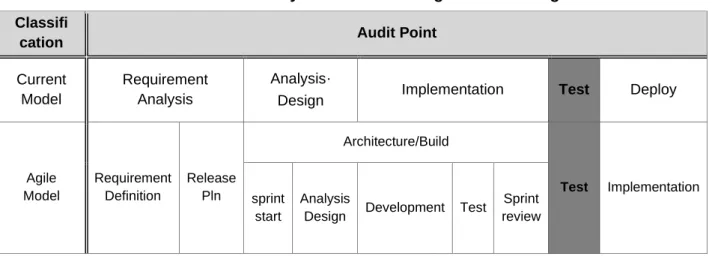
The current information system audit model plans and proceeds step-by-step test activities according to requirements analysis, analysis, design, implementation, testing, and deployment. However, in the case of an agile-based project, it was somewhat unreasonable to apply the existing guidelines as a repetitive performance concept.
Therefore, in the research of Donghyup Kim[5], the current information system audit model was used to propose a more suitable agile methodology base. However, in the study of audit methods applying the
proposed agile methodology, however, in the case of the test activities of the agile-based audit model, the test activities of the current audit model are applied equally, and the audit of the agile- based project test activities with the concept of repetitive performance was insufficient.
Table 2. Audit Point of Test Activity of Current and Agile Methodological Audit Model
Classifi
cation Audit Point
Current Model
Requirement Analysis
Analysis·
Design Implementation Test Deploy
Agile Model Requirement Definition Release Pln Architecture/Build Test Implementation sprint start Analysis
Design Development Test
Sprint review
3.2 Audit Domain
The agile-based test activity audit model proposed in this study is based on the agile methodology audit model proposed in Kim Donghyup's study[5], and is based on the test activities of each stage (unit test, acceptance test, integrated test, system test (performance test, load test) written by Dean Leppingwell [6] was applied. That means the functional implementation of the user story is completed for each repeated sprint, so the acceptance test after the unit test was presented [6].
In the release plan, system conversion plan, unit test plan, and sprint initiation and analysis at the architecture/construction stage are added in the release plan as a step-by-step test activity according to the audit point. System test plan and acceptance test plan are added in design, and unit test, acceptance test, and integrated test plan are added in development, test and sprint review stage. In the test stage, integrated test and system test were added, and in the implementation stage, performance test and load test were added, and system conversion test activities were proposed.
3.3 Test activity audit improvement check items
Audit of test activities is the last step to check the quality of information system development audit, so it is a very important step to ensure the reliability and efficiency of the information system. The step-by-step inspection items of the agile methodology-based test activity audit model were efficiently reflected in accordance with the agile characteristics based on the existing information system audit and inspection manual v3.0.
In the test stage, an integrated test and a system test were proposed so that components and subsystems were integrated into one system, and basic functional operations were performed normally in the actual product environment.
Table 3. Audit improvement check items of test stage [7-9]
Check items Task Remarks
Has a test environment reflecting the operating environment been established?
. Appropriateness of the test plan
.Preparation status of test data
.Applied system preparation status Was the integrated test properly conducted
according to the plan?
․Appropriateness of test scope
․Accuracy of test results
․Comply with test procedures Was improvement and regression tests
conducted according to the results of the integrated test?
․Defect resolution and regression test
․Retest that meets the requirements
Addition
Was the linkage between internal and external systems secured through integrated testing?
․Integrity of internal/external linkage
․Completeness of user interface
․Integrity of data verification function Has the system test been conducted properly
according to the plan?
․Appropriateness of load level
․Accuracy of test results
․Comply with test procedures Has performance, availability and security
been verified through system testing?
․Performance satisfaction . Availability satisfaction
․Satisfaction with security Was improvement and regression test
conducted according to the system test result?
․Accuracy of test results
․Comply with test procedures
Addition
Have you managed and improved the test results?
․Appropriateness of managing scenarios, data, and results by test type
․Improve errors according to test results Has the system been optimized by reflecting
the results of the integrated test and system test?
․Performance tuning target selection, method, schedule planning
․Performance improvement optimization
․ Performance evaluation before and after tuning
Does integration tests, components and subsystems are integrated into normal operation?
․Appropriateness of completed implementation functions
․Integrated build execution
Addition
Are system users and operating instructions properly prepared?
․ Equipment management, backup and recovery policy/method
․Sufficiency in explaining how to use the implementation function
․Realization of the contents of the guidelines
․Securing user's education, understanding and convenience of use
c
Among the inspection items in the test stage, the regression test is an inspection item that is not found in the existing information system supervision manual and is mainly used in the field. The regression test is a method of rerunning the previous execution test and checking whether errors that were corrected before are reproduced. It is an item that must be checked when testing agile of repetitive concepts.
4. VERIFICATION OF IMPROVEMENT PLAN
according to the agile methodology-based test activity audit improvement plan proposed in this paper, it is intended for IT industry workers with experience in project construction by applying an audit and agile methodology. As a result, an objective questionnaire was conducted.
4.1 Survey method and sample respondent composition
The subjects of the survey were auditors who have experience in audit belonging to the supervisory agency and IT experts working at information system construction companies.
A total of 38 people were sent via e-mail, paper questionnaire, and online questionnaire, and an explanation of the agile development methodology was included in the questionnaire data to enhance the level of discrimination of the sample group.
The survey targets were selected as shown in Table 4, and auditors (34.2%), project managers (18.4%), developers (26.3%), analysts and designers (7.8%), database and infrastructure managers (2.6%), customers (7.8%), and business operators (2.6%).
Table 4. Sample subject characteristics
Auditor Project
Manager Developer
Analysist Designer
DBA
Infra Customer Company Total
Count 13 7 10 3 1 3 1 38
Ratio(%) 34.2% 18.4% 26.3% 7.8% 2.6% 7.8% 2.6% 100%
Table 5 is the result of a questionnaire on the suitability of the improvement model when auditing the testing activities of agile-based projects, and the test activity area is appropriate for the test activity improvement model at the stages of unit test/acceptance test/integrated test/system test. More than 80% of the inquiries responded with an opinion that it was appropriate, and 15.7% of the respondents responded normally, indicating that it is suitable as a test activity audit model for agile-based projects.
Table 5. Improvement model suitability survey result
Very
suitable Suitable Usual Unsuitable
Very unsuitable
Count 15 16 6 1 0
Ratio (%) 39.4% 42.1% 15.7% 2.6% 0%
4.2 Survey results on test activity check items
Table 6 is the result of the questionnaire on the integrated test and system test in the test stage, and more than 70% of the respondents answered that it is appropriate. In addition, more than 80% of the respondents were found to be suitable or very suitable as a result of the questionnaire on improvement and regression tests according to the results of the integrated test, improvement and regression tests according to the system test results, and the integrated tests and component tests. In addition, it was evaluated as suitable as an improvement model and inspection items for supervision of test activities in the test stage.
Table 6. Result on the improvement and inspection items at the test stage
Check Items Very
suitable Suitable Usual Unsuitable
Very unsuitable
Mean/ SD Has a test environment reflecting the
operating environment been established? 0 (0%) 1 (2.6%) 5 (13.1%) 19 (50%) 13 (34.2%) 4.16 (0.75) Was the integrated test properly
conducted according to the plan?
0 (0%) 0 (0%) 5 (13.1%) 17 (44.7%) 16 (42.1%) 4.29 (0.69) Was improvement and regression
tests conducted according to the results of the integrated test?
0 (0%) 1 (2.6%) 4 (10.5%) 21 (55.2%) 12 (31.5%) 4.16 (0.72) Was the linkage between internal and
external systems secured through integrated testing? 0 (0%) 0 (0%) 8 (21%) 16 (42.1%) 14 (36.8%) 4.16 (0.75) Has the system test been conducted
properly according to the plan? (0%) 0 (0%) 0 (15.7%) 6 (52.6%) 20 (31.5%) 12 (0.68) 4.16 Has performance, availability and
security been verified through system testing? 0 (0%) 0 (0%) 5 (13.1%) 23 (60.5%) 10 (26.3%) 4.13 (0.62) Was improvement and regression
test conducted according to the system test result?
0 (0%) 0 (0%) 6 (15.7%) 16 (42.1%) 16 (42.1%) 4.26 (0.72) Have you managed and improved the
test results? 0 (0%) 0 (0%) 4 (10.5%) 20 (52.6%) 14 (36.8%) 4.26 (0.64) Has the system been optimized by
reflecting the results of the integrated test and system test?
0 (0%) 1 (2.6%) 4 (10.5%) 24 (63.1%) 14 (36.8%) 4.08 (0.67) Does integration tests, components
and subsystems are integrated into normal operation? 0 (0%) 1 (2.6%) 6 (15.7%) 22 (57.8%) 9 (23.6%) 4.03 (0.72) Are system users and operating
instructions properly prepared?
1 (2.6%) 0 (0%) 7 (18.4%) 20 (52.6%) 10 (26.3%) 4.00 (0.84)
5. CONCLUSION
In the case of an agile-based project, when audit is performed, it is somewhat inadequate to conduct comprehensive inspection and evaluation on the establishment and operation of information systems by performing audit only with audit and inspection elements provided by the existing information system audit. In particular, a large part of the system development area can be applied to the audit, but in the case of the test activity area, the existing supervision system is applied, so we studied the improvement of test activity audit check items to comprehensively check the agile-based development process. To this end, a research model was presented for the improvement of testing activities of the agile methodology audit model by emphasizing the repetition concept, a characteristic of the agile methodology. In order to verify the research model of this study, a survey was conducted on supervisors and designers/developers who have experience in performing agile-based projects and auditing information systems. When auditing test activities for agile-based projects, it was found that effective audit of agile-based test activities was possible by improving
and applying step-by-step inspection items according to the improvement model. It is possible to find out a number of improvements in advance for potential risks by conducting testing activities at the time of functional implementation of the user story for each repetitive sprint. Through this, the company that conducts the information system audit recognizes the concept of repetitive sprints, a characteristic of agile when conducting the audit of test activities, checks whether the test plan, test execution, and test management are appropriately performed in each step, and the quality of information systems can be improved and the failure rate can be reduced
REFERENCES
[1] S. Kee, N.H. Kim, D.H. Lee, and H. In, “A Scrum Development Process of an Agile Methodology using
Concurrent Testing,” Journal of Information Science Society: Software and Applications, Vol.39, No.2, pp.84-90, Feb, 2012
[2] Y.D. Kim, Requirements tracking method using matrix in agile development process, Master’s Thesis,
Graduate School of Chonnam National University, 2013
[3] G.R. Kim, A Study on Improvement of Audit Procedures and Inspection Items for Agile Methodology-based Projects, Master’s Thesis, Graduate School of Information and Communication Technology, Ajou University, 2012
[4] K.O. Kim, and H.Y. Yoo, “An Evaluation of Software Development Methodology Applicability at Medium and Small Business through AHP,” Journal of the Society for Information Processing. Software and data engineering, Vol.2, No.10, pp.691-696, 2013
[5] D.H. Kim, D.S. Kim, C. Koh, and H.W. Kim, “An Information System Audit Model for Project Quality Improvement by the Agile Methodology,” International Journal of Information and Education Technology, Vol. 3, No. 3,pp. 295-299, June 2013
[6] Dean Leffingwell, Scaling Software Agility: Best Practices for Large Enterprises, 2008.
[7] D.A. Park, and M.G. Park, ”A Study on the Quality Improvement of Information System Auditing for Agile Methodology,” Journal of Korea Multimedia Society, Vol. 20, No. 4, pp.660-670, April 2017 https://doi.org/10.9717/kmms.2017.20.4.660
[8] National Information Society Agency, Information System Audit Inspection Manual V3.0, National Information Society Agency, 2008
[9] K.H. Cho, Improvement of test activities audit for information system construction, Master’s Thesis, Graduate School of Konkuk University, 2012
![Table 3. Audit improvement check items of test stage [7-9]](https://thumb-ap.123doks.com/thumbv2/123dokinfo/4880466.34775/5.892.88.806.146.945/table-audit-improvement-check-items-test-stage.webp)


