1. INTRODUCTION
Synchronization phenomena in coupled chaotic systems have been extensively studied during the last decade due to its theoretical challenge and its great potential applications in secure communications, chemical reactions and modeling brain activity [1-3]. However, some many synchronization methods require several controllers to realize synchronization. The linearly error feedback coupling scheme can be adopted in many real fields, due to its simple configuration and easy implementation. According to the condition of coupling signals, they can be classified into bidirectional [4-6] and unidirectional [7-9].
The objective of the synchronization is that the error states of two chaotic systems are asymptotically stable in the Lyapunov sense. In this paper by using Lyapunov stability theorem and linear matrix inequality, we stabilize the error between chaotic drive and response systems at the origin, via unidirectional and bidirectional linear feedback approaches.
The paper is organized as follows. In Section 2, based on Lyapunov stability theorem and linear matrix inequality, the coupling parameters for linearly bidirectional coupled chaotic systems are derived. In Section 3, these methods are applied to a coupled modified Chua’s circuits. Numerical simulations are carried out in Section 4 for illustration and verification of the methods. Finally some concluding remarks are given in Section 5.
2. CHAOS SYNCHRONIZATION WITH
BIDIRECTIONAL OR UNIDIRECTIONAL
COUPLING
In order to observe the synchronization behavior, we consider two identical n -dimensional chaotic systems (which are called derive and response systems). The initial conditions of the systems are different. The drive and response systems are described by Equations (1) and (2) respectively. The third term of the right hand side has been added to the systems dynamics for the control design purposes.
) ( ) (x K1 y x f Ax x&= + + − (1) and ) ( ) (y K2 x y f Ay y&= + + − (2) n n R A∈ × is a constant matrix, n n R R f: → is a continuous
nonlinear function, K and 1 K2 are diagonal matrices
which are used as the feedback gains to be calculated.
Considering e=y−x and f(y)−f(x)=Mx,ye, error dynamics can be written as:
e K K M A e&=( + x,y−( 1+ 2)) (4)
Since a chaotic system has bounded trajectories, )
, (
, M x y
Mxy = is a bounded matrix.
The following theorem [10] gives the sufficient condition for system (4) to be globally stable.
Theorem 1. If there exists a positive definite symmetric
constant matrix P and a constant ε>0, such that
I K K M A P P K K M A xy T y x − + + + − + <−ε + ( )) ( ( )) ( , 1 2 , 1 2 (5)
uniformly for any x and y , where I is the identity matrix, the error dynamics system (4) is globally stable, i.e., system (1) and (2) are synchronized.
Proof. Consider the following Lyapunov function
) ( ) ( ) (t e t Pet V = T
Calculating its derivative, we have
0 ))) ( ( )) ( (( )) ( ( )) ( ( 2 1 , 2 1 , 2 1 , 2 1 , < − ≤ + − + + + − + = + − + + + − + = + = e e e K K M A P P K K M A e e K K M A P e Pe K K M A e e P e Pe e V T y x T y x T T y x T T y x T T T ε & & &
for all e(t)≠0. So, the theorem is proved.
With respect to Theorem 1, the result can be simplified as the condition of unidirectional coupling chaos systems when
0
1=
K or K2 =0.
In theorem 2 [11] the sufficient condition for system (4) to be globally asymptotically synchronized, is discussed.
Theorem 2. If there exists the feedback gain matrices K1
and K2 such that
0 )) ( ( , 1 2 0 0 + − + =−∞ ∀ ≥
∫
+∞ A M K K dt t t µ xyChaos Synchronization Using Error Feedback Coupling
Behzad Khademian, and Mohammad Haeri
Advanced Control System Lab., Department of Electrical Engineering, Sharif University of Technology, Tehran, Iran (Tel : +98-21-616-5971; E-mail: [email protected])
(Tel : +98-21-616-5964; E-mail: [email protected])
Abstract: This paper presents synchronization of two identical Modified Chua’s circuits using two strategies of error feedback
coupling. In the first method the synchronization is achieved by linear unidirectional and in the second one by linear bidirectional error feedback coupling. Both proposed methods can make the states of the Modified Chua’s circuits globally asymptotically synchronized. Numerical results are provided to show the effectiveness of the proposed approaches and to compare them together based on different criteria.
uniformly for all x , y , then the error dynamical system (4) is globally asymptotically stable at the origin, implying that the two systems (1) and (2) are globally asymptotically synchronized.
) (∗
µ denotes the matrix measure derive from the matrix
norm ∗ .
Corollary 1. The two systems (1) and (2) are globally
asymptotically synchronized, if there exists the feedback gain matrix K=K1+K2 such that at lease one of the following
conditions is satisfied. i)
∫
+ − +∑
+ =−∞ ≠ = +∞ dt y x M a K y x M a n j i i ij ij j jj jj t maxj ( ( , ) ( , )) , 1 0 ii)∫
+ − +∑
+ =−∞ ≠ = +∞ dt y x M a K y x M a n i j j ji ji i ii ii t maxi ( ( , ) ( , )) , 1 03. SYNCHRONIZATION OF MODIFIED CHUA’S
CIRCUIT
In this section we apply the above techniques to modified Chua’s circuit described by [12];
y q z z y x y x x x f x f y p x − = + − = − = − = & & & ( ( )), ( ) 2 3 7 (6)
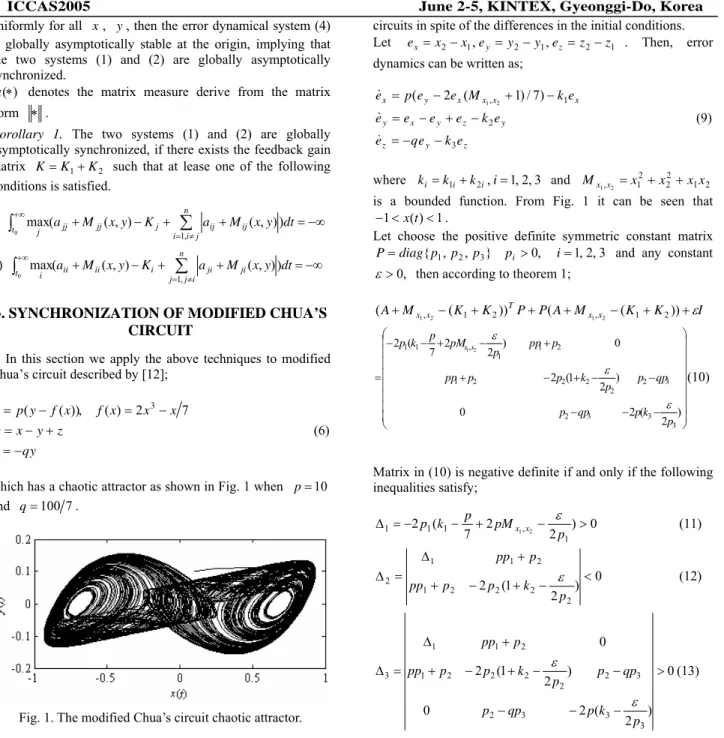
which has a chaotic attractor as shown in Fig. 1 when p=10 and q=1007.
Fig. 1. The modified Chua’s circuit chaotic attractor. We have two modified Chua’s circuits where the drive system with three state variables denoted by the subscript 1 drives the response system having identical equations denoted by the subscript 2. However, the initial condition on the drive system is different from that of the response system. The two modified Chua’s circuits with linearly bidirectional coupling are described, respectively, by the following equations.
) ( ) ( ) ( ) 7 / ) 2 ( ( 1 2 13 1 1 1 2 12 1 1 1 1 1 2 11 1 3 1 1 1 z z k y q z y y k z y x y x x k x x y p x − + − = − + + − = − + − − = & & & (7) ) ( ) ( ) ( ) 7 / ) 2 ( ( 2 1 23 2 2 2 1 22 2 2 2 2 2 1 21 2 3 2 2 2 z z k y q z y y k z y x y x x k x x y p x − + − = − + + − = − + − − = & & & (8)
Where )kij (i=1,2;j=1,2,3 are coupling parameters that to be determined in order to synchronize two modified Chua’s
circuits in spite of the differences in the initial conditions. Let ex=x2−x1,ey=y2−y1,ez=z2−z1 . Then, error
dynamics can be written as;
z y z y z y x y x x x x y x e k e q e e k e e e e e k M e e p e 3 2 1 , 1)/7) ( 2 ( 1 2 − − = − + − = − + − = & & & (9) where ki =k1i+k2i,i=1,2,3 and Mx1,x2 =x12 +x22+x1x2
is a bounded function. From Fig. 1 it can be seen that 1
) ( 1< <
− xt .
Let choose the positive definite symmetric constant matrix }
, , {p1 p2 p3 diag
P= pi >0, i=1,2,3 and any constant
, 0 >
ε then according to theorem 1;
I K K M A P P K K M A x x T x x − + + + − + +ε + ( )) ( ( )) ( 1,2 1 2 1,2 1 2 ⎟ ⎟ ⎟ ⎟ ⎟ ⎟ ⎟ ⎟ ⎠ ⎞ ⎜ ⎜ ⎜ ⎜ ⎜ ⎜ ⎜ ⎜ ⎝ ⎛ − − − − − + − + + − + − − = ) 2 ( 2 0 ) 2 1 ( 2 0 ) 2 2 7 ( 2 3 3 3 2 3 2 2 2 2 2 1 2 1 1 , 1 1 12 p k p qp p qp p p k p p pp p pp p pM p k p xx ε ε ε (10)
Matrix in (10) is negative definite if and only if the following inequalities satisfy; 0 ) 2 2 7 ( 2 1 , 1 1 1=− − + 1 2 − > ∆ p pM p k p x x ε (11) 0 ) 2 1 ( 2 2 2 2 2 1 2 1 1 2 + − + − < + ∆ = ∆ p k p p pp p pp ε (12) 0 ) 2 ( 2 0 ) 2 1 ( 2 0 3 3 3 2 3 2 2 2 2 2 1 2 1 1 3 > − − − − − + − + + ∆ = ∆ p k p qp p qp p p k p p pp p pp ε ε (13)
By calculating the above determinants we can extract the following inequalities to get the values of ki=k1i+k2i,
3 , 2 , 1 = i ; 1 , 1 7 2pM 1 2 2p p k > − x x + ε (14) 1 2 ) 2 2 7 ( 4 ) ( 2 1 , 1 2 1 2 2 1 2 2 1 − + − + − + < p p pM p k p p p pp k x x ε ε (15) 3 2 2 1 2 2 2 1 3 2 1 3 2 )) 2 1 ( 2 ) (( 2 ) ( p p k p p pp p qp p k ε + ε − + ∆ − + − ∆ > (16)
According to Theorem 2 and Corollary 1 there is a more simple procedure for choosing the feedback gain matrices K 1
⎟⎟ ⎟ ⎟ ⎠ ⎞ ⎜⎜ ⎜ ⎜ ⎝ ⎛ − − − − − + − = + − + 3 2 1 , 2 1 , 0 1 1 1 0 7 / ) 1 ( 2 ) ( 2 1 2 1 k q k p k M p K K M A x x x x (17)
Now we can choose ki=k1i+k2i,i=1,2,3 such that 0 } , 1 , 7 / ) 1 ( 2 max{− pMx1,x2+ −k1+p −k2+ q−k3 < (18) or 0 } 1 , 1 , 1 7 / ) 1 ( 2 max{− pMx1,x2+ −k1+ p− −k2+q −k3 < (19)
So the two coupled modified Chua’s circuits are globally asymptotically synchronized.
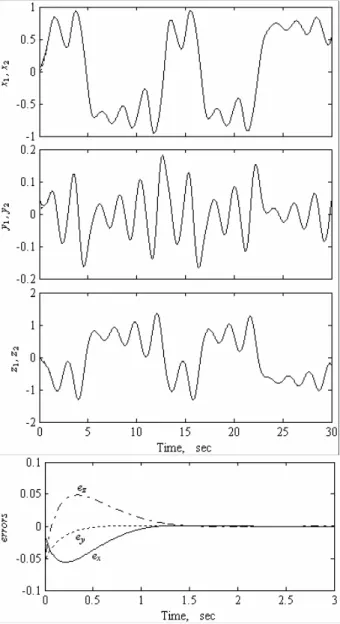
Fig. 2. Synchronization of linearly bidirectional coupled modified Chua’s circuits.
4. NUMERICAL RESULTS ES
To verify the effectiveness of the proposed synchronization approaches, we did some numerical simulations. The initial
values of drive system and response system in all simulations are taken (x1(0)=0.02,y1(0)=0.05, z1(0)=0.04) and
0002 . 0 ) 0 ( (x2 = y2(0)=0.0005, z2(0)=0.0004)
respectively. Due to the Theorem 1 and by selecting } 1 , 1 , 1 { diag
P= , ε=0.01 and the systems parameters
10 =
p and q=100/7, we can choose coupling parameters ,
2
21 11= k =
k k12= k22=3, k13= k23=1 which can
satisfy the inequalities (14), (15) and (16). The synchronized states of the drive and response systems and error trajectories are shown in Fig.2.
Selecting the matrix K2=0, the unidirectional coupled modified Chua’s circuits can be synchronized by choosing
, 2
11=
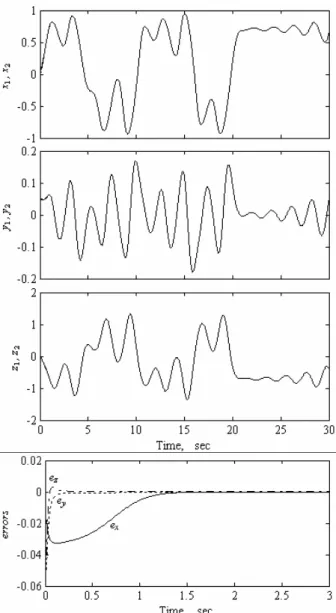
k k12 =3, k13=1. As it is shown in Fig. 3, the states
of two uncertain modified Chua’s circuits are synchronized. Due to the inequalities (18) or (19) for unidirectional method, we can choose K2 =0, k11=1, k12 =30, k13=30. The
simulation results are shown in Fig.4.
Comparing Figs. 3 and 4, we can see that with larger values of coupling parameters, the states are being synchronized more quickly.
Fig. 3. Synchronization of linearly unidirectional coupled modified Chua’s circuits.
To verify the robustness of the proposed methods in presence of noise, white Gaussian noise with mean 0 and variance 010. is added to the drive system states. The coupling parameters are taken k11= k21=2, k12= k22=3,
1
23 13= k =
k in bidirectional coupling and K2=0 ,
, 2
11=
k k12=3, k13=1 in unidirectional coupling. As it
is shown in Figs. 5 and 6, both methods are stable and the error values are bounded.
5. CONCLUSION
In this paper the unidirectional and bidirectional synchronization methods have been developed and applied to a coupled modified Chua’s circuits. Based on Lyapunov stability theorem and linear matrix inequality the values of coupling parameters are derived. Finally the numerical results are presented to verify and to compare the proposed methods.
ACKNOWLEDGMENTS
The authors gratefully acknowledge financial support from Iran Communication Research Center.
Fig. 4. Synchronization of linearly unidirectional coupled modified Chua’s circuits with large value of coupling
parameters.
Fig. 5. Synchronization of linearly unidirectional coupled modified Chua’s circuits in presence of noise.
Fig. 6. Synchronization of linearly bidirectional coupled modified Chua’s circuits in presence of noise.
REFERENCES
[1] Ott E, Grebogi C, Yorke J.A., “Controlling chaos”, Phys Rev. Letters, Vol. 64, pp. 1196-1199, 1990.
[2] Carroll TL, Pecora LM., “Synchronizing chaotic circuits”, IEEE Trans. Circuit and System I, Vol. 38, pp. 453-456, 1991.
[3] Chen G, Dong X., “From chaos to order: methodologies, perspectives and applications”, Singapore: World Scientific; 1998.
[4] Suykens JAK, Yang T, Chua LO, “Impulsive synchronization of chaotic Lur’e systems by measurement feedback”, Int. J. Bifurcation and Chaos, Vol. 8, No. 6, pp. 1371–1381, 1998.
[5] Boccaletti S, Kurths J, Osipov G, Valladares DL, Zhou CS, “The synchronization of chaotic systems”, Phys Rep 2002;366:1–101.
[6] Tsay S, Huang C, Qiu D, Chen W, “Implementation of bidirectional chaotic communication systems based on Lorenz circuits”, Chaos, Solitons & Fractals 2004;20(3):567–79.
[7] Suykens JAK, Vandewalle J., “Master–slave synchronization of Lur’e systems”, Int. J. Bifurcation Chaos 1997; 7(3):665–9.
[8] Jiang GP, Tang W. A, “Global synchronization criterion for coupled chaotic systems via unidirectional linear error feedback approach”, Int. J. Bifurcation and Chaos 2002; 12(10):2239–53.
[9] Jiang G, Tang W, Chen G., “A simple global synchronization criterion for coupled chaotic systems”, Chaos, Solitons & Fractals, 2003, 15(5), pp. 925–35. [10] Yu Y, Zhang S, “The synchronization of linearly
bidirectional coupled chaotic systems”, Chaos, Solitons & Fractals, 2004, 22, pp. 189–97.
[11] Zhang Y., Sun J., “Some simple global synchronization criterions for coupled time-varying chaotic systems”, Chaos, Solitons and Fractals, 2004 19, 93–98
[12] T.T. Hartley, “The duffing double scroll”, in: Proceedings of the American Control Conference, Pittsburgh, PA, June 1989, pp. 419–423.