1. INTRODUCTION
Holographic Data Storage System[1], one of the next generation data storage principle, is a 2-dimensional page oriented memory using volume hologram in writing and retrieving process. In the HDS system, data management procedure is performed in parallel so fast data transfer rate can be realized. And the system store data in binary form (0 or 1), so that computers can use the digital data directly. In writing procedure, Laser of specific wavelength passes through a Spatial Light Modulator (SLM) to make 2-dimensional data page. A digital data 0 makes image of a black pixel (off-pixel) by blocking the light on SLM and digital data 1 is imaged as a white pixel (on-pixel) on CCD camera.
Diffraction, the nature of light, makes the laser which passes through an on-pixel surrounded by off-pixels on SLM to affect surrounding pixels by 2-dimensional Fourier Transform of a plane wave and when retrieving process the effects to surrounding pixels of an on-pixel are photographed by CCD camera and cause errors to binary data.
In this paper, we generate fuzzy rules by substractive clustering and genetic algorithm. The recording and reconstruction system used fuzzy rules. The fuzzy rule parameter variable be find most suitable parameter by substractive clustering and genetic algorithm. Figure.1 is the HDDS system experiment test bed.
G
Fig.1 HDDS system experiment Test bed
2. FUZZY THOERY AND CLUSTERING ALGORITHM
2.1 Clustering algorithm
Subtractive clustering[5] can identify fuzzy system models according to determining cluster centers from numerical input-output data. The number of cluster centers corresponds to the number of fuzzy rules. If we consider the Sugeno-type fuzzy model, the parameters are also determined from the clustering algorithm. The clustering algorithm calculates the potential values Pi from N normalized data obtained
from the input-output product-space.
2 1 2 ,) 4/ || || exp( a N k i k i a x x a r P =
∑
− − = = (1) Yet , i=1 L, ,Nand ra is a positive constant to set data far apart from a cluster center not to have influence on the potential value. The first cluster center *1
x corresponds to the
Holographic Data Storage System using prearranged plan table by fuzzy rule
and Genetic algorithm
Jang-Hyun Kim*, Sang-Hoon Kim**, Hyun-Seok Yang***, Jin-Bae Park*** and Young-Pil Park***
* Department of Electrical Engineering, Yonsei University, Seoul, Korea (Tel : +82-2-2123-4677; E-mail: [email protected]) **Department of Mechanical Engineering, Yonsei University, Seoul, Korea
(Tel : +82-2-2123-4677; E-mail: [email protected])
Abstract: Data storage related with writing and retrieving requires high storage capacity, fast transfer rate and less access time. Today any data storage system cannot satisfy these conditions, however holographic data storage system can perform faster data transfer rate because it is a page oriented memory system using volume hologram in writing and retrieving data. System can be constructed without mechanical actuating part therefore fast data transfer rate and high storage capacity about 1Tb/cm3 can be realized. In this research, to reduce errors of binary data stored in holographic data storage system, a new method for bit error reduction is suggested. First, find fuzzy rule using experimental system for Element of Holographic Digital Data System. Second, make fuzzy rule table using Genetic algorithm. Third, reduce prior error element and recording Digital Data. Recording ratio and reconstruction ratio will be very good performance
Keywords: Holographic, Subtractive Clustering, Fuzzy rule , Data Storage, Genetic algorithm
ICCAS2005 June 2-5, KINTEX, Gyeonggi-Do, Korea
ICCAS2005 June 2-5, KINTEX, Gyeonggi-Do, Korea
largest potential value *
i
P . The second cluster center is calculated after removing the effect of the first cluster center. Eq. 2 shows how to remove the effect of the first cluster center. The second cluster center *
2
x corresponds to the largest potential value of ' i P. 2 2 * ' exp( || || ), 4/ a k i i i i P P x x r P = − −β − β = (2)
Positive constant
r
b prevents cluster centers to assemble to close. This process repeats until potential values reach a fixed limit( ε
ε
,
)
.Cluster centers
{
x
1*,
x
2*,
K
,
x
*M}
determine M fuzzy rules. They also determine the center position of input membership functions. Widths of membership functions are fixed according to experience. The parametersin i
i a a
a0, 1,K, can be optimized by linear least squares estimation[5] or adaptive training algorithms.ٻ
Step 1 : Normalize all data from 0 to 255 Step 2 : Calculate the potential of each data
Step 3 : Determine the largest potential value of P as i
*
i
P , and determine the data related with *
i
P as the first cluster center *
1
X
Step 4 : Calculate potential value '
i
P except for effect of the first cluster center
Step 5 : Determine the largest value of '
i
P as *
2
P , and determine the data related with *
2
P as the second cluster center *
2
X . Generally calculate potential value '
i
P after removing the k th cluster center *
k
X and determine the data for the largest potential value as cluster center *
1 k
X + . Step 6 : Stop iterating if * *
1 / k P P ≤ε. If * * 1 / k P P ≥ε, or * * 1 / k P P >ε and * min * 1 1 k a P d P
γ + ≥ than determine that as cluster center and repeat Step 5. If * *
1 / k P P >ε and * min * 1 1 k a P d P
γ + < than set the
* k
X as 0 and after determining the second largest potential value, determine that data as the new cluster center if
* min * 1 1 k a P d P γ + ≥ and repeat Step 5.
2.2 Fuzzy rules generated from clustering
Sugeno fuzzy system model[5] is used to represent fundamental rules of decimal data of image(BMP). The
MISO type fuzzy rules are of the form given in Eq. 3.
i ni i i I in n i i x a x a a y THEN A is x and and A is x and A is x IF + + + = L L 1 1 0 2 2 1 1 (3) ij
A is Gaussian membership functions for input fuzzy variables, coefficients
a
0i,
a
1i,
L
,
a
ni determine the output of the fuzzy system. Fuzzy modeling process based on the clustering of input-output data determines the centers of the membership functions for antecedent fuzzy variables.In order to develop the fuzzy model, input-output data are obtained from the group behavior algorithms. Fuzzy rules for digital data of image are generated from clustering the input-output data. We obtained input-ouput data for image and image is 10800 by 8(8bit)
After clustering the data, 6 cluster centers and therefore 6 fuzzy rules are obtained for binary data of image. The 6 fuzzy rules for digital data are of the form:
k BR k BL k TR k TL sum i k BR i k BL i k TR i k TL
D
b
D
b
D
b
D
b
b
D
then
A
is
D
A
is
D
A
is
D
A
is
D
IF
4 3 2 1 0 4 3 2 1,
,
,
+
+
+
+
=
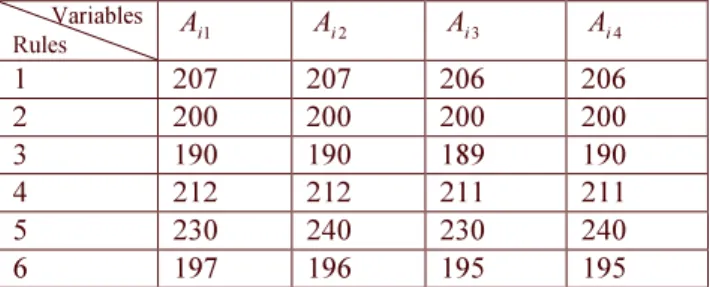
(4) ) 6 , , 3 , 2 ,1 (i= L sumD indicates Sum of D ,TL D ,TR D and BL DBR . Table 1 shows the 6 cluster centers and therefore the center locations of the 6 fuzzy rules. Gaussian input membership functions are shown in Fig. 3.
Table 1 Center locations of the input membership functions Variables Rules A i1 A i2 A i3 A i4 1 207 207 206 206 2 200 200 200 200 3 190 190 189 190 4 212 212 211 211 5 230 240 230 240 6 197 196 195 195 2.3 Genetic algorithm
In general, the design of fuzzy logic controllers has difficulties in the acquisition of expert’s knowledge and relies to a great extent on empirical and heuristic knowledge which, in many cases, cannot be objectively justified. To solve these problems, the proposed method using genetic algorithms in this paper, can turn the optimum parameters of fuzzy logic
ICCAS2005 June 2-5, KINTEX, Gyeonggi-Do, Korea
controller including scaling factors and determine the
appropriate number of fuzzy rules systematically and automatically.
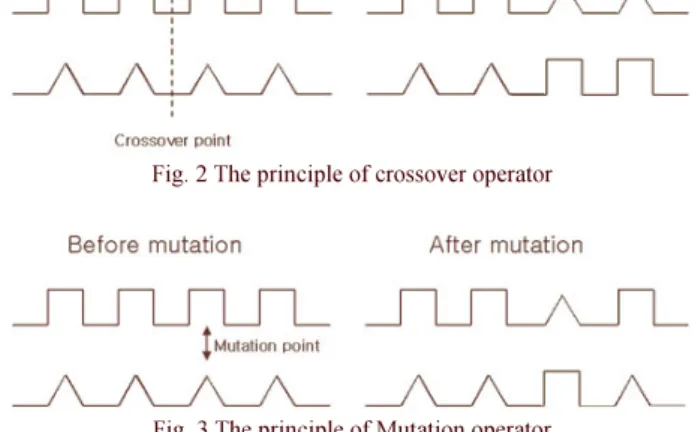
Main operators of Genetic algorithm are reproduction, crossover and mutation operator. Fig.2 and Fig.3 shows the main operators of genetic algorithm
Fig. 2 The principle of crossover operator
Fig. 3 The principle of Mutation operator
Genetic algorithm turning parameter of fuzzy system, optimal numbers of fuzzy rules and system performance
3. SIMULATIONS
To Generate fuzzy rules by subtractive clustering and genetic algorithm in simulation.
Fig. 4 Simulation using Lenna Picture
The picture wanted to be stored is the Lenna picture in figure 3. Size of the picture is 120x90 pixels and 256 level gray-scaled.
(a) Membership function for Top-left image pixel
(b) Membership function for Top-right image pixel
(c) Membership function for Bottom-left image pixel
ICCAS2005 June 2-5, KINTEX, Gyeonggi-Do, Korea
(d) Membership function for Bottom-right image pixel Fig. 5 Membership function
Fig. 5 is Gaussian input membership functions.
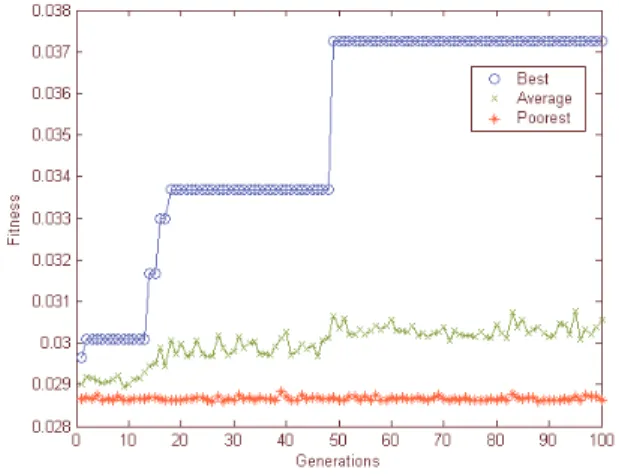
Fig. 6 Fitness values of genetic algorithm
For fitness function, Fig.6 shows transformation of generation. In this paper, fitness function used an equation (5),(6)
∑
= =rulenumber n n e x 0 2 (5) ) 1 ( 1 ) (x x ffitness = + (6)The Best is best parameter and The Poorest is bad parameter. The Maximum generation is 100 generation, Maximum rules number is 20, Minimum rules number is 5, the Population size is 50, the Crossover ratio is 0.6 and the Mutation ratio is 0.2
Fig. 7 reconstructed picture using fuzzy rules
Fig.7 is decimal data of input data. 4 input data and 1 ouput data. The results have successfully for recording and recovery by fuzzy rules.
4. CONCLUSIONS
This paper researched Holographic Digital Data Storage and intelligence recording systems. It has discussed fuzzy rule by substractive clustering and genertic algorithm. The proposed idea is new technology and the early stage of HDDS.
The experimental results have successfully validated the theoretical discussion.
ACKNOWLEDGMENTS
This research was supported by the MOCIE (Ministry of Commerce, Industry and Energy) of Korea through the program for the Next Generation Ultra-High Density Storage (00008145) and the Korea Science and Engineering Foundation (KOSEF) through the Center for Information Storage Device (CISD) Grant No. R11-1997-042-11002-0.
REFERENCES
[1] R. C. Baker and B. Charlie, “Nonlinear unstable systems,” International Journal of Control, Vol. 23, No. 4, pp. 123-145, 1989.
[2] G.-D. Hong, “Linear controllable systems,” Nature, Vol. 135, pp. 18-27, 1990.
[3] K. S. Hong and C. S. Kim, “Linear stable systems,” IEEE Trans. on Automatic Control, Vol. 33, No. 3, pp. 1234-1245, 1993.
[4] Z. Shiler, S. Filter, and S. Dubowski, “Time optimal paths and acceleration lines of robotic manipulators,” Proc. of the 26th Conf. on Decision and Control, pp. 98-99, 1987.
[5] R. Yager and D.Filev, Essentials of Fuzzy Modeling and Control, John Wiley and Sons, 1994.
[6] M. Young, The Technical Writer’s Handbook, Mill Valley, Seoul, 1989.