ORIGINAL ARTICLE
Poor correlation between tuberculin skin tests and
interferon-
g assays in close contacts of patients with
multidrug-resistant tuberculosis
KYUNG-WOOKJO,1KYEONGMANJEON,2YOUNGAEKANG,3WON-JUNGKOH,2KYUNG CHANKIM,4 YEEHYUNGKIM,5KWANGHAYOO,6SEUNGHEONLEE,7JAE-JOONYIM,8SANGBONGCHOI,9
WON-ILCHOI,10JAECHOLCHOI,11YONGILHWANG12AND TAESUNSHIM1
1Division of Pulmonary and Critical Care Medicine, University of Ulsan College of Medicine, Asan Medical Center,2Division of Pulmonary and Critical Care Medicine, Department of Medicine, Samsung Medical Center, Sungkyunkwan University School of Medicine,3Department of Internal Medicine, Yonsei University College of
Medicine,4Department of Pulmonary and Critical Care Medicine, Catholic University of Daegu Hospital, 5Department of Pulmonary and Critical Care Medicine, Kyung Hee University Hospital at Gangdong, 6Department of Pulmonary and Critical Care Medicine, Konkuk University, School of Medicine,7Division of Pulmonary and Critical Care Medicine, Department of Internal Medicine, Busan Paik Hospital, Inje University of Medicine, Busan,8Division of Pulmonary and Critical Care Medicine, Department of Internal Medicine and Lung Institute, Seoul National University College of Medicine,9Division of Respirology, Department of Internal
Medicine, Sanggye Paik Hospital, Inje University College of Medicine,10Department of Internal Medicine, Dongsan Hospital, Keimyung University School of Medicine,11Division of Pulmonary and Critical Care
Medicine, Department of Internal Medicine, Chung-Ang University School of Medicine,12Division of Pulmonary, Allergy and Critical Care Medicine, Department of Internal Medicine, Hallym University Sacred
Heart Hospital, Hallym University College of Medicine, Anyang, South Korea
ABSTRACT
Background and Objective: The results of tuberculin skin tests (TST) and QuantiFERON TB-Gold In-Tube (QFT-GIT) assays were compared in close contacts of patients with multidrug-resistant tuberculosis (MDR-TB).
Methods: Close contacts of patients with bacterio-logically confirmed MDR-TB (n= 101) were assessed.
Most contacts were members of the households of patients, and 79 (78.2%) had received Bacille Calmette-Guerin (BCG) vaccination. Samples from each contact were tested using the TST and the QFT-GIT assay on the same day, and the concordance between these results was assessed using kappa (k) coefficients.
Results: Forty-eight subjects (47.5%) showed positive responses on TST, using a 10-mm induration cut-off, and 54 (53.5%) were positive for the QFT-GIT assay. Of the 48 individuals who were TST positive, 34 (70.8%) were positive for the QFT-GIT assay. Of the 53 subjects
who were TST negative, 33 (62.5%) were negative for the QFT-GIT assay. The overall agreement between the two tests (k coefficient) was 0.33. The k coefficient was
higher in the 22 subjects who had not received BCG vaccination (k = 0.48) than in the 79 subjects who had
received BCG vaccination (k = 0.29).
Conclusion: The TST and QFT-GIT assays showed poor correlation in close contacts of patients with MDR-TB, especially those contacts who had received BCG vaccination.
Key words: close contact, interferon-g assay, multi-drug-resistant tuberculosis, tuberculin skin test.
INTRODUCTION
Multidrug-resistant tuberculosis (MDR-TB), defined as resistance to at least isoniazid and rifampicin, now Correspondence: Tae Sun Shim, Division of Pulmonary and
Critical Care Medicine, University of Ulsan College of Medicine, Asan Medical Center, 388-1 Pungnap-Dong, Songpa-gu, Seoul 138-736, South Korea. Email: [email protected]
Kyung-Wook Jo and Kyeongman Jeon contributed equally to this work.
Received 6 December 2011; Invited to revise 23 January 2012; revised 8 March 2012; accepted 21 April 2012 (Associate Editor: Chi Chiu Leung).
SUMMARY AT A GLANCE
There was a discrepancy between results of TSTs and QFT-GIT assays in close contacts of patients with multidrug-resistant tuberculosis, particularly those who had received BCG vaccination. These findings were similar to those from studies report-ing poor correlation between these tests in close contacts of South Korean patients with drug-susceptible tuberculosis.
affects all regions of the world and has become a serious threat to public health. In South Korea, which is an intermediate TB-burden country, 2.7% of patients newly diagnosed with TB in 2004 were found to have MDR-TB,1and the overall rate of treatment success in these patients was only 45.3%.2 Because about half of MDR-TB patients have unfavourable treatment outcomes and MDR-TB can continue to spread in the community, assessment of infection in close contacts of these patients is important in order to stop further transmission and to prevent new cases of MDR-TB.
In addition to the tuberculin skin test (TST), which until recently has been the only method for detecting TB infection, interferon-gamma release assays (IGRA) have emerged as a new tool for screening for TB infec-tions, and both these tests have been used in investi-gations of contacts of patients with infectious TB. However, guidelines on the use of TST or IGRA for detecting latent tuberculosis infection (LTBI) vary.3–5 Several South Korean studies comparing these assays in close contacts of patients with drug-susceptible TB have shown that these two tests generally show poor correlation.6–8
The relative transmissibility of MDR-TB and drug-susceptible TB to close contacts of patients infected with these bacteria remains unclear.9–12Moreover, few studies have compared the results from TST and IGRA in close contacts of patients with MDR-TB.13We there-fore compared TST and IGRA as methods for screen-ing for LTBI among close contacts of patients with confirmed MDR-TB.
METHODS
Subjects
A multicentre prospective cohort study to identify close contacts of patients with MDR-TB who have LTBI and active TB has started at 26 referring hospi-tals throughout South Korea since March 2010 and is expected to be completed in December 2013. Index patients were defined as those diagnosed with bac-teriologically confirmed pulmonary MDR-TB within 6 months of the time of enrolment, regardless of positivity on sputum acid fast bacilli (AFB) smear testing. Close contacts were categorized into two groups: (i) close household contacts, defined as indi-viduals who had resided in the same house as the index patient for at least 1 month during the 6 months prior to the index patient commencing anti-TB treatment; and (ii) close non-household con-tacts, defined as individuals who had spent more than eight hours per day at work with the index patient, had shared breathing space with the index patient, or were in regular, prolonged contact with the index patient.14 Close contacts who had been diagnosed with or were being treated for active TB at the time of enrolment were excluded.
For each close contact, demographic data and clini-cal history were recorded, and a physiclini-cal examina-tion, chest radiography and/or sputum AFB smear/ culture (if they produced sputum) were performed.
TST and QuantiFERON TB-Gold In-Tube assays (QFT-GIT; Cellestis Ltd, Carnegie, Victoria, Australia) were performed for each individual, at the same time on the day of enrolment, according to the study protocol. After enrolment, subjects will be followed-up every 6 months for 2 years.
The subjects for this study were selected from this cohort of contacts, and their baseline characteristics and results from the TST and QFT-GIT assays were analysed. The clinical protocol was approved by the institutional review board, and written informed consent was obtained from all patients. The trial has been registered with the Clinical Research Infor-mation Service of the Republic of Korea as KCT0000004.
Tuberculin skin tests
TSTs were performed by intra-dermal injection of two tuberculin units of purified protein derivative (PPD) RT23 (Statens Serum Institute, Copenhagen, Denmark) into the forearm using the Mantoux tech-nique.15 Reactions were evaluated 48 to 72 h after injection, with positive results being defined as indu-rationsⱖ10 mm in transverse diameter.
QuantiFERON-TB Gold In-Tube assay
The QFT-GIT assay was performed in two stages, according to the manufacturer’s instructions. One millilitre aliquots of blood were drawn directly into three evacuated blood collection tubes, one contain-ing heparin alone (negative control), one containcontain-ing T cell mitogen (positive control) and one contain-ing Mycobacterium tuberculosis-specific antigens, including early secreted antigenic target 6 (ESAT-6) and culture filtrate protein 10 (CFP-10) (TB antigen tube). Following overnight incubation, 200mL of plasma was removed from each well, and the concen-tration of interferon-gamma (IFN-g) was determined by enzyme-linked immunosorbent assay, with a posi-tive response being defined as an antigen-negaposi-tive IFN-g concentrationⱖ0.35 IU/mL.16
Statistical analyses
Concordance between the results from TSTs and QFT-GIT assays was assessed using kappa (k) coefficients, withk> 0.75 being defined as excellent agreement, k< 0.4 as poor agreement and k between 0.4 and 0.75 as fair to good agreement.6 All statistical analyses were performed using SPSS version 12.0 software (SPSS Inc., Chicago, IL, USA).
RESULTS
Characteristics of the subjects
The study cohort consisted of 101 contacts, from whom 47 were contacts of 32 TB patients who had a © 2012 The Authors
positive AFB sputum smear, and 54 were contacts of 35 TB patients who had a negative AFB sputum smear. Twenty-six (38.8%) of 67 patients with MDR-TB showed cavitary disease on chest X-ray. The mean age of the 101 contacts was 39.9⫾ 17.7 years, 69 (68.3%) were females, 79 (78.2%) had received Bacille Calmette-Guerin (BCG) vaccination and 95 (94.1%) were close household contacts (Table 1).
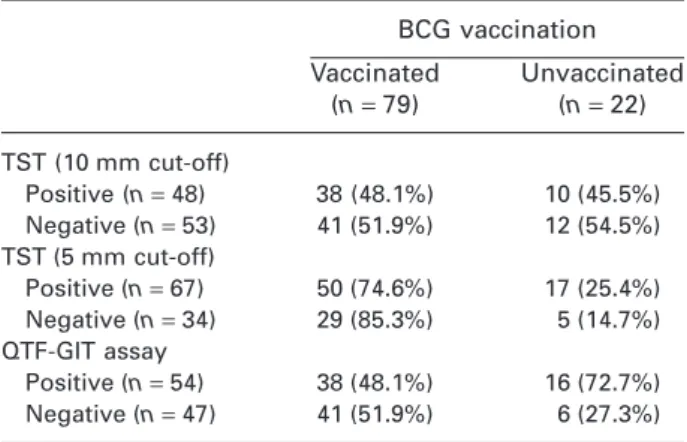
Of these 101 contacts, 48 (47.5%) were positive, and 53 (52.5%) were negative by TST. Moreover, 54 (53.5%) were positive, and 47 (46.5%) were negative by QFT-GIT assay. Of the 48 TST positive subjects, 38 (79.2%) had received BCG vaccination (Table 2). The median IFN-g concentration for subjects who were positive by QFT-GIT assay was 0.65 IU/mL (range 0.35 to 15.24) (Fig. 1). Among the four contacts with a previous history of TB, one was positive by TST, and two were positive by QFT-GIT assay.
Comparison between the TST and QFT-GIT results
Sixty-eight individuals (67.3%) were positive either by TST or QFT-GIT assay, and 34 (33.7%) were positive by both tests. Of the 48 TST positive individuals, 34 (70.8%) were positive by QFT-GIT assay, whereas of the 53 TST negative subjects, 33 (62.5%) were negative by QFT-GIT assay. The overall agreement between results from the TST and QFT-GIT assays in close con-tacts (k coefficient) was 0.33.
Assessment of the agreement between the TST and QFT-GIT results in the 79 BCG-vaccinated individu-als gave ak coefficient of 0.29. In contrast, the
cor-relation between these two tests was greater in the 22 contacts who had not been vaccinated (k = 0.48; Table 3). There was no significant difference in the level of correlation between the two tests among close contacts of index patients who were positive or negative on sputum AFB smear testing (Table 4). The level of agreement was also similar when analyzed according to degree of contact (i.e. household vs non-household).
Table 1 Clinical characteristics of 101 close contacts of patients with multidrug-resistant tuberculosis
Characteristic Number (%) Age, years 39.9⫾ 17.7* Gender Males 32 (31.7) Females 69 (68.3) BMI, kg/m 22.9⫾ 4.0 Current smokers 24 (23.8) Previous history of TB 4 (4.0) BCG vaccination 79 (78.2) Co-morbidity Hypertension 8 (7.9) Diabetes mellitus 5 (5.0) Angina 2 (2.0)
Chronic renal failure 0 (0)
Arrhythmia 2 (2.0)
Degree of contact
Close household 95 (94.1)
Close non-household 6 (5.9)
Data are *means⫾ SD or number (%) of subjects. BCG, Bacille Calmette-Guerin; BMI, body mass index; TB, tuberculosis.
Table 2 Results of tuberculin skin tests and QFT-GIT assays in close contacts of patients with multidrug-resistant tuberculosis BCG vaccination Vaccinated (n= 79) Unvaccinated (n= 22) TST (10 mm cut-off) Positive (n= 48) 38 (48.1%) 10 (45.5%) Negative (n= 53) 41 (51.9%) 12 (54.5%) TST (5 mm cut-off) Positive (n= 67) 50 (74.6%) 17 (25.4%) Negative (n= 34) 29 (85.3%) 5 (14.7%) QTF-GIT assay Positive (n= 54) 38 (48.1%) 16 (72.7%) Negative (n= 47) 41 (51.9%) 6 (27.3%) Data are numbers (%) of subjects. BCG, Bacille Calmette-Guerin; QFT-GIT, QuantiFERON-TB Gold In-Tube; TST, tuberculin skin test.
Figure 1 Dot plot showing individual results of tuberculin
skin tests and QuantiFERON TB-Gold In-Tube (QFT-GIT) assays in close contacts of patients with multidrug-resistant tuberculosis. The dashed line indicates a cut-off of 0.35 IU/mL for interferon-gamma. All points below zero for the QFT-GIT assay have been assigned a value of zero. The borderline zone is defined as the variation around the cut-off point (0.2 to 0.7 IU/mL for the QFT-GIT assay).
Incidence of tuberculosis during the study period
After a median follow-up period of 6 months (range 0–12), none of the 101 contacts had developed active TB.
DISCUSSION
We have assessed the degree of correlation between TSTs and QFT-GIT assays in close contacts of patients with MDR-TB. This is the first study that has com-pared the results from these two tests in close con-tacts of MDR-TB patients in South Korea. The most important finding from this study was that these assays showed poor correlation in close contacts of patients with MDR-TB, which is consistent with the findings from South Korean studies of close contacts of patients with drug-susceptible (DS)-TB.6–8
Studies assessing the prevalence of active TB in close contacts of patients with MDR-TB have yielded contradictory results. Thus, of the 4503 household contacts of Peruvian patients with MDR-TB, 359 (8.0%) had active TB during a 4-year follow up.9 Among these, 90.9% (129/142) were confirmed as having MDR-TB.9Kritski et al. reported similar results showing that 17 of 218 (7.8%) previously healthy close contacts of 64 MDR-TB patients in Rio de Janeiro developed TB.10Among 13 isolates, six (46%) showed
susceptibility patterns identical to those of the index cases.10In Israel, however, none of 476 close contacts of patients with MDR-TB developed active TB.11 Besides, one study in Brazil showed that household contacts of patients with DS-TB and MDR-TB had comparable rates of TB infection and progression to active TB. That is, six of 157 contacts of MDR-TB patients (4%) and 11 of 251 contacts of DS-TB patients (4%) were found to have active TB.12
Since the infectivity of MDR-TB may differ from that of DS-TB, it was unclear whether discrepancies in the correlation between TST and QFT-GIT results among contacts of patients with DS-TB6–8might also apply to contacts of South Korean patients with MDR-TB. This study showed that the overall rates of posi-tivity and levels of inconsistency between these two tests, in contacts of patients with MDR-TB, were similar to those in contacts of patients with DS-TB.6–8 The infectivity of MDR-TB is associated with the overall incidence of TB and the existence of national programmes to detect patients and contacts. That is, investigations of contacts of MDR-TB patients in areas with an overall low incidence of DS-TB and an effective national programme have shown that the TB burden among contacts was low,11,17with contrasting results being observed in areas of high incidence of DS-TB and/or an ineffective or non-existent national programme.9,10 Likewise, the level of agreement between TSTs and QFT-GIT assays has been reported to generally coincide with the national prevalence of Table 3 Agreement between results of tuberculin skin tests and QFT-GIT assays in close contacts of index patients according to BCG vaccination status
TST/QFT-GIT results Kappa P value +/+ +/- -/+ -/-TST (10 mm cut-off) BCG vaccinated (n= 79) 24 14 14 27 0.29 0.01 BCG unvaccinated (n= 22) 10 0 6 6 0.48 0.009 TST (5 mm cut-off) BCG vaccinated (n= 79) 29 21 9 20 0.25 0.021 BCG unvaccinated (n= 22) 15 2 1 4 0.64 0.003
Data are numbers of patients. BCG, Bacille Calmette-Guerin; QFT-GIT, QuantiFERON-TB Gold In-Tube; TST, tuberculin skin test.
Table 4 Agreement between results of tuberculin skin tests and QFT-GIT assays in close contacts of index patients with either positive or negative sputum AFB smear results
TST/QFT-GIT results
Kappa P value
+/+ +/- -/+
-/-TST (10 mm cut-off)
Sputum AFB smear (+) (n = 47) 15 8 8 16 0.32 0.029
Sputum AFB smear (-) (n = 54) 19 6 12 17 0.34 0.01
TST (5 mm cut-off)
Sputum AFB smear (+) (n = 47) 18 13 5 11 0.24 0.081
Sputum AFB smear (-) (n = 54) 19 6 12 17 0.42 0.002
Data are number of patients. AFB, acid fast bacilli; QFT-GIT, QuantiFERON-TB Gold In-Tube; TST, tuberculin skin test.
© 2012 The Authors
TB.8,18,19Taken together, these results suggest that the overall rate of positivity and degree of correlation between TSTs and QFT-GIT assays in contacts of MDR-TB patients are similar to those in contacts of DS-TB patients. Further studies are needed to test this hypothesis.
This study showed that previous BCG vaccination significantly affected the concordance between the two tests, which is in agreement with earlier reports.13,20A higherk coefficient was observed for the 22 subjects who had not received BCG vaccination than for the 79 subjects who had received BCG vacci-nation, suggesting that the PPD antigen used in TSTs leads to false-positive results in individuals who had received BCG vaccination. In South Korea, children receive BCG vaccination at birth; until 1997, TST non-responders were re-vaccinated at the age of 12 or 13 years. All 14 individuals who were positive by TST and negative by QFT-GIT assay had been vaccinated, and their mean age was about 13 years less than that of the entire study cohort. Although the exact number of subjects who had been re-vaccinated could not be determined, the present findings indicate that incon-sistency in the results for these individuals was likely due to the confounding effects of previous BCG vaccination, rather than possible mycobacterial infection.
The discrepancy observed in this study may be due to the inaccuracy of the QFT-GIT assay and/or TSTs. The ESAT-6, CFP-10 and TB7.7 peptides, which are used in IGRA, are not representative of the entire spectrum of antigenicity of Mycobacterium
tuberculo-sis.21,22In addition, short-term within-subject variabil-ity has been reported for IGRA, with variations around the cut-off point for the QFT-GIT assay (0.2 to 0.7 IU/ mL) being a ‘borderline zone’, such that results falling in this range should be interpreted with caution.23In the present study, 19 of 101 close contacts (18.8%) had QFT-GIT results in this range. Of 20 subjects who were negative by TST and positive by QFT-GIT assay, only five had QFT-GIT results within this range. This sug-gests that the findings in this group were mainly due to greater sensitivity of the QFT-GIT assay and a poorer sensitivity of TST for detecting TB infections, incorrect administration of TSTs, imprecise interpre-tation of reactions, very old TB infection, anergy due to natural waning of immunity or a viral illness.24
TB patients with positive sputum AFB smears are generally considered to have a higher infectivity than patients who are AFB smear negative. However, the present study showed that test results among contacts were similar, irrespective of the sputum AFB smear results for index patients. Similarly, there were no sig-nificant differences in the results for close household and non-household contacts, although the number of close non-household contacts was likely too small to reveal any significant differences. In most cases, a contact investigation was performed immediately after the termination of contact. However, the expo-sure time was expected to be substantial since the majority of cases were close household contacts.
The cohort study, from which the subjects were drawn, was originally designed to investigate the inci-dence of TB in close contacts of patients with
MDR-TB. To date, however, none of these contacts, even those who were positive by both assays, has devel-oped active TB. Moreover, although close contacts who had been diagnosed with or were being treated for active TB at the time of enrolment were excluded, as specified by the cohort study protocol, there were no close contacts who met these criteria at screening. However, these 101 subjects will be moni-tored for an additional 2 years to ascertain whether they develop active TB and, if they do, the findings for those subjects will be compared with those for subjects who do not develop active TB. As specified by the Korean TB guidelines, no close contacts received chemoprophylaxis.
Since South Korea is a country with a low burden of human immunodeficiency virus (HIV) infection, HIV testing was not performed for these subjects. In addi-tion, none of the close contacts had risk factors for HIV infection or showed signs that would suggest a clinical suspicion of HIV infection.
The Korean TB guidelines recommend a TST cut-off ⱖ10 mm for non-HIV-infected subjects in South Korea, where the incidence of HIV infection is low, and BCG vaccination is mandatory. When a cut-off of 5 mm, rather than 10 mm, was used in this study, the k coefficient for agreement between the two tests increased from 0.48 to 0.64 in subjects who had not received BCG vaccination, and from 0.34 to 0.42 in close contacts of patients with negative AFB sputum smears. These findings suggest that a 5 mm cut-off may provide a better indication of TB infection when screening contacts in South Korea.
This study had several limitations. Because it was part of a multicentre trial, TSTs were performed at different centres, depending on the subject’s place of residence. Therefore, the TST results were read by several different individuals, which might have resulted in inconsistency. In addition, all close con-tacts of index patients could not be investigated, either because they chose not to participate or because of their place of residence. Therefore, the study population may not have been representative of all close contacts of index patients.
In conclusion, TSTs and QFT-GIT assays showed inconsistent results in close contacts of MDR-TB patients in South Korea, which is similar to the find-ings in close contacts of DS-TB patients.
ACKNOWLEDGEMENTS
This research was supported by the Korean Academy of Tuberculosis and Respiratory Disease.
REFERENCES
1 Bai GH, Park YK, Choi YW et al. Trend of anti-tuberculosis drug resistance in Korea, 1994-2004. Int. J. Tuberc. Lung Dis. 2007; 11: 571–6.
2 Kim DH, Kim HJ, Park SK et al. Treatment outcomes and survival based on drug resistance patterns in multidrug-resistant tuber-culosis. Am. J. Respir. Crit. Care Med. 2010; 182: 113–19. 3 Centers for Disease Control and Prevention. Guidelines for using
the QuantiFERON®-TB Gold test for detecting Mycobacterium
4 Canadian Tuberculosis Committee (CTC). An Advisory Commit-tee Statement (ACS). Updated recommendations on interferon gamma release assays for latent tuberculosis infection. Can.
Commun. Dis. Rep. 2008; 34: 1–13.
5 National Institute for Health and Clinical Excellence (NICE).
Tuberculosis: Clinical Diagnosis and Management of Tuberculo-sis, and Measures for Its Prevention and Control. Royal College of
Physicians of London, London, 2006.
6 Kang YA, Lee HW, Yoon HI et al. Discrepancy between the tuberculin skin test and the whole-blood interferon gamma assay for the diagnosis of latent tuberculosis infection in an intermediate tuberculosis-burden country. JAMA 2005; 293: 2756–61.
7 Choi JC, Shin JW, Kim JY et al. The effect of previous tuberculin skin test on the follow-up examination of whole-blood interferon-gamma assay in the screening for latent tuberculosis infection. Chest 2008; 133: 1415–20.
8 Jong Lee K, Ae Kang Y, Mi Kim Y et al. Screening for latent tuber-culosis infection in South Korean healthcare workers using a tuberculin skin test and whole blood interferon-gamma assay.
Scand. J. Infect. Dis. 2010; 42: 672–8.
9 Becerra MC, Appleton SC, Franke MF et al. Tuberculosis burden in households of patients with multidrug-resistant and exten-sively drug-resistant tuberculosis: a retrospective cohort study.
Lancet 2011; 377: 147–52.
10 Kritski AL, Marques MJ, Rabahi MF et al. Transmission of tuberculosis to close contacts of patients with multidrug-resistant tuberculosis. Am. J. Respir. Crit. Care Med. 1996; 153: 331–5.
11 Attamna A, Chemtob D, Attamna S et al. Risk of tuberculosis in close contacts of patients with multidrug resistant tuberculosis: a nationwide cohort. Thorax 2009; 64: 271.
12 Teixeira L, Perkins MD, Johnson JL et al. Infection and disease among household contacts of patients with multidrug-resistant tuberculosis. Int. J. Tuberc. Lung Dis. 2001; 5: 321–8.
13 Huang YW, Shen GH, Lee JJ et al. Latent tuberculosis infection among close contacts of multidrug-resistant tuberculosis patients in central Taiwan. Int. J. Tuberc. Lung Dis. 2010; 14: 1430–5.
14 Erkens CG, Kamphorst M, Abubakar I et al. Tuberculosis contact investigation in low prevalence countries: a European consen-sus. Eur. Respir. J. 2010; 36: 925–49.
15 Sokal JE. Measurement of delayed skin-test responses. N. Engl. J.
Med. 1975; 293: 501–2.
16 Mori T, Sakatani M, Yamagishi F et al. Specific detection of tuber-culosis infection: an interferon-gamma-based assay using new antigens. Am. J. Respir. Crit. Care Med. 2004; 170: 59–64. 17 Burgos M, DeRiemer K, Small PM et al. Effect of drug resistance
on the generation of secondary cases of tuberculosis. J. Infect.
Dis. 2003; 188: 1878–84.
18 Harada N, Nakajima Y, Higuchi K et al. Screening for tuberculo-sis infection using whole-blood interferon-gamma and Mantoux testing among Japanese healthcare workers. Infect. Control Hosp.
Epidemiol. 2006; 27: 442–8.
19 Vinton P, Mihrshahi S, Johnson P et al. Comparison of QuantiFERON-TB Gold In-Tube Test and tuberculin skin test for identification of latent Mycobacterium tuberculosis infection in healthcare staff and association between positive test results and known risk factors for infection. Infect. Control Hosp. Epidemiol. 2009; 30: 215–21.
20 Shalabi NM, Houssen ME. Discrepancy between the tuberculin skin test and the levels of serum interferon-gamma in the diag-nosis of tubercular infection in contacts. Clin. Biochem. 2009; 42: 1596–601.
21 Demangel C, Brodin P, Cockle PJ et al. Cell envelope protein PPE68 contributes to Mycobacterium tuberculosis RD1 immuno-genicity independently of a 10-kilodalton culture filtrate protein and ESAT-6. Infect. Immun. 2004; 72: 2170–6.
22 Liu XQ, Dosanjh D, Varia H et al. Evaluation of T-cell responses to novel RD1- and RD2-encoded Mycobacterium tuberculosis gene products for specific detection of human tuberculosis infection.
Infect. Immun. 2004; 72: 2574–81.
23 van Zyl-Smit RN, Pai M, Peprah K et al. Within-subject variability and boosting of T-cell interferon-gamma responses after tuber-culin skin testing. Am. J. Respir. Crit. Care Med. 2009; 180: 49–58. 24 Centers for Disease Control and Prevention. 2011 Tuberculosis. Atlanta: CDC. Available at: http://www.cdc.gov/tb/publications/ factsheets/testing/skintesting.htm (accessed September 2011).
© 2012 The Authors