Preliminary Sensitivity Study on Gas-Cooled Reactor for NHDD System Using MARS-GCR
Seung Wook LEE*, Jae Jun JEONG, and Won Jae LEE
Korea Atomic Energy Research Institute, 150 Deokjin-dong, Yuseong-gu, Daejeon, Korea [email protected]
1. Introduction
A Gas-Cooled Reactor (GCR) is considered as one of the most outstanding tools for a massive hydrogen production without CO2 emission. Till now, two types of GCR are regarded as a viable nuclear reactor for a hydrogen production: 1) Prismatic Modular Reactor (PMR), 2) Pebble Bed Reactor (PBR). In this paper, a preliminary sensitivity study on two types of GCR is carried out by using MARS-GCR [1] to find out the effect on the peak fuel and reactor pressure vessel (RPV) temperature, with varying the condition of a reactor inlet, outlet temperature, and system pressure for both PMR and PBR.
2. Reference Models and System Conditions
The reference reactors for PMR and PBR are based on GT-MHR and PBMR, and their thermal power are 600 MWt and 400 MWt, respectively [2]. The independent variables for sensitivity study are reactor inlet, outlet temperature and system pressure. All conditions for sensitivity analysis are summarized in table 1. Case 0 is the reference case, and we have performed the other case studies based on these values using MARS-GCR.
Table 1. System parameters for sensitivity study
Parameters
Case Tin (℃) Tout (℃) Psys (MPa) Original* 490 / 500 850 / 900 7.0 / 9.0 Case 0 490 950 7.0 Case 1 540 950 7.0 Case 2 590 950 7.0 Case 3 490 1000 7.0 Case 4 490 950 5.5 Case 5 490 950 4.0
* Original system design value of GT-MHR / PBMR400
3. Code Modification and System Modeling
3.1 Code Modification
MARS-GCR has been improved from the best-estimate system code, MARS, which has been developed by KAERI for pressurized water-cooled reactor analysis. For the GCR analysis capability, fluid properties for He and CO2 and heat transfer models,
such as gas convection, radiation, and contact conduction, are incorporated into MARS-GCR.
The contact heat transfer model was developed to simulate the multi-dimensional heat conduction by direct contact between heat structures, such as
pebble-to-pebble in PBR or block-to-block in PMR. Generally, the contact heat transfer coefficient is a function of temperature. However, in the previous version of MARS-GCR, the contact heat transfer coefficient, hcij,
was given as a constant value (user input). For more realistic simulation, MARS-GCR was modified so that the contact heat transfer coefficient can be modeled as a function of heat structure temperature:
) ( ) ( ) ( i i j ij i i j eff i con j i eff con con A T T hc A T T x k A A T T x k A Q = − = − = − δ δ where 2 ) ( ) ( i j j i eff k T k T
k = + : Effective thermal conductivity,
Qcon : Net heat flow , Acon : Contact area between the heat
structure i and j, Ai : Total surface area of heat structure in a
fluid cell,
δ
x
: Distance between the centers of adjacent fluid cells, Tx, kx : Temperature and thermal conductivity of x cell,respectively (x=i, j)
3.2 Reactor Vessel and RCCS model
900 2x1x15 (RX cavity) Inlet Outlet 140 120 130 152 142 154156145 110 160
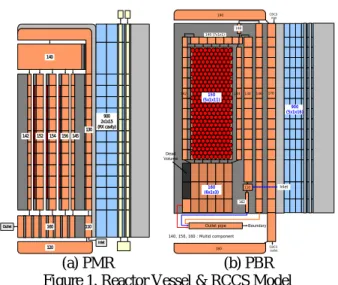
Boundary Outlet pipe 130 142 140 (7x1x1) 144 146 170 110 Dead Volume 190 180 140, 150, 160 : Multid component CBCS outlet CBCS inlet 148 160 (6x1x3) 150 (5x1x11) 162 900 (5x1x16) Inlet (a) PMR (b) PBR
Figure 1. Reactor Vessel & RCCS Model The Reactor vessel including internal structures and Reactor Cavity Cooling System (RCCS) is modeled for both PMR and PBR.
The Reactor vessel consists of coolant inlet plenum, coolant riser, core top plenum, core (fuel blocks or pebbles), outlet plenum, and bypass channels. For PBR, Core Barrel Conditioning System (CBCS) is also modeled. The RCCS is an ultimate heat sink of GCR and a passive heat removal system. Heat flow from the hot vessel wall is transferred to RCCS pipe through reactor cavity by convection and radiation, and then, rejected to the atmosphere by the air (PMR) or water (PBR) flow through the inside of pipe. Air RCCS flow path as well as related heat structures is modeled for
Transactions of the Korean Nuclear Society Autumn Meeting Busan, Korea, October 27-28, 2005
PMR, but the water flow of RCCS for PBR is not modeled. Instead, we have applied a constant temperature boundary condition (25 ℃) to the inside of RCCS pipe. This is a reasonable value in that the vendor of PBMR estimates that the temperature difference between inlet and outlet water is very small because of the large heat capacity of water. The nodal drawings of each reactor are shown in Figure 1.
4. Results and Discussion
4.1 Steady State Results
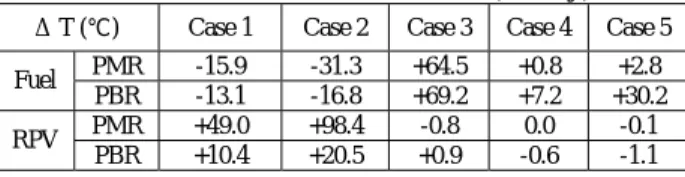
The steady state results are summarized in table 2. For the inlet coolant temperature, the higher inlet temperature (Case 1~2) results in the higher coolant mass flow rate, so that the heat transfer in core is also enhanced and the peak fuel temperature reduces. However, the temperature of RPV is proportional to the inlet temperature due to the increased mass flow as well as inlet temperature. This effect is greater in PMR than in PBR because CBCS acts as an additional heat sink in PBR and coolant riser channels exist in the side reflector.
The peak fuel temperature is increased with the higher outlet temperature (Case 3) because the reduced coolant flow results in the lower convective heat transfer in the core region. The effect of outlet temperature on RPV temperature is negligible.
The effect of system pressure (Case 4~5) is much smaller in PMR than in PBR because the core pressure drop in PBR is greater than in PMR. The difference of pressure drop is greater in the lower system pressure because pressure drop is in inverse proportion to the system pressure generally. Most thermal properties of fluid such as thermal conductivity, viscosity and specific heat are a function of pressure and temperature, and as a result, the pressure drop in the core affects the overall convective heat transfer.
Table 2. Relative difference from Case 0 (Steady)
Δ T (℃) Case 1 Case 2 Case 3 Case 4 Case 5 PMR -15.9 -31.3 +64.5 +0.8 +2.8 Fuel PBR -13.1 -16.8 +69.2 +7.2 +30.2 PMR +49.0 +98.4 -0.8 0.0 -0.1 RPV PBR +10.4 +20.5 +0.9 -0.6 -1.1 4.2 Transient Results
In this study, the High Pressurized Conduction Cooldown (HPCC) event is selected for the transient analysis. The HPCC is initiated by Loss of Off-site Power. At the beginning of HPCC, the reactor is scrammed and the coolant flow is coast-down to zero during 60 sec. The results of HPCC analysis are shown in table 3.
The higher inlet temperature results in the higher initial stored thermal energy in the internal vessel
structures and then, the peak fuel and RPV temperature is also increased.
The peak fuel and RPV temperature increase with the outlet temperature due to the higher initial fuel temperature. However, the effect of a rise in peak fuel temperature is much greater in PBR than in PMR due to the difference of heat capacity in the outlet plenum. Compared with PMR, the amount of heat structures in outlet plenum is much larger in PBR. A large heat capacity of outlet plenum, where is the hottest region during the full power operation, tends to reduces the effect of core cooling.
The system pressure plays an important role in the core natural circulation cooling during the transient. Natural circulation flow is affected by buoyancy force which is related to fluid density and so, the reduced system pressure results in the decrease of fluid density and the increase of peak fuel temperature. As mentioned above, due to the greater core pressure drop in PBR, a system pressure effect is also greater in PBR than in PMR. In terms of a RPV temperature, as the system pressure reduced, the overall convection heat transfer is also decreased, so that an unbalanced temperature distribution through the core region causes the difference between the fuel and RPV temperature to increase.
Table 3. Relative difference from Case 0 (HPCC)
Δ T (℃) Case 1 Case 2 Case 3 Case 4 Case 5 PMR +20.1 +41.7 +9.8 +22.7 +49.1 Fuel PBR +17.9 +37.0 +21.4 +52.6 +123.0 PMR +8.3 +17.6 +3.9 +7.4 +16.1 RPV PBR +3.5 +7.3 +3.9 -11.2 -26.2 5. Conclusion
A preliminary sensitivity study on the fuel and RPV temperature is performed for two reactor design, PMR and PBR. In terms of safety analysis, the higher inlet temperature is preferable to reduce the peak fuel temperature during the steady state. However, the higher inlet temperature results in the higher peak RPV temperatures and the higher peak fuel temperature during steady state and HPCC, respectively. Therefore, the lower inlet temperature can be a better choice. The lower outlet temperature is also suggested, but restricted by the hydrogen production process which requires the higher temperature above 900 ℃ at least. The higher system pressure is preferable for both fuel and RPV temperature. In conclusion, the lower inlet temperature and the higher system pressure are required in the GCR design for viable hydrogen production, especially in terms of safety analysis.
REFERENCES
[1] W. J. Lee, et al., Development of MARS-GCR/V1 for Thermal-Hydraulic Safety Analysis of Gas-Cooled Reactor System, Fall Meetings of Korea Nuclear Society, 2004. [2] IAEA, Evaluation of High Temperature Gas Cooled Reactor Performance, IAEA-TECDOC-TBD, 2004.