© Korean Powder Metallurgy Institute 733
-1. Introduction
Generally speaking, the application of fine powder such as Atmix’s PF-20F grade (D50=10µm) into the traditional
PM process have some merits, for example making possible to increase sintered density, to sinter at lower temperature, or to refine the grain size of sintered parts.However, fine powder has some difficulties to be applied. For example, fine particles can flow into the gap of die assembly and damage it. Furthermore, its poor flowability and compactibility make difficult to produce sound green parts. As a method to make use of the merits in fine powder while overcoming problems, this report will state the granulation of fine powder.
2. Experimental and Results
Three types of powder, SUS316L/PF-5F (D50 = 4µm),
SUS316L/PF-10F(D50=6µm) and SUS316L/PF-20F (D50=10µm)
were prepared by ATMIX’s high pressure atomization process for the purpose of making granulated powders. Their physical properties are shown in Table 1. Table 1 shows that the finer the particle size, the lower the tap density. and also larger the specific surface area.
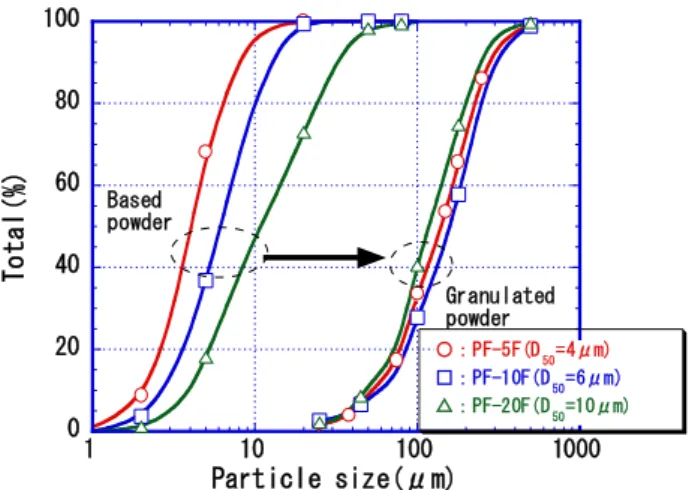
The powders were fed to an agitation fluidized bed granulator, with 0.75wt% of binder, to prepare the granulated powder. Other conditions were kept at constant value. A SEM micrograph of powder is shown in Photo 1(a), which reveals that ATMIX’s fine powder has spherical appearance. Photo 1(b) shows the SEM micrograph of granulated PF-10F powder. It can be seen from Photo 1(b) that the particles stuck with each other in the granulator to form granulated powder. Fig.1 shows the size distributions for powder and granulated powder. Granulated powders have practically same mean size,
120µm to 150µm, regardless of the powder used to produce it. Furthermore, the flow rate of granulated powder was about 32sec/50g.
Considering that the flow rate of powder was not able to measure, the granulation improved flowability markedly. Table1. Physical properties of used powders
PF-5F 2.07 4.01 7.30 3900 3.85 0.46
PF-10F 2.76 6.11 12.30 3400 4.11 0.32
PF-20F 3.80 10.32 24.52 3500 4.49 0.20
D10(µ m) T.D.(Mg/m3
)Specific surfacearea (m2
/g) O(ppm)
D90(µ m) D50(µ m)
(a) raw materials (b) granulated powders Photo.1. SEM of raw materials and granulated powders. Then the granulated powders were compacted into the green parts of φ27.7mm outside, φ14.2mm inside and 5mm thickness at the pressure of 60MPa. The green parts were then debound at 873K and sintered at 1423K, 1523K and 1623K. Fig.2 shows the relationship between sintering temperature and relative sintered density. The relative sintered density was calculated based on the true density of 7.95g/cm3. The sintering of granulated PF-5F powder
resulted in the relative density of 96.8 to 97.5%, which are relatively high, and the difference with sintering temperature was about 0.7%. In granulated PF-10F powder, about 96.3% of relative density at 1423K and about 97.0% at 1623K were obtained. The difference was also about 0.7% in granulated PF-10F powder. PF-20F powder gave the relative densities of about 93.2% at 1423K and about 2006 POWDER METALLURGY
World Congress
B01-07-2
20μm 100μm
Development of Granulated Powders by SUS316L
Ultra Fine Powder
Takeshi Kadomura1, Yu Maeta2, Isamu Otsuka3
4-44 Kaigan, Kawaragi, Hachinohe-shi Aomori-ken 039-1161 JAPAN e-mail1:kadomura,[email protected]
Abstract
Granulated powders, prepared from PF-5F(D50=4µm), PF-10F(D50=6µm) and PF-20F(D50=10µm) water atomized powder, were compacted, debound and sintered to evaluate the properties of sintered parts. As a result, the relative sintered density of about 97% at sintering temperature of 1423K was obtained. It can be considered that by using granulated finer particle size powder, mechanical properties of sintered parts were also improved.
© Korean Powder Metallurgy Institute 734 -0 20 40 60 80 100 1 10 100 1000 To tal( % ) Particle size(μm) Based powder Granulated powder 〇:PF-5F(D50=4μm) □:PF-10F(D50=6μm) △:PF-20F(D50=10μm)
Fig. 1. Relationship in SUS316L between based powder particle size and granulated powder one.
93 94 95 96 97 98 1400 1450 1500 1550 1600 1650 R ela tiv e D e n sit y ( %) Temperature (K) PF-5F(D50=4μm) PF-10F(D50=6μm) PF-20F(D50=10μm) True Density:7.95Mg/m3
Fig. 2. Relationship in SUS316L between based powder relative density and granulated powder one.
95.7% at 1623K. The difference was about 2.5%. These results show that higher sintered density can be attained at lower sintering temperature, for example at 1423K, by using granulated finer particle size powder. Furthermore, the influence of temperature variation in a furnace on the sintered density can be diminished because the sintered density will not fluctuate so much with temperature. Photo.2 shows the SEM micrographs of parts sintered at 1423K. The pores in the sintered parts of granulated PF-5F powder was not only smaller but also less than granulated PF-10F and PF-20F powders. It can be considered that the mechanical properties and/or corrosion resistance will be improved in the sintered parts by using granulated finer, such as PF-5F, powders.
(a) PF-5F (b) PF-10F (c)PF-20F Photo. 2. The microtructures of the sintered compacts of each raw material particle size in 1423K in the sintering temperature.
3. Summary
The followings can be confirmed by the sintering of granulated powders;
1. Granulated powders have practically same mean size regardless of the powder used to produce it.
2. Higher sintered density can be attained at lower sintering temperature, for example at 1423K, by using granulated finer particle size powder.
3. The influence of temperature variation in a furnace on the sintered density can be diminished because the sintered density will not fluctuate so much with temperature by using granulated finer particle size powder.
4. Pore becomes small and the ratio decreases by using a more fine powder as a granulation raw material.
4. Reference
1. Kato Yoshiyuki, Nakabayashi Koei, Watanabe Atsushi and Maeta Yu, Abstract of Spring Meeting of Japan Society of Powder and Powder Metallugy, Program No.1-19A (1999)
2. Kato Yoshiyuki, Nakabayashi Koei, Watanabe Atsushi and Maeta Yu, Abstract of Spring Meeting of Japan Society of Powder and Powder Metallugy Program No.1-20A (1999)