Journal of Magnetics 22(2), 244-249 (2017) https://doi.org/10.4283/JMAG.2017.22.2.244
©2017 Journal of Magnetics
Thermodynamic Analysis of Intergranular Additives in Sintered Nd-Fe-B Magnet
X. G. Cui1, X. H. Wang1, C. Y. Cui1*, G. C. Yin1, C. D. Xia1, X. N. Cheng2, and X. J. Xu1
1School of Mechanical Engineering, Jiangsu University, Zhenjiang 212013, PR China 2School of Materials Science and Engineering, Jiangsu University, Zhenjiang 212013, PR China
(Received 27 November 2016, Received in final form 30 May 2017, Accepted 30 May 2017)
To get deeper insight into the effect of intergranular additives in sintered Nd-Fe-B magnet and consequently improve the properties better, the interaction between additives (oxide, nitride, and carbide) and Nd-rich phase in the temperature range of 298.15-1400 K was analyzed thermodynamically. It can be found that the oxide additives became less stable than nitrides and carbides. Except for calcium oxide, almost all oxides could react with Nd from Nd-rich phase. To be different from oxide additives, the mechanism of nitrides and carbides was defined with various elements, either reaction with Nd from Nd-rich phase or not. The two different mecha-nisms would show different effects on the microstructure and hence properties of magnet. The thermodynamic analysis had a better agreement with the experimental information.
Keywords : sintered Nd-Fe-B magnet, intergranular additives, thermodynamic analysis, experimental verification
1. Introduction
Due to the outstanding magnetic properties, the produc-tion of sintered Nd-Fe-B magnets has grown rapidly and its application has been expanded extensively. However, poor thermal stability, limited corrosion resistance, and coercivity much less than the theoretical maximum have seriously restricted its further application. In order to overcome these weaknesses, many investigations have been made previously. It has been reported that the coercivity and corrosion resistance can be improved by alloying additions, such as the first type dopant element (Cu, Al, Ga, and Mg, etc.) and the second type dopant element (Nb, Zr, Ti, and Mo, etc.) [1-3]. But this also accompanies with the reduction of other properties, such as remanence and Curie temperature, due to the dilution effect of the magnetization. Recently, more and more workers focus mainly attention on the intergranular addi-tions for avoiding that. The adopted method is mainly powder blending [4, 5]. Previous studies have shown that the additions of the metal powders (such as Cu, Al, Ga, and Nb) are effective in avoiding or inhibiting the reduction of other properties on the basis of improved coercivity and corrosion resistance [6-9]. Besides that, the
compound additives are proved to be effective as well. Heh et al. have reported that the additions of fine nitride powders can homogenously improve the coercivity and remanence. Among them, BN, AlN, Si3N4, and TiN are the most effective. This is attributed mainly to the modifi-cation of intergranular phase probably resulting from the reaction between nitrides and the Nd-rich phase [10, 11]. Moreover, oxide additions have been also investigated widely. Previous results show that the additions of fine oxides powders (such as MgO, ZnO, and CaO) can enhance the coercivity considerably, which arises from the new intergranular Nd-O-Fe-M phase [12, 13]. Unfortunately, this is together with the reduction of remanence, whereas the problem of which can be solved through minor additions of their nanopowders [14, 15]. Although many studies have been made into the effect of compound additions on final magnetic properties, few have sought to first identify the mechanism between compounds and Nd-rich phase. In the present work, this is analyzed thermo-dynamically in detail, with the aim of using the resulting information to improve the properties better.
2. Thermodynamic Analysis
2.1. Oxide additivesAs well known, oxygen plays a very important role in the magnetic properties of Nd-Fe-B magnet [16]. There-fore, the mechanism of oxide additives is analyzed first.
©The Korean Magnetics Society. All rights reserved. *Corresponding author: Tel: +86-511-88797898
Here we choose four representative oxides, which are the oxides with high and low melting point of the first type dopant element (Al2O3 and Bi2O3), the oxide with high
melting point of the second type dopant element (TiO2), and very stable calcium oxide (CaO), respectively. First of all, achemical thermodynamic analysis is made on the reaction between Al2O3 and Nd from Nd-rich phase. The reaction between them may be as follows:
2Nd + Al2O3→ Nd2O3+ 2Al (1) Based on the thermodynamic data [17], the standard molar Gibbs energy of formation ( ) for Al2O3 and
Nd2O3 in the temperature range of 298.15-1400 K is depicted in Fig. 1. It can be seen that, values for Nd2O3 are more negative than those for Al2O3, indicating
that Nd2O3 is more stable than Al2O3. Therefore, the reaction (1) may carry out spontaneously. To further verify this, the standard molar Gibbs energy of reaction ( ) is calculated, as shown in Fig. 2. It is clearly shown that values are all negative in the temperature range of 298.15-1400 K, and become more negative with
increas-ing temperature. This implies that the reaction (1) can assuredly carry out spontaneously and is easier at higher temperature. The resultant Al can modify the grain boundary phase, thereby improving the coercivity and corrosion resistance. Small amounts of Nd2O3 can play a role on the refinement of Nd2Fe14B grains, which is also beneficial to
the improvement of coercivity and corrosion resistance. Secondly, we investigate the probability of reaction between TiO2 and Nd from Nd-rich phase. The reaction
equation can be given by:
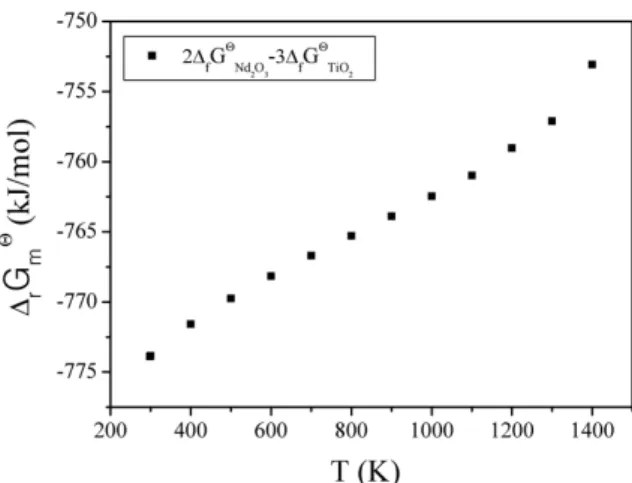
4Nd + 3TiO2→ 2Nd2O3+ 3Ti (2) According to the thermodynamic data [17], values for reaction (2) are calculated and shown in Fig. 3. As can be seen, values are all negative in the temperature range of 298.15-1400 K, indicating that the reaction (2) can carry out spontaneously during sintering. values become less negative with increasing temperature, which is different from that for Al2O3, but values are much smaller than those for Al2O3. This implies that TiO2
is more prone to react with Nd from Nd-rich phase com-pared to Al2O3. Moreover, the resultant Ti belongs to the second type dopant element with high melting point. So it can form binary boride phase. The reaction can be written as:
Ti + 2B → TiB2 (3)
Due to = 0 for simple substance Ti and B, values for TiB2 equal to for reaction (3). Therefore,
for reaction (3) is negative according to reference [17], hinting that TiB2 precipitates can be formed at the grain boundaries during sintering process. TiB2 precipitates
effectively inhibit the movement of grain boundaries, leading to the refinement of Nd2Fe14B grains, thereby improving the coercivity and corrosion resistance. Thus, the addition of appropriate amounts of TiO2 can improve ΔfGmΘ ΔfGmΘ ΔrGmΘ ΔrGmΘ ΔrGmΘ ΔrGmΘ ΔrGmΘ ΔrGmΘ ΔfGmΘ ΔfGmΘ ΔrGmΘ ΔrGmΘ
Fig. 1. ΔfGmΘ for Al2O3 and Nd2O3 at 298.15-1400 K.
both the coercivity and the corrosion resistance.
Using the same method, we analyze the role of Bi2O3 and CaO. The reactions between Bi2O3 or CaO and Nd from Nd-rich phase may be as follows:
2Nd + Bi2O3→ Nd2O3+ 2Bi (4)
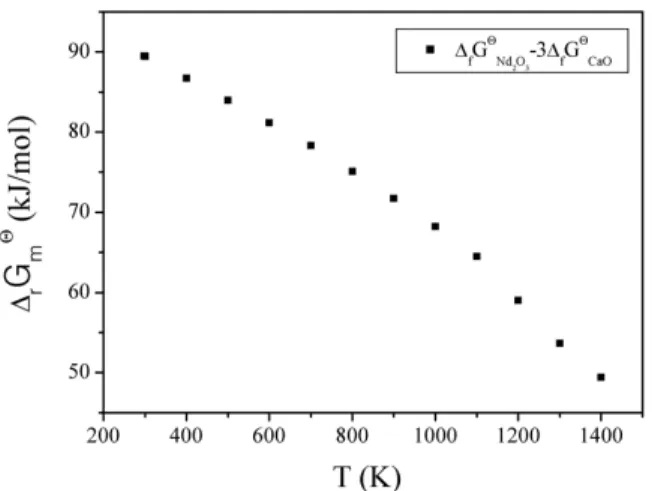
2Nd + 3CaO → Nd2O3+ 3Ca (5)
values for Bi2O3 are negative and much more
positive than those for Nd2O3 [17]. This indicates that Bi2O3 is much easier to react with Nd from Nd-rich phase, which is proved by the negative for reaction (4), with the value of −1229.3 ~ −1211.6 kJ/mol in the range from 298.15 K to 1400 K. Compared with Al2O3 and TiO2, the reactivity of Bi2O3 is higher, and its melting
point is much lower. Therefore, it may induce better densification and modification of microstructure, thereby improving the magnetic properties and corrosion resistance. To be different from Al2O3, TiO2 and Bi2O3, CaO is very stable and do not react with Nd from Nd-rich phase, resulting from the positive for reaction (5) (as shown in Fig. 4). In other words, Ca can act as deoxidant to increase the effect of Nd content and hence improving the densification of sintering. In addition, the resultant stable CaO particles or the addition of its nano-scale powders can refine the grains by inhibiting the movement of grain boundaries, thus improving the magnetic pro-perties and corrosion resistance.
2.2. Nitride additives
In order to investigate the effect of nitrides, AlN, Mg3N2, VN, and ZrN are chosen as examples in this paper. They are all with higher melting point. Firstly, we explore the mechanism of AlN as intergranular additive. The reaction between AlN and Nd from Nd-rich phase can be given by:
Nd + AlN → NdN + Al (6)
On the basis of the thermodynamic data [17], the standard molar Gibbs energy of formation ( ) for AlN and NdN in the temperature range of 298.15-1400 K is shown in Fig. 5. Here we use for CeN instead of that for NdN, because for NdN is not found in the reference and Ce and vicinal Nd both belong to the light rare earth element. It is clearly shown that values for CeN and AlN are nearly same. It can be inferred that the reactivity of reaction (6) is lower, even if it can carry out. This is also proved by values for reaction (6), as depicted in Fig. 6. As can be seen, whether AlN is reactive or not depends on the temperature, but the whole reactivity is lower. Therefore, the effect of AlN on the microstructure and properties of magnet is more compli-cated. On the contrary, Mg3N2 can react with Nd from Nd-rich phase as the following reaction (7) due to the negative values (as shown in Fig. 7).
2Nd + Mg3N2→ 2NdN + 3Mg (7) ΔfGmΘ ΔrGmΘ ΔrGmΘ ΔfGmΘ ΔfGmΘ ΔfGmΘ ΔfGmΘ ΔrGmΘ ΔrGmΘ Fig. 4. ΔrGmΘ for reaction (5) at 298.15-1400 K.
Fig. 5. ΔfGmΘ for AlNand CeN at 298.15-1400 K.
The resultant Mg with low melting point can be bene-ficial to the liquid sintering and the formation of new intergranular phase, Thereby enhancing the magnetic pro-perties and corrosion resistance.
Similarly, we investigate the mechanisms of nitrides of high-melting metals Zr and V. The results in Fig. 8, calculated from the data of reference [17], show that for reaction (8) and (9) is greater and less than zero, respectively. It can be deduced that reaction (9) can carry out spontaneously, but reaction (8) can not. There-fore, the intergranular addition of nano-scale ZrN powders can inhibit the grain growth according to Zener model, consequently improving the coercivity of magnets. More-over, the resultant V can form V-Fe-B phase at the grain boundaries, likewise, playing a role of grain refinement.
Nd + ZrN → NdN + Zr (8)
Nd + VN → NdN + V (9)
2.3. Carbide additives
Except for oxides and nitrides, carbides will be also
important additives. However, in the sintered magnets, they do not get enough attention. In this section, we take SiC, TiC, and WC as examples to elucidate the mech-anism of their intergranular addition in sintered Nd-Fe-B magnets. SiC may react with Nd from Nd-rich phase to form Si and Nd2C3, the equation can be expressed as:
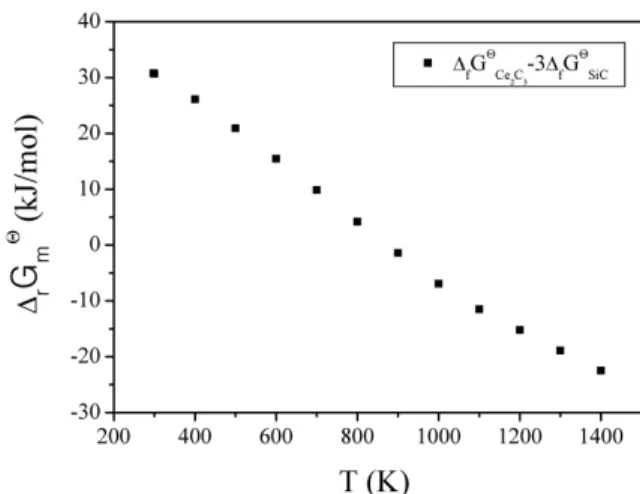
2Nd + 3SiC → Nd2C3+ 3Si (10) Similarly, values for Nd2C3 are replaced by those for Ce2C3 [17]. It can be seen from the calculation that
when temperature T < 792 K, for reaction (10) is greater than zero, contrarily, is less than zero, as shown in Fig. 9. Therefore, reaction (10) can carry out spontaneously during sintering process. The resultant Si can dissolve in Nd-rich phase, modifying the grain boundary phase, thereby improving the magnetic properties and corrosion resistance of magnets [18].
Additionally, the mechanism of TiC and WC are also investigated. The reaction between TiC or WC and Nd from Nd-rich phase may be as follows:
2Nd + 3TiC → Nd2C3+ 3Ti (11) 2Nd + 3WC → Nd2C3+ 3W (12)
for reaction (11) was calculated through values for TiC and Ce2C3, as presented in Fig. 10, sug-gesting that reaction (11) can not occur owing to > 0. Therefore, TiC can exist stably at the grain boundaries in the temperature range from 298.15 K to 1400 K, which is similar with ZrN. According to the above discussion, the intergranular addition of appropriate amount of TiC nanopowders is also an effective way to improve the coercivity and corrosion resistance in sintered Nd-Fe-B magnets by grain refinement. Contrarily, values for reaction (12) are all negative and decrease with increasing ΔrGmΘ ΔfGmΘ ΔrGmΘ ΔrGmΘ ΔrGmΘ ΔfGmΘ ΔrGmΘ ΔrGmΘ Fig. 7. ΔrGmΘ for reaction (7) at 298.15-1400 K.
Fig. 8. ΔrGmΘ for reaction (8) and (9) at 298.15-1400 K.
temperature (as shown in Fig. 11). This indicates that WC can react with Nd from Nd-rich phase. The resultant W can form W-Fe-B intergranular phase, which improves the coercivity and corrosion resistance of magnets due to the refined grains and modified grain boundaries.
2.4. Summary on various additives
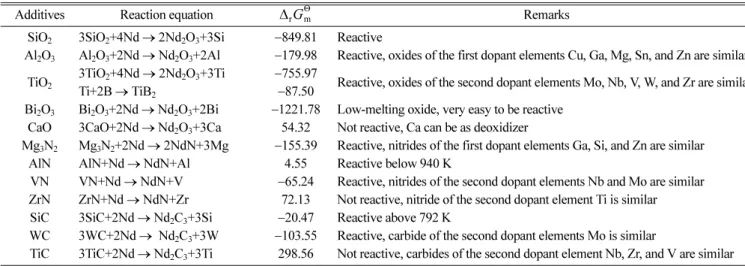
Based on the thermodynamic analysis, the mechanisms of various additives are investigated, as summarized in Table 1. The oxide additives are less stable than nitrides and carbides. Except for calcium oxide, almost all oxides can react with Nd from Nd-rich phase, thereby modifying the intergranular phase and then improving the properties of magnet probably. Moreover, calcium can be employed as deoxidizer, reducing the oxygen content in magnet. This is also beneficial to the improvement of the magnetic properties. On the other hand, the nitrides of low melting elements (such as Mg, Ga, Si, and Zn) and high melting elements (such as V, Nb, and Mo) are not stable, and they can react with Nd from Nd-rich phase, forming corre-sponding elements and neodymium nitrides. This is helpful to modify the grain boundary phases, thereby enhancing the magnetic properties and corrosion resistance. However, the nitrides of Zr and Ti are stable and can play a role of inhibition of grain growth. The carbides were similar with the nitrides. Among them, the carbides of the elements (such as Zn, Si, W, and Mo) can react with Nd from Nd-rich phase, whereas the carbides of the elements (such as Ti, Zr, Nb, and V) are stable.
3. Experimental Verification
The effects of intergranular additives on sintered Nd-Fe-B magnets have been also verified by our and other researchers’ experimental results. Our results show that, SiO2 added to intergranular region can react with Nd from Nd-rich phase, thereby modifying the intergranular phase and refining the matrix phase grains. The optimization of microstructure contributes to the improvement of intrinsic coercivity (Hcj), remanence (Br) and corrosion resistance
[19]. Likewise, Beseničar et al. have reported that the
Fig. 10. ΔrGmΘ for reaction (11) at 298.15-1400 K.
Fig. 11. ΔrGmΘ for reaction (12) at 298.15-1400 K.
Table 1. The standard molar Gibbs energy of reaction ( ) for variously possible reactions at 1340 K (in kJ/mol)
Additives Reaction equation Remarks
SiO2 3SiO2+4Nd → 2Nd2O3+3Si −849.81 Reactive
Al2O3 Al2O3+2Nd → Nd2O3+2Al −179.98 Reactive, oxides of the first dopant elements Cu, Ga, Mg, Sn, and Zn are similar
TiO2 3TiO2+4Nd → 2Nd2O3+3Ti −755.97 Reactive, oxides of the second dopant elements Mo, Nb, V, W, and Zr are similar
Ti+2B → TiB2 −87.50
Bi2O3 Bi2O3+2Nd → Nd2O3+2Bi −1221.78 Low-melting oxide, very easy to be reactive
CaO 3CaO+2Nd → Nd2O3+3Ca 54.32 Not reactive, Ca can be as deoxidizer
Mg3N2 Mg3N2+2Nd → 2NdN+3Mg −155.39 Reactive, nitrides of the first dopant elements Ga, Si, and Zn are similar
AlN AlN+Nd → NdN+Al 4.55 Reactive below 940 K
VN VN+Nd → NdN+V −65.24 Reactive, nitrides of the second dopant elements Nb and Mo are similar ZrN ZrN+Nd → NdN+Zr 72.13 Not reactive, nitride of the second dopant element Ti is similar SiC 3SiC+2Nd → Nd2C3+3Si −20.47 Reactive above 792 K
WC 3WC+2Nd → Nd2C3+3W −103.55 Reactive, carbide of the second dopant elements Mo is similar
TiC 3TiC+2Nd → Nd2C3+3Ti 298.56 Not reactive, carbides of the second dopant element Nb, Zr, and V are similar
ΔrGmΘ ΔrGmΘ
intergranular addition of ZrO2 has a positive influence on the magnetic properties, temperature coefficients and corro-sion resistance of Nd-Fe-B magnets [20]. TEM exami-nation reveals that the added ZrO2 may be reduced by Nd from Nd-rich phase to form Nd2O3 and Zr, and the resultant Zr can also form ZrB2 plate-like phase. The formed Nd
oxides and ZrB2 phase modify the microstructure of Nd-Fe-B magnet, thereby improving its properties. Besides, the intergranular additions of nitrides can also improve the magnetic properties and corrosion resistance of Nd-Fe-B magnets. As reported that, BN, AlN, Si3N4, and TiN
are the most effective for enhancing the magnetic proper-ties of magnet [10, 11]. Small addition of BN can result in a maximum 20% increase in Hcj. Chemical compositions
analysis indicates that BN particles react with Nd and dissolve in the Nd-rich phase during sintering. As a result, the microstructure is modified and thus Hcj is increased.
Moreover, the addition of Si3N4 can also improve the corrosion resistance of Nd-Fe-B magnet [21]. According to the EDX results, Si has been dissolved in Nd-rich phase, indicating that the added Si3N4 can react with Nd from Nd-rich phase to form Si and NdN. This leads to the modification of intergranular phase and optimization of microstructure, and thus improves the magnetic properties and corrosion resistance of Nd-Fe-B magnet. In addition, the intergranular addition of WC has been proved an effective method to increase coercivity [22]. The formation of W-Fe-B phase confirms the reaction of WC with Nd from Nd-rich phase. And the refined grains are the main reason for improving coercivity. Overall, the thermodynamic analysis can well explain the effect of intergranular addi-tives on the microstructure and properties of Nd-Fe-B magnet, and can be used to improve properties better.
4. Conclusions
The effects of intergranular additives (oxide, nitride, and carbide) in sintered Nd-Fe-B magnets were analyzed thermodynamically. The standard molar Gibbs energy of reaction ( ) between the additives and Nd-rich phase in the temperature range of 298.15-1400 K was calculated. The thermodynamic calculations indicated that almost all oxides additives apart from calcium oxide were less stable than nitrides and carbides, and could react with Nd from Nd-rich phase. However, nitrides and carbides either reacted with Nd from Nd-rich phase or not. In both mech-anisms, the effects of nitrides and carbides on the micro-structure and properties of magnet were different. In addi-tion, the thermodynamic analysis had been verified by the experimental results. This would be an important guide for better improving the properties of magnet.
Acknowledgments
This work was supported by National Natural Science Foundation of China (No. 51401087), China Postdoctoral Science Special Foundation (No. 201104511), the project from the Research Starting-Foundation of Jiangsu Univer-sity (No. 10JDG030), Open Fund of Jiangsu Province Key Laboratory of Tribology (No. Kjsmcx2012002).
References
[1] J. Fidler and T. Schrefl, J. Appl. Phys. 79, 5029 (1996). [2] A. S. Kim and F. E. Camp, IEEE Trans. Magn. 3, 3823
(1997).
[3] S. Pandian, V. Chandrasekaran, G. Markandeyulu, K. J. L. Iyer, and K. V. S. R. Rao, J. Appl. Phys. 92, 6082 (2002).
[4] C. H. de Groot, K. H. J. Buschow, and F. R. de Boer, J. Appl. Phys. 83, 388 (1998).
[5] T. S. Zhao, Y. B. Kim, and W. Y. Jeung, IEEE Trans. Magn. 35, 3301 (1999).
[6] O. M. Ragg and I. R. Harris, J. Alloys Compd. 256, 252 (1997).
[7] R. S. Mottram and A. J. Williams, J. Magn. Magn. Mater. 222, 305 (2000).
[8] W. H. Cheng, W. Li, C. J. Li, and S. Z. Dong, J. Magn. Magn. Mater. 234, 274 (2001).
[9] J. F. Hu, Y. L. Liu, M. L. Yin, Y. Z. Wang, B. P. Hu, and Z. X. Wang, J. Alloys Compd. 288, 226 (1999). [10] S. J. Heh, K. D. Lin, Y. M. Jein, F. D. King, and F. L.
Lee, IEEE Trans. Magn. 26, 2637 (1990).
[11] S. K. Chen, T. S. Chin, S. J. Heh, and K. D. Lin, IEEE Trans. Magn. 26, 2634 (1990).
[12] A. R. Yan, Z. M. Chen, X. P. Song, and X. T. Wang, J. Alloys Compd. 239, 172 (1996).
[13] Z. M. Chen, A. R. Yan, and X. T. Wang, J. Magn. Magn. Mater. 162, 307 (1996).
[14] W. J. Mo, L. T. Zhang, A. D. Shan, L. J. Cao, J. S. Wu, and M. Komuro, J. Alloys Compd. 461, 351 (2008). [15] W. J. Mo, L. T. Zhang, Q. Z. Liu, A. D. Shan, J. S. Wu, K.
Matahiro, and L. P. Shen, J. Rare Earths 26, 268 (2008). [16] A. S. Kim, J. Appl. Phys. 64, 5571 (1988).
[17] I. Barin and G. Platzki, Thermochemical data of pure substances, VCH, Weinheim (1995).
[18] X. K. Sun, G. F. Zhou, Y. C. Chuang, R. Grössinger, and H. R. Kirchmayr, J. Magn. Magn. Mater. 96, 197 (1991). [19] X. G. Cui, M. Yan, T. Y. Ma, W. Luo, and S. J. Tu, J.
Magn. Magn. Mater. 321, 392 (2009).
[20] S. Kobe Beseničar, J. Holc. G. Drafit, and B. Saje, IEEE Trans. Magn. 30, 693 (1994).
[21] W. J. Mo, L. T. Zhang, L. Chen, A. D. Shan, and J. S. Wu, J. Chin. Rare Earth Soc. 25, 588 (2007).
[22] G. X. Zhao, X. P. Song, Z. M. Chen, A. R. Yan, and X. T. Wang, Acta Metall. Sinica 32, 413 (1996).