INTRODUCTION
The conventional separators for lithium secondary batter-ies are made of polyolefins such as polyethylene (PE) and propylene (PP). These materials are nearly immiscible with most liquid electrolytes due to their significant differences in polarity and their hydrophobicity. To improve their affi-nity to liquid electrolyte, it may be necessary to consider more polar polymeric materials as a separator in the lithium ion secondary batteries. These polymeric materials include polyacrylonitrile, poly(vinylidene fluoride) (PVDF), poly (vinylidene fluoride-co-hexafluoropropylene) (PVDF-HFP), poly (vinyl alcohol), poly (ethylene glycol), and many others (Song et al. 1999; Song et al. 2002; Arora et al. 2004; McGrath et al. 2004; Souzy et al. 2005; Lee et al. 2006; Stephan 2006;). Among them, fluorinated polymers such as PVDF and PVDF-HFP have several advantages
over other polymers due to their affinity with liquid electro-lyte (Song et al. 1999; Arora et al. 2004; McGrath et al. 2004; Souzy et al. 2005; Lee et al. 2006; Stephan 2006). Although they show good chemical and electrochemical stability in lithium batteries, their properties need to be further improved (Hassanpour 1999; Bhattacharya 2000; Dargaville et al. 2003; Nasef et al. 2004, 2006; Gao et al. 2006). Various approaches have been proposed; the addi-tion of inorganic fillers, polymer blending, thermal or UV-induced crosslinking, and many others (Cheng et al. 2004). Among them, crosslinking induced by high energy irradia-tion is a well-established technique and does not require any initiators which can adversely influence the electro-chemical properties of the batteries (Zhou et al. 2004).
In this study, micro-porous PVDF membranes were pre-pared by a phase inversion process followed by γ-ray irra-diation. The influence of solvent/non-solvent composition ratio in the coagulation bath on the morphology of the mic-ro-porous PVDF membranes was studied by a scanning electron microscopy. The γ-ray irradiation effect on the
─ ─ 133 ──
Micro-porous Poly (vinylidene fluoride) Membranes
for Lithium-ion Secondary Battery
Jae-Hak Choi, Joon-Pyo Jeun, Joon-Yong Sohn, Sung-Jin Gwon, Chan-Hee Jung, Sung-Jun An, Youn-Mook Lim, Junhwa Shin, Phil-Hyun Kang and Young-Chang Nho*
Advanced Radiation Technology Institute, Korea Atomic Energy Research Institute 1266 Sinjeong-dong, Jeongeup-si, Jeollabuk-do 580-185 Korea
Abstract -- Micro-porous PVDF membranes for lithium-ion secondary battery were prepared by a phase inversion process followed by high energy irradiation. The influence of solvent/non-solvent composition ratio in the coagulation bath on the morphology of the micro-porous PVDF memb-ranes was studied by a scanning electron microscopy. High energy irradiation effects on the ther-mal and mechanical properties were investigated using a differential scanning calorimeter and a universal tensile machine. The membranes exhibit good ionic conductivity similar to the conven-tional polyethylene separator at room temperature. The potential applications of the prepared membranes for lithium-ion batteries were explored.
Key words : PVDF, Phase inversion, Radiation
* Corresponding author: Young-Chang Nho, Tel. +82-63-570-3060, Fax. +82-63-570-3068, E-mail. [email protected]
thermal and mechanical properties of the prepared mem-branes was also investigated.
MATERIALS AND METHODS
MaterialsPoly (vinylidene fluoride) (PVDF, Mn: 254,000) and poly (N-vinyl pyrrolidinone) (PVP, Mw: 1,300,000) were pur-chased from Aldrich Chemical. Dimethyl formamide (DM-F) and ethanol were purchased from Junsei Chemical and used without further purification. A liquid electrolyte solu-tion was prepared by dissolving 1 M LiClO4in γ -butyro-lactone in a glove box. Other reagents were reagent grade and used as received.
Preparation of micro-porous PVDF membranes and γγ-ray irradiation
Micro-porous PVDF membranes were obtained by a ph-ase inversion process (Deshmukh et al. 1998; Song et al. 2002; Stephan et al. 2002; Sol et al. 2006; Hwang et al. 2007; Subramania et al. 2007). PVDF was dissolved in DMF at 60�C to form a homogeneous solution. The
solut-ion was cooled to room temperature, stood for 1 h, cast on a glass plate, and then immersed immediately into a coagu-lation bath to induce polymer precipitation. The formed membranes were washed with distilled water several times and then dried under vacuum. The prepared membranes were irradiated using γ-ray from a 60Co source at room tem-perature. The absorption dose ranged from 10 to 200 kGy at a dose rate of 10 kGy h-1.
Characterization
Differential scanning calorimetry (DSC) thermograms of the prepared membranes were obtained with a DSC Model 7 system of TA instrument under nitrogen atmosphere at a heating rate of 10�C min-1. The degree of crystallinity was
calculated directly using an equation in the literature (Step-han et al. 2002; Cheng et al. 2004). An Instron (Model 4210, Instron Engineering Co.) was used to measure the mechanical property of the membranes. The ionic conduc-tivity of the membranes soaked with a liquid electrolyte was determined by AC impedance technique over the frequency range from 0.01 to 100 kHz using a Solatron SI 1260/1287 analyzer.
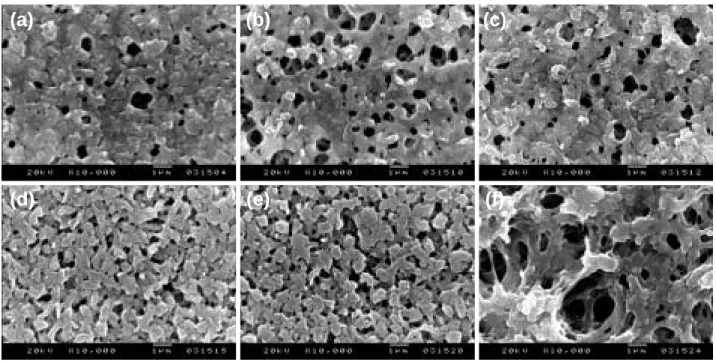
Fig. 1. Surface morphology of the membranes coagulated in: (a) 0 : 100 of ethanol : water bath, (b) 10 : 90 of ethanol : water bath, (c) 20 : 80
of ethanol : water bath, (d) 30 : 70 of ethanol : water bath, (e) 40 : 60 of ethanol : water bath, and (f) 50 : 50 of ethanol : water bath.
(a)
(b)
(c)
RESULTS AND DISCUSSION
Morphology of the membranesSurface morphologies of the membranes prepared by phase inversion are shown in Fig. 1. Coagulation medium plays an important role in the formation of membranes dur-ing phase inversion process. In general, the fast coagulation rate results in a formation of micro-voids, whereas the slow coagulation rate results in a microporous structure (Desh-mukh et al. 1998). In order to study these effects, 10~50% of ethanol containing coagulation medium was employed. The presence of ethanol in the coagulation bath could re-duce the polymer precipitation rate during the phase inver-sion process. As the concentration of the ethanol in the coa-gulation bath increased, the morphology of the prepared membranes changed from micro-void to micro-porous stru-cture.
The effect of PVP addition on the morphology of the re-sulting PVDF membranes was investigated. Fig. 2 shows the SEM images of the prepared membranes containing 1 to 4 wt% PVP coagulated in 20 : 80 of ethanol:water bath. The addition of PVP to the polymer solution increases the
pre-cipitation rate due to the hydrophilic nature of PVP, which may result in a formation of larger pores.
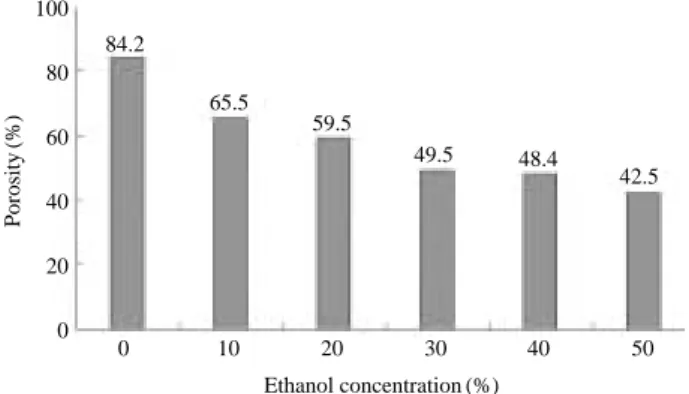
Fig. 3 shows the porosity of the prepared membranes. The porosity of the membrane decreases as the ethanol con-centration in the coagulation bath increases. An increase in the ethanol concentration in the coagulation bath results in a decrease in the precipitation rate, leading to a change in the membrane morphology.
Fig. 2. Surface morphology of the membranes containing PVP coagulated in 20 : 80 of ethanol : water bath: (a) PVP 1 wt%, (b) PVP 2 wt%,
(c) PVP 3 wt%, and (d) PVP 4 wt%.
Fig. 3. The porosity of the membranes as a function of ethanol
concentration.
(a)
(b)
(c)
(d)
Porosity (%) 100 80 60 40 20 0 0 10 20 30 40 50 Ethanol concentration (%) 84.2 65.5 59.5 49.5 48.4 42.5Ionic conductivity
Fig. 4 shows the ionic conductivity of the membranes. The ionic conductivity reached 0.3 mS cm-1for the highest
sample coagulated in 20% ethanol bath, which is similar to that of the conventional PE separator. However, there is no obvious relationship between the ethanol concentration in the coagulation bath and the ionic conductivity.
High energy irradiation
The prepared PVDF membranes were γ-irradiated in ord-er to investigate the high enord-ergy irradiation effect on the thermal and mechanical properties. Fig. 5 shows the mech-anical property of the irradiated membranes with different absorption dose. The required mechanical properties for battery separator are tensile modulus and flexibility (Arora et al. 2004). A high tensile modulus can withstand the st-ress during battery manufacturing process such as winding and stacking, and flexibility can make a battery more con-venient to be rolled or folded into its finished shape. The
results show that the tensile modulus of the membranes increased with increasing the absorption dose up to 100 kGy due to the formation of crosslinked network by high energy irradiation (Lim et al. 2006). However, the tensile modulus started to decrease above 100 kGy. It can be attri-buted to the fact that the PVDF could be decomposed with high absorption dose. As the absorption dose increases, the elongation of the membranes showed a tendency to decre-ase due to their high brittleness induced by the formation of crosslinked network (Cheng et al. 2004).
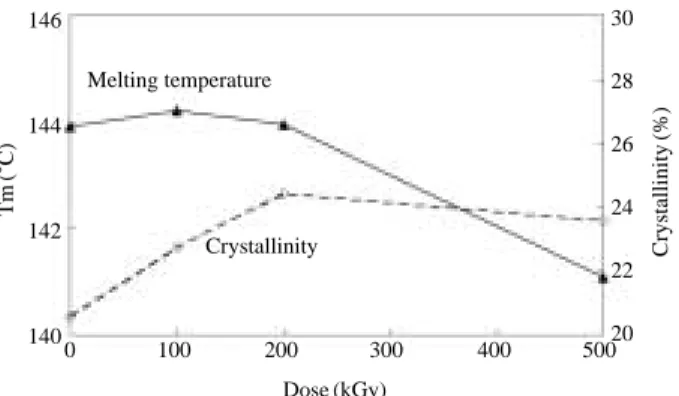
The changes in the degree of crystallinity of PVDF mem-branes by irradiation were investigated by a differential scanning calorimetry. As shown in Fig. 6, the degree of crystallinity was found to increase with an increase in the absorption dose up to 200 kGy beyond which it started to decrease. The increase in the degree of crystallinity upon irradiation can be attributed to the formation of crosslinked network (Lim et al. 2006).
As shown in Fig. 7, the electrolyte uptake decreases
slig-Fig. 5. Mechanical property of the membranes as a function of
ab-sorption dose.
Fig. 6. The melting temperature and the degree of crystallinity of
the membranes as a function of absorption dose.
Fig. 7. The electrolyte uptake of the membranes as a function of
absorption dose. Tensile strength (kgf mm -1 ) 25.0 24.5 24.0 23.5 23.0 22.5 22.0 60 50 40 30 20 10 0 Dose (kGy) Elongation (%) 0 50 100 150 200 Tensile modulus Elongation Tm (� C) Melting temperature Crystallinity Crystallinity (%) Dose (kGy) 146 144 142 140 30 28 26 24 22 20 0 100 200 300 400 500 Electrolyte uptake (%) 140 136 132 128 124 120 0 50 100 150 200 Dose (kGy)
Fig. 4. Ionic conductivity of the membranes.
1.E-02 1.E-04 1.E-06 1.E-08 1.E-10 0 10 20 30 40 50 PE Ethanol concentration (%) 2.1E-06 1.8E-05 3.3E-04 2.5E-06 6.8E-07 1.2E-04 8.0E-04 Ionic conductivity (S cm -1)
htly with an increase in the absorption dose. This is related to the crosslinking in the polymer membrane. The forma-tion of crosslinked network in the membrane hinders the swelling of the polymer chains by liquid electrolyte.
CONCLUSION
Micro-porous PVDF membranes were prepared by a ph-ase inversion process followed by γ-ray irradiation. As the concentration of the ethanol in the coagulation bath incre-ased, the morphology of the prepared membranes changed from micro-void to micro-porous structure. The addition of PVP to the polymer solution increased the size of pores in the membranes due to the hydrophilic nature of PVP. The ionic conductivity reached 0.3 mS cm-1for the highest
sam-ple, which was similar to that of the conventional PE sepa-rator. The tensile modulus of the membranes increased with increasing the absorption dose up to 100 kGy due to the for-mation of crosslinked network by high energy irradiation.
ACKNOWLEDGEMENTS
This study was financially supported by the Nuclear R& D Program from the Ministry of Science and Technology, Korea.
REFERENCES
Arora P and Zhang Z. 2004, Battery Separators. Chem. Rev.
104:4419-4462.
Bhattacharya A. 2000, Radiation and industrial polymers.
Pr-og. Polym. Sci. 25:371-401.
Cheng CL, Wan CD and Wang YY. 2004. Microporous PVdF-HFP based gel polymer electrolytes reinforced by PEG-DMA network. Electrochem. Commun. 6:531-535. Cheng CL, Wan CC and Wnag YY. 2004. Preparation of
porous, chemically cross-linked, PVDF-based gel polymer electrolytes for rechargeable lithium batteries. J. Power
Sources 134:202-210.
Dargaville TR, Geroge GA, Hill DJT and Whittaker AK. 2003. High energy radiation grafting of fluoropolymers. Prog.
Polym. Sci. 28:1355-1376.
Deshmukh SP and Li K. 1998. Effect of ethanol composition
in water coagulation bath on morphology of PVDF hollow fibre membranes. J. Membrane Sci. 150:75-85.
Gao K, Hu X, Yi T and Dai C. 2006. PE-g-MMA polymer ele-ctrolyte membrane for lithium polymer battery.
Electro-chim. Acta 52:443-449.
Hassanpour S. 1999. Radiation grafting of styrene and acrylo-nitrile to cellulose and polyethylene. Radiat. Phys. Chem.
55:41-45.
Hwang YJ, Jeong SK, Nahm KS and Stephan AM. 2007. Electrochemical studies on poly (vinylidene fluoride-hexa-fluoropropylene) membranes prepared by phase inversion method. Eur. Polym. J. 43:65-71.
Lee JS, Quan ND, Hwang, Lee SD, Kim H, Lee H and Kim HS. 2006. Polymer electrolyte membranes for fuel cells. J.
Ind. Eng. Chem. 12:175-183.
Lim YM, Kang PH, Lee SM, Kim SS, Jeun JP, Jung CH, Choi JH, Lee YM and Nho YC. 2006. Effect of electron beam irradiation on poly (vinylidene fluoride) films at the melt-ing temperature. J. Ind. Eng. Chem. 12:589-593.
McGrath KM, Prakash GKS and Olah GA. 2004. Direct met-hanol fuel cells, J. Ind. Eng. Chem. 10:1063-1080. Nasef MM and Hegazy EA. 2004. Preparation and applications
of ion exchange membranes by radiation-induced graft co-polymerization of polar monomers onto non-polar films.
Prog. Polym. Sci. 29:499-561.
Nasef MM and Saidi H. 2006. Single fadiation-induced graf-ting method for the preparation of two proton- and lithium ion-conducting membranes. Macromol. Mater. Eng. 291: 972-983.
Nasef MM, Suppiah RR and Dahlan KZM. 2004. Preparation of polymer electrolyte membranes for lithium batteries by radiation-induced graft copolymerization. Solid State
Ioni-cs 171:243-249.
Sol SH, Lee YM and Park JK. 2006. Preparation and charac-terization of new microporous stretched membrane for lith-ium rechargeable battery. J. Power Sources 163:247-251. Song JY, Wang YY and Wan CC. 1999. Review of gel-type
polymer electrolytes for lithium-ion batteries. J. Power
Sources 77:183-197.
Song JY, Cheng CL, Wang YY and Wan CC. 2002. Microstructure of poly (vinylidene fluoride)-based polymer electrolyte and its effect on transport properties. J.
Electro-chem. Soc. 149:A1230-A1236.
Souzy R and Ameduri B. 2005. Functional fluoropolymers for fuel cell membranes. Prog. Polym. Sci. 30:644-687. Stephan AM and Saito Y. 2002. Ionic conductivity and
diffu-sion coefficient studies of PVdF-HFP polymer electrolytes prepared using phase inversion technique. Solid State
Io-nics 148:475-481.
lithium batteries. Eur. Polym. J. 42:21-42.
Subramania A, Sundaram NTK, Priya ARS and Kumar GV. 2007. Preparation of a novel composite micro-porous poly-mer electrolyte membrane for high performance Li-ion battery. J. Membrane Sci. 294:8-15.
Zhou YF, Xie S, Ge XW, Chen CH and Amine K. 2004. Prep-aration of rechargeable lithium batteries with poly (methyl
methacrylate) based gel polymer electrolyte by in situ γ
-ray irradiation induced polymerization, J. Appl.
Elect-rochem. 34:1119-1125.
Manuscript Received: October 16, 2007 Revision Accepted: November 7, 2007