Implementation of Fuzzy Logic Control for Air Conditioning Systems
M. Mongkolwongrojn, V. Sarawit
Mechanical Engineering Dept., Faculty of Engineering, ReCCIT,
King Mongkut’s Institute of Technology Ladkrabang Thailand
E-mail: [email protected]
Abstract
Fuzzy logic control has been widely applied for handling the system which has uncertainty or high robust system. Since the dynamic behaviors of the systems contain complexity and uncertainty in its parameters, several fuzzy logic controllers have been implemented to control room temperature in the field of air conditioning system.
In this paper, the fuzzy logic control has been developed to control both in door temperature and humidity in the air conditioning systems. The manipulating variables are speed of compressor , heater and supply air flow rate. The microcomputer was used to interface with in system. The experimental results show the superior of multivariable fuzzy logic control to keep room temperature and humidity in air conditioning system for the best comfortable.
Keywords: Fuzzy Logic Control, Multivariable Control System, Air Conditioning System, Temperature and humidity control.
1. INTRODUCTION
The consumption of energy in heating, ventilating, and air conditioning (HVAC) equipment in industrial, commercial and residential buildings constitute nearly 50 % of the world energy consumption [1]. Therefore, an HVAC system is essential to a building in order to keep occupant comfortable. In modern intelligent buildings, a sophisticate control system should be provided for high energy efficiency and comfort.
Over the last few years, fuzzy logic controllers have been widely applied for temperature control in HVAC system which has uncertainty or high robust system. Since the dynamic behaviors of the systems contain complexity and uncertainty in its parameters [1, 2, 3, 4, 5]. The fuzzy logic temperature control of HVAC was developed to achieve a high comfort level with energy saving up to twenty five percent.
In this paper, the fuzzy logic controller was developed to control both room temperature and humidity in the residential air conditioning system. Two input signals to the controller are temperature and relative humidity with three output signals from the controller to regulate the speed of compressor, fan speed and electric heater in a residential conditioning system.
2. SYSTEM DESCRIPTION
The single-zone air conditioning system with temperature and relative humidity control as a multi-input and multi-output closed loop system as shown in Figure 1. The fuzzy logic control structure differs from the single input single output conventional temperature control system. Two sets of sensor inputs are thermocouple and electronic humidity sensor and three outputs from the controller are distributed to regulate fan motor, compressor motor using inverters and ON/OFF the heater in order to give the best comfort room. Both temperature error and relative humidity error are quantified according to the memberships in the fuzzy sets; negative, zero, and positive as shown in Figure 2 and Figure 3 respectively. Figure 4, Figure 5 and Figure 6 are the rule base for fan coil, compressor and heater follow the inputs of fuzzy set in temperature error and humidity error as shown in Figure 2 and Figure 3 respectively.
Fuzzy Logic Control 1
Fuzzy Logic Control 2
Fuzzy Logic Control 3
A ir C ond itionin g S ystem
Speed Fan Coil
Speed Compressor Heater On/Off Temperature RH Humidity Error Temp Error RH Output Temperature Output RH Humidity
Figure 1. Fuzzy logic control structure
Figure 2. Membership of fuzzy set in temperature error
Figure 3. Membership of fuzzy set in humidity error
ICCAS2005
June 2-5, KINTEX, Gyeonggi-Do, Korea
N B N Z P P B N B N Z P P B Error Temp E r r o r R H H H H H H H H H H M M M M M M M L L L L L L L L L
Figure 4. Fuzzy logic control conditions for fan coil
N B N Z P P B N B N Z P P B Er ro r T e mp E r r o r R H H H H H H H H H H H H H M M M L L L L L L L L L L
Figure 5. Fuzzy logic control conditions for compressor
N B N Z P P B N B N Z P P B Er ro r T e mp E r r o r R H O N O N O N O N O F F O F F O N O F F O F F O N O F F O F F O F F
Figure 6. Fuzzy logic control conditions for heater 3. SYSTEM MODEL
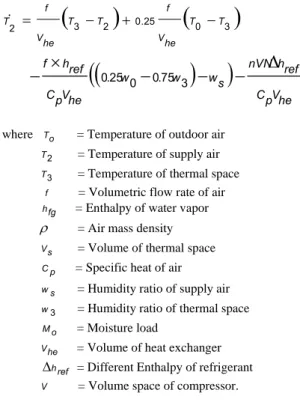
The differential equations describing the dynamic behavior Of the air conditioning system as shown in Fig.1 can be derived from energy equation and mass conservation equation as :
(
)
(
)
⎜
⎝
⎛
−⎟
⎠
⎞
ρ + − × − − = o M fg h 0 Q p C s V 1 3 w s w s V p C fg h f 3 T 2 T s V f 3 T&(
)
s
V
M
w
w
s
V
f
w
ρ
0
3
2
3
=
−
+
&
(
3
2
)
0
.
25
(
0
3
)
2
T
T
he
V
f
T
T
he
V
f
T
&
=
−
+
−
(
(
)
)
he
V
p
C
ref
h
nVN
s
w
w
w
he
V
p
C
ref
h
f
∆
−
−
−
×
−
.0
25
0
.0
75
3
where
T
o
= Temperature of outdoor airT
2
= Temperature of supply airT
3
= Temperature of thermal spacef
= Volumetric flow rate of airh
fg
= Enthalpy of water vaporρ
= Air mass densityV
s
= Volume of thermal spaceC
p
= Specific heat of airw
s
= Humidity ratio of supply airw
3
= Humidity ratio of thermal spaceM
o
= Moisture load
V
he
= Volume of heat exchanger∆
h
ref
= Different Enthalpy of refrigerant
V
= Volume space of compressor.Assumptions
1.Ideal gas with perfect mixing
2.neglected wall and thermal loss between components 3.neglected infiltration and exfiltration effects
4. RESULTS AND DISCUSSION
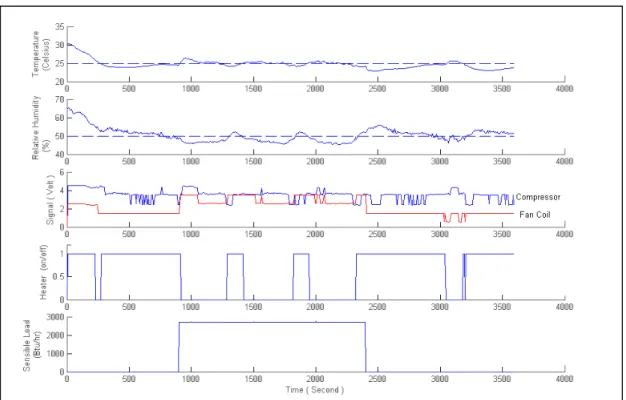
The proposed air conditioning system with fuzzy logic controller has been installed in a room test bed and has been integrated with a data acquisition system for collecting test data. The system has performed well in maintaining the comfort level based on temperature and relative humidity parameters.The experimental results were showed without heat load and with heat load conditions as shown in Figure 7 and Figure 8 respectively. In Figure 7, the temperature and relative humidity set points are 25 degree Celsius and 50% RH with small heat transfer from outside. The transient responses of room temperature and room relative humidity were presented as well as the control signals were calculated to regulate compressor speed, fan speed and ON/OFF the heater as shown in Figure 7. The time spent for room temperature and relative humidity reach steady state are approximately ten minutes. The steady state errors of temperature and relative humidity are +/- 1.0 degree Celsius and +/- 2.0 % RH as shown in
Figure 7.
Figure 7 .Response of room temperature and relative humidity for no heat load condition
Figure 8 Response of room temperature and relative humidity with heat load condition
The set points of room temperature and relative humidity are 23 degree Celsius and 50% RH with heat load condition as shown in Figure 8. The responses of room temperature and relative humidity as well as control signals to regulate compressor speed, fan speed and ON/OFF heater were shown in Figure 8. The time spent to reach steady state of room temperature and relative humidity are also approximately ten minutes and the offsets are also +/- 1.0 degree Celsius and +/- 2.0 % RH with heat load condition as shown in Figure 8.
5. CONCLUSION
The split air conditioning system using fuzzy logic controller has been installed and implemented successfully with two input signals to the controller with three outputs to control both room temperature and relative humidity and can be concluded as:
1. The implement of fuzzy logic controller to control both room temperature and room relative humidity are successfully which has performed well in maintaining the comfort level. 2. The offset of temperature and relative humidity are within +/- 1.0 degree Celsius and +/- 2 percent in relative humidity respectively.
3. The fuzzy logic controller give fast response for the proposed air conditioning system. The system can reach steady state within ten minutes.
4. The fuzzy logic controller with the combination of inverters for variable speed of compressor motor and fan motor give high energy efficiency.
6. REFERENCES
[1] M. S. Imbabi : “Computer validation of scale model tests for building energy simulation”, Int. J. Energy Res., vol. 14 , pp.727-736, 1990.
[2] B. Arguello, S. Miguel, “ Nonlinear Control of a Heating , Ventilating and Air Conditioning System with Thermal Load Estimation”, IEEE Transaction on Control Systems Technology, Vol. 7, No. 1, January 1999.
[3] Piao Ying-guo, Zhang Hua-guang : “A Simple Fuzzy Adaptive control Method and Application in HVAC”
IEEE , pp 528 – 532 ,1998.
[4] C. Georgescu, A. Afahari, and G. Bornard, “Fuzzy Predictive PID Controllers: A Heating Control Application”,Proceedings of the 2nd IEEE International Conference on Fuzzy Systems (FUZZ-IEEE’92), Vol.II, pp.1091, 1993.
[5] L. Fortuna, G. Muscato, G. Nunnari and L.Occhipinte, “Neural Modelling and Fuzzy Control: An Application to Control the Temperature in a Thermal Process”, Proceedings of the 2nd IEEE International Conference on Fuzzy Systems (FUZZ-IEEE’93) , Vol.III, pp.1713, 1994. [6] G. Manish, P.Y. Woo, “Efficiency of fuzzy and Adaptive fuzzy controllers relative to PID Controller
in Temperature control” , pp. 55 – 60, IEEE, 1996.