260
|
wileyonlinelibrary.com/journal/etrij ETRI Journal. 2021;43(2):260–271.O R I G I N A L A R T I C L E
Hybrid genetic-paired-permutation algorithm for improved VLSI
placement
Vladimir V. Ignatyev
1|
Andrey V. Kovalev
2|
Oleg B. Spiridonov
1|
Viktor M. Kureychik
3|
Alexandra S. Ignatyeva
3|
Irina B. Safronenkova
4 1Department of the Design Bureau ofModeling and Controlling Systems, Southern Federal University, Rostov Oblast, Russia
2Engineering Center of Radio and Microelectronic Instrument Making, Southern Federal University, Rostov Oblast, Russia
3Department of Computer-Aided Design Systems, Southern Federal University, Rostov Oblast, Russia
4Federal Research Center, The Southern Scientific Center of the Russian Academy of Sciences, Rostov-on -Don, Russian Federation
Correspondence
Vladimir V. Ignatyev, Department of the Design Bureau of Modeling and Controlling Systems, Southern Federal University (SFU), Rostov Oblast, Russia. Email: [email protected] Funding information
This work was supported by the project "Creating a high-tech production of hardware and software systems for processing agricultural raw materials based on microwave radiation" (Agreement with the Ministry of Education and Science of the Russian Federation, No 075-11-2019-083, dated 20.12.2019; Agreement Southern Federal University, No 18, dated 20.09.2019; work number in Southern Federal University, No HD/19-25-RT).
This paper addresses Very large-scale integration (VLSI) placement optimization, which is important because of the rapid development of VLSI design technologies. The goal of this study is to develop a hybrid algorithm for VLSI placement. The proposed algorithm includes a sequential combination of a genetic algorithm and an evolutionary algorithm. It is commonly known that local search algorithms, such as random forest, hill climbing, and variable neighborhoods, can be effectively applied to NP-hard problem-solving. They provide improved solutions, which are obtained after a global search. The scientific novelty of this research is based on the develop-ment of systems, principles, and methods for creating a hybrid (combined) placedevelop-ment algorithm. The principal difference in the proposed algorithm is that it obtains a set of alternative solutions in parallel and then selects the best one. Nonstandard genetic operators, based on problem knowledge, are used in the proposed algorithm. An investigational study shows an objective-function improvement of 13%. The time complexity of the hybrid placement algorithm is O(N2).
K E Y W O R D S
evolutionary algorithm, genetic algorithm, multi-objective optimization, VLSI design, VLSI placement
This is an Open Access article distributed under the term of Korea Open Government License (KOGL) Type 4: Source Indication + Commercial Use Prohibition + Change Prohibition (https://www.kogl.or.kr/info/license.do#05-tab).
1
|
INTRODUCTION
Very large-scale integration (VLSI) is one of the most widely used technologies for microchip processors, integrated cir-cuits (IC), and component design. In today's world, VLSI chips are widely used in various branches of engineering; for example, voice and data communication networks, digital signal processing, computers, commercial electronics, auto-mobiles, medicine, etc.
In the present stage of technological development, VLSI designs are very complicated and have high dimensionalities. In this context, applying traditional computer-aided design al-gorithms is ineffective because of the length of the computa-tional process. Moreover, new trends in VLSI manufacturing technology restrict the usage of traditional design methods and approaches. VLSI technologies have multiple advantages, such as compactness, low cost, low power consumption, high reli-ability, and wide functionality [1,2]. As modern VLSI design technologies play a major role in the manufacturing of high-tech electronic circuit boards, developing new computer-aided design methods and algorithms is an urgent task [3].
VLSI placement is a crucial step in modern physical VLSI design. Formally, placement involves computing an optimal variant for arranging the components on the board, in accor-dance with a set of criteria [4].
The latest research in VLSI design shows that a great many scientists are focused on developing methods and al-gorithms for multi-objective VLSI placement optimization. This is because the VLSI placement determines the speed and quality of the routing. Consequently, an optimal element arrangement on a chip increases the reliability of the entire designed product. It also reduces the size of the structural units and minimizes mutual pickups, signal delays, and the lengths of the interconnections [5].
Classical methods for multi-objective problem-solv-ing in computer-aided design (CAD) are branch and bound methods, scalarizing objective functions by using weighting coefficients, and sequential optimization [6,7]. Reducing a multi-objective problem to a single-objective problem with sequential optimization has several disadvantages.
First, the solution to a single-objective optimization prob-lem depends on the parameter restrictions, which are imposed by an engineer. If the restrictions are incorrect, a solution will have no practical meaning, and/or will not produce an opti-mal result. Moreover, better solutions may exist, which will not be considered.
Second, many optimization algorithms used in modern industrial CAD systems are based on single-criterion opti-mization methods, whereby a set of criteria are optimized se-quentially. Therefore, the result largely depends on the order of the optimization criteria. When sequential optimization takes place, multi-objective optimization (MOO) loses its meaning.
In CAD, the broadcast method of MOO problem-solving is a natural process with system simulations. It generally in-volves evolutionary and genetic algorithms (GAs), annealing modeling algorithms, various swarm-intelligence methods, and others [8,9]. Hybrid algorithms combine GAs with other search methods. With this method, an alternative solution is optimized in each generation. Then, the best solutions are ex-changed. This mechanism is relatable to Lamarck evolution, when each alternative solution can learn, and then transfer new "skills" to a new generation [10,11].
For example, in [12,13], evolutionary and co-evolutionary methods were developed to reduce the soft error rate, which applies to chips in aerospace applications. The proposed methods were based on a GA and particle swarm optimiza-tion (PSO) and improved the convergence rate and cost of the former methods.
Algorithm integration allows us to use the advantages of both algorithms. To overcome local-optima problems, an approach based on a combination of genetic global search algorithms and local search algorithms appears to be very promising. The consistent performance of global and local search algorithms suggests that they are the simplest and most effective methods of combining standard cells. A se-quential strategy is the frame for the hybrid algorithm pro-posed in this paper.
2
|
LITERATURE REVIEW
As VLSI technologies have developed, new design trends have appeared. Because of element size and signal delay re-duction, over 80% of the total time delay now corresponds to interconnection delays. In this context, placement is becom-ing increasbecom-ingly important, and new methods are required [14,15].
The main advantage of evolutionary methods is that they provide a set of alternative solutions for parallel computing. They are a powerful tool for overcoming local optima [16,17].
One solution for VLSI placement is PSO [18,19]. This approach is very effective when solving for an optimum at the initial placement stage.
Maji and others [20] proposed an evolutionary algorithm called craziness-based PSO (CRPSO) for optimizing the floor planning of a VLSI chip. It was used to speed up local searches and improve the precision of the solution. The main objective of floor planning optimization is to minimize the chip area and the interconnection wirelength.
Laudis and others [21] focused on the multi-objective bat algorithm (MOBA), a biologically inspired metaheuris-tic, and successfully used it to improve the floor planning in VLSI design. The algorithm's key idea is to simulate bats' echolocation abilities to optimize the placement. The place-ment was considered as a MOO problem, wherein equal
importance was given to wirelength minimization and dead-space minimization.
To improve the quality of a VLSI implementation, Basir-Kazeruni [22] proposed a new temperature-uncertainty formulation during the clock-tree synthesis process called stochastic perturbation-based clock optimization (SPECO). The study considers the effect of a chip's temperature varia-tion on the synchronizavaria-tion quality, which in turn has a great influence on the speed of modern VLSI chips. Experimental results showed a significant reduction in the dephasing and computational complexity.
Later, Yang and associates [23] proposed a new mixed al-gorithm that combined the ant-colony alal-gorithm and the tabu search algorithm to improve the net routing design scheme in a VLSI physical design. The results showed that the new al-gorithm avoided the low convergence rate in the initial stage of a basic ant-colony system. The efficiency of the tabu-ant colony system improved by approximately 16.667%, com-pared to existing approaches. Moreover, it effectively avoided local optima.
Subhojit and Susovon [24] presented an efficient tech-nique for designing a fixed-order compensator for com-pensating the current-mode control architecture of DC-DC converters. The proposed algorithm involved combining a population search-based optimization approach, specifically, PSO, and a local search-based method.
Although many scientists have tried to improve VLSI placement by developing new algorithms and techniques, the high computational complexity problem has not been ad-dressed until recently.
Martins and associates [25] focused on the concept of MOO while automating the placement in analog integrated circuit layout design. An innovative archive-based multi-objective simulated-annealing algorithm, operating over an absolute representation, is proposed to optimize the placement of each proximity group. In contrast to traditional single-objective placement approaches, the resulting Pareto fronts, represent-ing the trade-offs between the optimization objectives of each group, are combined, bottom-up, through the design hierarchy, until a final front is obtained. In this manner, the problem's complexity is reduced, and split over multiple executions of the optimization kernel with fewer design variables. Moreover, the analog designer becomes aware of the design trade-offs.
Taher and others [26] presented PASSIOT, a new ap-proach for multi-objective-optimized synthesis of analog circuits, based on computing Sobol' indices for the vectors of their input variable parameters. PASSIOT was simulated using real optimization functions and was proven competitive in terms of runtime and solution quality.
In [27], to efficiently optimize a multi-objective thermally aware nonslicing floor planning method, an adaptive hy-brid memetic algorithm was presented to optimize the area, total wirelength, and maximum and average temperatures of
a chip. In [27]'s proposed algorithm, a genetic search algo-rithm is used as a global search method to explore the search space as much as possible. A modified simulated-annealing search algorithm is used as a local search method to exploit the information in the search region. The global exploration and local exploitation are balanced by a death-probability strategy. Experimental results on standard test benchmarks showed that the proposed algorithm efficiently obtained floor plans, while decreasing the average and peak temperatures.
In [28], the authors presented a smart decision-making hybrid PSO-GA that tried to reduce the area, wirelength, and hotspots by distributing the temperature evenly across the chip. A B* tree was used to generate the initial floor plan, and later, a PSO-GA–based hybrid algorithm was used to ob-tain an optimal placement solution. Temperature-driven floor planning was considered at the perturbation stage to sepa-rate the hotspots, thereby reducing the average and maximum temperatures. The experimental results showed that the pro-posed algorithm created an efficient floor plan, with reduced average and peak temperatures.
In [29], the authors described a two-phase method that combined an ant-colony algorithm and a simulated-anneal-ing method to conduct VLSI placement with a fixed distance between placement rows.
2.1
|
Genetic algorithms for VLSI placement
Genetic algorithms are stochastic search algorithms. However, they have evolutionary development strategies, which are based on programmable selection and reproduc-tion mechanisms, leading to near-optimal solureproduc-tions. The effectiveness of a GA depends largely on the specificity of the current task, and applying new and modified search pro-cedures [30]. The specificity of the current problem is con-sidered during the structure development, and while creating the chromosome encoding and decoding principles. When a GA is developed, it is desirable to have homologous chromo-somes (chromochromo-somes with an identical structure and length, and containing information on an identical set of solutions). It prevents nonrealistic solutions and simplifies the genetic-operator execution process [31].
Singh and Jain [32] proposed an intellectual approach for VLSI placement, which was based on a heuristic placement strategy and their entropy-based intelligent genetic algorithm (EBIGA). The concept of entropy was introduced in the GA to resolve the problem of finding local optima. The experi-mental results demonstrated that EBIGA could achieve op-timal and competitive solutions for both fixed-outline and outline-free floor plans.
In [33], artificial intelligence-based nature-inspired techniques, such as ant-colony optimization (ACO), modified ant-colony optimization (MACO), artificial
bee-colony optimization (ABC), bat, and firefly algorithms were proposed to perform effective test scheduling, thereby reducing the total cost of the chip. The performance of the various algorithms was evaluated, and it was concluded that the bat algorithm performed best in reducing the over-all testing time of a system-on-a-chip (SoC). Hence, the SoC cost was also reduced.
In [34], the ACO, MACO, ABC, Modified ABC, Firefly, and Modified Firefly test-scheduling algorithms were tested on two SoC benchmark circuits. When compared with the ACO, Modified ACO, ABC, Firefly, and Modified Firefly algo-rithms, the Modified ABC algorithm's testing time was faster by 82%, 69%, 25%, 43%, and 48% for the d695 SoC, and 80%, 73%, 20%, 41%, and 47% for the p22810 SoC, respectively.
The advantage of GAs is a linear evaluation of the time and space complexities of the genetic procedures that are performed during each iteration. This enables the solution of high-dimensional problems, and is important for the VLSI design process. Many methods are available for selecting a chromosome-mutation engine, and for selecting solutions from the population for the next iteration, depending on how they influence the algorithm convergence.
It is possible to improve GA efficiency by using its par-allelization and subsequent chromosome migration among the populations [35]. Although GA has natural parallelism [36], this ability complicates the algorithm implementation, increasing its time and space complexity.
Genetic algorithms also have disadvantages. During a genetic search, many solutions, which are dispersed across the search space, are examined at the beginning of the search. However, some solutions that are worse in comparison with others, but belong to an area with points of global optimum, can be lost.
Another problem with a genetic search is that the solutions from the evolving population are near-optimal. Genetic search mechanisms, which realize stochastic variations, do not often find the chain of changes that lead to an optimum. Hence, rea-sonable changes are needed, which will achieve an optimum. Analyses have presented a great variety of methods and approaches for VLSI placement, indicating the relevance of the current research. However, placement optimization with regard to the interconnection delay has not been fully covered in the reviewed literature. Therefore, this domain should con-tinue to be studied.
The current study proposes a new hybrid VLSI place-ment algorithm that involves a sequential strategy combining global and local searches.
3
|
PROPOSED METHOD
The additive approach is a well-known method of forming complex placement criteria. Each partial optimization crite-rion contributes to the total value of the complex objective
function. Then, the significance of its contribution is deter-mined by the user with the help of a weighting factor for each partial criterion [37].
For additive criterion, the complex objective function is as follows:
where α, β, and γ are significant weighting factors and satisfy the conditions α + β + γ = 1; fH
1 is the normalized indicator of the
total circuit length, which is defined as the sum of the semi-pe-rimeters of the describing rectangles; fH
2 is the normalized
indi-cator of the number of critical circuits, where the delay exceeds the maximum allowed; fH
3 is the normalized routability indicator,
which corresponds to the total area of all intersecting areas, which are formed by the describing rectangles of the circuits.
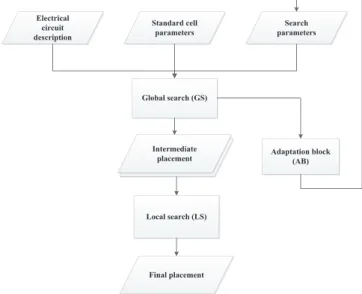
The proposed VLSI placement algorithm consists of two stages. In the first stage, a global search is performed using the modified GA. Subsequently, a local search takes place based on the paired-permutation algorithm. A flowchart of the computational process is shown in Figure 1.
The input data for the hybrid algorithm are as follows: - Electrical schematic, which includes the information about
a set of topographical features and a list of circuits that will be implemented in a standard cell;
- Parameters of the designed standard cell, such as the phys-ical dimensions of the work field, step of an approximat-ing grid, and manufacturapproximat-ing technology;
- Search parameters, including GA parameters, weighting factors, and a number of solutions that will be improved with the help of a local search algorithm.
A global search is performed with a modified GA, which provides a set of midline placements. A local search involves (1)
F = 𝛼f1H+𝛽f2H+𝛾f3H→ opt,
FIGURE 1 Flowchart of the computational process
Electrical circuit description
Standard cell
parameters parametersSearch
Global search (GS) Local search (LS) Intermediate placement Final placement Adaptation block (AB)
launching the paired permutation (PP) algorithm for each of the received placements. Then, the best solution is selected from among the local search results.
The adaptation block accomplishes the following functions:
- Changes the probability of crossover and mutation op-erators during the GA execution to increase the pop-ulation diversity at the beginning of the algorithm (by increasing the mutation probability). It also increases the algorithm convergence rate for the last of the iterations (by increasing the probability of crossovers);
- Defines the number of interim placements, which are im-proved by the algorithm, depending on the population di-versity and size.
The placement of a standard cell is described with a chromosome, called an alternative solution (AS), each gene of which corresponds to a fixed position in the work field.
Each gene contains information about which topographi-cal feature is assigned to its corresponding position. Hence, the gene value can change within the limits of the element numbers. The gene values cannot be repeated in the chro-mosome because an element cannot be assigned to multiple positions simultaneously. All gene values in a chromosome must be unique; hence, these chromosomes are nonhomolo-gous and require using modified genetic operators, which do not cause illegal solutions [38].
An assessment of the decision quality is conducted in ac-cordance with the complex objective function. The algorithm for calculating a solution to the objective function is written as follows:
For each placement i in the population:
1. Evaluate f1i, f2i, and f3i partial objective functions.
1.1. Iff1i≥f1 max, then f1 max=f1i.
1.2. Iff2i≥f2 max, then f2 max=f2i.
1.3. Iff3i≥f3 max, then f3 max=f3i.
2. Evaluate normalized partial objective functions for placement i:
3. Evaluate the complex objective function for placement i:
The procedures for evaluating partial objective functions are performed in linear time with respect to the number of el-ements, N, which should be allocated. Therefore, evaluating
one solution to an objective function has the time complexity
O(N).
The proposed GA contains crossover, mutation, selection, and aging operators. Because chromosomes are nonhomolo-gous and illegal solutions are not permitted during the algo-rithm performance, the following modifications of the main operators were chosen: a single-point ordered crossover op-erator and a two-point mutation opop-erator.
The aging operator (AO) selects only “young” individ-uals that have been living for less than a given number of iterations. One iteration is equal to 1 year in the life of an individual. The AO enhances the variability of the solutions and acts as a counter. If an individual reaches the maximum age, it dies and is replaced by a new one, with age zero. The individual age neither mutates nor crosses.
The AO helps to decrease the probability of local optima. It controls the individual lifetimes and eliminates solutions that have been living for several iterations.
It is necessary to assign each individual a value equal to zero. If the CO or MO has not been applied to this individual during the GA operation, then, in the new population, its age will increase by one. If its age exceeds a given value, this individual is eliminated.
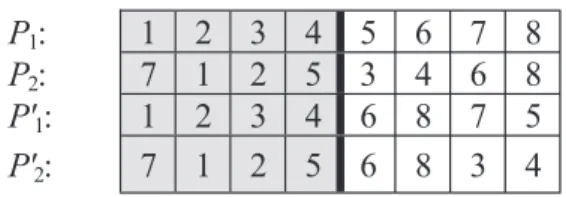
The crossover point is selected randomly during the ordered crossover operator's (CO) performance. Then, the left segment of the first parent P1 is copied to the first
de-scendant P'1. The remaining gene values of the first
de-scendant P'1 are copied from left to right from the second
parent P2, beginning from the cut point, except for the
el-ements that have already been included in P'1. The second
descendant P'2 is treated in the same manner, using the
second parent. As a result of the CO execution, the descen-dant with the better objective-function value is chosen. The ordered CO is performed in linear time, with respect to the number of elements, N. Hence, its time complexity is O(N). An example of an ordered crossover operation is shown in Figure 2.
Two cut points are selected randomly during the mutation operator (MO) execution. Then, the values are exchanged between genes that were chosen within the chromosome. A two-point mutation is performed in constant time. Therefore, the time complexity of MO is O(1).
A selection operator chooses one solution from the popu-lation for the subsequent crossover and mutation operations. The selection, which is based on a roulette wheel, is used in (2) f1iH= f1i f1 max , f2iH= f2i f2 max , f3iH= f3i f3 max . (3) Fi=𝛼f1iH+𝛽f2iH+𝛾f3iH.
FIGURE 2 Example of an ordered crossover operation
P
1:
1 2 3 4 5 6 7 8
P
2:
7 1 2 5 3 4 6 8
P'
1:
1 2 3 4 6 8 7 5
the proposed algorithm. In this case, the probability P(xi) of
selected solution xi is defined by (4):
where F(xi) is the objective-function value of solution xi; and M
is the population size.
The solution selection, which is based on a roulette wheel, is performed in linear time, relative to the population size, M. Its time complexity is O(M) [39].
The proposed GA consists of the following procedures: 1. Create the initial solution population.
2. Apply the operations and select the solutions, until the specified number of G iterations is performed:
2.1. Apply an ordered CO to the solutions that were se-lected from the current population by the selection op-erator, in accordance with the crossover probability P, and obtain new solutions.
2.2. Apply a two-point MO to the solutions that were selected from the current population by the selection operator, in accordance with the probability P of the mutation operator, and obtain new solutions.
2.3. Select new and old solutions based on an elitist strat-egy for the next generation.
3. Output the set of the best solutions (D).
The initial solution population is created randomly and based on the "shotgun" strategy to maximally cover an ac-ceptance placement region and prevent local optima. This procedure is performed in linear time, in relation to the num-ber of elements N. It requires the evaluation of the objective function for each new solution; thus, the time complexity of this procedure is O(M × N).
Traditionally, the probability of CO and MO is deter-mined by the number of new solutions that they create. Thus, new solutions P(OK) × M are formed by CO and P(OM) × M are formed by MO. The proportion of P(OK) and P(OM) af-fects the solution diversity in the population. Creating a new solution requires a selection operator and the recalculation of the objective function for each CO and MO call.
Selecting the solutions for the next generation uses the elitist strategy and is performed as follows. Solutions from the current population are combined with new solutions, which were obtained using the genetic operator applica-tion, and are ranked according to the objective-function value. The M best solutions are selected for the new gener-ation. Therefore, the population size is permanent in each generation. The selection for the new generation requires an objective-function recalculation for M × 2 solutions. Hence, the time complexity of the selection procedure is
O(N × M).
After evaluating the execution time of the GA blocks, a theoretical evaluation of the complete algorithm can be con-ducted. Thus, the GA operating time is proportional to the product of the number of allocated elements (N) times the population size (M) times the number of genetic search gen-erations (G): N × M × G. P(CO) and P(MO) are the probabil-ities of CO and MO, respectively. D is the number of interim placements in a hybrid algorithm, which are the search or hybrid algorithm parameters.
The paired-permutation algorithm (PPA), which performs a local search in the solution neighborhood that was obtained by the global search, uses the same solution model and deci-sion-quality assessment method as the proposed GA.
Following is the PPA execution scheme:
1. Sort the allocated elements of the number of links in descending order.
2. Perform the test permutations with the following (N – i) elements for each i-th element:
2.1. Evaluate the objective function for each permutation. 2.2. If certain permutations improve the objective func-tion, select the one among them that improves it in the greatest degree.
3. Output the resultant placement.
The described PPA performs N iterations, for each of which, (N – i) permutations are performed, where i is the iter-ation number. Evaluating the objective function does not re-quire its complete recalculation, which was described above; hence, it is performed in constant time: O(1). Thus, the theo-retical evaluation of the PPA time complexity is O(N2).
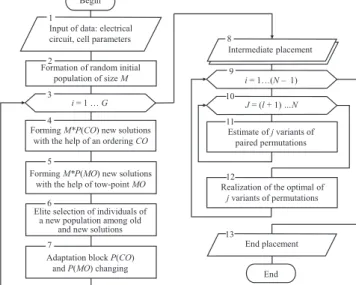
Figure 3 shows a flowchart of the developed hybrid place-ment algorithm. The theoretical evaluation of the hybrid al-gorithm time complexity is O(N2).
The program that implements the proposed hybrid place-ment algorithm for VLSI eleplace-ments in standard cells was de-veloped using Microsoft Visual Studio 2010 Express and was written in C# for execution in a Windows environment.
The developed program allows us to allocate up to 500 device features, which connect up to 800 circuits. Files of a certain for-mat are used for data transfers between the placement program and the software for other stages of standard cell-topology syn-thesis. The user interface of the program is shown in Figure 4.
A program window contains a main menu, the input tools for the placement source data, and the tools for presenting the results. The main menu controls the input and output data flow, searches the results for the optimal placement, selects the tracing method (dynamic or static tracing), and provides online help.
The «Search Settings» console is presented in Figure 5. It displays the main algorithm parameters, such as the number of generations in a genetic search, the solution population size, the probability of applying crossover and mutation operators, and the number of interim placements, which were obtained by the GA. (4) P(xi) = F(xi) ∑M j=1F(xj) ,
When the "Automatic configuration" is selected, the ge-netic-search adaptation unit automatically selects crossover and mutation probability settings, and the number of interim solutions.
The «Placement Criteria» console allows priorities to be set for partial optimization criteria, such as the total length, number of circuits with a critical signal delay, and the traceability while the search takes place. Weight values can be inserted in the ed-itable fields, and determine the contribution of each criterion.
The results of the placement algorithm are displayed on the «Search Results» and «Placement» tabs. The first tab contains a graph of the objective-function changes, the al-gorithm run time, and the obtained estimates of the partial optimization criteria. The second tab contains a visual repre-sentation of the obtained placement.
The «Search Results» tab contains a graph of the objec-tive-function changes that occurred during the placement al-gorithm performance (Figure 6).
The graph can change dynamically during the algorithm per-formance (if the corresponding check box is set). In this case, values are scaled dynamically, enabling the optimization pro-cess to be visualized more clearly. If the dynamic output is dis-abled, the graph will change only after the algorithm completes. The objective-function diagram consists of two parts, cor-responding to the different stages of the hybrid algorithm. The solid line corresponds to the global genetic search imple-mentation and the dashed line corresponds to the local search implementation.
The «Placement» tab contains a visual representation of the resultant placement. In the first stage, a regular grid, which is the height and width of a standard cell, is displayed. In the sec-ond stage, the transistor output is displayed, in accordance with its number in the list of elements. The circuit display is also provided. The critical circuits, where the signal delay exceeds the specified level, are indicated in red; the others are green. The color intensity of the circuits depends on the density of the links.
The described visualization methods allow us to observe the placement quality from the viewpoint of all of the partic-ular optimization criteria. The number of critical circuits is estimated by the proportion of red and green colors.
The traceability is estimated, based on the color intensity difference between the different areas of the work field. FIGURE 3 Flowchart of the hybrid-placement algorithm
1 2 3 4 5 6 7 8 9 10 11 12 13 Begin
Input of data: electrical circuit, cell parameters
Formation of random initial population of size M
i = 1 … G
FormingM*P(CO) new solutions with the help of an ordering CO
Adaptation block P(CO) and P(MO) changing Elite selection of individuals of
a new population among old and new solutions FormingM*P(MO) new solutions
with the help of tow-point MO
End placement
End Realization of the optimal of
j variants of permutations Estimate of j variants of paired permutations J = (l + 1) …N i = 1…(N – 1) Intermediate placement
FIGURE 4 User interface
FIGURE 5 «Search Settings» console
FIGURE 6 «Search Results» tab
Objective function change chart
Objective function valu e Iterations 150 100 50 0 80 85 90 95 100 105 Global search Local search
4
|
RESULTS
The experimental studies are conducted on the presented hy-brid algorithm to determine the parameters that enable the algorithm to achieve globally optimal solutions in the mini-mum amount of time. They also prove the effectiveness of the proposed algorithm.
Experimental studies were conducted for 50 randomly generated schemes, and for 50 real cell schemes, which were taken from the NanGate library. The randomly generated schemes have the following characteristics:
- Number of elements ≤200;
- Number of circuits ≤800 (it exceeded the amount of ele-ments three or four times);
- Number of united elements in one circuit.
α, β, and γ are chosen by the decision maker for f1H, f2H,
and f3H, respectively. As a rule, α = 0.6, β = 0.2, and γ = 0.2;
however, they can be changed in compliance with a given technical design specification. In some cases, recommenda-tions and expert systems can be applied.
The 45-nm NanGate Open Cell Library [40] is an open library of 45-nm standard cells, which is designed for testing and researching computer-aided design tools for electronic computing equipment. The library contains all widely used standard cells, from simple buffers to complex triggers, with editable values.
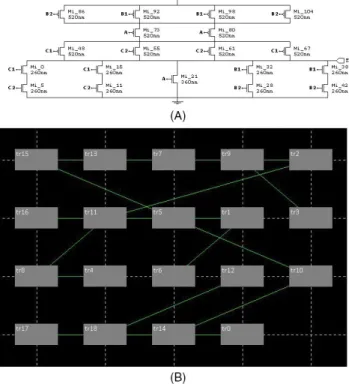
All cells are presented in several variants for standard syn-thesis routes in the standard cell stages of placement and tracing. Figure 7A,B shows the placement result, which was ob-tained using the proposed hybrid algorithm, for a standard cell of the NanGate 45-nm Open Cell Library. Figure 7A demonstrates the initial electrical circuit (19 elements) and Figure 7B shows the obtained placement.
The objective function is improved by 13%, and is shown in Figure 8.
A series of experiments with different numbers of N was performed to estimate the time-expenditure growth. During the experiments, the number of elements was changed from 20 to 1000 in 20-element increments. The number of gen-erations and the size of the population remained constant at 50. The time complexity of the program diagram is shown in Figure 9.
The obtained diagram indicates the quadratic nature of the algorithm's time complexity, which agrees with the theoreti-cal estimation obtained previously.
In general, the amount of memory required for a software algorithm implementation is equal to the amount of memory occupied by the program, output, and intermediate data.
The size of the input and output data is determined by the number of elements, circuits, and other standard cell parameters, which are specified by a user. The size of the
intermediate data varies and depends on the search param-eters, which are also specified by a user. The minimum and maximum amounts of memory required for the ex-perimental-study implementation are 5 MB and 26 MB, respectively.
FIGURE 7 Standard cell placement using NanGate library elements. (A) Initial electric circuit, (B) obtained placement
FIGURE 8 Objective function improvement chart
Objective function change chart
Objective function valu e Iterations 60 40 20 0 80 85 90 95 100 105 Global search Local search
The heuristic algorithm effectiveness considers the degree of the planned action implementation and the achieved re-quired objective-function values [41,42].
In accordance with this definition, the efficiency of the proposed algorithm can be estimated by the number of glob-ally optimal solutions obtained in a single launch, as well as by the number of independent algorithm runs, which guaran-tee the achievement of the global optimum.
Because a global placement optimum is not known, all solutions that are within 10% of the best solution obtained from the series of launches are considered optimal. The prob-ability of an optimum achievement in at least one indepen-dent launch is expressed by the relation:
where P1 is the required probability; P2 is the probability of an
optimum achievement in a single launch; and R is the number of launches in the series.
When a probability value P1 is specified, for example,
99%, the sufficient number of independent launches can be calculated:
The probability of achieving an optimum in a single launch, P2, depends on the parameter quality of the
ge-netic search; namely, the number of generations in each launch, G, and the population size, M. To determine the dependence of the probability of global optimum
achieve-ment P2 on the number of search iterations (number of
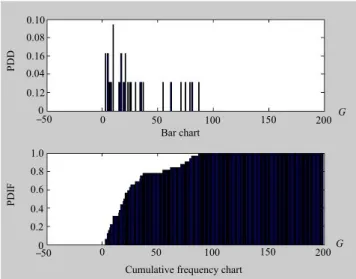
generations), G, it is necessary to construct a histogram that reflects the probability distribution density (PDD), and a histogram of the accumulated frequency, which cor-responds to the probability distribution integral function (PDIF).
Figure 10 shows the results of the experimental character-istic studies, discussed above. The experiment included 1000 search algorithm runs with a population size M = 150. The
maximum iteration number Gmax = 200.
With the help of the integral probability distribution function diagram and the time complexity diagram, com-bination of the optimal population number and number of independent runs in the context of time minimization was found. The population size is M = 150, the number of re-quired hybrid algorithm runs is R = 5, and the number of generations is G = 30.
To determine the optimal population size, M, it was neces-sary to build several combined diagrams and select the opti-mal point that provided the minimum time, from the optiopti-mal points of all graphs.
5
|
DISCUSSION
The distinctive feature of the proposed hybrid algorithm is the sequential application of a modified GA and PPA for multi-objective VLSI placement.
For example, compared with [18,19], where an optimal VLSI placement is determined using algorithms based on PSO, the proposed algorithm optimizes the VLSI placement by con-sidering several criteria. Thus, a global placement method is proposed.
Metaheuristics [20,21,29] consider several optimization criteria and provide very good placement results. However, compared with our hybrid algorithm, the metaheuristic ap-proach uses a complex mathematical apparatus, which leads to increased time and computational complexity.
Other studies [23,24,28,33,34] present hybrid metaheuris-tic algorithms for VLSI optimization. However, they require significant computational resources, compared with the pro-posed algorithm.
Compared with [32], the proposed algorithm uses non-standard genetic operators, which are based on a knowledge of the specific problem to be solved. This helps avoid illegal solutions in the interim placement stage.
Using memetic algorithms for optimization [27] is also associated with long-term local searches and requires further study.
6
|
CONCLUSION
VLSI placement is one of the most important design stages and is quite relevant because of the appearance of new design trends, which require the development of new methods and algorithms. (5) P1=1 −(1 − P2)R, (6) R = [ log(1 − P1 ) log(1 − P2 ) ] .
FIGURE 10 Experimental estimates of the probability distribution functions 0.10 0.08 0.16 0.04 0.12 0 PD D ė50 0 50 100 150 200 PDIF 0 0.2 0.4 0.6 0.8 1.0 ė50 0 50 100 150 200 G G Bar chart
This paper presented a complex VLSI placement algo-rithm that accomplished the following:
- Complex placement criteria were synthesized;
- New and modified genetic operators were described by considering the specific placement features;
- A hybrid VLSI placement algorithm, based on sequen-tially applying parallel-GA and PPA usage, was presented; - Experimental studies that were carried out showed a 13%
objective-function improvement;
- The theoretical and experimental time complexities of the hybrid algorithm were presented (O(N2));
- An experimental evaluation of the algorithm time and space complexity was described, as well as the test data.
The novelty of the research lies in the choice of opera-tors, which is based on a knowledge of the current problems, alternative solution migrations within several GA iterations, obtaining a set of alternative solutions, and selecting a qua-si-optimal one.
The experimental results proved the efficiency of the pro-posed algorithm for VLSI placement. It demonstrated the usage of the proposed algorithm in the field of VLSI CAD multi-objective decision-making designs.
The list of swarm algorithms (ACO, BCA, cuckoo-search algorithm, wolf-pack search algorithm, and so forth) was assembled by the authors. Further, with the help of hybrid approaches and expert and recommendation systems, we will experimentally evaluate the placement algorithm effi-ciency, which depends on current problem knowledge. ORCID
Vladimir V. Ignatyev https://orcid. org/0000-0002-7988-3111
REFERENCES
1. L. Jain and G. A. Singh, Review: Meta- heuristic approaches
for solving rectangle packing problem, Int. J. Comput. Eng. Inf.
Technol. 4 (2013), no. 2, 410– 424.
2. K. S. P. Kumari, S. Kumar, and S. Sinha, VLSI systems energy
management from a software perspective: A literature survey,
Perspectives Sci. 8 (2016), 611– 613.
3. L. Jain and A. Singh, Non slicing floorplan representations in VLSI
floorplanning: A summary, Int. J. Comput. Appl. 71 (2013), no. 15,
12– 19.
4. T. Singha, H. S. Dutta, and M. De, Optimization of floor- planning
using genetic algorithm, Procedia Technol. 4 (2012), 825– 829.
5. A. P. Karpenko, Sovremennye algoritmy poiskovoi
optimizat-sii. Algoritmy, vdokhnovlennye prirodoi [Modern algorithms of search engine optimization: Nature- inspired optimization algo-rithms], Moscow, Bauman MSTU Publ. 446 (2014), (in Russian).
6. R. Martins, N. Lourenço, and N. Horta, Multi- objective
optimiza-tion of analog integrated circuit placement hierarchy in absolute coordinates, Expert Syst. Appl. 42 (2015), no. 23, 9137– 9151.
7. A. Darwish, Bio- inspired computing: algorithms review, deep
analysis, and the scope of applications, Future Comput. Inform. J.
3 (2018), no. 2, 1– 16.
8. V. Ignatyev et al., The fuzzy rule base automatic
optimiza-tion method of intelligent controllers for technical objects using fuzzy clustering, in Proc. Conf. Creativity Intell. Technol. Data
Sci. (Bolgograd, Russia), Sept. 2019, pp. 135– 152, https://doi. org/10.1007/978- 3- 030- 29750 - 3_11
9. V. Ignatyev et al., System for automatic adjustment of intelligent
controller parameters, in Proc. Conf. Creativity Intell. Technol.
Data Sci. (Bolgograd, Russia), 2019, pp. 226– 242, https://doi. org/10.1007/978- 3- 030- 29750 - 3_18.
10. E. Sopov, Genetic programming hyper- heuristic for the automated
synthesis of selection operators in genetic algorithms, in Proc. Int.
Joint Conf. Comput. Intell. (Madeira, Portugal), Nov. 2017, https:// doi.org/10.5220/00064 97002 310238.
11. P. Orzechowski, W. La Cava, and J. H. Moore, Where are we now?
a large benchmark study of recent symbolic regression methods,
in Proc. Genetic Evolutionary Comput. Conf. (Kyoto, Japan), July 2018, pp. 1183– 1190.
12. H. Jahanirad and K. Mohammadi, Reliable implementation on
SRAM- based FPGA using evolutionary methods, IETE J. Research
59 (2013), no. 5, 597– 603.
13. H. Jahanirad, Co- evolutionary approach to reduce soft error rate
of implemented circuits on SRAM- based FPGA, Int. J. Comput.
Applicat. 180 (2018), no. 43, 42– 49.
14. J. Funke, S. Hougardy, and J. Schneider, An exact algorithm for
wirelength optimal placements in VLSI design, Integr. VLSI J. 52
(2016), 355– 366.
15. V. Kureychik and A. Kulakov, Algorithm of thermal optimization
of placement of basic elements of VLSI, in Proc. IV Int. Research
Conf.: Inf. Technol. Sci., Manag., Social Sphere, Medicine (Tomsk, Russia), Dec. 2017 pp. 63– 67.
16. P. Bateson, Evolution, epigenetics and cooperation, J. Biosci. 38 (2013), 1– 10.
17. M. Rahul, S. Narinder, and S. Yaduvir, Genetic algorithms:
Concepts, design for optimization of process controllers, Comput.
Inf. Sci. 4 (2011), no. 2, 39– 54.
18. S. Venkatraman and M. Sundhararajan, Particle swarm
optimiza-tion algorithm for VLSI floorplanning problem, J. Chem. Pharm.
Sci. 10 (2017), no. 1, 311– 316.
19. B. Xue, M. Zhang, and W. N. Browne, Particle swarm optimization
for feature selection in classification: A multi- objective approach,
IEEE Trans. Cybern. 43 (2013), no. 6, 1656– 1671.
20. K. B. Maji et al., An evolutionary algorithm based approach for
VLSI floor- planning, in Proc. Int. Conf. Sci. Technol. (Pathum
Thani, Thailand), Nov. 2015, pp. 248– 253.
21. L. L. Laudist et al., MOBA: Multi objective bat algorithm for
com-binatorial optimization in VLSI, Procedia Comput. Sci. 125 (2018),
840– 846.
22. S. Basir- Kazeruni et al., SPECO: Stochastic perturbation based
clock tree optimization considering temperature uncertainty,
Integr. VLSI J. 46 (2013), no. 1, 22– 32.
23. P. Yang et al., Optimal approach on net routing for VLSI physical
design based on Tabu- ant colonies modeling, Appl. Soft Comput.
21 (2014), 376– 381.
24. S. Ghosh and S. Susovon, Fixed structure compensator design
using a constrained hybrid evolutionary optimization approach,
25. R. Martins, N. Lourenco, and N. Horta, Multi- objective
optimiza-tion of analog integrated circuit placement hierarchy in absolute coordinates, Expert Syst. Appl. 42 (2015), no. 23, 9137– 9151.
26. T. Kourany et al., PASSIOT: A Pareto- optimal multi- objective
op-timization approach for synthesis of analog circuits using Sobol’ Indices- based Engine, in Proc. IEEE Int. Midwest Symp. Circuits
Syst. (Abu Dhabi, United Arab Emirates), Oct. 2016, pp. 16– 19. 27. J. Chen et al., An adaptive hybrid memetic algorithm for thermal-
aware non- slicing VLSI floorplanning, Integr. 58 (2017), 245– 252.
28. P. Sivaranjani and A. Senthil Kumar, Thermal- aware non- slicing
VLSI floorplanning using a smart decision- making PSO- GA based hybrid algorithm, Circuits Syst. Signal Process. 34 (2015), no. 11,
3521– 3542.
29. J. Chen et al., Combining the ant system algorithm and simulated
annealing for 3D/2D fixed- outline floorplanning, Appl. Soft
Comput. 40 (2016), 150– 160.
30. B. Xue et al., A survey on evolutionary computation approaches
to feature selection, IEEE Trans. Evolutionary Comput. 20 (2016),
no. 4, 606– 626.
31. W. A. Albukhanajer, J. A. Briffa, and Y. Jin, Evolutionary
multi-objective image feature extraction in the presence of noise, IEEE
Trans. Cybern. 45 (2015), no. 9, 1757– 1768.
32. A. Singh and L. Jain, VLSI floorplanning using entropy based
intelligent genetic algorithm, Comput., Anal. Netw. (Chandigarh,
India), July 2018, pp. 53– 71.
33. G. Chandrasekaran, S. Periyasamy, and P. R. Karthikeyan,
Minimization of test time in system on chip using artificial intelligence- based test scheduling techniques, Neural Comput.
Applicat. 32 (2019), 5303– 5312. https://doi.org/10.1007/s0052 1- 019- 04039 - 6
34. G. Chandrasekaran, S. Periyasamy, and P. R. Karthikeyan, Test
scheduling for system on chip using modified firefly and modi-fied ABC algorithms, SN Appl. Sci. 1 (2019), no. 1, https://doi.
org/10.1007/s4245 2- 019- 1116- x.
35. E. Hancer et al. A multiobjective artificial bee colony approach
to feature selection using fuzzy mutual information, in Proc. IEEE
Congr. Evol. Comput. (Sendai, Japan), 25– 28, May 2015, pp. 2420– 2427.
36. M. Gong et al., Evolutionary computation in China: A literature
survey, CAAI Trans. Intell. Technol. 1 (2016), no. 4, 334– 354.
37. C. Wu, J. Fang, and Q. Li, Multi- material topology optimization for
thermal buckling criteria, Comput. Methods Appl. Mech. Eng. 346
(2019), 1136– 1155.
38. L. A. Gladkov, V. V. Kureichik, and V. M. Kureichik, Geneticheskie
algoritmy [Genetic algorithms], 2nd ed, Moscow: Fizmatlit, 2010,
368.
39. N. A. Sherwani, Algorithms for VLSI physical design automation, 3rd ed, Kluwer Academic Publisher, USA, (2013).
40. NanGate FreePDK45 Open Cell Library, http://www.nanga te.com/?page_id=2325
41. V. V. Kureichik and V. Kureichik, Integrated VLSI fragment
place-ment algorithm, Izvestiya SFedU, Eng. Sci. (2015), 196– 205.
42. V. V. Kureichik, V. M. Kureichik, and S. I. Rodzin, Teoriya
evoly-ucionnyh vychislenij [The theory of evolutionary computation],
OOO Izdatel‘skaya firma “Fiziko- matematicheskaya literatura”, Moscow, Russia (2012).
AUTHOR BIOGRAPHIES
Vladimir V. Ignatyev graduated from Southern Federal University, Rostov Oblast, Russia, as an engineer of infor-matics and control in technical systems in 2008. He defended his candidate's thesis in technical sciences, with spe-cialties of “System analysis, control, and Information Processing” and “Automation and control of technological processes and production” in 2011. He is currently a doctoral candidate at Southern Federal University and head of the Department of the Design Bureau of Modeling and Controlling Systems of Southern Federal University. He has authored more than 50 scien-tific publications. His scienscien-tific interests are automated control systems for technological processes, design and development of hybrid control systems, intelligent control systems, and decision support.
Andrey V. Kovalev graduated from Taganrog State University of Radio Engineering, Taganrog, Russia, as an engineer of Electronic Computing Design and Technology in 1998. In 2001, he defended his candidate's the-sis in the field of microelectronics and CAD, and in 2009, he received the degree of doctor of engineering. He has authored more than 60 scientific publications. He is cur-rently an assistant professor and head of the Engineering Center of Radio and Microelectronic Instrument Making of Southern Federal University. His scientific interests are microelectronics, methods and means of automated VLSI design, and IP core design.
Oleg B. Spiridonov graduated from Taganrog State University of Radio Engineering as an engineer of comput-ing machines, complexes, systems, and networks in 1998. In 2001, he defended his candidate's thesis on the “Use of computer technology, mathematical modeling, and mathematical methods in scientific re-search.” He is currently Director of the Design Bureau of Modeling and Controlling Systems of Southern Federal University and has authored over 130 scientific publica-tions. His scientific interests are information-measuring and control systems for the creation of ground-based and onboard-based devices.
Viktor M. Kureychik graduated from the Taganrog Radio Engineering Institute, Taganrog, Russia, in 1967 as an engineer of counting and solving instruments and devices. In 1971, he defended his thesis for the degree of candidate of technical sciences. In 1978, he defended his doctoral dissertation, and he has au-thored more than 700 scientific publications. He is cur-rently a professor at the Department of Computer-Aided Design Systems of Southern Federal University and head of the scientific school, “Theory and Practice of Designing Intelligent Problem-Oriented Information Systems based on Evolutionary Calculations.” His scientific interests are the theory of computer-aided design of computer systems based on large and super-large integrated circuits, the con-struction of intelligent information processing systems, knowledge bases, and expert CAD systems, evolutionary modeling, and genetic algorithms and their applications in CAD.
Alexandra S. Ignatyeva graduated from Southern Federal University as an engineer of information security or-ganization and Technology in 2009. She is currently a PhD student at the Department of Computer-Aided Design Systems of Southern Federal University. Her sci-entific interests are big data processing and intelligent control systems.
Irina B. Safronenkova graduated from Southern Federal University as a research teaching fellow in the field of information and computer science in 2019. She is currently a junior research scientist in the Federal Research Center at the Southern Scientific Center of the Russian Academy of Sciences, Rostov-on-Don, Russian Federation. Her scien-tific interests are intelligent CAD systems, distributed sys-tems, and ontologies.