서 론
체르노빌과 후쿠시마 원전 사고 시 다량의 방사성물질이
환경으로 누출되어 인간과 환경에 위해한 영향을 주었다(UN
SCEAR 2011; UNSCEAR 2014). 특히 후쿠시마 사고 초기 대 기로 누출된 방사성물질은 육상 및 해수면으로 침적되어 생 태 환경을 오염시켰다(Chino et al. 2011; Katata et al. 2012; Hirose 2016). 원전 사고로 인해 환경으로 방출된 방사성물 질이 인간 및 환경에 미치는 중장기적 영향을 평가하기 위해 서는 수생 환경 내 침적된 방사성핵종의 장기거동을 평가하 는 기술 개발이 필요하다(JAEA 2015). 토양침적-지표수-연안 환경 내 중장기적 방사성핵종의 거동 해석과 환경 및 보건영 향 평가를 위해서는 다양한 평가모델과 자료가 필요한데, 방 사성핵종의 지표수계 이동해석을 위한 수치모델의 중요한 입 력 자료로는 분배계수(distribution coefficient, Kd)와 농도계수 (concentration factor, CF)가 있다. 환경 내 분배계수는 토양, 담수 그리고 해양 환경 내에서 방사성핵종이 고체 및 액체와 어떻게 상호작용을 하는지 모 사하기 위해 가장 일반적으로 사용되는 변수이다. 물과 입자 사이의 핵종 치환이 전적으로 가역적이고 용해된 미립상 사 이 평형의 균형이 존재한다는 가정을 기본으로 한다(IAEA 2004). 농도계수는 생태계 내 방사성핵종의 거동을 평가하기 위해 가장 일반적으로 사용되는 접근법으로, 생물체와 환경 매체 간의 방사성핵종의 농도가 평형을 이루었다는 가정을 기본으로 하여, 토양, 퇴적토, 물, 또는 공기 내 핵종 농도로부 터 생물체 내 방사성핵종의 농도를 예측한다(IAEA 2004). 이 에 관련하여 국제원자력기구 IAEA는 인간과 환경에 대한 방 사선 영향 평가를 지원하기 위한 목적으로 여러 환경매체에
방사성핵종 전이인자
DB
연계를 위한 데이터 로더모듈 개발
서경석1,* · 민병일1· 김소라1· 박기현1· 김지윤1 1한국원자력연구원 환경안전연구실Development of Data Loader Module for Database Link of
Transfer Parameters of Radionuclides
Kyung-Suk Suh
1,*, Byung-Il Min
1, Sora Kim
1, Kihyun Park
1and Jiyoon Kim
11Environmental Safety Research Division, Korea Atomic Energy Research Institute, Daejeon 34057, Republic of Korea
Abstract - Radionuclide migration numerical model in surface water is now being developed for evaluating long-term behavior of radioactive materials released into aquatic environment from a nuclear accident. Data of distribution coefficient(Kd) and concentration factor(CF) were gathered
and constructed with database(DB) for an environmental media to use with the basic input parameter of radionuclide migration model in surface water environment. Also, a data loader module has been developed using the C language in Linux system, and it was composed of link with the radionuclide migration model efficiently for easy utilization. Developed data loader module was verified through the process of configuring DB file again after reading each data in DB. A data loader module will be updated by aquisition new data set from International Atomic Energy Agency. Key words : Radionuclide, Distribution coefficient, Concentration factor, Data loader
─ 93 ─ Technical Paper
* Corresponding author: Kyung-Suk Suh, Tel. +82-42-868-4788, Fax. +82-42-868-8943, E-mail. [email protected]
서 방사성핵종의 분배계수와 농도계수에 관한 다양한 보고서 를 발간해 왔다(IAEA 1985; IAEA 1994; IAEA 2004).
본 연구에서는 환경 내 핵종의 장기거동 평가를 위해 중요 한 인자인 분배계수와 농도계수에 대한 최신 데이터 값에 관 한 정보를 수집하고, 수생환경 내 방사능오염 평가 모델에 활 용 가능하도록 상기 인자들을 데이터베이스(Database; DB)화 하였다. 이러한 데이터베이스를 사용자가 편리하게 이용토록 데이터 로더 모듈을 개발하였고, Linux 환경에서 빠르게 필요 한 자료를 검색하여 수치모델에 연동되도록 구성하였다.
재료 및 방법
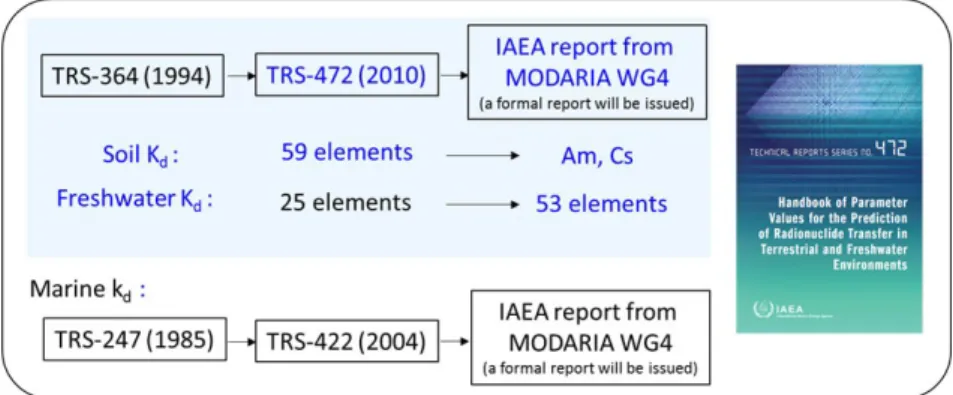
IAEA는 환경 내 핵종의 장기거동 평가를 위하여 환경 내 분배계수와 농도계수에 관한 자료를 기술보고서(TechnicalReport Series; TRS)로 발간하였다(IAEA 1985; IAEA 1994; IAEA 2004; IAEA 2010; IAEA 2014). Fig. 1과 Fig. 2에 각 각 방사성핵종의 환경 내 분배계수와 농도계수 값을 제공 하고 있는 IAEA의 기술보고서에 대한 정보를 나타내었다. 이 중 2개의 주요 보고서인 해양 환경에서의 분배계수와 농 도계수를 수록한 TRS-247(IAEA 1985)과 온대기후 내 핵 종의 거동 예측을 위한 변수 값을 제시한 TRS-364(IAEA 1994)에 해양, 담수, 그리고 육상 생태계 내 사용 가능한 핵 종 거동 관련 변수 값이 상세히 나타나 있다. 이 두 보고서 에 제시된 자료들은 다양한 분야에서 방사선환경영향을 평 가하기 위한 주요 자료로 활용되고 있다. TRS-247의 내용 을 개정하여 TRS-422(IAEA 2004)가 발간되었다. IAEA는 Environmental Modelling for Radiation Safety(EMRAS) 국
제 공동 프로그램의 일환으로 TRS-346을 개정하여 TRS-472
(IAEA 2010)를 발간하였다. TRS-364가 발간된 이후, 생산된
광범위한 새로운 데이터 세트들을 바탕으로 TRS-472가 준
비되었고, 이 보고서에 제시된 변수 값을 도출하는데 적용된
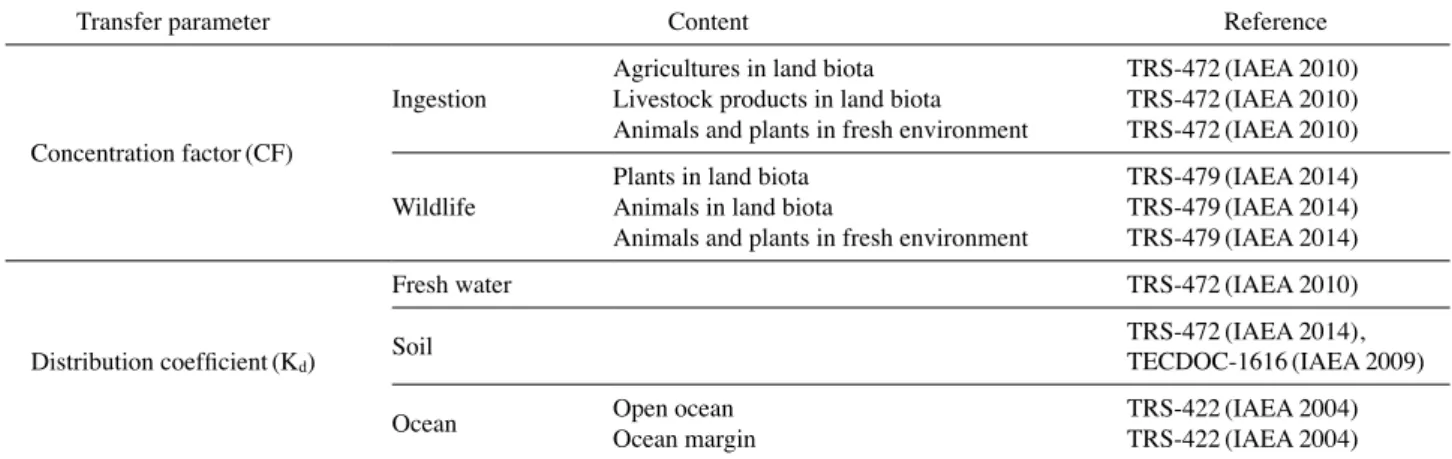
데이터와 방사선 생태학적 개념 및 모델 등에 대한 사항들은 TECDOC-1616(IAEA 2009)에 상세히 기술되어 있다. Table 1에 핵종 전이인자의 DB 수집 항목 및 자료 출처 등에 대
한 정보를 나타내었다. 담수에 대한 분배계수 Kd 값은 IAEA
의 방사선영향평가 모델 국제공동연구(Model and Data for
Radiological Impact Assessment II, MODARIA-II)의 워킹그
룹 4의 보고서가 공식 발간되고 난 후, 이를 참고하여 구축한
DB 중 일부를 업데이트할 예정이다.
데이터로더 모듈을 개발하기 위해, 앞서 언급한 IAEA의 기
술보고서들을 통해 공개된 최신의 환경 내 분배계수와 농도
계수 자료를 환경매체, 생물종, 방사성핵종에 따라 분류하여
Fig. 2. IAEA Technical Report Series(TRS) for values of concentration factor(CF) of radionuclides in environment.
각각의 데이터 파일을 생성하고, 생성된 데이터 파일 내 자료 들에 대한 검증작업을 실시하였다. 다음 작업으로 검증을 완 료한 데이터 파일로부터 사용자가 원하는 조건의 입력을 받 기 위한 컨트롤 파일을 추가하였다. 사용자의 입력을 받기 위 해 컨트롤 파일을 읽고, 조건과 일치하는 자료를 데이터 파일 에서 검색하여 출력하기 위한 소스코드를 C언어를 사용하여 작성하였다. 최종적으로 데이터를 읽어 들이는 과정에서 발생 될 수 있는 오류의 가능성을 확인하기 위하여 읽은 DB를 그 대로 다시 DB 파일을 구성하는 작업을 수행하였다.
결과 및 논의
개발 중인 수생환경 내 방사능오염 평가 모델에 활용 가능 하도록 핵종 별로 데이터베이스화한 전이인자(분배계수와 농 도계수) 자료들이 수치 모델에 바로 연계될 수 있도록 데이터 로더를 C언어를 사용하여 개발하였다. 개발된 데이터 로더 모듈은 Linux 메모리에 상주하여 접속 속도가 빠르고, 동시에 다양한 프로그램과 사용자가 이용 시 프로그램의 구동이 원 활토록 하였다. 데이터 로더 모듈은 크게 기본 구조문, 데이터 파일과, 컨트롤 파일, 컨트롤 파일을 읽는 소스코드, 컨트롤 코드에서 읽은 조건에 일치하는 자료를 데이터 파일에서 검 색하여 출력하는 소스코드로 구성되어 있다. 개발된 전이인자 의 데이터 로더 구성을 Fig. 3에 나타내었다. 1. 분배계수(Kd) 데이터 모듈 구조 분배계수 데이터는 방사성핵종과 환경 특성에 따라 정의되Table 1. Database of transfer parameters published by IAEA
Transfer parameter Content Reference
Concentration factor(CF)
Ingestion Agricultures in land biotaLivestock products in land biota TRS-472TRS-472(IAEA 2010)(IAEA 2010)
Animals and plants in fresh environment TRS-472(IAEA 2010)
Wildlife Plants in land biotaAnimals in land biota TRS-479TRS-479(IAEA 2014)(IAEA 2014)
Animals and plants in fresh environment TRS-479(IAEA 2014)
Distribution coefficient(Kd)
Fresh water TRS-472(IAEA 2010)
Soil TRS-472TECDOC-1616(IAEA 2014), (IAEA 2009)
Ocean Open oceanOcean margin TRS-422TRS-422(IAEA 2004)(IAEA 2004)
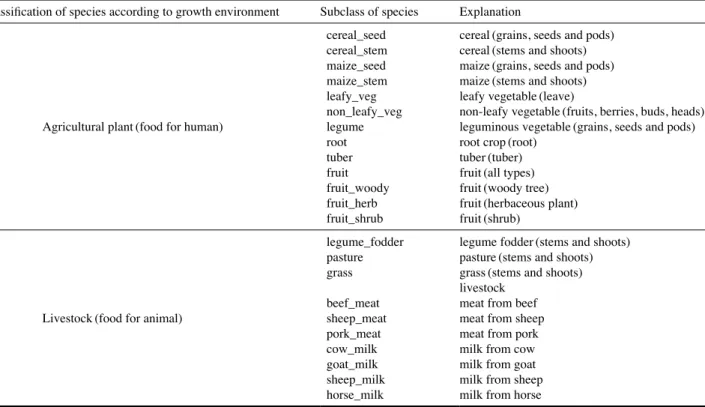
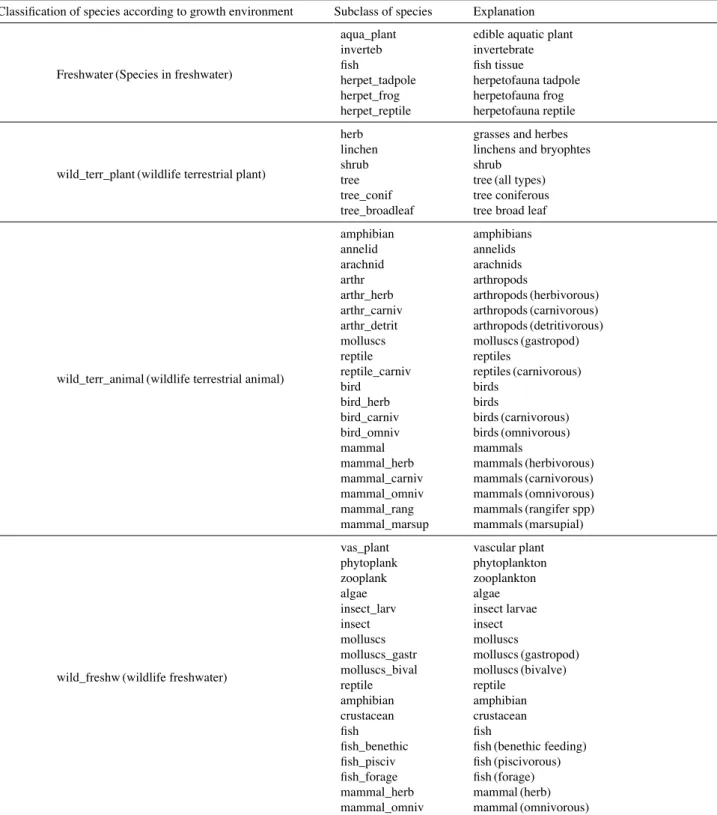
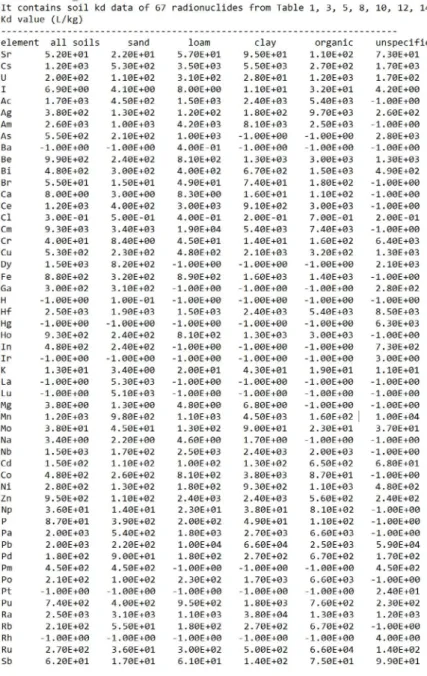
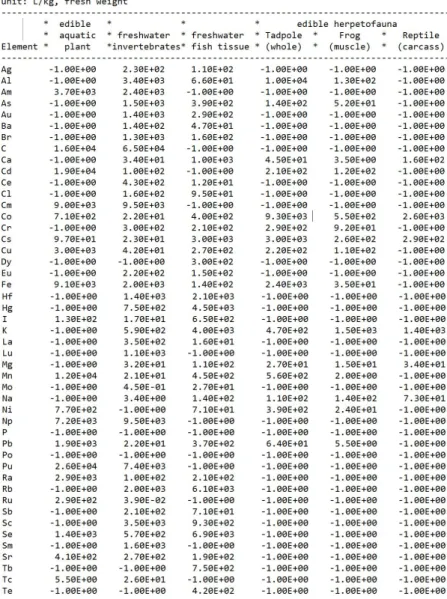
며, 환경 매체는 토양, 담수, 그리고 해양으로 분류되며, 각각의 환경 매체는 환경 내 특성에 따른 각각의 Kd 값을 가진다. Kd 데이터 모듈 구조문의 변수를 Table 2와 Table 3에 제시하였다. 2. 농도계수(CF) 데이터 모듈 구조 농도계수 데이터는 방사성핵종과 환경 특성, 생물종 등에 따라 정의되며, 생장환경에 따른 생물종 분류는 IAEA TRS-472(IAEA 2010)에 제시되어 있는 인간에 의해 재배 및 사육 되는 동·식물에 대한 분류와 TRS-479(IAEA 2014)의 야생 생태계 내 동·식물에 대한 분류를 따른다. 농도계수 데이터 모듈 구조문의 변수를 Table 4와 Table 5에 나타내었다. 3. 데이터 파일 구조 핵종전이인자의 모듈의 데이터 파일은 4개의 분배계수(Kd) 데이터 파일과 6개의 농도계수(CF) 데이터 파일로 구성되어 있으며, Table 6과 Table 7에는 각 파일에 수록되어 있는 데이 터에 대한 설명이 제시되어 있다. Fig. 4와 Fig. 5에 토양 및 담수 환경내 방사성핵종에 대한 각각 Kd와 CF 데이터 파일의 일부를 제시하였다. 데이터 파일 에서 ‘-1.00+00’으로 표기된 수치는 해당 조건의 데이터 값 이 없음을 의미한다.
Table 3. Explanation of objective contents for Kd in data loader
Environmental
target environmental targeCharacteristics of Explanation Soil
All All kinds of soil
Sand Sand
Loam Loam
Clay Clay
Organic Organic
Freshwater SusDep Suspended sedimentDeposited sediment
Ocean OpenMargin Open oceanOcean margin
Table 4. Objective contents for CF in data loader
Variable Declaration Explanation
Struct inpcf bio_grp Character Classification of species
according to growth environment
Struct inpcf bio_type Character Kinds and compartment of
species
Struct inpcf nucname Character Name of radionuclide
Struct inpcf no_nuc Integer Number of radionuclide
Struct inpcf cfval Double precision Value of CF
Table 5. Explanation of objective contents for CF in data loader
Classification of species according to growth environment Subclass of species Explanation
Agricultural plant(food for human)
cereal_seed cereal(grains, seeds and pods)
cereal_stem cereal(stems and shoots)
maize_seed maize(grains, seeds and pods)
maize_stem maize(stems and shoots)
leafy_veg leafy vegetable(leave)
non_leafy_veg non-leafy vegetable(fruits, berries, buds, heads)
legume leguminous vegetable(grains, seeds and pods)
root root crop(root)
tuber tuber(tuber)
fruit fruit(all types)
fruit_woody fruit(woody tree)
fruit_herb fruit(herbaceous plant)
fruit_shrub fruit(shrub)
Livestock(food for animal)
legume_fodder legume fodder(stems and shoots)
pasture pasture(stems and shoots)
grass grass(stems and shoots)
livestock
beef_meat meat from beef
sheep_meat meat from sheep
pork_meat meat from pork
cow_milk milk from cow
goat_milk milk from goat
sheep_milk milk from sheep
horse_milk milk from horse
Table 2. Objective contents for Kd in data loader
Variable Declaration Explanation
Struct inpkd envir Character Environmental target
Struct inpkd subcon Character Characteristics of
environmental target
Struct inpkd nucname Character Name of radionuclide
Struct inpkd no_nuc Integer Number of radionuclide
Table 5. Explanation of objective contents for CF in data loader
Classification of species according to growth environment Subclass of species Explanation
Freshwater(Species in freshwater)
aqua_plant edible aquatic plant
inverteb invertebrate
fish fish tissue
herpet_tadpole herpetofauna tadpole
herpet_frog herpetofauna frog
herpet_reptile herpetofauna reptile
wild_terr_plant(wildlife terrestrial plant)
herb grasses and herbes
linchen linchens and bryophtes
shrub shrub
tree tree(all types)
tree_conif tree coniferous
tree_broadleaf tree broad leaf
wild_terr_animal(wildlife terrestrial animal)
amphibian amphibians
annelid annelids
arachnid arachnids
arthr arthropods
arthr_herb arthropods(herbivorous)
arthr_carniv arthropods(carnivorous)
arthr_detrit arthropods(detritivorous)
molluscs molluscs(gastropod)
reptile reptiles
reptile_carniv reptiles(carnivorous)
bird birds
bird_herb birds
bird_carniv birds(carnivorous)
bird_omniv birds(omnivorous)
mammal mammals
mammal_herb mammals(herbivorous)
mammal_carniv mammals(carnivorous)
mammal_omniv mammals(omnivorous)
mammal_rang mammals(rangifer spp)
mammal_marsup mammals(marsupial)
wild_freshw(wildlife freshwater)
vas_plant vascular plant
phytoplank phytoplankton
zooplank zooplankton
algae algae
insect_larv insect larvae
insect insect
molluscs molluscs
molluscs_gastr molluscs(gastropod)
molluscs_bival molluscs(bivalve)
reptile reptile
amphibian amphibian
crustacean crustacean
fish fish
fish_benethic fish(benethic feeding)
fish_pisciv fish(piscivorous)
fish_forage fish(forage)
mammal_herb mammal(herb)
mammal_omniv mammal(omnivorous)
Table 5. Continued
Table 6. Data file structure for Kd in data loader
File name Explanation
kd_soil.dat Kd values(L·kg-1) of 67 radionuclides in all soil, sand, loam, clay, organic and unspecified
kd_freshwater.dat Kd values(L·kg-1) of 25 radionuclides in freshwater
kd_open_ocean.dat Kd values(kg·kg-1) of 61 radionuclides in open ocean
Fig. 4. Example data file of Kd in ‘kd_soil.dat.’
Table 7. Data file structure for CF in data loader
File name Explanation
CF_agri_plant.dat CF values of 41 radionuclides for 11 kinds of agriculture products
(Bq·kg-1 in dry plant, Bq·kg-1 in dry soil, Bq·kg-1 in fresh fruit and Bq·kg-1 in dry soil for fruit)
CF_livestock.dat CF values of 35 radionuclides for 7 kinds of livestock products
(kg·L-1 for milk and dimensionless for meat)
CF_freshw_biota.dat CF values of 55 radionuclides for 4 kinds of animals and plants in freshwater environment
(L·kg-1 in fresh weight)
CF_terrestrial_wild_plant.dat CF values of 52 radionuclides for 4 kinds of plants in land biota
(Bq·kg-1 in fresh weight) and Bq·kg-1 dry weight)
CF_terrestrial_wild_animal.dat CF values of 52 radionuclides for 8 kinds of animals in land biota
(Bq·kg-1 in fresh weight and Bq·kg-1 in dry weight)
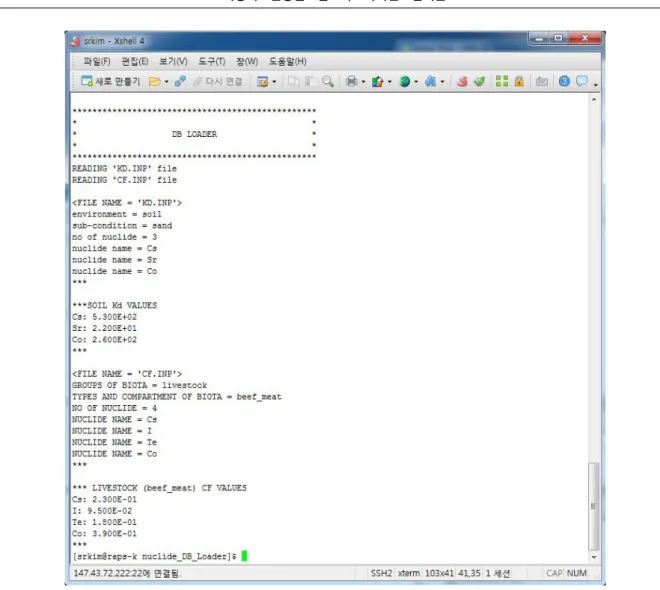
4. 컨트롤 파일 구조 핵종전이인자 데이터 로더모듈의 컨트롤 파일은 사용자의 편의성 증대를 위하여 단순한 몇 개의 키워드로 구성되었다. Fig. 6은 분배계수 Kd 값과 농도계수 CF 값을 불러오기 위한 컨트롤 파일의 예시이다. 이러한 컨트롤 파일을 사용하여, DB 로 구축된 자료를 지표수계 핵종이동 평가 모델에서 손쉽게 호출하여 사용할 수 있다. Kd 값을 호출하기 위한 컨트롤 파 일의 ‘environment’와 ‘sub-condition’에 해당하는 키워드 목 록은 Table 3에, CF 값을 호출하기 위한 컨트롤 파일의 ‘group of biota’와 ‘types and compartment of biota’에 해당하는 키워
드 목록은 Table 5에 각각 제시되어 있다. 각 환경 및 생물종
에 대해 평가하고자 하는 방사성핵종에 대한 데이터 값은 복
Fig. 5. Example data file of CF in ‘CF_freshw_biota.dat.’
(a) Control file of Kd
(b) Control file of CF
수로 선택할 수 있도록, 호출하고자 하는 핵종 수와 핵종 이
름을 기입하도록 구성하였다.
5. 데이터 로더를 통한 변수값 호출 구조
토양에 대한 Kd 값은 all soil, sand, loam, clay, organic, un-specified 중 사용자가 선택하는 토양 그룹에 대한 결과가 출 력된다. 만약 사용자가 sand, loam, clay, organic 중 하나를 선
택하였을 때, DB에 해당 값이 존재하지 않으면, all soil에 대
한 Kd 값을 출력한다. All soil에 대한 Kd 값이 DB에 존재하
지 않는 경우는 unspecified 값을 출력하며, 사용자가 원하는
핵종에 대한 데이터가 없을 경우는 에러 메시지를 출력한다.
Freshwater에 대한 Kd 값은 suspended sediment와 deposited
sediment 중 사용자가 선택한 조건에 대한 Kd 값을 출력한 다. Suspended sediment를 선택하였지만 이에 해당하는 Kd 값 이 존재하지 않는다면, deposited sediment Kd 값을 출력하며, 이 또한 존재하지 않는 경우 sediment 종류에 대한 정의가 되 지 않은 Kd 값을 출력한다. 마찬가지로, deposited sediment 를 선택하였지만 이에 해당하는 Kd 값이 존재하지 않는다면, suspended sediment Kd 값을 출력하며, 이 또한 존재하지 않 는 경우 sediment 종류에 대한 정의가 되지 않은 Kd 값을 출 력한다. 해양의 Kd 값의 경우는 open ocean과 ocean margin에
대해 사용자가 선택한 조건에 대한 Kd 값을 출력한다. CF 값은 생물종이 거주하는 환경, 생물종의 종류, 평가 대 상이 되는 생물종의 특정 부분 등에 대한 사용자의 입력에 따 라 그 값이 출력되며, 사용자가 요구한 조건에 해당하는 값이 DB에 존재하지 않을 경우에는 에러 메시지를 출력한다. Fig. 7에 본 연구에서 구축한 핵종 전이인자 자료와 연계하여 개 발된 데이터 로드모듈의 예를 나타내었다.
결 론
방사선 사고로 인해 환경으로 방출된 방사성물질의 수생 환경 내 중장기적 영향을 평가하기 위해서 지표수계 핵종이 동 모델이 개발 중에 있다. 본 연구에서는 수생 환경 내 방사성핵종의 지표수계 이동해석을 위한 수치모델의 중요한 입 력자료인 분배계수(distribution coefficient, Kd)와 농도계수 (concentration factor, CF)에 관하여 IAEA 기술 보고서로부터
최신의 자료를 수집하여 환경매체별로 체계적으로 DB화 하 였다. 또한 구축된 핵종 전이인자 자료의 지표수계 핵종이동 모델과의 연계 및 구축된 자료의 사용자 활용 향상을 위하여 데이터로더 모듈을 개발하였다. 개발된 핵종전이인자 데이터 로더모듈은 Linux 환경에서 C 언어를 이용하여, 범용으로 활용 가능하도록 개발되었다. 데 이터 로더모듈을 검증하는 부분에 있어서는 데이터를 읽어 들이는 과정에서의 오류가 발생할 수 있다. 따라서 이를 해결 하기 위하여 읽은 DB를 그대로 다시 DB 파일을 구성하는 작 업을 통하여 검증을 수행하였고, 이러한 과정에서의 가시적인 오류는 발견되지 않았다. 향후 지속적으로 다양한 케이스에 대한 검증 평가를 수행할 예정이고, 또한, 신뢰성 있는 자료를 추가적으로 획득함으로써 자료의 DB 업데이트를 수행할 예 정이다. 개발된 데이터 로더모듈은 사용자가 간단한 조건 입 력만으로 원하는 자료를 쉽게 얻을 수 있다는 장점이 있다. 반면, 한정된 방사성핵종, 환경적 특성, 생물종에 대한 정보만 을 얻을 수 있다는 것이 한계점이라 할 수 있으며, 이는 새로 운 데이터의 축적을 통해 추후 지속적으로 개선해 나갈 계획 이다.
사 사
본 연구는 과학기술정보통신부 재원으로 한국연구재단 의 지원을 받아 수행되었습니다(과제번호: NRF-2017M2 A8A4015253, NRF-2015M2A2B2034282).참 고 문 헌
Chino M, Nakayama H, Nagai H, Terada H, Katata G and Yamazawa H. 2011. Preliminary estimation of release amount of 131I and 137Cs accidentally discharged from the Fukushima
Dai-ichi nuclear power plant into the atmosphere. J. Nucl. Sci. Technol. 48:1129-1134.
Hirose K. 2016. Fukushima Daiichi Nuclear Plant accident: At-mospheric and oceanic impacts over the five years. J. Envi-ron. Radio. 157:113-130.
International Atomic Energy Agency. 1985. Sediment Kds and concentration factors for radionuclides in the marine environ-ment. IAEA TRS 247. IAEA. Vienna.
International Atomic Energy Agency. 1994. Handbook of param-eter values for the prediction of radionuclide transfer in ter-restrial and temperate environments. IAEA TRS 364. IAEA. Vienna.
International Atomic Energy Agency. 2004. Sediment distribution coefficients and concentration factors for biota in the marine environment. IAEA TRS 422. IAEA. Vienna.
International Atomic Energy Agency. 2009. Quantification of ra-dionuclide transfer in terrestrial and freshwater environments for radiological assessment. IAEA TECDOC-1616. IAEA. Vienna.
International Atomic Energy Agency. 2010. Handbook of param-eter values for the prediction of radionuclide transfer in ter-restrial and freshwater environments. IAEA TRS 472. IAEA. Vienna.
International Atomic Energy Agency. 2014. Handbook of param-eter values for the prediction of radionuclide transfer to wild-life. IAEA TRS 479. IAEA. Vienna.
Japan Atomic Energy Agency. 2015. Use of knowledge and ex-perience gained from the Fukushima Daiichi nuclear power station accident to establish the technical basis for strategic off-site response, JAEA-Review 2015-001 91pp. JAEA. Katata G, Ota M, Terada H, Chino M and Nagai H. 2012.
At-mospheric discharge and dispersion of radionuclides during the Fukushima Daiichi nuclear power plant accident. Part I: source term estimation and local-scale atmospheric dis-persion in early phase of the accident. J. Environ. Radio. 109:103-113.
United Nations Scientific Committee on the Effects of Atomic Radiation. 2011. Sources and effects of ionizing radiation. UNSCEAR 2008 Report Volume II. 219pp. UNSCEAR. New York.
United Nations Scientific Committee on the Effects of Atomic Radiation. 2014. Levels and effects of radiation exposure due to the nuclear accident after the 2011 great east-Japan earthquake and tsunami. UNSCEAR 2013 Report Volume 1. 311pp. UNSCEAR. New York.
Received: 13 May 2019 Revised: 2 June 2019 Revision accepted: 11 June 2019