ContentslistsavailableatScienceDirect
Corrosion
Science
jo u r n al ho m e p a g e :w w w . e l s e v i e r . c o m / l o c a t e / c o r s c i
Atomic
diffusion
induced
degradation
in
bimetallic
layer
coated
cemented
tungsten
carbide
Zirong
Peng
a,
Michael
Rohwerder
a,∗,
Pyuck-Pa
Choi
a,b,
Baptiste
Gault
a,∗,
Thorsten
Meiners
a,
Marcel
Friedrichs
c,
Holger
Kreilkamp
c,
Fritz
Klocke
c,
Dierk
Raabe
aaMax-PlanckInstitutfürEisenforschungGmbH,Max-PlanckStr.1,40237Düsseldorf,Germany
bKoreaAdvancedInstituteofScienceandTechnology(KAIST),DepartmentofMaterialsScienceandEngineering,Daejeon305-338,RepublicofKorea cFraunhoferInstituteforProductionTechnology(IPT),Steinbachstrasse17,52074Aachen,Germany
a
r
t
i
c
l
e
i
n
f
o
Articlehistory:Received2December2016
Receivedinrevisedform12January2017 Accepted13January2017
Availableonline20February2017 Keywords: A.Metalcoatings A.Sputteredfilm B.TEM C.Oxidation C.Interfaces
a
b
s
t
r
a
c
t
Weinvestigatedthetemporaldegradationofglassmouldingdies,madeofcementedtungstencarbide coatedwithPtIronanadhesiveCrorNiinterlayer,byelectronmicroscopyandatomprobetomography. Duringtheexposuretreatmentsat630◦Cunderanoxygenpartialpressureof1.12×10−23bar,Cr(Ni) wasfoundtodiffuseoutwardsviagrainboundariesinthePtIr,alteringthesurfacemorphology.Upon dissolutionoftheinterlayer,theWCsubstratealsostarteddegrading.Extensiveinterdiffusionprocesses involvingPtIr,Cr(Ni)andWCtookplace,leadingtotheformationofintermetallicphasesandvoids, deterioratingtheadhesionofthecoating.
©2017TheAuthors.PublishedbyElsevierLtd.ThisisanopenaccessarticleundertheCCBY-NC-ND license(http://creativecommons.org/licenses/by-nc-nd/4.0/).
1. Introduction
Multilayercoatingsorthinfilmshavevariousapplicationfields. Theyarefrequentlyutilisedinengineeringcomponents,toolsand mouldsaswellasmicroelectronic,magneticandopticaldevices [1–4].Comparedtosinglelayercoatings,multilayercoatings, com-biningbeneficialpropertiesofdifferentmaterials,mayfulfilseveral practicalrequirementsatonce.Theymayalsobeusefulincases whereonlyapplyingasinglelayercoatingmaynotbesufficient. Animportantexampleistheuseofaninterfacialbondinglayer betweenthetopcoatingandthesubstratetoenhanceadhesion [5–8].However,multi-layeredstructuresarecommonly thermody-namicallyunstable.Thereisastrongdrivingforceforinterdiffusion and reaction, which will bedetrimental tothermal stability of thecoatingunlesskineticsoftheseprocessesareslow. Unfortu-nately,thetypicalfine-grainedmicrostructureofthinfilmsaswell aslargesurfaceandinterfaceareasprovidenumeroushigh diffu-sivitypaths.Togetherwiththeshortdiffusiondistancesnaturally associatedwiththincoatings,tremendouscompositionalchanges
∗ Correspondingauthors.
E-mailaddresses:[email protected](M.Rohwerder),[email protected] (B.Gault).
canariseandnewphasesaswellasvoidscanform,which will considerablydeterioratethecoatingproperties[9–12].
Here, wereportonthetemporal degradationof abimetallic layercoatingdepositedoncementedtungstencarbidesubstrate duringisothermalexposuresunderanoxygenpartialpressureof 1.12×10⁻²³barat630◦C.The coatingconsistsofan ∼650-nm-thickPtIrtop layerand an∼20-nm-thickintermediate layerof metallicCrorNi(PtIr/CrorPtIr/Ni),whichisfrequentlyutilised in moulds for precision glass moulding (PGM) [13–15]. It is a promising and worldwide employed process for manufacturing highquality optical products withcomplex-geometries. During PGM,glassblanksareplacedinthemouldofapressingtoolandare heatedundervacuumorN2protectiveatmosphereuptotheglass formingtemperature,whichnormallyrangesfrom400to700◦C. Subsequently,highpressforces(2–20kN)areappliedforseveral minutesuntilthemouldformishomogeneouslyfilledwithglass. Aftercontrolledcooling,thefinalproductscanbedetachedfrom themould[16–18].PtIr,asanoblemetalbasedcoating,is chem-icallyinactiveanddoesnotsticktoglass.Anintermediatelayer, CrorNi,isusedtoimprovetheadhesionstrengthbetweenbase materialandtopcoating[19,20].Duetotheharshoperating con-ditionduringglasspressingwhereintensethermal,chemicaland mechanicalforcesareimposedsimultaneously,coating degrada-tiontakesplaceveryfastandbecomesasevereproblem,strongly limitingtheservicelifetimeofmoulds[21–23].Sincethe produc-http://dx.doi.org/10.1016/j.corsci.2017.01.007
0010-938X/©2017TheAuthors.PublishedbyElsevierLtd.ThisisanopenaccessarticleundertheCCBY-NC-NDlicense(http://creativecommons.org/licenses/by-nc-nd/4. 0/).
Fig.1.(a)Configurationofthedepositionchamber.(b)SketchshowingthearrangementofthepureIrandPtpieceswithinthetarget.(c)Schematicdrawingofthetopview ofthedepositionchambertoillustratethecoatingprocessofthePtIrlayer.
tioncosts are directly related to themould lifetime, designing high-performanceand high-durabilitymouldsaswell as devel-opingconceptstoimpedetheirdegradationhave becomea top priorityforthePGMindustry.Akeytoachievethisgoalisthe under-standingofthefundamental degradationmechanismsofmould materialssuchasPtIr/Cr/WCandPtIr/Ni/WC.
Inpreviousstudies,thereliabilityandstabilityofdiverse metal-licmultilayerthinfilmshavebeeninvestigated,e.g.Cu/Sn [24], Au/Ni/Cr[25],Cu/Ta[26],Pt/Ti-W[27],MoRu/Cr/Ti[28],PtIr/Ni [23,29], and PtIr/Cr[15,23], bymeans ofa variety of analytical techniquessuchasX-raydiffraction(XRD),Rutherford backscat-tering spectroscopy (RBS), Auger electron spectroscopy (AES), energy-dispersiveX-rayspectroscopy(EDS),X-rayphotoelectron spectroscopy(XPS)andsecondaryionmassspectroscopy(SIMS) [29–32].However,thespatialresolutionanddetectionsensitivity ofthesetechniqueswasnotsufficienttorevealthediffusionand segregationphenomenaatgrainboundaries,andlimitedinsights weregainedonthedegradationmechanisms.Atomprobe tomog-raphy(APT)isauniquetechnique,whichhasthecapabilitytoreveal three-dimensional(3D)chemicalinformationat(sub-)nanometre scalewithhighsensitivity(intherangeoftensofpart-per-million) and which hasbeensuccessfully appliedto thin filmmaterials [33–38].Therefore,inthis workweappliedAPTtostudy diffu-sionand degradationphenomenainPtIr/Cr/WCandPtIr/Ni/WC. In addition to APT, we also use scanning electron microscopy (SEM)and(scanning)transmissionelectronmicroscopy((S)TEM) formicrostructuralanalysisandSTEM-EDSandAESforchemical analysis.
2. Materialandmethods
2.1. Specimenpreparation
The basematerial was nano-grain sized cementedtungsten carbidecontainingaround0.3wt.%Cobinder (CTN01L,Ceratizit S.A). Before coating, bulk substrate samples were grinded and polished,makingtheirsurfaceroughness Rasmallerthan5nm. Subsequently, the samples were cleaned in an ultrasonic bath (SurTec089/131, SurTecInternationalGmbH). The coating pro-cesswasaccomplishedinamagnetronsputteringunit(CemeCon CC800/9).Theconfigurationofthedepositionchamberisshownin Fig.1(a).Beforecoating,aplasmaetchingprocesswascarriedoutto cleanandactivatethesubstratesurfacetoensureagoodadhesion. Subsequently,aCrorNilayerofabout20nminthicknessandan ∼650-nm-thickPtIrtopcoatingweredepositedsequentially.The detailedparametersofthecoatingprocessarelistedinTable1.The
PtIrtargetusedinthisstudyishome-made,andisnotaPtIralloy butconsistsofthreepiecesofpurePtstackedwithninepiecesof pureIr,asshowninFig.1(b).
2.2. Exposuretreatment
Anovellaboratoryset-upwasusedtoinducedegradationofthe coating,withwhichtheexposureconditionse.g.time,atmosphere andtemperaturecanbeaccuratelycontrolled[39].Mimickingthe realPGMprocess,thetreatmenttemperaturewassettobe630◦C andthefurnaceatmospherewasselectedas97.5%N2-2.5%H2with thedewpoint (DP)of+20◦C. TheDPismanipulatedbyforcing thegasmixturethroughcolumnswhicharefilledwithwater.By adjustingtheirtemperature,desireddewpointscanbeobtained. Undertheseconditions,theresultingoxygenpartialpressurewas calculatedtobeapproximately1.12×10−23bar.Suchalowoxygen partialpressureisdesirable forcontrollingcoatingdegradation. Thereby,thesuccessivestagesofthedegradationprocesscanbe accessedsimplyby adjusting theexposuretime.Moreover,the partialpressureofoxygeniskepthighenoughtooxidiseCrbut notNi,sotheeffectsofoxidationondegradationcanbeseparated andstudiedindividually.DuringtherealPGMprocesses,the oxy-genpartialpressuresinthePGMmachinewereestimatedtolie intherange of10−6bar,much higherthanthepartialpressure weappliedinthisstudy.Inrealprocessingsystems,it is deter-minedbytheleakagerateofthesystemandthermodynamically notwelldefined.TheH2O/H2equilibriumconditionsusedinthis studyprovidefullthermodynamiccontrol.Inthiswork,resultswill beshownforthePtIr/Cr/WCsystemintheas-fabricatedstate,as wellasafter6h,18h,and168hexposureat630◦Cunderthe above-describedcondition(PO2≈1.12×10⁻²³bar)inordertoillustrate theevolutionofdegradation.AsforthePtIr/Ni/WCsystem,only representativeresultsforthe48h-exposedspecimenwillbeshown, sincetheobserveddegradationmechanismisverysimilartothat inthePtIr/Cr/WCsystem.Itisworthtomentionthatalthoughin ordertobeabletoresolvethesuccessivestagesofthe degrada-tion,especiallytheearlystages,thepartialpressureofoxygenin theatmosphereusedhereismuchlowerthanthatintheactual processing,wedonotexpectaneffectonthedegradation mecha-nisms.Wealsoanalysedsamplesobtainedfromatechnicalset-up andfoundthesamedegradationfeatures. Furthermore,thefact thatthedegradationmechanismsobservedinthePtIr/Cr/WCand PtIr/Ni/WCsystemsareverysimilarisalsoaproofthatthe degra-dationmechanismisnotstronglyaffectedbytheoxygenactivity.
Table1
Detailedparametersforlayerdepositionprocess.
Etching Interlayerdeposition PtIrlayerdeposition
Target – Chromiumornickel(99.9%) Platinum(99.99%)andiridium(99.9%)
Heatingpower/kW 0 2 2 Argonpressure/mPa 390 200 200 Biasvoltage/V(f=240kHz) 650 60 60 Cathodepower/W(f=50kHz) – 125 250 Tablerevolution/rpm 2.5 2.5 2.5 Time/min 15 4 40 Thickness/nm – ∼20 ∼650
Fig.2. SketchtoillustratethepositionandorientationofAPTand(S)TEMspecimens.
2.3. Specimencharacterisation
BothAPTand(S)TEMspecimenswerefabricatedusingadual
beam focused-ion-beam (FIB) instrument (FEI Helios Nanolab
600/600i)andthein-situlift-outmethod[40,41].Asillustratedin
Fig.2,theAPTspecimenswerepreparedwithanalignment per-pendiculartothesamplesurface,sothattheanalysisdirectionis paralleltothecoatinggrowthdirection.Forthe(S)TEM measure-ments,bothcross-sectional(perpendiculartothesamplesurface)
andplan-view(paralleltothesamplesurface)lamellaewere pre-pared.Toremoveregionsseverelydamagedbythehigh-energy (30kV)GaionbeamduringAPTspecimensand(S)TEMlamellae fabrication,afinalcleaningprocedurewascarriedoutat2kVand 28pA.APTmeasurementswereconductedusingaLEAPTM3000X HR(CamecaInstruments)instrument,equippedwithareflectron lens.Laserpulsingmode(532nmwavelength,∼10mspotsize) wasappliedatapulserepetitionrateof250kHzandapulseenergy of0.8 nJ.Thespecimenbasetemperaturewaskeptat 60Kand thetargetdetectionratewassettobe0.2%(2ionsdetectedevery 1000pulses).Theseanalysisparameterswereoptimised accord-ingtoapreviouswork[42].(S)TEMimageswereacquiredusing aJEOLJEM-2200FSmicroscopewith200kVaccelerating voltage (Figs.3(b),5(b),6(a),10(a),11(b),12(a),13(a),15(a),17) STEM-EDS were performed using a probe-correctedFEI Titan Themis 60–300S/TEM with300kVacceleratingvoltageusinga Super-X windowlessEDS detector.Correspondinglyahigh-angleannular darkfield (HAADF)imagewastakenfromthemeasuredregion usingaFischioneHAADFdetector(FischioneInstruments)(Fig.8). AESmeasurementswereconductedwithaJEOLJAMP-9500F sys-temequippedwitha hemisphericalanalyser.Thefieldemission electrongunoperatedatanaccelerationvoltageof25keVanda
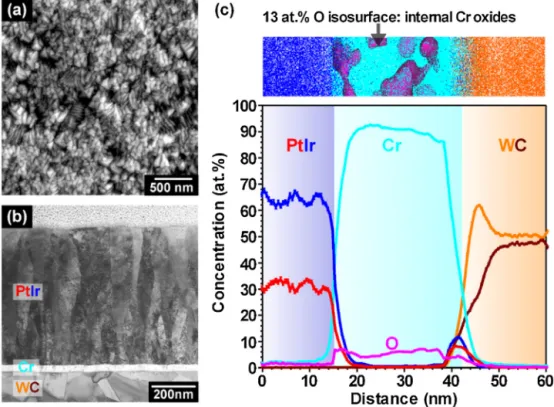
Fig.3. Representativecharacterisationresultsobtainedfromtheas-fabricatedPtIr/Cr/WCspecimen:(a)SurfaceSEMimage,(b)cross-sectionalBFSTEMimage,and(c)1D concentrationprofileandacorrespondingclippedatommapacrosstheCrlayer.Forclarity,onlyIr(blue),Cr(cyan),O(magenta)andWions(orange)areshown.The13at.% Oiso-concentrationsurfacesrepresentthesmallCroxidesfoundinsidetheCrlayer.(Forinterpretationofthereferencestocolourinthisfigurelegend,thereaderisreferred tothewebversionofthisarticle.)
beamcurrentof10nA.AESpeaksofPtMNN,IrMNNandCrLMM wererecordedandused.
3. Results
3.1. PtIr/Cr/WCspecimen 3.1.1. As-fabricatedstate
The surface SEM and cross-sectional bright-field (BF) STEM micrographsoftheas-fabricatedPtIr/Cr/WCsampleareshownin Fig.3(a)and(b),respectively.ThePtIrandCrlayersaswellasthe WCsubstratecanbeclearly identifiedintheSTEMimage.They exhibitdistinctlydifferentmicrostructures.Ascommonlyobserved forsputteredfilms,thePtIrlayerconsistsofveryfinecolumnar grains,growingalongthedepositiondirection.Individualgrains canbedistinguishedbydifferencesincontrast,wherethegrain sizesrangefrom50to100nm.ThethicknessoftheCrlayeris uni-form.BothPtIr/CrandCr/WCinterfacesappearflatandsharp.No voidsorcrackscanbeobserved.APTanalysesofthePtIrlayershow thattheoverallatomicratiobetweenIrandPtisaround2,matching thetargetvalue.However,periodicIr-andPt-richsublayerswere observed(seeFigs.3(c)and14(b)),whichcanbeattributedtothe combinationofthePtIrtargetand substraterotationduringthe deposition.AsillustratedinFig.1,thenon-uniformarrangement ofthePtandIrpiecesinthePtIrtargetcanleadtoan inhomo-geneousdistributionofPtand Irionsintheplasmaflux.When thesubstrateisdirectlyfacingthetarget,thecontentofPtwillbe slightlyhigher,while,whenitmovesaway,Ircontentwillincrease. Withtherotation of thesubstrate, this concentration variation willappearperiodically.Similarphenomenahavebeenreported inseveralpreviousstudies[43–45].Theatomicmapandthe1D concentrationprofileacrosstheCrlayerobtainedfromAPT mea-surement(Fig.3(c))demonstratethatCrdiffusesneitherintothe PtIrlayernorintotheWCsubstrate.Around10at.%Irand8at.%Pt arefoundtobesegregatedattheCr/WCinterface,indicatingthat duringdeposition,IrandPtrapidlydiffusedthroughtheCrlayer, buttheirpenetrationintotheWCsubstratewasrestricted.There isalsoaround10at.%WsegregatedattheCr/WCinterface,which maybeattributedtothelossofcarbonduringtheplasma activa-tionpriortocoating.WithintheCrlayer,somesmall,dispersed Cr-oxideparticlesarefound.SinceCrisafairlyactivemetal,itis difficulttoachievevacuumconditionsinsidethedeposition cham-bergoodenoughtoavoiditsoxidation.Therefore,duringsputter deposition,someCratomswillreactwithoxygenfromthe resid-ualgasandformCroxides.TheAPTanalysesoftheWCsubstrate indicatethatCandWatomsdistributehomogeneouslywhileCo, asthebinderphase,ismainlysegregatedatWCgrainboundaries (notshown).
3.1.2. After6hexposureat630◦Cunder1.12×10−23barO2 partialpressure
Comparingthe6h-exposedstatewiththeas-fabricatedstate, noobviousdifferencescanbefoundbetweenboth surfaceSEM andcross-sectionalSTEMimages(notshownhere).Thesideview atommapoftheCrlayer(Fig.4(a))alsoconfirmsthatnomassive diffusiontookplace.ThePtIrcoating,theCrinterlayerandtheWC substratearewellseparated.BoththePtIr/CrandCr/WCinterfaces arestillsharpandflat.However,asshowninFig.4(b),atthe bot-tomofthePtIrlayer,Crisobservedtosegregatetoseveralplanar features,whicharelikelytobegrainboundaries.However,the seg-regatedamountisrelativelylimited(∼1.5-3.5at.%Cr)andaround 30nmawayfromtheoriginalCrlayer,nofurthersegregationcan bedetected(Fig.4(c)).
Fig.4.3DatommapsobtainedfromthenearCrlayerregionofthePtIr/Cr/WC specimenafter6hexposureat630◦Cunder1.12×10−23barO2partialpressure:(a)
Sideview,(b)topviewofthesliceIImarkedin(a),and(c)topviewofthesliceI markedin(a).Forclarity,onlyIr(blue),Cr(cyan),O(magenta)andWions(orange) areshown,ifanyofthemaredetected.(Forinterpretationofthereferencestocolour inthisfigurelegend,thereaderisreferredtothewebversionofthisarticle.)
3.1.3. After18hexposureat630◦Cunder1.12×10−23barO2 partialpressure
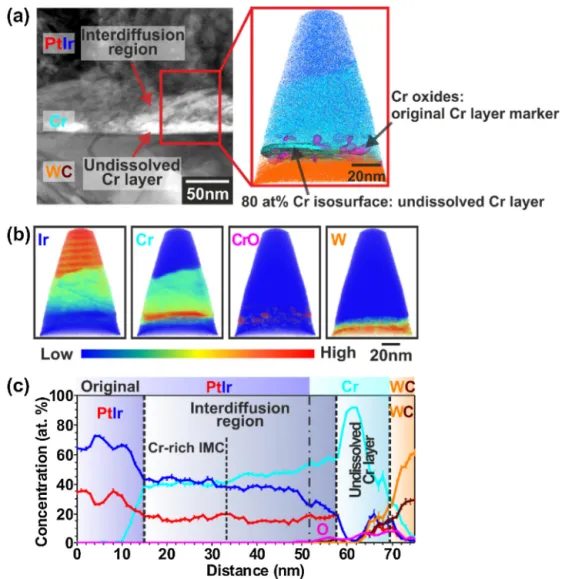
Fig.5(a)isanSEMimageacquiredfromthesurfaceofthe 18h-exposedspecimen.Comparedtotheas-fabricatedstate(Fig.3(a)), thesurfacemorphologyhaschanged.Fig.5(b)isaBFSTEMimage obtained froma cross-sectional TEMlamella. Even though the Cr layer can still be distinguished, as indicated by the bright-nesschange,itsupperregionseemstobedissolved,resultingina wavyPtIr/Crinterface.However,theCr/WCinterfaceisstillintact andflat.Fig.6(a)showsarepresentative3Datommapobtained fromthe Crlayerregionand a corresponding magnified cross-sectionalBFSTEMimage.Tobetterillustratethedistributionof eachspecies,blue-to-redrainbowcolourconcentrationmaps(blue indicateslowestconcentrationandredindicateshighest concen-tration)areshowninFig.6(b)anda1Dconcentrationprofilefrom thePtIrlayertotheWCsubstrateisplottedinFig.6(c).Boththe APTandSTEM resultsrevealtheformationofan∼50-nm-thick interdiffusionzonebetweenthePtIrandCrlayerwhichexhibits aninhomogeneouschemicalcomposition.TheCrcontent progres-sivelydecreaseswhiletheIrcontentincreasestowardsthePtIr layer.TheCroxidesformedduringdepositioncanstillbedetected, which seemsstable and remain immobile, thereby providing a markerofthepositionoftheoriginalCrlayer.AsdisplayedinFig.6 (c),thisintermixedregionisfoundtoformonthebasisofthe out-warddiffusionofCr.Therearestillsomenon-uniform,interrupted fragmentsoftheCrlayerleftneartheCr/WCinterface.Fig.7(a)and (b)aresideandtopview3DatommapsobtainedfromthePtIrlayer, respectively. Comparedto the6h-exposed state,larger amount ofCr(∼2.6–5.9at.%Cr)segregatingatthese grain-boundary-like-features.Fig.8showsaSTEM-EDSmapandacorrespondingHAADF STEMimageofaplan-viewTEMlamella,fromwhichthegrainsize andgrainstructure ofthePtIrlayercanberevealed.SinceCris exclusivelydetectedatgrainboundaries,itcanbeconfirmedthat thefeatureswhereCrisseentosegregateintheAPTdatasetsare
Fig.5.SurfaceSEM(a)andcross-sectionalBFSTEMimage(b)ofthePtIr/Cr/WCspecimenafter18hexposureat630◦Cunder1.12×10−23barO2partialpressure.
Fig.6.RepresentativecharacterisationresultsobtainedfromthenearCrlayerregionofthePtIr/Cr/WCspecimenafter18hexposureat630◦Cunder1.12×10−23barO2
partialpressure:(a)A3Datommaptogetherwithamagnifiedcross-sectionalBFSTEMimage;(b)correspondingblue-to-redrainbowcolourconcentrationmapsofIr,Cr, CrOandWionswiththecolourscalethatblueindicatesthelowestconcentrationandredindicatesthehighestconcentration;(c)1DconcentrationprofilefromthePtIr layertotheWCsubstrate.TheinterdiffusionregionandundissolvedCrlayercanbeobserved.Forcomparison,theoriginallocationsofthePtIrandCrlayersaswellasthe WCsubstrateareshown.Atthediffusionfront,the∼20-nm-thicklayerwithalmostconstantcompositionissupposedtobeCr-richintermetalliccompound(IMC).(For interpretationofthereferencestocolourinthisfigurelegend,thereaderisreferredtothewebversionofthisarticle.)
actuallygrainboundaries.Infact,thesegregationofCratPtIrgrain boundariesgivesevidenceoftheshortcircuitdiffusionprocess.No noticeableamountofoxygenoranyoxideparticlesaredetectedat thegrainboundaries.
Fig.9showstheAPTanalysisresultfromthesurfaceregion. Here,discontinuousnanometre-sizedCroxideislandsarefound. Fig.9(b)illustratestopviewblue-to-redrainbowcolour concen-trationmapsofCrfromdifferentdepthofthedatasetshownin Fig.9(a).Bluecolourindicates0at.%Crandredindicates3.5at.%
Fig.7.3DatommapsobtainedfromthePtIrlayerofthePtIr/Cr/WCspecimenafter 18hexposureat630◦Cunder1.12×10−23barO2partialpressure:(a)Sideview
(forclarity,Ptionsarenotshown);(b)topviewoftheregionmarkedbythe semi-transparentcubein(a).HereCrionsaredenotedwithbiggerdotstohighlighttheir segregationatgrainboundaries.
Cr.Asmarkedbythewhitearrow(Fig.9(b)III),underneaththe surface,there isagrainboundarydecoratedwithCratoms.The CratomsdiffuseviaPtIrgrainboundariesandthengetincontact withoxygenatthepositionswheregrainboundariesintersectwith thesurface.However,asFig.9(b)IandIIreveal,thenucleationofCr oxidesisnotrestrictedtothegrainboundaryarea(indicatedbythe whitedashedlines),implyingthatmetallicCratomsalsodiffused laterallyonthesurfacebeforereactingwithoxygen.Fig.10(a)isa cross-sectionalTEMimageofthesurfaceregionathigher magni-fication,inwhichthethinbrightestlayerisconsideredtobethe approximately1-nm-thickCroxide.Atthisstage,thesurfaceisnot fullycoveredbyCroxides.Fig.10(b)showstheAESsurfacemapsof Cr,IrandPt.ConsistentwiththeAPTandTEMobservations, inho-mogeneousCrsignalsweredetected.SinceAESisahighlysurface sensitivetechnique,theextensiveIrandPtsignalsconfirmthatthe surfaceCroxidesarethinnerthan2nm.
3.1.4. After168hexposureat630◦Cunder1.12×10−23barO2 partialpressure
Fig. 11(a) is an SEM picture taken from the surface of the 168h-exposedPtIr/Cr/WCspecimen.Comparedtotheas-fabricated (Fig.3(a))andthe18h-exposedspecimens(Fig.5(a)),the 168h-exposedspecimenexhibitsadifferentsurfacemorphology.TheBF STEMimageofa cross-sectionalTEMlamella(Fig.11(b))shows
Fig.9.(a)3DatommapofthenearsurfaceregionofthePtIr/Cr/WCspecimenafter 18hexposureat630◦Cunder1.12×10−23barO2partialpressure.TinyCroxides
canbefoundonthesurface.(b)Topviewblue-to-redrainbowcolourconcentration mapsofCrfromdifferentdepthofthedatasetshownin(a),whereblueindicates 0at.%Crandredindicates3.5at.%Cr.ThewhitedashedlinesinIandIIdepictthe positionofthegrainboundarymarkedwiththewhitearrowinIII.(Forinterpretation ofthereferencestocolourinthisfigurelegend,thereaderisreferredtotheweb versionofthisarticle.)
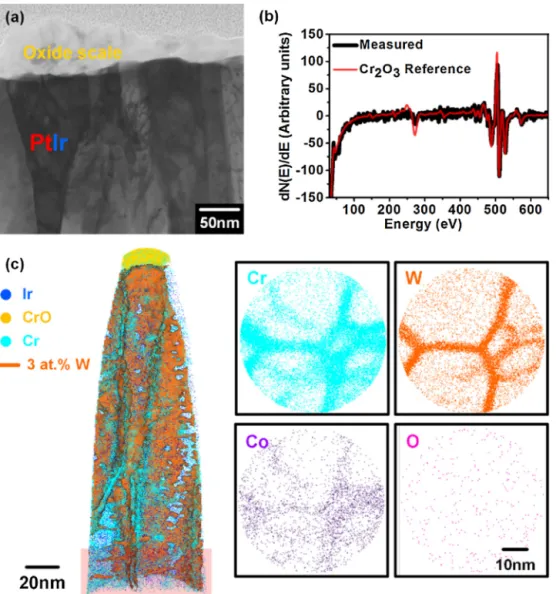
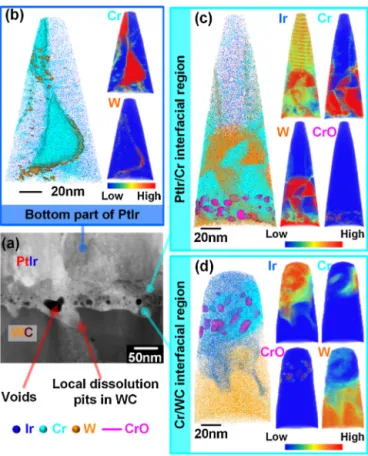
thattheoriginalCrlayerhasbeencompletelydissolvedandvoids haveformed.TheCr/WCinterfacealsobecomes rough.Another noticeablefeatureisthesurfaceoxidescale,whichcanbeseen moreclearlyinthemagnifiedBFSTEMimageshowninFig.12(a). After168h,largeramountsofCratomshavereachedthetop sur-faceandcontributedtothedevelopmentofathickeroxidescale, whichisidentifiedtobeCr2O3byAES(Fig.12(b)).Besidesthese surfaceoxides,noothernewlyformedoxidesnoranymeasurable amountofoxygenaredetectedinsidethestructure(Fig.12(c)).In addition,unlikethe18h-exposedstate,notonlyCratoms,butalso WandCoatomsarefoundatgrainboundariesandtriple junc-tionsofthePtIrlayer,whichisastrongindicationthatWCis,at thisstage,alsoinvolvedinthedegradationprocess.Fig.13shows amagnifiedcross-sectionalHAADFSTEMimageoftheinterfacial regiontogetherwithrepresentativeAPTresultsfromthisregion: (b)thebottompartofthePtIrlayer,(c)thePtIr/Crinterface,and (d)theCr/WCinterface.Asmentionedabove,theembeddedsmall Cr-oxideparticlescanbeusedasatraceroftheoriginalpositionof theCrlayer.Fig.13(d)illustratesthattheremainingCrispresent onlyinaverylimitedamount.Non-uniformdamageoftheWC sub-strateoccursattheCr/WCinterface,wherethedegradationfeatures
Fig.8.(a)STEMHAADFimageofaplan-viewTEMlamellafabricatedfromthePtIr/Cr/WCspecimenafter18hexposureat630◦Cunder1.12×10−23barO2partialpressure.
Fig.10. (a)Magnifiedcross-sectionalTEMimageofthenearsurfaceregionofthePtIr/Cr/WCspecimenafter18hexposureat630◦Cunder1.12×10−23barO2partialpressure.
Athin,discontinuoussurfaceoxidescalecanbeobserved.(b)AESsurfaceelementalmapsshowingthedistributionofCr,IrandPtrespectively.Inaddition,theSEMimage ofthemeasuredareaisalsoshown.
Fig.11.SurfaceSEM(a)andcross-sectionalBFSTEMimage(b)ofthePtIr/Cr/WCspecimenafter168hexposureat630◦Cunder1.12×10−23barO2partialpressure.
alonggrainboundariesaresevere.Theinterdiffusionzoneformed betweenPtIrandCrafter18hexposureevolvedfurtherintoa mix-tureofsmallCr-richandW-richregions(Fig.13(b)).Additionally,in thebottompartofthePtIrlayer,someCr-richparticlesarefoundat thegrainboundariesandWatomssegregateattheparticle/matrix interfaces.
3.2. PtIr/Ni/WCspecimen
ThesurfaceSEMandcross-sectionalSTEMimages(notshown here) of the as-fabricated PtIr/Ni/WC specimen reveal similar featuresasthemicrostructureoftheas-fabricatedPtIr/Cr/WC spec-imen. The three different regions, PtIr layer, Ni layer and WC substratecanbeclearlydistinguishedandbothPtIr/NiandNi/WC interfacesareflat,sharpandfreeofvoids.However,asillustratedin Fig.14,somedifferenceswerediscoveredbyAPTanalysis.Firstly, therearenoembeddedNioxideswithintheNilayer,whichcanbe attributedtothehigheroxidationresistanceofNicomparedtoCr. Secondly,evenintheas-fabricatedstate,outwarddiffusionofNi alongPtIrgrainboundarieshasalreadytakenplace,buttheextent issmallandthediffusionlengthisbelow50nm.
Fig.15summarisestherepresentativecharacterisationresults ofthePtIr/Ni/WCspecimenafter48hexposureat630◦Cunder 1.12×10⁻²³barO2partialpressure.Thecross-sectionalBFSTEM image(Fig.15(a))showsthatthePtIr/Niinterfaceisblurredandthe originalNilayerseemstoalreadydisappear.Fig.15(b)exhibitsthe APTresultobtainedfromthenearsurfaceregionofthespecimen.Ni atomsratherthanNioxidesarefoundtoaccumulateatthesurface. WithinthePtIrlayer,theenrichmentofNiatomsatgrain bound-ariesisobvious(Fig.15(c)),revealingthattheoutwarddiffusionof Niisalsosupportedbytheshortcircuitdiffusionmechanism.The 1Dconcentrationprofileacrossthegrainboundary(Fig.15(c)) indi-catesthatatthisstage,onlyNiatomsaresegregatedatthegrain boundaries.Fig.15(d)summarisestheresultsobtainedfromAPT analysisofthenearNilayerregion.SimilartothePtIr/Cr/WC sam-ple,aninterdiffusionregionformed,whichcontainsNi-richand W-richzones.Eventhoughfromthecross-sectionalSTEMimage, noobviousdamagesarevisibleat theNi/WCinterface,theAPT resultsclearlysuggestthatthedegradationofWCalreadystarted. Howeveratsuchrelativelyshortexposuretime,elementsfromthe WCsubstratehavenotyetpenetratedintothePtIrlayer.
Fig.12.RepresentativecharacterisationresultsobtainedfromthenearsurfaceregionofthePtIr/Cr/WCspecimenafter168hexposureat630◦Cunder1.12×10−23barO2
partialpressure:(a)cross-sectionalBFSTEMimage;(b)AESpointanalysisresult(differentialspectrum)showingthatthesurfaceoxidesareCr2O3;(c)3Datommaps.Left:
sideview;right:topviewofthebottom30nmsliceofthedatasetshownontheleft,asmarkedbythesemi-transparentcube.ThesegregationofCr,WandCoatomsatthe PtIrgrainboundariesaredetected.
4. Discussion
ThedegradationevolutioninthePtIr/Cr/WCspecimendeduced fromtheexperimentalobservationsissketchedinFig.16.Similar phenomenawereobservedinthecaseofthePtIr/Ni/WCspecimen. TheonlymajordifferenceisthatwhenNiatomsdiffusethroughthe PtIrlayerandreachthesurface,theyarenotoxidised.Accordingto thermodynamics,seee.g.theEllinghamdiagram[46],at630◦C,the criticaloxygenpartialpressuretooxidiseNiis∼10−17bar,which issubstantially higherthantheoneappliedinourexperiments (∼1.12×10⁻²³bar).
4.1. Outwarddiffusionoftheinterlayer
TheoutwardtransportandsegregationofCrorNiatomsalong thegrainboundariesofthePtIrlayerseemstoindicatetheonset ofthe degradationprocess. For thePtIr/Cr/WC specimen,these processestakeplaceslowlyatthebeginning.After6hexposure, onlyasmallamountofCrisdetectedatthePtIrgrainboundaries, withinadiffusiondistanceofapproximately30nm.Comparedto Cr,Nifollowsthesametransportmechanismbutatahigher dif-fusionrate.Alreadyduringcoatingdeposition,Niatomspenetrate intothePtIrlayer.Fromathermodynamicpointofview,the
gra-dientinchemical potentials oractivitiesofindividual elements acrosstheinterfacedrivestheirdiffusion.Thisgradientinchemical potential,togetherwiththeelementaldiffusivity,determinestheir diffusionbehaviour.Typically,diffusionalonggrainboundariesis 4–8ordersofmagnitudefasterthantransportwithingrain inte-riors[47],therefore,atrelativelyshorttimeandlowtemperature (typeB-diffusionregime[48,49]),grainboundariesarethemain pathwaysfortheoutwarddiffusionofatomsfromtheinterlayer. GrainboundarydiffusiondataforCrandNiinPtIrarenot avail-ableinliterature.Accordingtoourresultsoftheas-fabricatedand earlydegradationstates,itislikelythatNidiffusesfasterthanCr. However,after48h,asshowninFig.17,thewholesurfaceofthe PtIr/Cr/WCsampleiscoveredbyanoxidescalewithathickness intherangeof15–120nm.WhileforthePtIr/Ni/WCsample,even after48h,thequantityofNiatomsaccumulatingonthesurfaceis stillsmall(Fig.15(a)),whichseemstocontradictourprevious infer-encethatNidiffusesmorerapidlythanCr.Ithasbeenreportedin previousstudiesthatsurfaceoxidationcanstronglyaffectinternal materialtransport.Thefirstdiffusionstepofsolutesdecoratingthe PtIrgrainboundariesisdrivenbytheGibbsadsorptionisotherm,i.e. theinterfaceenergygetsreducedbysolutedecoration.Thiscreates adiffusionfluxalongthegrainboundariestowardsthesurface.As thediffusingspeciesreachthefilmsurface,theoxidationprocess
Fig.13.Representativecharacterisation resultsobtained from thenear inter-face regionof thePtIr/Cr/WCspecimenafter 168hexposure at630◦Cunder
1.12×10⁻²³barO2partialpressure:(a)cross-sectionalHAADFSTEMimage.(b)On
theleft:3DatommapofthebottompartofthePtIrlayerwithiso-concentration sur-faceof1.2at.%W(orange);ontheright:correspondingblue-to-redrainbowcolour concentrationmapsofCrandW.(c)Ontheleft:3DatommapofthePtIr/Cr interfa-cialregion;ontheright:correspondingblue-to-redrainbowcolourconcentration mapsofIr,Cr,WandCrO.(d)Ontheleft:3DatommapoftheCr/WCinterfacial region;ontheright:correspondingblue-to-redrainbowcolourconcentrationmap ofIr,Cr,CrOandW.Inallconcentrationmaps,blueindicatesthelowest concentra-tionandredindicatesthehighestconcentration.Forclarity,inallatommaps,onlyIr (blue),Cr(cyan),W(orange)ionsandCroxideparticles(magenta)areshown,ifany ofthemaredetected.(Forinterpretationofthereferencestocolourinthisfigure legend,thereaderisreferredtothewebversionofthisarticle.)
Fig.14.(a)3DatommapofthenearNilayerregionoftheas-fabricatedPtIr/Ni/WC specimen.Forclarity,onlyIr(blue),Ni(green)andW(orange)ionsareshown.(b) 1DconcentrationprofileacrosstheNilayer.(Forinterpretationofthereferencesto colourinthisfigurelegend,thereaderisreferredtothewebversionofthisarticle.)
startsremovingsolutesfromthematerial,particularlyfromthe decoratedgrainboundariesbecausetheygettrappedintheoxides. Thiseffect reducestheirsolute chemical potentialonthegrain boundaries,hencecreatingachemicalpotentialgradienttowards thesurface,promotingfurtheroutbounddiffusion[31,50–54].Then theoutwardtransportationofthediffusingelementbecomesthe slower,rate-controllingstep[55].AsforthePtIr/Ni/WCsample, theexposureatmosphere isnon-oxidising.Thereisno substan-tialattractiveforcetofurtherpromotethespreadingandlateral diffusionofNiatomsontothePtIrsurface,especiallyonceafirst surfacecoverageisreached.Undersuchconditions,Niatomswill bemostly trappedalong thegrainboundariesof thePtIrlayer. Therefore,asillustratedinFig.15(c),significantenrichmentsofNi (∼30at.%)withbroadsegregationzones(>10nm)arefrequently foundatnumerousPtIrgrainboundaries.Whentheyaresaturated, therewillbenofurtherthermodynamicdrivingforceforfurther segregation.
4.2. Formationofintermetallicphaseandevolutionofthe interfacialregion
Sincethereisnosubstantialdifferenceintheinternal degra-dation processes between the PtIr/Cr/WC and the PtIr/Ni/WC specimen,inthis and thefollowingsubsections,thePtIr/Cr/WC systemwillbetaken asrepresentative.After168hexposureat 630◦C under1.12×10−23barO2 partialpressure,Cr-rich parti-clesappearatPtIrgrainboundaries(Fig.13(b))aswellasinside theinterdiffusionregion(Fig.13(c)).APTanalysisrevealsthatthe chemical compositionsof alltheseCr-rich particlesare similar, namelyapproximately56at.%Ir,17at.%Ptand27at.%Cr. Stud-ies aboutthe Pt-Ir-Cr ternary system are rare in theliterature andknowingthechemicalcompositionoftheprecipitatesaloneis insufficienttodrawanunequivocalconclusionabouttheassociated reactionandphasetransformationpathways.Thecompositional similarityobservedisnonethelessastrongindicationthatallthese particlesbelongtothesametypeofintermetallicphase.Moreover, after168hexposure,localequilibriabetweenPtIrandthenewly formedintermetalliccompound particles aremostlikely estab-lished,which meansthatthis intermetallicphase, denotedhere as(Pt,Ir)3Cr,isthefirststableintermetallicphasefromthe PtIr-richsidetotheCr-richside,yet,withcomparablyhighPtIrcontent andlowCrcontent.After18h,volumediffusioninducedchanges becomesubstantial.Awell-definedinterdiffusionzone between thePtIrandCrlayerappears(Fig.6)andCrisproventobethe dominantdiffusingspecies.However,surprisingly,theCrcontent withinthewholeregionismuchhigherthan27at.%.Additionally, asnotedfromtheconcentrationprofile,inthediffusionfront,there isan∼20-nm-thickthinlayerwithalmostconstantcomposition (markedinFig.6(c)),namelyapproximately43at.%Ir,17at.%Pt and40at.%Cr.Itisthusverylikelythatanothertypeof intermetal-licphasehasformed,denotedhereas(Pt,Ir)3Cr2,whichshouldbe closertotheCr-richsideinthephasediagram.
The evolution fromthe Cr-richto thePtIr-rich intermetallic compoundcanbeexplainedbythefollowingmechanism.Firstly, theintermetallicphasewiththelowesteffectiveinterfacial reac-tionbarrier,e.g.(Pt,Ir)3Cr2,nucleatesatthePtIr/Crinterface.With ongoingexposure,theCrinterlayeriscontinuouslyconsumedby thegrowthoftheseintermetalliccompoundnucleiaswellasthe formationofsurfaceoxidescale.WhentheoriginalCrlayerhas beenfullyconsumed,theCractivitywilldropandtheformation of(Pt,Ir)3Cr2willstop.Subsequently,thechemicalpotential gradi-entacrossthePtIr/(Pt,Ir)3Cr2interfacewilldrivePtIrtodiffuseinto (Pt,Ir)3Cr2 andCrmaydiffuseout.Afterashorttransitionperiod, thesecondintermetallicphase,i.e.(Pt,Ir)3Cr,withhigherPtIr con-tentwillformandgrow.Correspondingly,(Pt,Ir)3Cr2 willshrink andevendisappear.Thisphenomenon,termedassupply
limita-Fig.15.RepresentativeanalysisresultsobtainedfromthePtIr/Ni/WCspecimenafter48hexposureat630◦Cunder1.12×10−23barO2partialpressure:(a)cross-sectional
BFSTEMimage.(b)3Datommapofthesurfaceregion.(c)Ontheleft:3DatommapofthePtIrlayerwithiso-concentrationsurfaceof15at.%Ni(green);ontheright:1D concentrationprofilewithinthecylinderhighlightedintheatommapalongthedirectionmarkedwiththeredarrow.(d)ontheleft:3DatommapofthenearNilayer region;ontheright:correspondingblue-to-redrainbowcolourconcentrationmapsofIr,Ni,andWwiththecolourscalethatblueindicatesthelowestconcentrationand redindicatesthehighestconcentration.Forclarity,inallatommaps,onlyIr(blue),Ni(green)andW(orange)ionsareshown,ifanyofthemaredetected.(Forinterpretation ofthereferencestocolourinthisfigurelegend,thereaderisreferredtothewebversionofthisarticle.)
Fig.16. SchematicillustrationoftheevolutionofdegradationofthePtIr/Cr/WCsystemduringisothermalexposureat630◦Cunderawell-controlledatmosphere(N2-2.5%H2
with+20◦Cdewpoint,PO2≈1.12×10⁻²³bar).
Fig.17.Cross-sectionalBFSTEMimageofthenearsurfaceregionofthePtIr/Cr/WCspecimenafter48hexposureat630◦Cunder1.12×10−23barO2partialpressure.The
edgeofthesurfaceoxidescaleishighlightedusingreddottedline.(Forinterpretationofthereferencestocolourinthisfigurelegend,thereaderisreferredtotheweb versionofthisarticle.)
Fig.18. APTresulted1Dconcentrationprofileandacorrespondingatommapacross theinterfacebetweenaCr-richandaW-richintermetalliccompound(IMC).For clarity,onlyCr(cyan)andWions(orange)areshown.(Forinterpretationofthe referencestocolourinthisfigurelegend,thereaderisreferredtothewebversion ofthisarticle.)
tioninducedsecondphaseformation,hasbeenreportedinvarious previousstudies[11,56–63].
Atalaterstage,theWCsubstratealsogetsinvolvedinthe reac-tiveinterdiffusionprocess,givingrisetotheformationofaW-rich intermetalliccompound(Fig.13).Fig.18showsa1Dconcentration profilefromaCr-richtoaW-richparticle.ThesolubilityofCrinthe W-richparticlesisfoundtobeverylimited,implyingthatCratoms havebeensubstitutedbyWatomstoformaW-richphase. Actu-ally,theCr-richintermetallicphaseistheproductofthereaction betweenPtIrandCrlayer.AfterthefullconsumptionoftheCrlayer, WCbecomesthenewendmember.Forthissystem,i.e.PtIr-WC, theCr-richintermetallicsshouldbeunstablephases,whichwill begraduallyreplacedbythermodynamicallymorestablephases, suchastheobservedW-richphase.Inadditiontotheintermetallic compounds,achainofnanometre-sizedvoidsarealsoformedin theinterfacialregion(Fig.13).Thisphenomenonisattributedto theKirkendalleffect,whereanimbalanceinmasstransportdueto differentdiffusionratescreatesfreevolumeandhencevoidsare formed.Morespecific,inthepresentcasewhereCristhe dominat-ingdiffusingspecies,duringitsoutwarddiffusion,vacanciesmove intheoppositedirection.Theseextravacanciesmaycondensate furtherintovoids[9,64–66],whichmayplayanimportantrolein theonsetofdegradationoftheWCsubstrate.
4.3. Dissolutionofthetungstencarbide
ThedissolutionofWCoccurringduringthelaterstagesof degra-dationfirstrequiresthedecompositionofthecompound,especially considering that only W atoms, rather than WC entities, were involvedinthereactiveinterdiffusionprocess.SincenoCatoms werefoundwithinthesurfacecoating,apossibilityisthatWCfirst reactedwithoxygen,resultingin elementaltungstenaswellas gaseousspeciessuchasCOandCO2,whichformedattheexpense ofthefreecarbonatoms,andfinallyleakedintotheatmosphere [67,68].Asforthematerialwestudiedhere,WChasnodirect con-tactwithair,thepre-requisiteisthatoxygenpenetratethrough thecoating.HoweveraccordingtotheAPTresults,nosubstantial amountsofoxygenweredetected(Fig.7(b),Fig.12(c)).Apossible reasoncouldbethatafterexposure,specimensarecooleddownto
roomtemperatureslowly(coolingrate∼5◦C/min).Duringsucha slowcoolingprocedure,gasesincludingO2,COandCO2mayescape forinstanceviadiffusingalongthegrainboundaries.Another pos-sibilityisthatthesegaseousphasesmaybetrappedintheobserved voidsattheinterfacialregionandpromotefurthervoidnucleation andgrowth[69,70].
APTreliesonthedetectionofindividualionswhichare suc-cessivelyfieldevaporatedfromasharp,needle-shapedspecimen andidentificationofthemusingtime-of-flight(TOF)mass spec-trometry.Quantitativechemicalinformationisnormallyobtained throughcountingtheionswithinthepeaksoftheresultingmass spectrum,whichisahistogramshowingthenumberofthedetected ionsasafunctionofmass-to-chargeratio,i.e.TOFvalue[71–73]. Therefore,theaccuracyoftheresultswillbeinfluencedbyerrors forexampleinpeakrecognition,peakdeconvolution,mass rang-ingandbackgroundsubtraction[74,75].Insomecases,minorpeaks maybeburiedunderbackgroundduetotheirlowintensity.Inthis study,thepossibleimportantsimpleormolecularionspeciesthat containoxygenareO+,O
2+,CrO2+,CrO+,CrO22+,CrO2+andCrO3+. Theoverallnoiselevelatthesepositionsisevaluatedtofallinto therangeof0.18–0.84at.%,dependingonthedataset.Therefore, iftheoxygencontentisbelow∼1at.%,itwouldnotnecessarilybe properlyquantified.Indeed,sinceCrisnotfoundtobeoxidised internallyatleastuptothis stage,theactivityofoxygenwithin thematerialinteriorshouldbebelowthecriticalpartialpressure of Croxidation. AccordingtotheEllingham diagram, at630◦C, thecriticaloxygenpartialpressureforCroxidationis∼10−34bar (Cr→Cr2O3),andforWoxidationis∼2.2×10⁻²⁵bar(W→WO2) [46].IfCrhasnotbeenoxidisedinternally,itisnotpossibleforWto getoxidised.However,ifcoatingspallationtakesplace,andtheWC substrateisindirectcontactwithair,orincasethatthemetallic tungstenatomsdiffusetothesurface,wherehigheroxygenpartial pressureprevails,oxidationoftungstenwilltakeplace.
5. Conclusion
We investigatedthestability and degradationevolution ofa bimetalliclayercoating(PtIr/CrandPtIr/Ni)oncementedtungsten carbidesubstrateduringisothermalexposuretreatmentat630◦C underawell-controlledatmosphere(N2-2.5%H2with+20◦Cdew point,PO2≈1.12×10⁻²³bar).Fromourexperimentalresults,the followingconclusionscanbedrawn:
(1)The transportand migration ofdifferentatomic speciescan be traced by APT.Combining theAPT results withdetailed microstructureanalysisusingadvanced electronmicroscopy suchasSTEMprovidesadditionallynewinsightsintothe degra-dationprocessinmultilayerthinfilmsorcoatings.
(2)Bothsystemsstudied,i.e.PtIr/Cr/WCandPtIr/Ni/WC,are unsta-bleundertheexposureconditions.CrorNiwereobservedto diffusethroughPtIrgrainboundariestothesurface,whereCr gotoxidisedselectively,whileNiremainedmetallic.Internally, all threeregions, i.e.PtIr,Cr(Ni)and WC,wereinvolved in complexreactiveinterdiffusionprocesses,givingriseto inter-metallicparticlesandvoidsattheinterfacialregion.
(3)ThenanocrystallinecolumnargrainstructureofthePtIrcoating isakeyfactorlimitingthestabilityofthesystem,asitprovides numerousfastandshortdiffusionpathways.
(4)BycomparingthePtIr/Cr/WCtothePtIr/Ni/WCsamples,itis possibletoinferthatsurfaceoxidationpromotesthe replenish-ingdiffusionofsoluteCrtowardssurfaceatthelaterexposure stages. Initially, for both systems, segregation to the grain boundaries is thedominating drivingforce forthe outward diffusion,whichoccursfasterforNithanforCr.
Acknowledgements
Theauthorsaregratefulforthefinancialsupportfromthe Ini-tialWearproject, fundedby theMax-Planck-Gesellschaft(MPG) andtheFraunhofer-Gesellschaft.TheexposuretreatmentsandAES measurementswere conductedby AlexandraVogel, we greatly appreciateher help. Theauthors arethankful to UweTezins & AndreasSturmfortheirsupportoftheAPT&FIBfacilitiesatMPIE. AleksanderKostka(Ruhr-UniversitätBochum),MinjieLai,Volker Kreeand ChristianLiebscher arethankedfor theirvitalhelp in (S)TEMexperiments.
References
[1]G.S.Upadhyaya,CementedTungsten,Carbides:ProductionPropertiesand Testing,NoyesPublicationsWestwood,NewU.S.A.Jersey,1998. [2]DiffusionPhenomenainThinFilmsandMicroelectronicMaterials,in:D.
Gupta,P.S.Ho(Eds.),NoyesPublications,ParkRidge,NewJersey,USA,1988. [3]ThinFilmStructuresinEnergyApplications,in:S.BabuKrishnaMoorthy
(Ed.),SpringerInternationalPublishing,Switzerland,2015.
[4]K.L.Chopra,S.R.Das,ThinFilmSolarCells,Springer,NewU.S.A.York,1983. [5]J.J.Yang,J.P.Strachan,Q.Xia,D.A.A.Ohlberg,P.J.Kuekes,R.D.Kelley,W.F.
Stickle,D.R.Stewart,G.Medeiros-Ribeiro,R.S.Williams,Diffusionofadhesion layermetalscontrolsnanoscalememristiveswitching,Adv.Mater.22(2010) 4034–4038.
[6]K.W.Vogt,P.A.Kohl,W.B.Carter,R.A.Bell,L.A.Bottomley,Characterizationof thintitaniumoxideadhesionlayersongold:resistivity,morphology,and composition,Surf.Sci.301(1994)203–213.
[7]H.Hieber,Agingpropertiesofgoldlayerswithdifferentadhesionlayers,Thin SolidFilms37(1976)335–343.
[8]G.Bernhardt,C.Silvestre,N.LeCursi,S.C.Moulzolf,D.J.Frankel,R.J.Lad, PerformanceofZrandTiadhesionlayersforbondingofplatinum metallizationtosapphiresubstrates,Sens.ActuatorsBChem.77(2001) 368–374.
[9]K.Zeng,R.Stierman,T.-C.Chiu,D.Edwards,K.Ano,K.N.Tu,Kirkendallvoid formationineutecticSnPbsolderjointsonbareCuanditseffectonjoint reliability,J.Appl.Phys.97(2005)24508.
[10]J.Li,A.Dasgupta,Failuremechanismmodelsformaterialagingdueto interdiffusion,IEEETrans.Reliab.43(1994)2–10.
[11]ThinFilms:InterdiffusionandReactions,in:J.M.Poate,K.Tu,J.W.Mayer (Eds.),JohnWiley&Sons,NewYork,USA,1978.
[12]M.Ohring,MaterialsScienceofThinFilms,2nded.,AcademicPress,Orlando, USA,2001.
[13]K.J.Ma,H.H.Chien,W.H.Chuan,C.L.Chao,K.C.Hwang,Designofprotective coatingsforglasslensmolding,KeyEng.Mater.364–366(2008)655–661. [14]K.Bobzin,N.Bagcivan,T.Brögelmann,T.Münstermann,Correlationbetween
chemicalglasscomponentsandtheglassstickingonsputteredPtIrphysical vapourdepositioncoatingsforprecisionblankmoulding,Mater.Sci.Appl.5 (2014)316–329.
[15]K.Bobzin,N.Bagcivan,M.Ewering,R.H.Brugnara,T.Münstermann,Influence ofinterlayerthicknessofathinnoblemetalMSIP-PVDcoatingoncompound andsystempropertiesforglasslensmoulding,Prod.Eng.6(2012)311–318. [16]F.Klocke,O.Dambon,A.Y.Yi,F.Wang,M.Hünten,K.Georgiadis,D.
Hollstegge,J.Dukwen,Processchainforthereplicationofcomplexoptical glasscomponents,in:E.Brinksmeier,O.Riemer,R.M.Gläbe(Eds.),Fabr. ComplexOpt.ComponentsFromMoldDes.toProd.,Springer,Berlin Heidelberg,2013,pp.119–132.
[17]A.Y.Yi,A.Jain,Compressionmoldingofasphericalglasslenses-Acombined experimentalandnumericalanalysis,J.Am.Ceram.Soc.88(2005)579–586. [18]L.Zhang,W.Liu,Precisionglassmolding:towardanoptimalfabricationof
opticallenses,Front.Mech.Eng(2016)1–15.
[19]H.Monji,M.Aoki,H.Torii,H.Okinaka,MoldforPress-moldingGlass Elements,UnitedStatesPatentNo.4721518,1988.
[20]F.Klocke,K.-D.Bouzakis,K.Georgiadis,S.Gerardis,G.Skordaris,M.Pappa, Adhesiveinterlayers’effectontheentirestructurestrengthofglassmolding tools’Pt–Ircoatingsbynano-testsdetermined,Surf.Coat.Technol.206(2011) 1867–1872.
[21]F.Bernhardt,K.Georgiadis,O.Dambon,F.Klocke,Noveltestingfacilityfor investigatingwearonPGMsampletools,in:J.L.Bentley,M.Pfaff(Eds.),Proc. SPIE(2013)(p.88841V).
[22]K.D.Fischbach,K.Georgiadis,F.Wang,O.Dambon,F.Klocke,Y.Chen,A.Y.Yi, Investigationoftheeffectsofprocessparametersontheglass-to-mold stickingforceduringprecisionglassmolding,Surf.Coat.Technol.205(2010) 312–319.
[23]F.Klocke,O.Dambon,M.Rohwerder,F.Bernhardt,M.Friedrichs,S.V. Merzlikin,Modelofcoatingweardegradationinprecisionglassmolding,Int. J.Adv.Manuf.Technol.87(2016)43–49.
[24]K.N.Tu,InterdiffusionandreactioninbimetallicCu-Snthinfilms,ActaMetall. 21(1973)347–354.
[25]B.Yan,T.Lin,D.Mao,C.Yang,InterdiffusionofanAu/Ni/Crmultilayer metallizationonsiliconsubstrates,ThinSolidFilms173(1989)39–51.
[26]K.Holloway,P.M.Fryer,C.Cabral,J.M.E.Harper,P.J.Bailey,K.H.Kelleher, Tantalumasadiffusionbarrierbetweencopperandsilicon:failure mechanismandeffectofnitrogenadditions,J.Appl.Phys.71(1992)5433. [27]J.Nazon,P.Simon,B.Domenichini,S.Bourgeois,Thermalstabilityunderairof
tungsten–titaniumdiffusionbarrierlayerbetweensilicaandplatinum, Corros.Sci.78(2014)208–214.
[28]Y.-I.Chen,L.-C.Chang,J.-W.Lee,C.-H.Lin,Annealingandoxidationstudyof Mo?Ruhardcoatingsontungstencarbide,ThinSolidFilms518(2009) 194–200.
[29]J.Masuda,J.Yan,T.Zhou,T.Kuriyagawa,Y.Fukase,Thermallyinducedatomic diffusionattheinterfacebetweenreleaseagentcoatingandmouldsubstrate inaglassmouldingpress,J.Phys.D.Appl.Phys.44(2011)215302. [30]A.I.Oleshkevych,S.M.Voloshko,S.I.Sidorenko,G.A.Langer,D.L.Beke,A.R.
Rennie,Enhanceddiffusioncausedbysurfacereactionsinthinfilmsof Sn–Cu–Mn,ThinSolidFilms550(2014)723–731.
[31]J.M.Poate,P.A.Turner,W.J.DeBonte,J.Yahalom,Thin-filminterdiffusion.I. Au-Pd,Pd-Au,Ti-Pd,Ti-Au,Ti-Pd-Au,andTi-Au-Pd,J.Appl.Phys.46(1975) 4275.
[32]R.N.Singh,InterdiffusionandcompoundformationintheMo/Pd/Sithinfilm metallizationsystem,ThinSolidFilms143(1986)249–257.
[33]I.Povstugar,P.-P.Choi,D.Tytko,J.-P.Ahn,D.Raabe,Interface-directed spinodaldecompositioninTiAlN/CrNmultilayerhardcoatingsstudiedby atomprobetomography,ActaMater.61(2013)7534–7542.
[34]D.Tytko,P.-P.Choi,D.Raabe,ThermaldissolutionmechanismsofAlN/CrN hardcoatingsuperlatticesstudiedbyatomprobetomographyand transmissionelectronmicroscopy,ActaMater.85(2015)32–41. [35]P.-P.Choi,I.Povstugar,J.-P.Ahn,A.Kostka,D.Raabe,Thermalstabilityof
TiAlN/CrNmultilayercoatingsstudiedbyatomprobetomography, Ultramicroscopy111(2011)518–523.
[36]T.Schwarz,O.Cojocaru-Mirédin,P.Choi,M.Mousel,A.Redinger,S. Siebentritt,D.Raabe,Atomprobetomographystudyofinternalinterfacesin Cu2ZnSnSe4thin-films,J.Appl.Phys.118(2015)95302.
[37]C.B.Ene,G.Schmitz,R.Kirchheim,A.Hütten,Stabilityandthermalreactionof GMRNiFe/Cuthinfilms,ActaMater.53(2005)3383–3393.
[38]M.R.Chellali,Z.Balogh,H.Bouchikhaoui,R.Schlesiger,P.Stender,L.Zheng,G. Schmitz,Triplejunctiontransportandtheimpactofgrainboundarywidthin nanocrystallineCu,NanoLett.12(2012)3448–3454.
[39]M.Auinger,D.Vogel,A.Vogel,M.Spiegel,M.Rohwerder,Anovellaboratory set-upforinvestigatingsurfaceandinterfacereactionsduringshortterm annealingcyclesathightemperatures,Rev.Sci.Instrum.84(2013)85108. [40]G.B.Thompson,M.K.Miller,H.L.Fraser,Someaspectsofatomprobespecimen
preparationandanalysisofthinfilmmaterials,Ultramicroscopy100(2004) 25–34.
[41]M.Schaffer,B.Schaffer,Q.Ramasse,Samplepreparationforatomic-resolution STEMatlowvoltagesbyFIB,Ultramicroscopy114(2012)62–71.
[42]Z.Peng,P.-P.Choi,B.Gault,D.Raabe,Evaluationofanalysisconditionsfor laser-pulsedatomprobetomography:exampleofcementedtungsten carbide,Microsc.Microanal.(2017)(pp.1–12).
[43]M.Hans,M.toBaben,Y.-T.Chen,K.G.Pradeep,D.M.Holzapfel,D. Primetzhofer,D.Kurapov,J.Ramm,M.Arndt,H.Rudigier,J.M.Schneider, Substraterotation-inducedchemicalmodulationinTi-Al-O-Ncoatings synthesizedbycathodicarcinanindustrialdepositionplant,Surf.Coat. Technol.305(2016)249–253.
[44]A.O.Eriksson,J.Q.Zhu,N.Ghafoor,M.P.Johansson,J.Sjölen,J.Jensen,M.Odén, L.Hultman,J.Rosén,LayerformationbyresputteringinTi–Si–Chardcoatings duringlargescalecathodicarcdeposition,Surf.Coat.Technol.205(2011) 3923–3930.
[45]L.Rogström,L.J.S.Johnson,M.P.Johansson,M.Ahlgren,L.Hultman,M.Odén, Agehardeninginarc-evaporatedZrAlNthinfilms,ScriptaMater.62(2010) 739–741.
[46]N.Birks,G.H.Meier,F.S.Pettit,IntroductiontotheHighTemperature OxidationofMetals,2nded.,2006.
[47]A.M.Brown,M.F.Ashby,Correlationsfordiffusionconstants,ActaMetall.28 (1980)1085–1101.
[48]L.G.Harrison,Influenceofdislocationsondiffusionkineticsinsolidswith particularreferencetothealkalihalides,Trans.FaradaySoc.57(1961)1191. [49]H.Mehrer,DiffusioninSolids:Fundamentals,Methods,Materials,
Diffusion-ControlledProcesses,Springer,Berlin,2007.
[50]H.G.Tompkins,M.R.Pinnel,Low-temperaturediffusionofcopperthrough gold,J.Appl.Phys.47(1976)3804.
[51]C.-A.Chang,EffectofCOonthelowtemperaturediffusionofCrandSi throughthingoldfilms,J.Electrochem.Soc.127(1980)1331.
[52]J.H.Lee,H.D.Jeong,C.S.Yoon,C.K.Kim,B.G.Park,T.D.Lee,Interdiffusionin antiferromagnetic/ferromagneticexchangecoupledNiFe/IrMn/CoFe multilayer,J.Appl.Phys.91(2002)1431.
[53]J.R.Rairden,C.A.Neugebauer,R.A.Sigsbee,Interdiffusioninthinconductor films–chromium/gold,nickel/goldandchromiumsilicide/gold,Metall.Trans. 2(1971)719–722.
[54]A.Hiraki,Formationofsiliconoxideovergoldlayersonsiliconsubstrates,J. Appl.Phys.43(1972)3643.
[55]H.G.Tompkins,M.R.Pinnel,Relativeratesofnickeldiffusionandcopper diffusionthroughgold,J.Appl.Phys.48(1977)3144.
[56]U.G ¨osele,Growthkineticsofplanarbinarydiffusioncouples:“thin-filmcase” versus“bulkcases”,J.Appl.Phys.53(1982)3252.
[57]G.Ottaviani,Reviewofbinaryalloyformationbythinfilminteractions,J.Vac. Sci.Technol.16(1979)1112.
[58]C.Canali,F.Catellani,G.Ottaviani,M.Prudenziati,OntheformationofNiand Ptsilicidefirstphase:thedominantroleofreactionkinetics,Appl.Phys.Lett. 33(1978)187.
[59]G.Ottaviani,M.Costato,Compoundformationinmetal—semiconductor interactions,J.Cryst.Growth45(1978)365–375.
[60]C.Canali,G.Majni,G.Ottaviani,G.Celotti,Phasediagramsandmetal-rich silicideformation,J.Appl.Phys.50(1979)255.
[61]E.G.Colgan,B.Y.Tsaur,J.W.Mayer,PhaseformationinCr-Sithin-film interactions,Appl.Phys.Lett.37(1980)938.
[62]K.N.Tu,Interdiffusioninthinfilms,Annu.Rev.Mater.Sci.15(1985)147–176. [63]K.N.Tu,G.Ottaviani,U.G ¨osele,H.F ¨oll,Intermetalliccompoundformationin
thin-filmandinbulksamplesoftheNi-Sibinarysystem,J.Appl.Phys.54 (1983)758.
[64]A.D.Smigelkas,E.O.Kirkendall,Zincdiffusioninalphabrass,Trans.Am.Inst. Min.Metall.Eng.171(1947)130–142.
[65]A.Paul,T.Laurila,V.Vuorinen,S.V.Divinski,Thermodynamics,Diffusionand theKirkendallEffectinSolids,SpringerInternationalPublishing,Cham,2014. [66]H.Springer,A.Kostka,J.F.dosSantos,D.Raabe,Influenceofintermetallic
phasesandKirkendall-porosityonthemechanicalpropertiesofjoints betweensteelandaluminiumalloys,Mater.Sci.Eng.A528(2011)4630–4642.
[67]J.Brillo,H.Kuhlenbeck,H.-J.Freund,InteractionofO2withWC(0001),Surf. Sci.409(1998)199–206.
[68]L.Chen,D.Yi,B.Wang,H.Liu,C.Wu,Mechanismoftheearlystagesof oxidationofWC-Cocementedcarbides,Corros.Sci.103(2016)75–87. [69]Y.Kumagai,Y.Enatsu,M.Ishizuki,Y.Kubota,J.Tajima,T.Nagashima,H.
Murakami,K.Takada,A.Koukitu,Investigationofvoidformationbeneaththin AlNlayersbydecompositionofsapphiresubstratesforself-separationof thickAlNlayersgrownbyHVPE,J.Cryst.Growth312(2010)2530–2536. [70]J.R.Lloyd,S.Nakahara,Formationandgrowthofvoidsand/orgasbubblesin
thinfilms,ThinSolidFilms93(1982)281–286.
[71]B.Gault,M.P.Moody,J.M.Cairney,S.P.Ringer,AtomProbeMicroscopy, Springer,NewYork,2012.
[72]T.F.Kelly,M.K.Miller,Invitedreviewarticle:atomprobetomography,Rev. Sci.Instrum.78(2007)31101.
[73]M.K.Miller,AtomProbeTomography,Springer,US,Boston,MA,2000. [74]M.Thuvander,Ontheaccuracyofcompositionalquantificationforatom
probetomography,Microsc.Microanal.22(2016)642–643.
[75]D.Hudson,G.D.W.Smith,B.Gault,Optimisationofmassrangingforatom probemicroanalysisandapplicationtothecorrosionprocessesinZralloys, Ultramicroscopy111(2011)480–486.