저작자표시-비영리-변경금지 2.0 대한민국 이용자는 아래의 조건을 따르는 경우에 한하여 자유롭게 l 이 저작물을 복제, 배포, 전송, 전시, 공연 및 방송할 수 있습니다. 다음과 같은 조건을 따라야 합니다: l 귀하는, 이 저작물의 재이용이나 배포의 경우, 이 저작물에 적용된 이용허락조건 을 명확하게 나타내어야 합니다. l 저작권자로부터 별도의 허가를 받으면 이러한 조건들은 적용되지 않습니다. 저작권법에 따른 이용자의 권리는 위의 내용에 의하여 영향을 받지 않습니다. 이것은 이용허락규약(Legal Code)을 이해하기 쉽게 요약한 것입니다. Disclaimer 저작자표시. 귀하는 원저작자를 표시하여야 합니다. 비영리. 귀하는 이 저작물을 영리 목적으로 이용할 수 없습니다. 변경금지. 귀하는 이 저작물을 개작, 변형 또는 가공할 수 없습니다.
年
月
23
-Table 1. Postmortem metabolic rate and meat quality traits of longissimus
dorsi muscle in different breeds
Breed
Significance
JBP
JD
JLYD
Muscle pH
45min5.96±0.28
b6.28±0.11
a5.98±0.29
b***
Muscle pH
24h5.59±0.19
b5.94±0.20
a5.64±0.11
b***
Temperature
24h5.32±1.57
ab5.42±0.64
a4.42±1.13
b***
Lightness
24h(L
*)
51.09±3.37
a41.78±5.38
b50.66±3.11
a***
Redness
24h(a
*)
6.93±1.27
b14.15±3.66
a5.82±1.49
c***
Yellowness
24h(b
*)
5.13±1.09
b6.13±1.74
a4.47±1.11
b***
NPPC color
3.06±0.68
b5.00±0.60
a2.82±0.62
b***
NPPC marbling
1.69±0.76
b3.90±1.25
a1.82±0.63
b***
Levels of significance: *** P<0.001.
a-c
Means with different superscripts in the same row significantly differ
24
-Table 2. Eating quality traits (means ± s.d.) of the porcine longissimus dorsi
muscle in different breeds
Breed
significance
JBP
JD
JLYD
FFU (mg)
170.14±44.25
a7.28±3.98
b61.68±34.74
a***
Drip loss (%)
5.53±1.40
a0.95±0.25
b5.07±2.49
a***
Cooking loss (%)
26.21±4.01
a18.84±4.63
b26.03±3.65
a***
Hardness (N/g)
41.51±6.73
a31.58±4.94
b37.62±4.09
a***
Cohesiveness
0.40±0.12
a0.26±0.18
b0.42±0.10
a**
Springiness
0.62±0.20
a0.48±0.26
b0.62±0.15
a†
Levels of significance:
†
P < 0.1; ***
P<0.001.
a-b
Means with different superscripts in the same row significantly differ
(P<0.05).
25
-Table 3. Muscle fiber characteristics of longissimus dorsi muscle in different
breeds
Breed
Significance
JBP
JD
JLYD
Area percentage (%)
Type I
11.88±8.85
a12.83±5.16
a8.91±2.89
b*
Type IIa
6.53±5.97
a8.66±2.70
a5.62±1.69
aNS
Type IIb
83.01±9.98
a78.51±5.48
b85.55±3.92
a*
Number percentage (%)
Type I
16.07±4.98
a14.46±4.92
a13.85±4.33
aNS
Type IIa
9.23±3.02
a8.88±2.56
a10.15±2.94
aNS
Type IIb
74.86±5.55
a76.46±5.95
a75.82±5.87
aNS
Levels of significance: NS = not significant; * P<0.05.
a-b
Means with different superscripts in the same row significantly differ
26
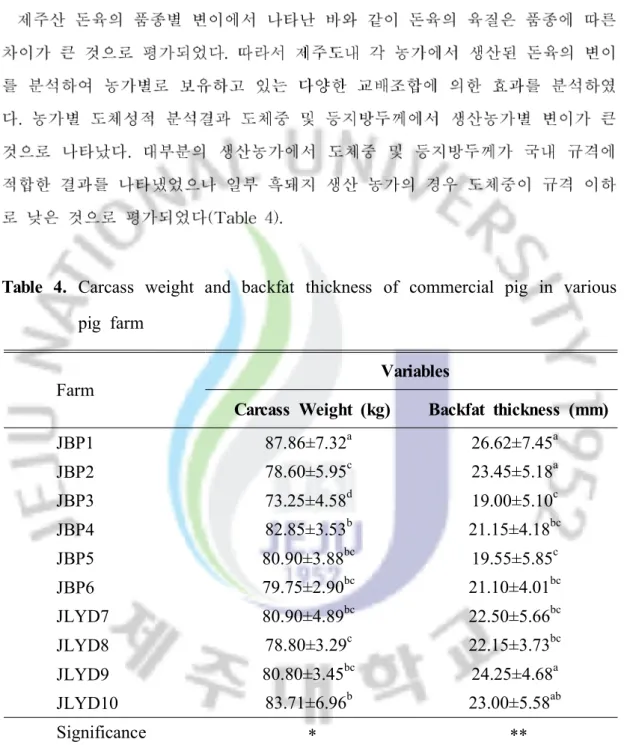
-Table 4. Carcass weight and backfat thickness of commercial pig in various
pig farm
Farm
Variables
Carcass Weight (kg)
Backfat thickness (mm)
JBP1
87.86±7.32
a26.62±7.45
aJBP2
78.60±5.95
c23.45±5.18
aJBP3
73.25±4.58
d19.00±5.10
cJBP4
82.85±3.53
b21.15±4.18
bcJBP5
80.90±3.88
bc19.55±5.85
cJBP6
79.75±2.90
bc21.10±4.01
bcJLYD7
80.90±4.89
bc22.50±5.66
bcJLYD8
78.80±3.29
c22.15±3.73
bcJLYD9
80.80±3.45
bc24.25±4.68
aJLYD10
83.71±6.96
b23.00±5.58
abSignificance
*
**
Levels of significance: * P<0.05; ** P<0.01.
a-c
Means with different superscripts in the same column significantly differ
27
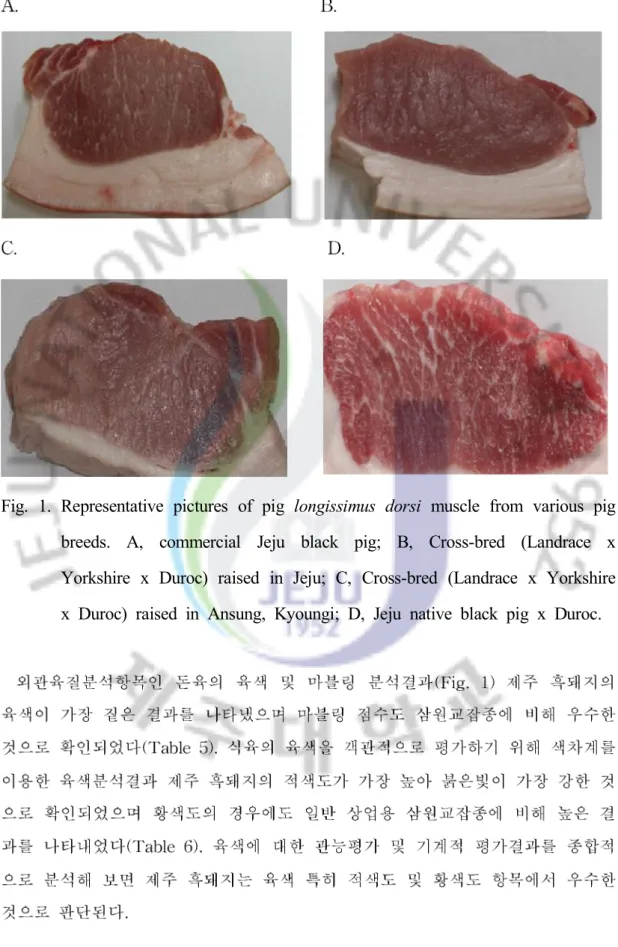
-Fig. 1. Representative pictures of pig longissimus dorsi muscle from various pig
breeds. A, commercial Jeju black pig; B, Cross-bred (Landrace x
Yorkshire x Duroc) raised in Jeju; C, Cross-bred (Landrace x Yorkshire
x Duroc) raised in Ansung, Kyoungi; D, Jeju native black pig x Duroc.
28
-Table 5. Meat color and marbling score of Longissimus dorsi muscle
Farm
Variables
Meat color score
Marbling score
JBP1
3.02±0.79
a2.07±0.75
aJBP2
2.81±0.43
ab2.30±0.81
aJBP3
3.15±0.63
a1.38±0.55
cJBP4
3.00±0.66
ab1.40±0.72
cJBP5
3.06±0.83
a1.50±0.66
bcJBP6
2.98±0.62
ab1.52±0.66
bcJLYD7
2.55±0.74
b1.94±0.54
abJLYD8
2.96±0.42
ab2.03±0.60
aJLYD9
2.96±0.41
ab1.53±0.66
bcJLYD10
2.94±0.76
ab1.53±0.61
bcSignificance
*
**
Levels of significance: * P<0.05; ** P<0.01.
a-c
Means with different superscripts in the same column significantly differ
29
-Table 6. Instrumental meat color parameters of Longissimus dorsi muscle
Farm
Variables
Lightness (L*)
Redness (a*)
Yellowness (b*)
JBP1
49.51±3.72
c7.09±1.20
a5.12±1.26
abJBP2
52.94±2.47
a6.12±1.10
bc5.18±0.98
aJBP3
49.69±2.49
c6.27±1.17
b4.64±0.93
abJBP4
50.14±2.95
bc7.38±1.14
a5.27±0.93
aJBP5
52.03±3.92
bc7.49±1.09
a3.88±1.03
cJBP6
51.16±3.15
abc6.86±1.46
ab4.48±0.93
bcJLYD7
50.09±3.06
bc5.18±1.32
d5.05±1.11
abJLYD8
50.73±3.20
bc5.43±1.15
cd5.18±1.18
abJLYD9
50.72±3.19
bc6.85±1.46
ab5.05±1.10
abJLYD10
51.93±3.04
bc6.22±2.25
b4.81±1.57
abSignificance
***
**
**
Levels of significance: ** P<0.01; *** P<0.001.
a-d
Means with different superscripts in the same column significantly differ
30
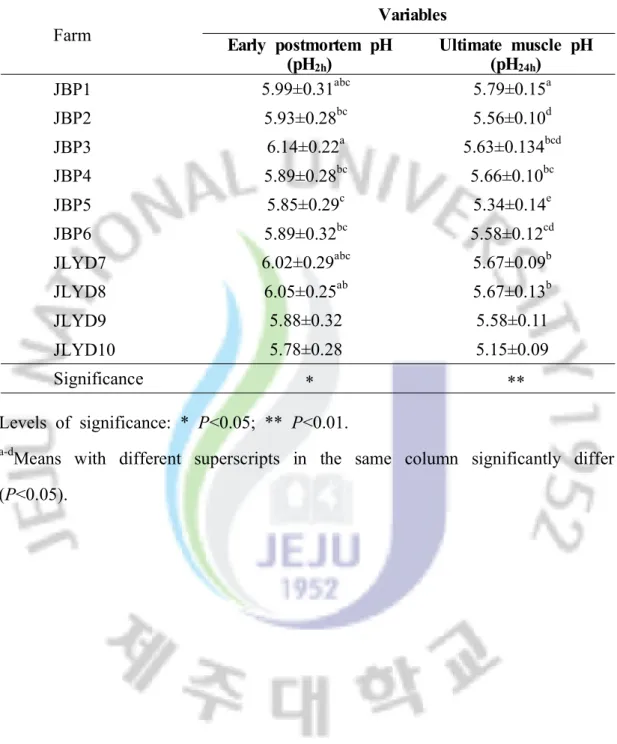
-Table 7. Longissimus dorsi muscle pH during postmortem period
Farm
Variables
Early postmortem pH
(pH
2h)
Ultimate muscle pH
(pH
24h)
JBP1
5.99±0.31
abc5.79±0.15
aJBP2
5.93±0.28
bc5.56±0.10
dJBP3
6.14±0.22
a5.63±0.134
bcdJBP4
5.89±0.28
bc5.66±0.10
bcJBP5
5.85±0.29
c5.34±0.14
eJBP6
5.89±0.32
bc5.58±0.12
cdJLYD7
6.02±0.29
abc5.67±0.09
bJLYD8
6.05±0.25
ab5.67±0.13
bJLYD9
5.88±0.32
5.58±0.11
JLYD10
5.78±0.28
5.15±0.09
Significance
*
**
Levels of significance: * P<0.05; ** P<0.01.
a-dMeans with different superscripts in the same column significantly differ
(P<0.05).
31
-Table 8. Water-holding capacity and cooking loss of Longissimus dorsi muscle
Farm
Variables
FFU
1(mg)
Drip loss (%)
Cooking loss (%)
JBP1
56.67±31.60
cd5.53±0.98
ab25.13±3.38
bJBP2
70.90±35.39
bc4.75±079
bc28.11±3.14
aJBP3
36.65±10.76
d4.80±0.81
bc28.88±2.18
aJBP4
58.65±23.78
cd5.19±1.44
bc24.91±3.34
bJBP5
126.40±57.40
a6.33±1.45
a27.76±3.64
aJBP6
59.20±22.61
cd5.16±1.63
bc28.76±2.52
aJLYD7
39.60±10.63
d4.44±0.95
c24.91±3.34
bJLYD8
86.25±44.37
b5.22±1.85
ab24.45±3.50
bJLYD9
83.75±41.27
b5.22±1.84
ab28.76±2.52
aJLYD10
132.40±48.40
a10.41±2.63
a19.94±3.32
cSignificance
**
***
**
Levels of significance: ** P<0.01; *** P<0.001.
a-d
Means with different superscripts in the same column significantly differ
(P<0.05).
32
-Table 9. Hardness, cohesiveness, and springiness of Longissimus dorsi muscle
Farm
Variables
Hardness (N/g)
Cohesiveness
Springiness
JBP1
39.45±5.09
b0.39±0.12
a0.56±0.28
bJBP2
40.70±6.90
b0.41±0.07
a0.72±0.12
aJBP3
44.55±4.21
a0.46±0.11
a0.66±0.14
abJBP4
45.91±4.28
a0.42±0.10
a0.62±0.15
abJBP5
40.45±5.63
b0.40±0.15
a0.60±0.20
abJBP6
37.48±3.75
bc0.44±0.12
a0.62±0.13
abJLYD7
35.75±4.26
c0.43±0.10
a0.65±0.16
abJLYD8
39.65±3.44
b0.41±0.11
a0.60±0.17
abJLYD9
39.64±3.43
b0.41±0.13
a0.60±0.18
abJLYD10
36.63±4.03
a0.45±0.13
a0.66±0.24
abSignificance
**
NS
*
Levels of significance: NS = not significant; * P<0.05; ** P<0.01.
a-c
Means with different superscripts in the same column significantly differ
33
-Table 10. Gumminess, chewiness, and resilience of Longissimus dorsi muscle
Farm
Variables
Gumminess (N/g)
Chewiness (J/g)
Resilience
JBP1
17.55±4.34
abc13.05±3.23
ab0.16±0.05
bJBP2
17.12±4.72
abc12.82±3.33
ab0.23±0.16
aJBP3
19.78±4.65
a13.93±3.36
a0.15±0.06
bJBP4
19.40±5.14
ba13.13±3.75
ab0.14±0.04
bJBP5
15.32±5.21
c11.27±3.93
b0.16±0.04
bJBP6
16.48±5.12
abc11.69±3.58
ab0.14±0.03
bJLYD7
15.49±4.33
c11.36±3.42
ab0.15±0.06
bJLYD8
15.99±4.53
bc11.79±3.38
ab0.14±0.04
bJLYD9
16.37±4.52
abc11.78±3.33
ab0.17±0.03
bJLYD10
16.63±5.02
abc10.24±4.02
c0.16±0.05
bSignificance
**
*
*
Levels of significance: * P<0.05; ** P<0.01.
a-c
Means with different superscripts in the same column significantly differ
34
-Fig. 2. Representative images of pig longissimus dorsi muscle fibers from various
pig breeds. A, commercial Jeju black pig; B, Cross-bred (Landrace x
Yorkshire x Duroc) raised in Jeju; C, Cross-bred (Landrace x Yorkshire x
Duroc) raised in Ansung, Kyoungi.
35
-Table 11. Pig Longissimus dorsi muscle fiber area from different farms
Farm
Variables
Type I ( m
μ
2)
Type IIa ( m
μ
2)
Type IIb ( m
μ
2)
JBP1
3367±519.31
a2799±291
a6286±353
abJBP2
2962±350
a2312±250
a4235±584
bJBP3
3128±713
a3568±652
a5979±320
abJBP4
3912±1663
a3112±972
a5844±1405
abJBP5
3616±487
a2995±276
a6077±804
abJBP6
3113±681
a2789±1035
a6015±1524
aJLYD7
2860±470
a2400±717
a5366±918
abJLYD8
3359±851
a3192±1401
a6646±1961
aJLYD9
3125±581
a2793±935
a5875±290
abJLYD10
3628±527
a3147±782
a4975±521
bSignificance
NS
NS
*
Levels of significance: NS, not significant; * P<0.05.
a,b
Means with different superscripts in the same column significantly differ
(P<0.05).
Table 12. Fiber area percentage of Longissimus dorsi muscle fiber type
Farm
Variables
Type I (%)
Type IIa (%)
Type IIb (%)
JBP1
8.93±0.96
ab5.38±1.40
a85.69±1.57
abJBP2
13.94±2.96
a4.37±0.81
a81.68±2.79
abJBP3
12.92±0.83
a6.17±2.89
a80.91±2.62
bJBP4
8.37±3.76
ab5.96±0.40
a85.67±3.67
abJBP5
8.81±4.78
ab4.87±0.88
a86.31±3.91
abJBP6
9.21±3.87
ab4.81±1.73
a85.98±5.44
abJLYD7
11.25±4.17
ab5.29±2.33
a83.46±6.25
abJLYD8
7.11±2.78
b4.29±1.05
a88.60±3.53
aJLYD9
12.42±1.63
a6.37±2.69
a81.21±2.82
bJLYD10
7.51±2.78
b4.09±1.05
a88.40±3.53
aSignificance
*
NS
*
Levels of significance: NS, not significant; * P<0.05.
a,b
Means with different superscripts in the same column significantly differ
36
-Table 13. Fiber number percentage of Longissimus dorsi muscle fiber type
Farm
Variables
Type I (%)
Type IIa (%)
Type IIb (%)
JBP1
14.68±1.91
ab10.54±2.38
a74.78±3.15
aJBP2
18.11±3.95
ab7.57±2.78
a74.32±3.83
aJBP3
21.45±1.38
a9.19±5.16
a69.36±6.53
aJBP4
12.17±6.94
b10.25±0.78
a77.58±6.17
aJBP5
12.55±5.23
b8.98±1.84
a78.47±3.61
aJBP6
15.16±5.14
ab9.27±2.61
a75.57±6.74
aJLYD7
17.83±4.74
ab10.00±3.26
a72.17±7.99
aJLYD8
12.44±4.63
b8.43±2.40
a79.13±4.27
aJLYD9
21.05±2.38
a9.39±4.66
a69.56±5.73
aJLYD10
12.84±3.73
b8.23±3.18
a77.13±4.73
aSignificance
*
NS
NS
Levels of significance: NS, not significant; * P<0.05.
a-c
Means with different superscripts in the same column significantly differ
(P<0.05).
Fig. 3. SDS-PAGE of myofibrillar proteins (A) and sarcoplasmic proteins (B) of
pig longissimus dorsi muscle from various pig breeds.
37
39
-Table 14. Effect of chilling methods on pH and temperature of longissimus
dorsi muscle during postmortem period
Chilling Methods
Significance
Fast Chilling
Normal Chilling
Muscle pH
2h6.14±0.21
aA5.89±0.27
b**
Muscle
Temperature
2h22.22±1.65
a
29.22±0.94
b***
Muscle pH
24h5.62±0.13
a5.66±0.10
aNS
Levels of significance: NS, not significant; **P<0.01; ***P<0.001.
a-b
Means with different superscripts in the same row significantly differ
(P<0.05).
A
40
-Table 15. Effect of chilling methods on meat color and intra muscular fat
content of longissimus dorsi muscle during postmortem period
Chilling Methods
Significance
Fast Chilling
Normal Chilling
NPPC color
3.15±0.63
aA3.0±0.66
aNS
NPPC marbling
1.37±0.55
a1.40±0.71
aNS
Lightness (L*)
49.69±2.49
a50.14±2.94
aNS
Redness (a*)
6.26±1.17
a7.38±1.13
b**
Yellowness (b*)
4.64±0.92
a5.26±0.93
b*
Levels of significance: NS, not significant; *P<0.05;**P<0.01.
a-b
Means with different superscripts in the same row significantly differ
(P<0.05).
A
42
-Table 16. Effect of chilling methods on water-holding capacity and texture of
longissimus dorsi muscle during postmortem period.
Chilling Methods
Significance
Fast Chilling
Normal Chilling
Filter-paper fluid
uptake (mg)
36.65±10.75
aA58.65±23.78
b***
Drip loss (%)
4.80±0.80
a5.19±1.44
aNS
Hardness
44.55±4.20
a45.91±4.28
aNS
Gumminess
19.77±4.64
a19.39±5.14
aNS
Chewiness
13.93±3.36
a13.13±3.75
aNS
Levels of significance: NS, not significant; ***P<0.0001.
a-b
Means with different superscripts in the same row significantly differ
(P<0.05).
45
-This study was to investigate the effects of pig breed and carcass chilling rate on meat quality traits in Jeju pork. This study involved 188 pigs from three different breeds as follows: commercial Jeju black pigs (JBP); native Jeju black pig×Duroc (JD); Jeju Landrace×Yorkshire×Duroc (JLYD). Pigs were slaughtered according to standard commercial procedures in a Korean abattoir. Within 45 min postmortem, muscle samples for histochemical analysis were taken from the longissimus muscle at the 8th thoracic vertebrae. Samples were cut into 0.5×0.5×1.0 cm pieces, promptly frozen in liquid nitrogen, and stored at -80℃ until subsequent analyses. Serial transverse muscle sections (10 μm) were obtained from each sample with a cryostat at -20℃ and mounted on glass slides. The myosin adenosine triphosphatase activities were detected after acid (pH 4.7) preincubation. About 300 fibers per sample were examined by an image analysis system and the muscle fibers were divided into type I, IIa, and IIb. Muscle pH was measured directly on carcass at the 7th/8th thoracic
vertebrae using a spear type electrode at 45 min (pH45min) and 24h postmortem (pH24h). Following 24h of chilling, M. longissimus dorsi was taken to evaluate the meat quality traits. Drip loss was determined by suspending muscle samples standardized for surface area in an inflated plastic bag for 48h. The color of the meat was measured at the 8th/9th thoracic vertebrae at 24h postmortem with a chromameter after exposing the surface to the air for 30 min. The average of triplicate measurements was recorded and the results were expressed as C.I.E. L*, a*, and b*. The texture was measured after cooking, 2.0×2.0×2.0 cm3 pieces were cut for texture profile analysis (TPA). Three pieces for each sample were measured for TPA. JD contained a significantly lower mean area percentage of type IIb fibers than those of other breeds (P<0.05). The muscle pH45min and pH24h were significantly higher in JD (P<0.001). Drip loss and color parameters were significantly different
46
-between the breeds (P<0.001). The muscle pH45min and pH24h were significantly higher in JD Meat color and sensory evaluation value was closely related to postmortem metabolic rate and pH value. The muscle color and sensory evaluation value was positively related to pH value. However, the a* value of the JLYD group was the lowest at 24 h postmortem (P<0.001). NPPC color value and NPPC marbling value of the JD group were highest in the breed groups (P<0.001). The water-holding capacity and texture were significantly dependent on breed. For the water-holding capacity measurements, the JD group had significantly highest values of FFU, drip loss, and cooking loss (P<0.001). The JD group had the highest value of hardness (P<0.001), cohesiveness (P<0.01), and springiness (P<0.1). The L* value, a* value and b* value of the JD group was the highest at 24 h postmortem (P<0.001). In this study, JD group, which showed the highest muscle pH, the lowest drip loss, and L* values contained a significantly lower mean area percentage of type IIb fibers than those of other breeds. Comparing the fiber type composition and meat quality traits observed from the different breeds, the results imply that the
longissimus dorsi muscle of native Jeju black pig×Duroc group is better meat quality
trait than that of other breeds. JD group, which showed the highest muscle pH, the lowest drip loss, and L* values contained a significantly lower mean area percentage of type IIb fibers than those of other breeds.
47
-Anderson, M.L., Keeton, J.T., Acuff, G.R., Lucia, L.M. and Vanderzant, C. 1989. Microbiological characteristics of precooked, vacuum packaged uncured beef and pork. Meat Sci. 25:69-79.
Ashgar, A. and Pearson, A.M. 1981. Influence of ante- and post-mortem treatments on the chemical composition and quality. Adv. Food Res. 26:355
Beattie, V. E., Weatherup, R. N., Moss, B. W., and Walker, N. 1999. The effecting of increasing carcass weight of finishing boars and gilts on joint composition and meat quality. Meat Science 52, 205-211.
Bendall, J.R. 1978. Variability in rates of pH fall and of lactate production in the muscles on cooling beef carcasses. Meat Sci. 2:91-104.
Bendall, J.R.. and Wismer-Pederson, J. 1962. Some properties of fibrillar proteins of normal and watery pork muscle. J. Food Sci. 27:144-159.
Bouton, P.E., Carrol, F.D., Fisher, A.L., Harris, P.V. and Shorthose, W.R. 1973. Effect of altering pH on bovine muscle tenderness. J. Food. Sci 38:816 Bouton, P.E., Carrol, F.D., Fisher, A.L., Harris, P.V. and Shorthose, W.R. 1983.
Influence of pH and fiber contraction state up on factors affecting the tenderness of bovine muscle. J. Food Sci 38:404.
Bouton, P.E., Harris, P.V. and Shorthose, W.R. 1971. Effext of ultimate pH upon the water holding capacity and tenderness of mutton. J. Food Sci 36:435
Bowker, B.C., C. Botrel, D.R. Swartz, A.L. Grant and D.E. Gerrard. 2004. Influence of myosin heavy chain isoform expression and postmortem metabolism on the ATPase activity of muscle fibers. Meat Sci. 68:587-594.
Brewer, M.S., W.G. Ikins and C.A.Z. Harbers. 1992. TBA values, sensor characteristics and volatiles in ground pork during long-term frozen storage: Effect of packaging. J. Food Sci. 57:558-563.
48
-Briskey, E.J. 1964. Etiological status and associated studies of pale, soft, exudative porcine musculature. Adv. Food Res. 13:89-178.
Brooke, M. H. and Kaiser, K. K. 1970. Muscle fiber types: How many and what kind. Arch. Neurol. 23, 369.
Candek-Potokar, M., Zlender, B., Lefaucheur, L., and Bonneau, M. 1998. Effects of age and/or weight at slaughter on longissimus dorsi muscle: Biochemical Traits and Sensory Quality in pigs. Meat Science 48(3), 287-300.
Cho, S. H., Park, B. Y., Kim, J. H., Kim, M. J., Seong, P. N., Kim, Y. J., Kim, D. H. 2007. Carcass yields and meat quality by live weight of Korean native black pigs. Kor. J. Anim. Sci. 49(4), 523-530.
Choi, Y. S., Park, B. Y., Lee, J. M., and Lee, S. K. 2005. Comparison of carcass and meat quality characteristics between Korean native black pigs and commercial crossbred pigs. Kor. J. Food Sci. Ani. Resour. 25, 322-327. Chrystall, B.B. and Devine, C.E., Ellery, S. and Wade, L. 1984. Low voltage
electrical stimulation of lamb: its effects in muscle pH and tenderness. Newzealand J. Agric. Res 27:57-13
Cisneros, F., Ellis, M., McCaw, J., McKeith, F. K., and Hyun, Y. 1994. Influence of slaughter weight on carcass cutting yields and meat quality in pigs. Journal of Animal Science 72: suppl. 1, 378(abstr)
Cisneros, F., Ellis, M., McKeith, F. K., McCaw, J., and Fernando, R. L. 1996. Influence of slaughter weight on growth and carcass characteristics, commercial cutting and curing yields, and meat quality of barrows and gilts from two genotype. J. Anim. Sci. 74, 925-933.
Crawford, S. M., Moeller, S. J., Zerby, H. N., Irvin, K. M., Kuber, P. S., Velleman, S. G., Leeds, T. D. 2009. Effects of cooked temperature on pork tenderness and relationships among muscle physioligy and pork quality traits in loins from Landrace and Berkshire swine. Meat Science.
Crouse, J.D., Cundiff, L.V., Koch, R.M., Koohmaraie, M., and Seideman, S.C. 1989. Comparisons of Bos indicus and Bos taurus inheritance for carcass beef
49
-characteristics and meat palatability. J. Anim. Sci. 67:2661-2668 Drumm, B.M., McKenna, B.M. & Joseph, R.L. 1992. J. Food Engng, 15:285.
Eggert, J.M., Sheiss, E. B., Schnickel, A. P., Forrest, J. C., Grant, A. L., Mills, S. E., and Watkins., K. F. 1996. Effects of genotype, sex, slaughter weight, and dietary fat on pig growth, carcass composition and pork quality. 1996 Purdue Swine Day.
Eggert, J.M., F.F.S. Depreux, A.P. Schinckel, A.L. Grant and D.E. Gerrard. 2002. Myosin heavy chain isoforms account for variation in pork quality. Meat Sci. 61:117-126.
Ellis, M., Smith, W. C., Clark, J. B. K., and Innes, N. 1983. A comparison of boars, gilts and castrates for bacon manufacture. Animal Production 37, 1-9. Ellis, M., Webb, A. J., Avery, P. J., and Brown, I. 1996. The influence of terminal
sire genotype, sex, slaughter weight, feeding regime and slaughter-house on growth performance and carcass and meat quality in pigs and on the organoleptic properties of fresh pork. Animal Science 65, 521-530
Essen-Gustavsson, B., Karlstrom, K. and Lundstrom, K. 1992. Intramuscular fat content and lipid in muscle fibers of pigs fed high and low protein diet and relation to meat quality. 38th International Congress of Meat Science and Technology, Clermont Ferrand, France, pp. 41-44.
Galloway, D.E. and Goll, D.E. 1967. Effect of temperature on molecular properties of postmortem porcine muscle. J. Anim Sci. 26:1302-1308.
Garcia-Macias, J. A., Gispert, M., Oliver, M. A., Diestre, A., Alonso, P., Munoz-Luna, A., Sliggens, K., and Cuthbert-Heavens, D. 1996. The effects of cross, slaughter weight and halothane genotype on leanness and meat and fat quality on pig carcasses.Animal Science 63, 487-496.
Greaser, M.L. 1986. In: muscle as food. Conversion of muscle to meat. Academic Press. New York.
Gu, Y., Schickel, A. P., and Martin, T. G. 1992. Growth, development and carcass composition in five genotypes. J. Anim. Sci. 70, 1719-1792.
50
-Hah, K. H., Jin, S. K., Kim, I. S., Jung, H. J., and Kim, D. H. 2006. Effect of gender on sensory scores, fatty acid and amino acid of berkshire pork. Kor.
J. Food Sci. Ani. Resour. 26, 426-430.
Hah, K. H., Kim, I. S., Jin, S. K., Nam, Y. W., and Cho, J. H. 2007. Proximate coposition and physico-chemical characteristics of Berkshire pork by gender.
Kor. J. Food Sci. Ani. Resour. 27(2), 137-141.
Hales, K.C. 1963. Adv. Food Res. 12:147-207.
Henckel, P., A. Karlsson, N. Oksbjerg and J.S. Petersen. 2000. Control of post mortem pH decrease in pig muscles: Experimental design and testing of animal models. Meat Sci. 55:131-138.
Honikel, K.O. 1987. Influence of chilling on meat quality attributes of fast glycolysing pork muscles. In: Evaluation and control of meat quality in pigs. eds. P.V. Tarrant. Martinus Nijhoff Publ. pp. 273.
Honikel, K.O. and Kim, C.J. 1986. Causes of the development of PSE pork. Fleischwirtschaft66, 349-353.
Honikel, K.O., Kim, C.J., Jamm, R. and Roncales, P. 1986. Sarcomere shortening of prerigor muscles and its influence on drip loss. Meat Sci. 16:267
Hwang, I. H., Park, B. Y., Cho, S. H., Kim, J. H., and Lee, J. M. 2004. Identificaiton of muscle proteins related to objective meat quality in Korean native black pig. Asian-Australasian Journal of Animal Sciences. 17, 1599-1607.
Jeremiah, L. E., Gibson, J. P., Gibson, L. L., Ball, R. O., Aker, C., and Fortin, A. 1999. The influence of breed, gender, and PSS(Halothane) genotype on meat quality, cooking loss, and palatability of pork. Food Research
International. 32, 59-67.
Jin, S. K., Kim, C. W., Song, Y. M. Jang, W. H., Kim, Y. B., Yeo, J. S., Kim, J. W., and Kang, K. H. 2001. Physicochemical characteristics of longissimus muscle between the Korean native pig and Landrace. Kor. J. Food Sci. Ani.
51
-Jin, S. K., Kim, I. S., Hur, S. J., Kim, S. J., and Jeong, K. J. 2006. The influence of pig breeds on qualities of loin. Kor. J. Anim. Sci. 48(5), 747-758.
Jin, S.K., Kim, I.S., Kim, S.J., Jeong, K.J., Ko, B.S., Nam, Y.W., and Moon, S.S. 2007. Comparison of physicochemical and sensory properties of branded pork by feeding probiotics and crossbred between Korean native and Wild pigs. Kor. J. Anim. Sci. 49(1), 99-108.
Jin, S. K., Song, Y. M., Lee, J. I., Park, T. S., Joo, S. T., and Park, G. B. 1999. Effects of feeding oriental medicinal residue on physico-chemical properties of pork during storage. Kor. J. Food Sci. Ani. Resour. 19, 179-187
Joo, S.T., Kauffman, R.G., Kim, B.C. and Kim, C.J. 1995. The relationship between color and water-holding capacity in postrigor porcine longissimus muscle. J. Muscle Food. 6:211-226.
Joo, S.T., R.G. Kauffman, B.C. Kim and G.B. Park. 1999. The relationship of sarcoplasmic and myofibrillar protein solubility to color and water-holding capacity in porcine longissimus muscle. Meat Sci. 52:291-297.
Judge, M.D., Aberle, E.D., Forrest, J.C., Hedrics, H.B., and Merkel, R.A. 1989. Principle of meat science. Kendall/Hunt Publishing Co. p.128
Kang, S. M., Kang, C. G., Lee, S. K. 2007. Comparison of quality characteristics of Korean native black pork and Modern genotype pork during rdfrgerated storage after thawing. Kor. J. Food Sci. Ani. Resour. 27(1), 1-7.
Kang, S. M., Lee, S. K. 2007. Quality comparison of M.longissimys from crossbred Wild boars, Korean native black pigs and Modern genotype pigs during refrigerated storage. Kor. J. Anim. Sci. 49(2), 257-268.
Karlsson, A.H., R.E. Klont, and X. Fernandez. 1999. Skeletal muscle fibers as factors for pork quality. Livestock Production Science, 60:255-269.
Kastner, C.L, R.L. Henrickson and R.D. Morrison. 1973. Characteristics of hot-boned bovine muscle. J. Anim. Sci. 36:484-487
Kauffman, R.G., G. Eikelenboom, P.G. Van der Wal, B.G. Merkus and M. Zaar. 1986. The use of filter paper to estimate drip loss of porcine musculature.
52 -Meat Sci. 18:191-200.
Kim, B. K., Kang, S. S., and Kim, Y. J. 2001. Effects of dietary oriental medicine refuse and mugwort powder on physico-chemical properties of Korean native pork. Kor. J. Food Sci. Ani. Resour. 21, 208-214.
Kim, I. S., Jin, S. K., Kim, C. W., Song, Y. M., Cho, K. K., and Chung, K. H. 2008. The effect of pig breeds on proximate, physicochemical, cholesterol, amono acid, fatty acid and sensory properties of loins. Kor. J. Anim. Sci. 50(1), 121-132.
Kim, Y. B., Rho, J. H., Richardson, I., and Wood, J. 2000. Comparison of physicochemical properties of pork from 4 different pig breeds. Kor. J.
Anim. Sci. & Technol. 42(2), 195-202.
King, N.L. and Harris, P.V. 1982. Heat-induced tenderization of meat by endogenous carboxyl protease. Meat Sci 6:137
Ko, M.S. and J.B. Yang. 2001. Effects of wrap and vacuum packaging on shelf life of chilled pork. Kor. J. Food and Nutr. 14:255-262.
Krzywicki, K. 1979. Assessment of relative content of myoglobin, oxymyoglobin and metmyoglobin at the surface of beef. Meat Sci. 3:1-10
Lawrie, R.A. 1979. Meat Science. 3rd ed. p.300. Pergamon Press, New York. Lawrie, R.A. 1991. In: Meat science. 5th ed. Pergamon Press, Oxford.
Leach, L. M., Ellis, M., Sutton, D. S., McKeith, F. K., and Wilson, E. R. 1996. The growth performance, carcass characteristic and meat quality of halithane carrier and negative pigs. J. Anim. Sci. 74, 934-943.
Lee, S. D. 2002. Effects of carcass and pork quality characteristics by marketing day of Kagoshima berkshire. MA. thesis, Chinju National Univ., Chinju, Korea. Lee, S. K., Ju, M. K., Kim, Y. S., Kang, S. M., and Choi, Y. S. 2005. Quality
comparison between Korean native black ground pork and medern genotype ground pork during refrigerated storage. Kor. J. Food Sci. Ani. Resour. 25, 71-77.
53
-relation to the metabolic type of the fibers. Meat Sci. 29, 229.
Locker, R.H. and Hagyard, C.J. 1963. A cold shortening effect in beef muscles. J. Sci. Food Agric. 14:787.
Locker, R.H., Davey, C.L., Nottingham, P.M., Haughey, D.P. and Law, N.H. 1975. New concepts in meat processing. Adv. Food. Res. 21:157.
Lundstrom, K. Essen-Gustavsson, B., Rundgren, M., Edfors-Lilja, I. and Malmfors, G. 1989. Effect of halothane genotype on muscle metabolism at slaughter and it's relationship with meat quality: A within-litter comparison. Meat Sci. 25, 251.
Mallikarjunan, P., G.S. Mittal. 1995. Optimum Conditions for Beef Carcass Chilling. 39:215-223.
Malmfors, B. and Nillson, R. 1978. Meat quality traits of boars in comparison with castrates and gilts. Swedish Journal of Agricultural Research 8, 209-217. Marsh, B.B. and Leet, N.G. 1966. Studies in meat tenderness. 111. The effects of
cold shortening on tenderness. J. Food Sci. 31:450.
Martel, J., Minvielle, F., and Poste, L. M. 1988. Effects of crossbreeding and sex on carcass composition, cooking properties and sensory characteristics of pork.
J. Anim. Sci. 66, 41-46.
Martens, H. 1998. Physiologie der Muskulatur und das MHS-Gen des Schweines: Zur Diskussion um eine Eliminierung des mutierten Ryanodin-Rezeptors aus der deutschen Schweinezucht. Arch. Trierzucht. Dummerstorf. 41(1/2), 179-192. Matsuoka, A., Yamano, Y., Furukawa, N., Ikeda, S., and Yamanaka, Y. 1991.
Studies on meat quality of pigs crossbred with wild boars 5. Effects of sex on growth, carcass traits and physico-chemical properties of meat. Japanese
Journal of Wsine Sience 28(1), 6-12.
Mikkelsen, A., Juncjer, D., and Skibsted, L. H. 1999. Metmyoglobin reductase activity in porcine m. longissimus dorsi mscle. Meat Sci. 51, 155-161. Moeller, P.W., Fields, P.A., Duton, T.R., Landmann, W.A. and Carpenter, Z.L. 1976.
54
-levels of lysosomal enzymes. J. Food Sci 41:216
Monin, G. and A. Ouali. 1992. Muscle differentiation and meat quality. In R. Lawrie (Ed.), Developments in meat science (pp. 89-157). London: Elsevier Applied Science.
Monin, G., Mejenes-Quijano, A., Talmant, A. and Sellier, P. 1987. Influence of breed and muscle metabolic type on muscle glycolytic potential and meat pH in pigs. Meat Sci. 20, 149.
Nikitenko, R. I., Mukhanov, F. E., Podskrebkin, N. V., Silich, S. V., and Zagorel'skii, V. N. 1990. The use of young boars for meat. Zootekhniya No. 3, 76-77
Offer, G. 1991. Modeling of the formation of pale, soft and exudative meat: Effect of chilling regime and rate and extent of glycolysis. Meat Sci. 30:157. Offer, G., & Knight, P. 1988. The strctural basis of water-holding capacity in meat.
Part 2: Drip losses. In R. Q. Lawrie (Ed.), Developments in meat science (pp. 173-241). London:Elsevier Applied Science.
Ouai, A. 1990. Meat tenderization: Possible cause and mechanisms. A review. J. Muscle Foods. 1:129.
Park, B. Y., Kim, N. K., Lee, C. S., Hwang, I. H. 2007. Effect of fiber type on postmortem proteolysis in longissimus muscle of Landrace and Korean native black pigs. Meat Science. 77, 482-491.
Park, G. B., Lee, J. R., Lee, H. G., Park, T. S., Lee, J. I., Kim, Y. H., and Jin, S. K. 1998. The effect of feeding oriental medicine refuse on changes in physico-chemical properties of pork with storage time. Kor. J. Anim. Sci. 40, 391-400.
Parrish, F.C. jr., Olson, D.G. Miner, B.E. and R.E. Rust. 1973. Effect of degree of marbling and internal temperature of doneness on beef rib steaks. J. Anim. Sci 37:430
Parrish, F.C. Jr., Selving, C.J., Culler, R.D. and Zeece, M.G. 1981. CAF activity, calcium concentration, and 30,000-dalton component of tough and tender
55
-bovine longissimus muscle. J. Food Sci 46:308
Penny, I.F. 1969. Protein denatration and water holding capacity in port muscle. J. Food Technol. 4:269-273.
Penny, I.F., Voyle, C.A. and Dransfild, E. 1974. The tenderzing dffect of muscle proteinase on beef. J. Sci. food Agri 25:703
Peter, J. B., Barnard, R. J., Edgerton, V. R., Gillespie, C. A. and Stempel, K. E. 1972. Metabolic profiles of three fiber types of skeletal muscle in guinea pigs and rabbits. Biochemistry 11, 2627.
Pierson, C.J. and Fox, J.D. 1976. Effect of postmortem aging time and temperature on pH, tenderness and soluble collagen fractions in bovine longissimus muscle. J. Anim. Sci 43:1206
Risvik, E. (1994) Sensoty properties and preferences. Meat Sci. 36, 67-77.
Ryu, Y.C., Y.M. Choi and B.C. Kim. 2005. Variations in metabolite contents and protein denaturation of the longissimus dorsi muscle in various porcine quality classifications and metabolic rates. Meat Sci. 71:522-529.
Salviati, G., Betto, R. and Betto, D. D. 1982. Polymorphism of myofibrillar proteins of rabbit skeletal muscle fibres. An electrophoretic study of single fibres.
Biochem. J. 207, 261.
SAS Institute. 2001. SAS user’s guide, version 8.2. Cary, NC: SAS Institute.
Sather, A. P., Jones, S. D. M., Tong, A. K. W., and Murray, A. C. 1991. Halithane genotype by weight interactions on pig meat quality. Can. J. Anim. Sci. 71(3), 646-653.
Schiaffino, S. and C. Reggiani. 1996. Molecular diversity of myofibrillar proteins: Gene regulation and functional significance. Physiological Reviews, 76:371-23.
Schon, L. and Strosiek, M. 1958. Sodium under pH in rindfleisch and sch2einefleish. Fleischwirtschaft 10:78
Scopes, R.K. 1970. Charterization and studies of sarcoplasmic proteins. "In physiology and biochemistry of muscle as a food." Vol. 2. E.J. Briskey.
56
-R.G. Cassens and J.C. Trautman, ed. Univ. Wisconsin Press Midison. P. 471
Smith, G.C., Arango, T.C. and Canpenter, Z.L. 1971. Effect of physical and mechanical treatment on the tenderness of beef longissimus. J. Food Sci 36:455
Suzuki, A., Matsumoto, Y., Nonami, Y. and Saito, M. 1982. Ca2+ activated protease in stored muscle. Meat Sci 7:269
Tikk, K., Tikk, M., Karlsson, A. H., and Andersen, H. J. 2006. The effect of a muscle-glycogen-reducing finishing diet on porcine meat and fat colour.
Meat Science. 73, 378-385.
Tornberg, Z. 1996. Biophysical aspects of meat tenderness. Meat Sci. 43:s157.
Unruh, J. A., Friesen, K. G., Stuewe, S. R., Dunn, B. L., Nelssen, J. L., Goodband, R. D., and Tokach, M. D. (1996)
Van Den Berg, L., Lentz, C.P., Khan, A.W. 1964. Food Technol. 18:729-731.
Van der Wal, P.G., Engel, B and Hulsegge, B. 1997. Causes for variation in pork quality. Meat Sci. 46(4):319-327.
Warkup, C. C., Dilworth, A. W., Kempsterm A. J., and Wood, J. D. 1990. The dffects of sire type, company source, feeding regimen and sex on eating quality of pig meat. Animal Production. 50, 550-557.
Warner, R.D., P.G. Kauffman and M.L. Greaser. 1997. Muscle protein changes post mortem in relation to pork quality traits. Meat Sci. 45:339-352.
Warriss, P. D. and Brown, S. N. 1987. The relationships between initial pH, reflectance and exudation in pig muscle. Meat Sci. 20, 65-74.
Warriss, P.D., and Lister, D. 1982. Improvement of meat quality in pigs by beta-adrenergic blookade. Meat Sci. 7:183-187.
Yang, S. J., Kim, Y. K., Hyon, J. S., Moon, Y. H., and Jung, I. C. 2005. Amino acid contents and meat quality properties on the loin from cressbred black and crossbred pigs reared in Jejudo. Kor. J. Food Sci. Ani. Resour. 25, 7-12.
57
-Yoo, Y. M., Ahn, J. N., Cho, S. H., Park, B. Y., Lee, J. M., Kim Y. K., and Park, H. K. 2002. Feeding effects of ginseng by-product on characteristics of pork carcass and meat quality. Kor. J. Food Sci. Ani. Resour. 22, 337-342 Young, O. A. and Davey, C. L. 1981. Electrophoretic analysis of proteins from
single muscle fibers. Biochem. J. 195, 317.
, , , , , , , . 1998.
. . pp.61-90, 93-147.
. 2004. . Kor. J.
58