INTRODUCTION
Surface modification of a polymer to obtain desirable sur-face properties is one of the major scientific challenges for the manufacture of high performance polymers. For many applications, such as the adhesion of polymers on metals and alloys, wettability, biocompatibility, and so on, various methods have been developed to modify the surface proper-ties, including chemical treatment, corona discharge, grafting, coating, plasma treatment, and ion implantation. Among them, grafting has numerous advantages over other methods to improve surface properties of polymers (Borcia et al. 2008; Chen et al. 2008). Grafting is simple and useful to introduce polymer chains with high density at exact localization and it can provide a long-term chemically stable grafted polymer chain (Gupta et al. 2003; Ito et al. 2006; Uhlmann et al. 2006). Graft polymerization is mediated by an active site as a starting point. Many different methods, such as the use of
a chemical initiator, plasma discharge, ozone treatment, UV radiation, and high energy radiation, have been developed to create active sites on the surface (Choi et al. 2008).
Among them, high energy radiation-induced graft poly-merization is a well-established technique that does not require any initiators and additives. A grafting reaction with electron beams and gamma rays was extensively studied (Brack et al. 2004; Nasef et al. 2004). However, grafting induced by ion beam has rarely been carried out. Ion beam-based process is one of the attractive techniques because it is a surface-specific modification technique without detri-mentally affecting the bulk properties. Moreover, it is also controllable, reproducible, and clean, and the dimensions of a material are not affected due to a low processing tempera-ture. For these merits, ion beam-based process is suitable to modify the surface of polymeric materials to obtain desira-ble properties (Massa et al. 2005; Choi et al. 2009).
In this study, we reported the surface graft polymerization of 4-vinyl pyridine (4VP) on a poly(tetrafluoroethylene) (PTFE) film by ion irradiation to functionalize its surface. The surface functionalization and surface property were
─ ─ 341 ──
Surface Functionalization of a Fluoropolymer by
Ion Beam-induced Graft Polymerization of 4-Vinyl Pyridine
Chan-Hee Jung, In-Tae Hwang, Jae-Hak Choi* and Young-Chang Nho Advanced Radiation Technology Institute, Korea Atomic Energy Research Institute,
Jeongeup 580-185, Korea
Abstract-- The surface functionalization of a fluoropolymer by ion beam-induced graft polymeri-zation was described in this research. The surface of poly(tetrafluoroethylene) (PTFE) films were irradiated by a 150 keV H++
ions, and 4-vinyl pyridine (4VP) as a functional monomer was then thermally graft polymerized on the irradiated surface. The surface properties of poly(4-vinyl pyridine) (P4VP)-grafted PTFE films were investigated in terms of grafting degree, wettability, chemical structure, and morphology. The results revealed that the surface of PTFE films was successfully functionalized by ion beam-induced graft polymerization of 4VP.
Key words : Surface functionalization, Ion beam-induced graft polymerization, Poly(tetrafluo-roethylene), 4-Vinyl pyridine
* Corresponding author: Jae-Hak Choi, Tel. +82-63-570-3062, Fax. +82-63-570-3090, E-mail. [email protected]
investigated by using a grafting degree measurement, con-tact angle measurement, attenuated total reflectance Fourier transform infrared spectroscopy (ATR-FTIR), and scanning electron microscopy (SEM).
MATERIALS AND METHODS
1. MaterialsA poly(tetrafluoroethylene) film with 100μm thickness purchased from Universal corporation was used as a sub-strate material for radiation-induced graft polymerization. The functional monomer, 4-vinyl pyridine, was purchased from Aldrich and used without further purification.
2. The surface activation of PTFE by ion irradiation
PTFE films were ultrasonically washed with ethanol and dried under a vacuum before used. PTFE films were irradiat-ed with 150 keV H++
ions at various flunences ranging from 1×10¹⁴to 9×10¹⁴ions cm-2. The pressure in the im-planter’s target chamber was 10-5~10-6Torr. The beam current density was kept less than 1.0μmA cm-2to prevent a thermal effect on the sheets. The irradiated films were stored in air for 24 h for further oxidation.
3. Surface graft polymerization
The irradiated PTFE films were put into glass tubes con-taining aqueous solution concon-taining 40, 60, and 80 vol% of 4-vinyl pyridine and, subsequently, purged with nitrogen gas to remove oxygen. Graft polymerization was performed by placing the tubes at 80�C in a water bath for 12 to 18 h. After the graft polymerization, the resulting films were thoroughly washed with deionized water to remove the homopolymers. The resulting poly(4-vinyl pyridine) (P4VP)-grafted PTFE films were finally dried under vacuum at 45�C.
The grafting degree of poly(4-vinyl pyridine) grafted onto the PTFE surface was measured by an Acid Orange 7 (AO7) staining method (Combellas et al. 2007). The grafted films were immersed in a 0.5 mM AO7 solution at pH 10 and then placed for 6 h at room temperature. The resulting stained films were thoroughly washed with an excess amount of a sodium hydroxide solution (pH 10) to remove the free AO7 molecules on the surface. Afterwards, the AO7 molecules
complexed on the grafted films were detached in a 0.l mol NaOH base solution. The grafting degree was calculated from the calibration plot of the optical density versus AO7 concentration assuming the 1 : 1 stoichiometry of the binding between the AO7 and the pyridine group. The optical den-sities of the resulting solution were measured at 480 nm using a UV/Vis spectrophotometer (MQX 200 model, Bio-Tek Instruments).
4. Surface characterization
The surface chemical structure was analyzed by using an attenuated total reflectance Fourier transform infrared spec-troscopy (ATR-FTIR, Bruker, Tensor 37). The water contact angle measurement was performed by using a contact angle analyzer (Phoenix 300, Surface Electro Optical Company). The surface morphology was observed by using a scanning electron microscopy (SEM, JEOL JSM-6390).
RESULTS AND DISCUSSION
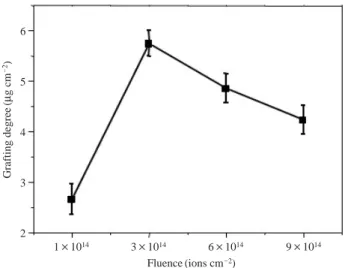
The surface graft polymerization of 4VP on PTFE films was performed under various conditions to optimize the surface functionalization of PTFE films and the grafting degree of P4VP grafted onto the PTFE surface was deter-mined by a AO7 staining-based colorimetric method. Fig. 1 shows the grafting degree of P4VP on the surface as a func-tion of the fluence. The grafting degree increased to 5.7μg cm-2with increasing the fluence to 3×10¹⁴ions cm-2, above
Fig. 1. The grafting degree as a function of the fluence: [4-vinyl
pyridine]=80 vol% and grafting reaction time=14 h.
Grafting degree (μ g cm -2) 6 5 4 3 2 1×10¹⁴ 3×10¹⁴ 6×10¹⁴ 9×10¹⁴ Fluence (ions cm-2)
which it decreased. This result could be explained by the fact that the ion irradiation at a relatively lower fluence than 3×10¹⁴ions cm-2generates higher amounts of active
spe-cies such as peroxide or hydroperoxide on the surface due to proper oxidation, but carbonization by defluorination pre-dominantly occurs at a higher fluence, resulting in the reduc-tion of active species on the irradiated PTFE.
The effect of the grafting reaction time on the grafting degree was also investigated and the results are shown in Fig. 2. The grafting degree initially increased with increasing the grafting reaction time up to 14 h, after which it leveled off. This result can be interpreted as follows. With increasing the reaction time up to 14 h, the graft polymerization of 4VP
initiated by radicals generated from active species such as peroxide and hydrogen peroxide on the irradiated PTFE surface was predominant, resulting in an increase in the grafting degree. However, for the reaction time above 14 h, the grafting degree was not much increased because all the formed peroxides on the PTFE surface were almost con-sumed and the monomers were almost polymerized after the certain grafting time.
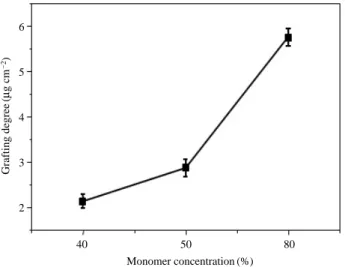
The effect of the monomer concentration on the grafting degree is present in Fig. 3. The grafting degree increased with increasing the concentration of 4VP up to 80 vol%. Therefore, from these data, it is clear that the surface graft Fig. 3. The grafting degree as a function of monomer concentration:
the fluence=3×10¹⁴ions cm-2and reaction time=14 h.
Grafting degree (μ g cm -2) 6 5 4 3 2 40 50 80 Monomer concentration (%)
Fig. 2. The grafting degree as a function of the reaction time: the
fluence=3×10¹⁴ions cm-2and [4-vinyl pyridine]=80 vol%.
Grafting degree (μ g cm -2) 6 5 4 3 2 12 14 18 Reaction time (h)
Fig. 4. The ATR-FTIR spectra of the control (a), irradiated (b), and
P4VP-grafted PTFE films (c).
Absorbance 4000 3500 3000 2500 2000 1500 1000 Wavenumber (cm-1) (c) (b) (a) 3,022 cm-1 2,943 cm-1 1,596 cm-1 1,545 cm-1 1,406 cm-1
Fig. 5. The Contact angles of the control, irradiated, and
P4VP-grafted PTFE films as a function of the fluence.
Contact angle (� ) 120 110 100 90 80 70 60 0 1×10¹⁴ 3×10¹⁴ 6×10¹⁴ 9×10¹⁴ Fluence (ions cm-2) Irradiated PTFE P4VP-grafted PTFE
polymerization with the 80 vol% concentration of 4VP on the PTFE irradiated at a fluence of 3×10¹⁴ions cm-2for
14 h achieved the maximum grafting degree in this grafting system.
The ATR-FTIR spectra of the control, irradiated, and P4VP-grafted PTFE films are shown in Fig. 2. The PTFE irradiated with Ar ions at 3×10¹⁴ions cm-2and the
P4VP-grafted PTFE prepared with the PTFE treated at the same fluence were used for the analysis. As shown in the control PTFE spectrum of Fig. 4(a), the characteristic bands corre-sponding to the stretching vibration of the -CF2present in
the control PTFE appeared at 1,161 and 1,241 cm-1. The
irra-diated film does not show significant changes in the main spectrum compared to the control PTFE as shown in the con-trol PTFE spectrum of Fig. 4(a) and (b). On the other hand, the P4VP-grafted PTFE fim in Fig. 4(c), the characteristic bands corresponding to the chemical structure of P4VP were identified at 3,022 (the stretching vibration of aromatic CH2),
2,943 (the stretching vibration of aliphatic CH2), and 1,596,
1,545, and 1,406 cm-1(the stretching vibrations of C=C and
C=N) (Melendez-Ortiz et al. 2009). These results confirm that P4VP has been successfully grafted onto the surface of the PTFE film.
The changes in the water contact angle of the control, irra-diated, and P4VP-grafted PTFE films as a function of the fluence are shown in Fig. 5. In comparison with that of the control PTFE film, 105�, the contact angles of the irradiated
PTFE films were gradually decreased up to 95�with an
increasing fluence. In the case of the P4VP-grafted PTFE films, the contact angle further decreased up to about 70�.
This result implies that hydrophtlic P4VP was successfully grafted on the hydrophobic PTFE surface, which improved
the wettability of the PTFE surface.
The changes in the surface morphology of the PTFE after ion implantation and graft polymerization of 4VP was in-vestigated by SEM observation and are shown in Fig. 6. As shown in Fig. 6(a), the surface of the control PTFE had a few scar like poles but was rather smooth on the whole surface. After ion irradiation, the surface morphological changes were not observed in comparison to that of the con-trol PTFE as shown in Fig. 6(b). However, after surface graft polymerization, the surface morphology of the PTFE was much rougher as present in Fig. 6(c). This result revealed that the P4VP was successfully grafted on the irradiated PTFE surface.
CONCLUSIONS
In this study, the surface functionalization of PTFE was successfully performed by ion beam-induced graft polymeri-zation of a functional monomer, 4-vinyl pyridine. The results of the ATR-FTIR, contact angle measurement, and SEM observation confirmed that the surface graft polymerization of 4-vinyl pyridine was successfully carried out on the irra-diated PTFE. The grafting degree was dependant on the flu-ence, monomer concentration, and grafting reaction time. The surface graft polymerization using 80 vol% vinyl pyri-dine on the irradiated PTFE films at a fluence of 3×10¹⁴
ions cm-2for 14 h was the optimum graft polymerization
condition to achieve the maximum grafting degree. Further work is underway to immobilize metal nanoparticles on P4VP-grafted PTFE surfaces for electronic applications. Fig. 6. The SEM images of the control (a), irradiated (b), and P4VP-grafted PTFE films (c): The insets in (b)-(c) magnify the dotted rectangles
in each respective figure.
ACKNOWLEDGMENTS
This research was supported by the Nuclear R&D program through the National Research Foundation funded by the Ministry of Education, Science, and Technology, Korea.
REFERENCES
Borcia C, Borcia G and Dumitrascu N. 2008. Relating plasma surface modification to polymer characteristics. Appl. Phys. A 90:507-515.
Brack HP, Padeste C, Slaski M, Alkan S and Solak HH. 2004. Preparation of micro- and nanopatterns of polymer chains grafted onto flexible polymer substrates. J. Am. Chem. Soc. 126:1004-1005.
Chen Y and Koberstein FT. 2008. Fabrication of block copoly-mer mobnolayers by adsorption from supercritical fluids: A versatile concept for modification and functionalization of polymer surfaces. Langmuir 24:10488-10493.
Choi J-H, Kim D-K and Jung C-H. 2008. Preparation of pat-terned polymer brushes by radiation-induced grafting. J. Korean Phys. Soc. 52:880-883.
Choi J-H, Ganesan R, Kim D-K, Jung C-H, Hwang I-T, Nho YC, Yun JM and Kim JB. 2009. Patterned immobilization of biomolecules by using ion irradiation-induced graft polymerization. J. Polym. Sci. Part A: Polym. Chem. 47: 6124-6134.
Combellas C, Kanoufi F and Nunige S. 2007. Surface
modifi-cation of halogenated polymers. 10. Redox catalyst induc-tion of the polymerizainduc-tion of vinylic monomer. applicainduc-tion to the localized graft copolymerization of poly(tetrafluo-roethylene) surfaces by vinylic monomers. Chem. Mater. 19:3830-3839.
Gupta B and Anjum N. 2003. Plasma and radiation-induced graft modification of polymers for biomedical applications. Adv. Polym. Sci. 162:35-61.
Ito N, Mase A, Seko N, Tamada M, Sakata E and Kogi Y. 2006. Surface treatment of poly(tetrafluroroethylene) and per-fluoroethylene-propylene by radiation grafting. J. Appl. Phys. 45:9244-9246.
Massa G, Mazzei R, Bermudez GG, Filevich A and Smolko E. 2005. Grafting of acrylic acid onto polypropylene films irradiated with argon ions. Nucl. Instrum. Methods. B 236: 272-276.
Melendez-Ortiz HI, Bucio E and Burillo G. 2009. Radiation-grafting of 4-vinylpyridine and N-isopropylacrylamide onto polypropylene to give novel pH and thermo-sensitive films. Radiat. Phys. Chem. 78:1-7.
Nasef MM and Hegazy ESA. 2004. Preparation and applications of ion exchange membranes by radiation-induced graft copolymerization of polar monomers onto non-polar films. Prog. Polym. Sci. 29:499-561.
Uhlmann P, Ionov L, Houbenov N, Nitschke M, Grundke K, Motornov M, Minko S and Stamm M. 2006. Surface func-tionalization by smart coatings: Stimuli-responsive binary polymer brushes. Prog. Org. Coat. 55:168-174.
Manuscript Received: November 4, 2010 Revision Accepted: November 10, 2010