Energy Management Services
based on Wireless Sensors and Home Gateway
Jongwoon Hwang, Jeongho Seo and Woong Hee Kim KIST Europe
Uni Campus E71, 66123, Saarbruecken, Germany Email: {hwang, whkim}@kist-europe.de
Abstract
In this paper, we propose an energy monitoring and management service based on wireless sensors and a home gateway for homes and buildings. Homes and buildings have a significant energy saving potential compared with other sectors. Sensing, monitoring, and managing of the information on the energy consumption are required for an efficient energy saving service. The proposed system is composed of two main components, wireless sensor and an intelligent home gateway. Wireless sensors have the ZigBee communication interface for communication, and the intelligent home gateway is an energy portal. We expect that energy saving could be achieved with this system. As a further work, we will analyze the practical impact of the proposed service.
1. Introduction
Recently, smart metering and its infrastructure have attracted a lot of attention. Many countries, including South Korea, have made some projects for them. Utility companies or service companies could read energy consumption and get feedback from customers with smart meter. It could also provide real-time energy consumption information and the possibilities of remote reading and controlling. However, most of the systems and projects are focusing on measuring energy consumption or electricity and communication infrastructure for data transaction. More efficient energy management services like optimizing profile and controlling appliances would be expected as a next step. In this paper, we propose an energy monitoring and
management service based on wireless sensors and home gateway for homes and buildings. Homes and buildings have a significant energy saving potential compared with other sectors. Sensing, monitoring, and managing of the information on the energy consumption are required for an efficient energy saving service. The proposed system is composed of two main components, wireless sensor and an intelligent home gateway. This paper is organized as follows. In section 2, the background and related works on smart metering and home network and ZigBee are explained. Section 3 presents the proposed service in detail. Finally, section 4 concludes the paper.
2. Background and Related Works
2.1. Smart Metering
-151-Smart metering is to measure and read the consumption of electricity remotely using smart meter and communication network. Smart meter provides real-time or near real-time information on the consumption of electricity to utility companies or service companies. It could helpful to analyze data for generation and to offer better services such as different tariffs at different time. Also, renewable energy generation or distributed generation would be integrated into it in the future. Many countries have made projects for smart metering infrastructure or testing its benefits. Italian utility company, ENEL, already tested smart meters over 27 million customers across the country [1]. In United Kingdom, the Department of Energy and Climate Change announced that all homes would have smart meters by 2020 [2]. Many countries in Europe (Sweden, Netherlands, Germany, etc), United States, Japan, Australia, New Zealand and South Korea make similar projects in smart metering. As we mention before, more services such as optimizing profile and controlling appliances would be provided in the future. These kinds of services require a communication network and sensors for each appliance at homes and buildings.
2.2. Home Network and ZigBee
As many network enabled devices such as mobile phones, PDAs, and laptops have been introduced recently, home network has been an important topic in this field. Home network is a residential local area network. Conventional wired communication like Ethernet or IEEE1394 and wireless protocols such as Wi-Fi, bluetooth, and ZigBee could be used for it. For the energy management services, we also need a communication network between sensors and a control or a managing component at homes or buildings. PLC (Power Line Communication) or conventional Ethernet could be considered for it. However, they have a significant practical limitation in
mobility and installation for sensors. Wireless communication could solve it better. Shen and et al. compare the wireless protocols in [3]. Among them, ZigBee is one of the promising protocols for low rate communication and home automation [1, 4]. ZigBee defines a set of communication protocols for low-data-rate short-range wireless networking [5]. It is based on IEEE 802.15.4 for simple devices. It has very long battery-life time and low signal rate. Because the amount of data is usually small in home automation or controlling, it is enough for these kinds of applications. It has much more maximal number of cell nodes than other protocols. For example, Bluetooth has only 8 nodes as the maximal number of cell nodes, but ZigBee could have 65000 maximal nodes [3]. The number of nodes is one of important factors to be considered, because there are many appliances for sensing at each home.
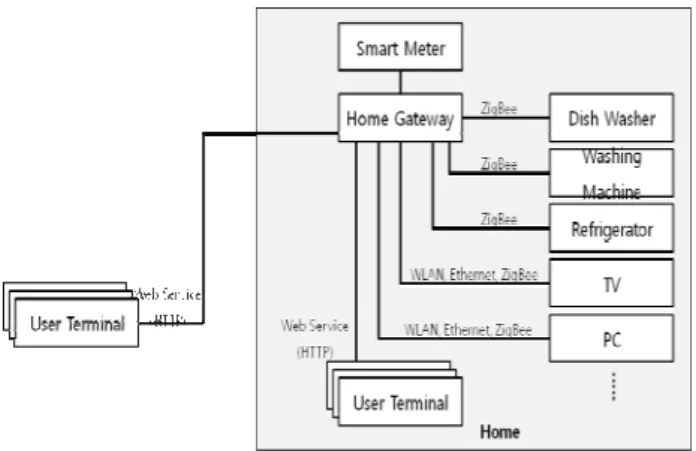
Fig. 1. Overall architecture of the proposed system
3. Energy Saving System and Services
In this section, the proposed system and service are presented. The proposed system is composed of two components, wireless sensors and home gateway. The service is classified into three categories – monitoring, visualization, and pricing. Fig. 1 represents our overall architecture.
-152-3.1 Proposed System
In our system, sensors have some requirements, which are mobility, the number of nodes, and power consumption. To meet them, ZigBee protocol is selected for the communication interface. Also, our sensor should be universal or independent from appliances or electronic products. We designed our sensor as an additional device of conventional power outlets between power lines and products. A home gateway with ZigBee interface is proposed as a managing component. It has various communication protocols like conventional gateways as well as ZigBee interface. All of the data from each sensor are stored in the gateway and every service would be implemented in it. Our approach is similar as [1], but their system is focusing on on-off control and providing a limited service.
First, a wireless sensor is composed of mainly three parts, which are a controller with ADC (analog digital converter), a ZigBee transreceiver, and a sensing unit as shown in Fig. 2. TI (Texas Instrument) MSP430and TI CC2520 are used in our system as a control unit and ZigBee module respectively.
Fig. 2. Architecture of a sensor
Secondly, an intelligent home gateway is a monitoring and management component of the proposed system, which is based on OSGi(Open Services Gateway initiative). The home gateway as an energy portal provides a transparent interface to end-user like the
conventional home gateways. Additionally, it has the ZigBee network interface for energy consumption monitoring and management. It has a storage device for storing information from each sensor and analyzing or managing usage profile. To provide web service, it has a web server.
3.2 Proposed Services
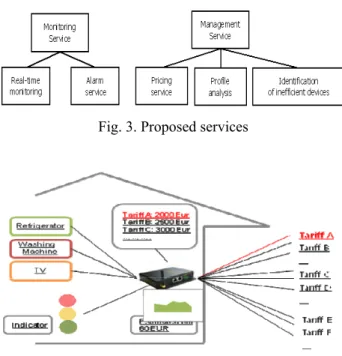
The proposed services are categorized into two parts, monitoring and management. Every service would be implemented in the home gateway, and end users could access and use services with network enabled devices with Wi-Fi and Ethernet.
Fig. 3. Proposed services
Fig. 4. Scenario of our services
Monitoring service should provide an easy and user-friendly real-time monitoring service with various network devices. Users could check the status of energy consumption of each appliance visually and numerically. If a device consumes much electricity abnormally, it could give an alarm to users.
Management service has several functions such as analyzing energy consumption, identification of
-153-inefficient appliances. It could provide statistics and bill information. Finally, if utility companies offer various tariffs, it gives users the optimal tariff information with the pricing service.
4. Conclusion
In this paper, we have presented an energy saving services at homes and buildings. These services are expected to save or optimize energy consumption at homes and buildings. As a further work, we will analyze the practical impact of this system and extend the applications such as lighting control and security.
[References]
[1] Jinsoo Han, Haeryong Lee, and Kwang-Roh Park, “Remote-Controllable and Energy-Saving Room Architecture based on ZigBee Communication,” IEEE Trans. On Consumer Electronics, Vol. 55, No. 1, pp. 264-268, Feb., 2009
[2]http://www.decc.gov.uk/en/content/cms/news/pn139/p n139.aspx
[3] Jin-Shyan Lee, Yu-Wei Su, and Chung-Chou Shen, “A Comparative Study of Wireless Protocols: Blutooth, UWB, ZigBee, and Wi-Fi,” The 33rd annual
Conference of the IEEE Industrial Electronics Society(IECON), Nov. 5-8, 2007
[4] Khusvinder Gill, Shuang-Hua Yang, Fang Yao, and Xin Lu, “A ZigBee-based Home Automation System,” IEEE Trans. On Consumer Electronics, Vol. 55, No. 2, pp. 422-430, May, 2009
[5] IEEE 802.15.4: Wireless Medium Access Control (MAC) and Physical Layer (PHY) Specifications for Low-Rate Wireless Personal Area Networks (WPANs), Sept. 2006