© Korean Powder Metallurgy Institute 946 -1. Introduction
Rapid technical improvements are leading to increasing demands on accurate determination of relevant materials parameter such as creep or tensile strength of structural materials used for applications at extremly high temperatures. Because no commercial measuring system exists for creep and tensile tests conducted on metals at temperatures up to 3000°C, special devices were developed and constructed at the University of Applied Sciences in Jena, Germany. For example, tensile tests on pure tungsten sheet material for high temperature furnace applications have been carried out up to 2500°C [1]. Thin foils (thickness 30 µm) of molybdenum alloy MY (particle strengthened molybdenum with yttrium and cerium oxide), which are used for high performance lamps have been tested in tensile mode up to 2000°C. Another example is the determination of mechanical properties and creep properties of X-ray target materials, TZM and W/Re up to 2100°C (tensile) and 1600°C (creep).
2. Experimental and Results
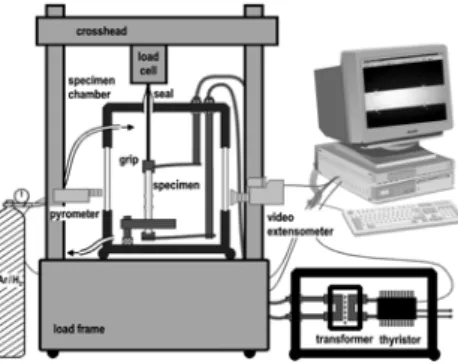
A principle setup of the test facility is given in Fig. 1. Both creep tests under constant load and high temperature tensile tests can be performed. Tests can be conducted either in air or under a protective gas atmosphere. Main components to achieve extremly high testing temperatures are the ohmic heating device and copper grips. Due to constant temperature distribution in the middle range of the
sample and lower temperature at the grips, the copper grips can be operated without additional cooling devices. Temperature is measured with a highly sensitive pyrometer (response time down to 1 ms) which allows temperature control at high heating (+100°C/s) and cooling rates (-30°C/s) [2]. Emissivity calibration of materials with unknown emissivity in the investigated temperature range is performed on thin foils of a Pt/Rh alloy pasted on the specimen [3, 4].
Fig. 1. Test facility to measure tensile and creep properties of metallic materials at temperatures up to 3000°C.
Since no direct measurement of specimen elongation is applicable at these high temperatures, strain is continousely recorded with the aid of a CCD camera (exposure time from 1 to 1000 ms) and introduction of markers in the central zone of the specimen (uniform temperature) [5]. Precise strain measurement (∆ε≈ ±0.07%) then is simply performed by determination of the distances between corresponding 2006 POWDER METALLURGY
World Congress
C08-03-2
Mechanical Properties of Refractory Metals at
Extremly High Temperatures
B. Fischer1,a, M. Beschliesser2,b, A. Hoffmann3,c and S. Vorberg1,d 1
FH Jena – University of Applied Sciences Jena, Jena, Germany 2
PLANSEE SE, Reutte, Austria 3
PLANSEE Metal GmbH, Reutte, Austria a
[email protected], [email protected], [email protected], d
[email protected] Abstract
Driven by the unavailibility of commercial test equipment for tensile and creep testing at temperatures up to 3000°C a measuring system has been developed and constructed at the University of Applied Sciences, Jena. These temperatures are reached with precision by heating samples directly by electric current. Contact-less strain measurements are carried out with image processing software utilizing a CCD camera system.
This paper covers results of creep tests which have been conducted on TZM sheet material (thickness 2 mm) in different heat-treatment conditions in the temperature range between 1200°C and 1600°C.
© Korean Powder Metallurgy Institute 947
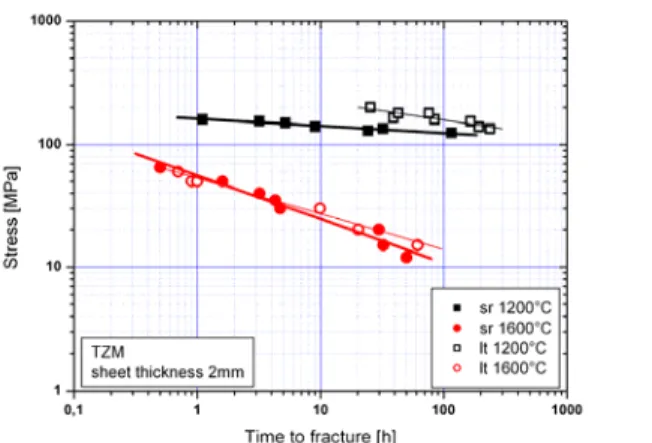
-markers [6]. Signal procession is done by the software “SuperCreep” [2, 5, 6]. Creep tests under constant load conditions (maximum stress 200 MPa) in reducing atmosphere (Ar-5% H2) have been conducted on TZM (titanium-zirconium-molybdenum) sheets which have been rolled to 2 mm thickness and further ground to 1 mm. Investigated samples were low-temp annealed (800°C/6h) and stress-relieved annealed (1150°C/2h) in H2 atmosphere. After heat treatment the microstructure consists of deformed and partly recrystallized regions for low-temp and stress-relieved samples, respectively. Testing temperature were 1200°C and 1600°C which correspond to homologous temperatures T/Tm of 0.51 and 0.65, respectively. From the obtained strain-time data, creep rupture curves (Fig. 2) and stress vs. minimum creep rate curves (Fig. 3) could be extracted.
Fig. 2. Creep rupture plot of TZM sheet material (thickness 2 mm) in low-temp (lt) and stress-relieved (sr) heat treatment condition.
Fig. 3. Double log stress vs. minimum creep rate diagram (n Norton stress exponent) of TZM sheet material (thickness 2 mm) in low-temp (lt) and stress-relieved (sr) heat treatment.
From Fig. 2 it is obvious that the low-temp annealed TZM sheet material is more creep resistant at 1200°C. The stress exponent at 1200°C reveals that the minimum creep rate of the stress-relieved TZM sheet material is more stress-
sensitive than the minimum creep rate of the low-temp samples. Moreover, both stress exponents appear to be rather high which is attributed to the high stress levels in this investigation [7]. Both findings indicate that in the stress-relieved sample the mean free path of dislocations is larger than in the samples annealed at lower temperatures. For the investigated stress region, sub-grains and cell walls are obstacles for mobile dislocations in the low-temp TZM sheet material at 1200°C. Support for this assumption comes from investigations by C. Wüstefeld et al. [7] and T. Mrotzek et al. [8] who studied the evolution of microstructure during creep experiments and static annealing treatments. At 1600°C this effect diminishes due to the fact that both the low-temp and stress-relieved material fully recrystallize hence showing the same creep performance (compare stress exponent n = 3.1 for both conditions, Fig. 3).
3. Summary
With the aid of the designed and constructed equipment at the University of Applied Sciences Jena it was possible to gather mechanical properties of refractory metals up to 2500°C. In detail, the influence of subsequent heat treatment on creep performance of TZM sheet material has been investigated.
4. References
1. B. Fischer, S. Vorberg, R. Völkl, M. Beschliesser and A. Hoffmann, Proc. 16th Intern. PLANSEE Seminar, Reutte, vol. 1, 2005, R54.
2. R. Völkl, D. Freund and B. Fischer, J. Test. & Eval. vol. 31, no. 1, 2003, pp. 35-43.
3. G. Neuer, P. Pohlmann and E. Schreiber, Technical R eport IKE 5-249, ISSN 0173-6892, Stuttgart, 1998. 4. G. Neuer and G. Jaroma-Weiland, Intern. J. Thermop
hysics, vol. 19, no. 3, 1998, pp. 917-929.
5. R. Völkl, D. Freund, B. Fischer and D. Gohlke, Wer kstoffprüfung Berichtsbände - ISSN 0941-5300, no. 6 38, 1998, pp. 211-218.
6. R. Völkl and B. Fischer, Exp. Mechanics vol. 44, no. 2, 2004, pp. 121-128.
7. C. Wüstefeld, T. Mrotzek, A. Hoffmann, M. Beschliesser and U. Martin, Proc. 16th Intern. PLANSEE Seminar, Reutte, vol. 1, 2005, R54.
8. T. Mrotzek, U. Martin and A. Hoffmann, Proc. 16th Intern. PLANSEE Seminar, Reutte, vol. 1, 2005, R54.