한국정밀공학회 2013 년도 춘계학술대회논문집
1. Introduction
Gelcoat resin is applied to improve the surface properties of composite materials. It is a surface coating of pigmented polyester resin which gels against the mold surface and cures with the structural laminate. Today, gelcoat is combined with fiberglass/ polyester to increase the hardness, smoothness and aesthetics for common products. The linking gelcoat-polyester is secondary-joint. It mean gelcoat-polyester resin is laid-up onto the gelcoat after this layer has cured. Mechanical properties of this linking is quite high. Actually, some structures demand high strength and good surface properties. So, combinations of gelcoat and glass/epoxy or carbon/epoxy are seen as solutions to satisfy the above requirements.
2. Theory and experimental
Three kinds of experiments are carried out to determine mechanical properties of interface of gelcoat and glass/polyester (GPG), glass/epoxy (GEG), carbon/epoxy (CEG).
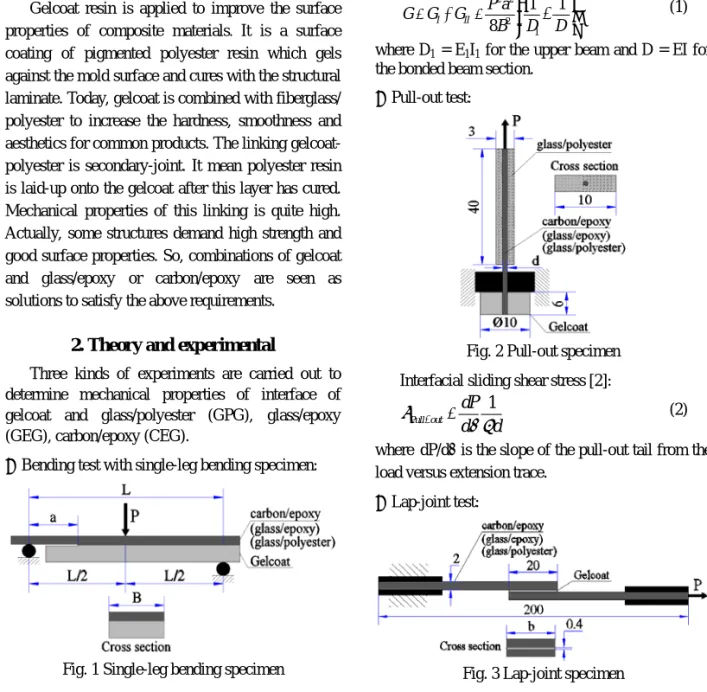
Bending test with single-leg bending specimen:
Fig. 1 Single-leg bending specimen
The total energy release rate G [1]:
2 2 2 1 1 1 8 I II P a G G G B D D (1)
where D1 = E1I1 for the upper beam and D = EI for
the bonded beam section. Pull-out test:
Fig. 2 Pull-out specimen Interfacial sliding shear stress [2]:
1 Pull out dP d d
(2)where dP/d is the slope of the pull-out tail from the load versus extension trace.
Lap-joint test:
Fig. 3 Lap-joint specimen
젤코트수지와 복합재료 접착면의 기계적 성질
Mechanical Properties of Interface of Gelcoat Resin and
Composite Material
팜탄눗, 김태형, *염영진
P. T. Nhut, T. H. Kim and *Y. J. Yum ([email protected])
울산대학교 기계공학부
Key words : gelcoat resin, glass/epoxy, carbon/epoxy, pull-out, single-leg bending, lap-joint
한국정밀공학회 2013 년도 춘계학술대회논문집
The shear stresses yz, xy, xz are calculated from
Ny [3]. 2 y P N b (3)
3. Results and discussion
The specimens were tested on UTM machine with three specimens for each case and the average value was reported. Experiment results were combined with equation (1), (2) and (3) to obtain the strength or energy.
Bending strength:
Fig. 4 Bending test results The total energy release rates:
GGPG = 0.0142 (N/mm2) GGEG = 0.0032 (N/mm 2 ) GCEG = 0.0041 (N/mm2) Interfacial strength: Fig. 5 Pull-out test results
Interfacial sliding shear stresses: GPG = 216.83 (N/mm2)
GEG = 154.41 (N/mm2)
CEG = 99.91 (N/mm2)
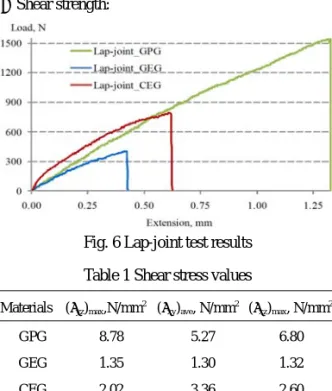
Shear strength:
Fig. 6 Lap-joint test results
Table 1 Shear stress values
Materials (yz)max,N/mm2 (xy)ave, N/mm2 (xz)max, N/mm2
GPG 8.78 5.27 6.80
GEG 1.35 1.30 1.32
CEG 2.02 3.36 2.60
4. Conclusion
For bending and lap-joint tests, GPG composite has the highest and GEG has the lowest strength or energy. But for pull-out test, the interfacial sliding shear stress of GPG is the highest and CEG is the lowest. From the results of strength and energy, it is observed that the adhesion between gelcoat and glass/epoxy or gelcoat and carbon/epoxy is not good (too low compared to gelcoat and glass/polyester). Therefore, in order to apply these structures, we should study the method to improve mechanical properties of interface.
References
1. Kim, W.S., and Lee, J.J., "Interfacial fracture toughness measurement and improvement for composite/metal interfaces," KAIST, Korea. 2. Difrancia, C., Thomas, C.W., and Richard, O.C.,
“The single-fibre pull-out test,” Composite: part A, 27A, 597-612, 1996.
3. Nhut, P.T., and Yum, Y.J., “Effect of surface properties on adhesive strength of joint of glass fiber/polyester composite panels,” Trans. Korea Soc. Mech. Eng. A, 36, 1591-1597, 2012.