서 론
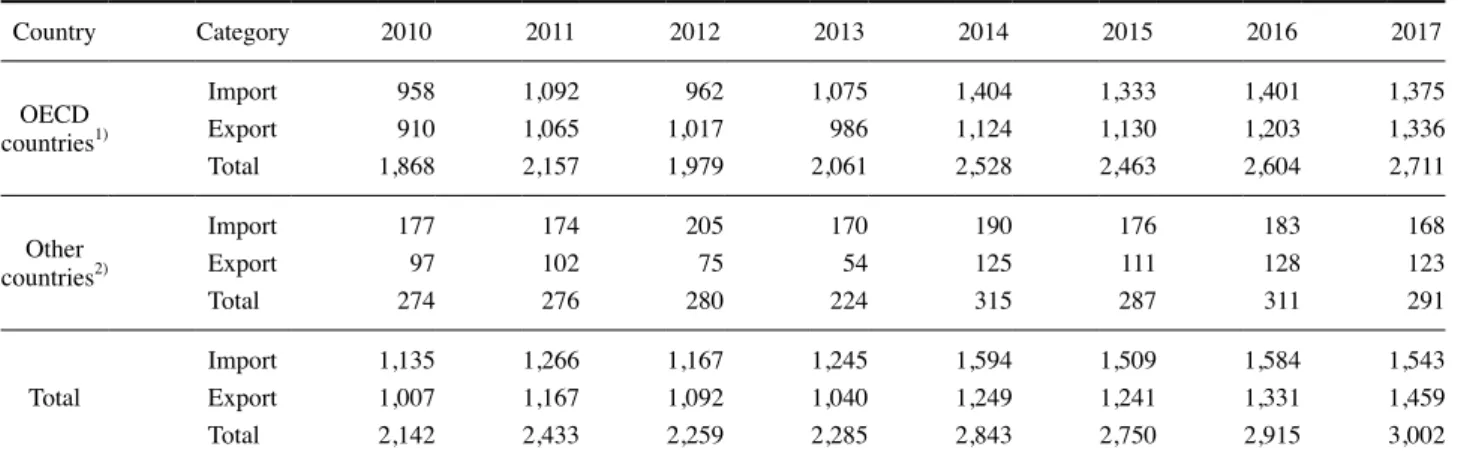
1895년 렌트겐에 의해 X-선이 발견된 이래로 방사선은 의료뿐만 아니라 농업, 산업, 연구 등 다양한 분야에서 활용 되고 있으며 방사선의 사용 규모가 확장됨에 따라 방사성 물질의 운반이 날로 증가하고 있다. 「2017년 방사선 및 방 사성동위원소 이용실태조사」(한국방사선진흥협회 2018)에 의하면 업종별로 방사성동위원소 또는 방사선발생장치(이 하 “방사성동위원소 등”이라 한다) 이용기관은 2017년 말 기준으로 약 7,937개로 2013년 대비 약 30% 증가하였으며, Table 1을 통해 확인할 수 있다. 또한 Table 2에서는 방사성 동위원소 및 화합물 수출입 추이를 확인할 수 있는데, 전체 조사 대상국의 2017년 전체 수출입 규모는 3,002M$로서 2010년 대비 약 40% 증가하였다. 이 중 OECD 회원국 규모 가 90.3%를 점유하였으며, 그 외 국가가 9.7%를 점유하였 다. 이와 같이 방사선 산업의 성장에 따라 방사성동위원소 등 방사성물질에 대한 운반량이 증가하고 있는 실정이다. 방사성동위원소 등 방사성물질에 대한 운반은 도로, 철방사성물질의 운반에 관한 국내
·
외 선량기준 분석
김혜진
1· 박태진
1· 박 일
1· 정원영
1· 박찬희
1,*
1(사)한국방사선진흥협회Analysis on the Dose Standards that Transport of
Radioactive Materials for Domestic and International
Hye Jin Kim
1, Tai-Jin Park
1, Il Park
1, Won Young Jung
1and Chan Hee Park
1,*
1
Korean Association for Radiation Application, 77 Seongsuil-ro Seongdong-gu,
Seoul 04790, Republic of Korea
Abstract - According to the research on the actual condition in Korea, as the field of radiation
expands, the number of transport of radioactive materials are increasing day by day. The IAEA
is constantly amending and supplementing the standards for transport of radioactive materials
based on the latest scientific technology and the data on the health effects of radiation accumulated
every so far, however, it is difficult to apply them collectively because there are different acceptable
conditions for each country. For actively cope with such international trends and achieve advanced
regulation, it is necessary to review the current standards for transport of radioactive materials in
domestic and to establish regulations of the radiation protection that reflect characteristics of the
radiation environment in domestic. In this study, therefore, to evaluate the validity of the current
standards for transport of radioactive materials in domestic, we drew the background and basis of
calculation of standards with comparing and analyzing international standards for the dose criteria
for transport of radioactive materials. These results can be used as basic data for the improvement
of domestic regulations for transport of radiation material.
Key words : Radiation protection standard, Transport of radioactive material, Packaging and
package, Radiation worker
─ 95 ─ Technical Paper
* Corresponding author: Chan Hee Park, Tel. +82-2-3490-7131, Fax. +82-2-445-1014, E-mail. [email protected]
로, 해상, 항공 및 내륙 수로 등 다양한 형태로 수행되고 있 다. 이에 방사성물질의 운반은 공공에 노출될 가능성이 있 으며, 방사성물질의 위험으로부터 인간과 환경을 보호하기 위하여 안전성이 보장되어야 한다. 특히 국토가 좁고 인구 밀도가 높은 우리나라의 경우 방사성물질로 인한 피해는 치 명적일 수 있으므로 방사성물질의 운반에 대한 규정은 안전 성을 확보하는 것이 최우선이라고 할 수 있다(한국원자력 안전기술원 2009). 또한 방사성물질은 국내를 넘어 국제적 으로도 운반되고 있기 때문에 많은 국가와 운반 관련 국제 기구들 그리고 운반 주체 간의 조화가 필수적이다. 따라서 방사성물질의 운반에 관한 안전관리를 체계적으로 수행하 고 다양한 요구의 적절한 반영을 위해서는 해당 규정에 대 한 재검토와 개정의 과정이 필요하다(이 2008). 방사성물질의 운반에 관한 국제 기준으로는 UN의 ‘위 험물질의 국제운반기준’과 IAEA의 ‘방사성물질 안전 운 반 규칙’이 있으며, 기술적 진보 고려, 운전경험 반영 및 규 정요건의 정비 등을 위하여 1964년, 1967년, 1973년, 1985 년, 1996년, 2001년, 2003년, 2005년, 2009년 주기적으로 개 정 및 보완을 수행하고 있다(IAEA 2009). 우리나라의 경우 IAEA에서 발간한 운반규정을 기반으로 제정된 원자력법을 이용하여 방사성동위원소 등에 대한 국내 운반 규정을 제 시하고 있다. 하지만 현재 국내 원자력법에 제시된 운반규 정은 1996년 IAEA의 운반규정을 기반으로 제정된 것이며, 1996년 이후 IAEA, UN 등에서 운반에 대한 개선된 규정을 포함하고 있지 않다. 이에 따라 개선된 방사성물질 운반규 정의 국내 도입, 그리고 국내 운반 환경에 적합한 규정보완 에 대한 필요성이 제시되고 있다(이 2008; 차 2010). 따라서 본 연구에서는 국내 실정에 적합한 운반 규정의
Table 1. Trend of institutions using radioisotopes, etc. by year and industry (Unit: No. of Businesses) Year
Category 2013 2014 2015 2016 2017 increase rateAverage annual (%) Industry1) 4,594 5,048 5,426 5,805 6,208 7.8 Public 642 674 704 750 802 5.7 Medicine 206 208 212 199 197 -1.1 Education 294 297 287 299 299 0.4 Research 282 298 305 323 329 3.9 Military 67 87 92 97 102 11.1 Total 6,085 6,612 7,026 7,473 7,937 6.8 Increase rate compared to
previous year(%) 8.5 8.7 6.3 6.4 6.2
-1)Includes general manufacturing, production and sales, and non-destructive inspection industries using radiation and radioisotopes
Table 2. Import/Export statistics of radioisotopes and compounds (Unit: M$)
Country Category 2010 2011 2012 2013 2014 2015 2016 2017 OECD countries1) Import 958 1,092 962 1,075 1,404 1,333 1,401 1,375 Export 910 1,065 1,017 986 1,124 1,130 1,203 1,336 Total 1,868 2,157 1,979 2,061 2,528 2,463 2,604 2,711 Other countries2) Import 177 174 205 170 190 176 183 168 Export 97 102 75 54 125 111 128 123 Total 274 276 280 224 315 287 311 291 Total ImportExport 1,1351,007 1,2661,167 1,0921,167 1,2451,040 1,5941,249 1,2411,509 1,3311,584 1,5431,459 Total 2,142 2,433 2,259 2,285 2,843 2,750 2,915 3,002
1)More than 31 countries such as the U.S., Japan, Germany, France, Canada, Great Britain, Italy, Republic of Korea, Greece, the Netherlands, New Zealand,
Denmark, Luxembourg, Mexico, Belgium, Sweden, Switzerland, Spain, Slovakia, Slovenia, Ireland, Estonia, Austria, Czech Republic, Chile, Turkey, Portugal, Poland, Finland, Hungary, and Australia
2)More than 13 countries such as China, Russia, Taiwan, Malaysia, Sri Lanka, Singapore, India, Indonesia, Thailand, the Philippines, Hong Kong, Kazakhstan, and
개선을 위한 기초 연구로서, 국내외 방사성동위원소 등에 대한 운반 규정과 규정 내 각 기준에 대한 설정 방법 및 근 거를 조사하였다.
본 론
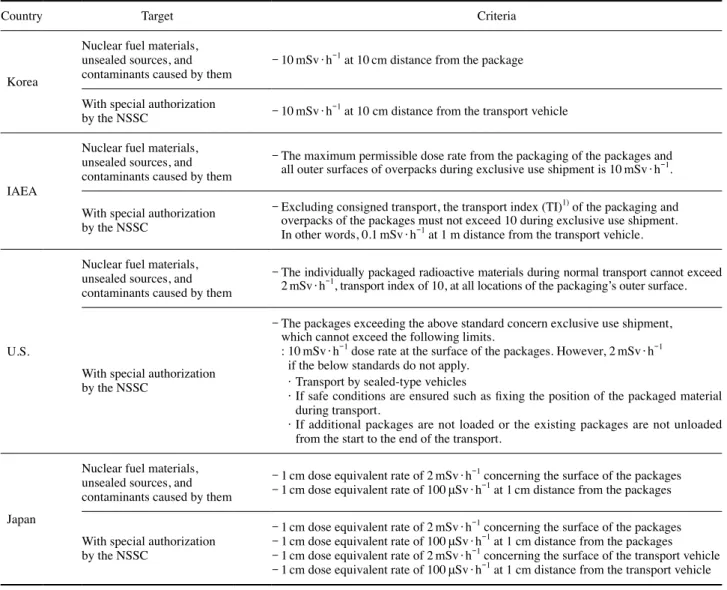
국내 법령은 법률-시행령-시행규칙-기술기준 및 고시 등 의 다단계 체계로 이루어져 있으며, 방사성물질 운반에 관 한 규정들은 원자력법 -원자력법시행령-원자력법시행규칙-방사선안전관리 등 기술기준에 관한 규칙 및 원자력안전위 원회 고시를 통해 제정되어 있다. 원자력법에서는 방사성물질의 포장 및 운반에 대한 안전 관리를 위하여, 운반신고, 포장 및 운반에 관한 기술기준, 피 폭관리, 사고의 조치, 포장 및 운반검사, 운반용기의 설계승 인, 운반용기의 검사 등의 규정을 두고 있다. 하위 규정으로 서 원자력법시행령과 원자력법시행규칙을 통하여 원자력법 에서 규정한 사항들에 대한 세부 요건 및 행정절차 등을 규 정하고 있으며, IAEA 운반규정에서 정하고 있는 기술적인 사항들은 방사선안전관리 등의 기술기준에 관한 규칙과 원 자력안전위원회 고시 제2019-7호(방사성물질 등의 포장 및 운반에 관한 규정 고시)에 규정되어 있다(이 2008). 그러나 본 연구에서는 방사선안전관리 등의 기술기준에 관 한 규칙에 명시되어 있는 방사성물질 포장·운반과 관련한 국 내 및 국외(IAEA, 미국, 일본) 기준을 조사하였으며, 각 기준 들에 대한 산출원리, 설정배경 등을 조사 및 분석하였다. 조 사한 세부 항목으로는 사업소안의 운반, 운반물 또는 덧포 장물의 최대 방사선량률, 적재한도, 전용운반 방사선량률 기 준 선박 및 항공운반에 관한 방사선량률 기준, 운반수단/장 비 관련 부속물의 제염 기준 및 재사용 금지 기준이 있다.Table 3. Dose rate related to transport within workplaces
Country Target Criteria
Korea
Nuclear fuel materials, unsealed sources, and
contaminants caused by them -10mSv·h
-1 at 10cm distance from the package
With special authorization
by the NSSC -10mSv·h-1 at 10 cm distance from the transport vehicle
IAEA
Nuclear fuel materials, unsealed sources, and contaminants caused by them
- The maximum permissible dose rate from the packaging of the packages and all outer surfaces of overpacks during exclusive use shipment is 10mSv·h-1. With special authorization
by the NSSC
- Excluding consigned transport, the transport index (TI)1) of the packaging and overpacks of the packages must not exceed 10 during exclusive use shipment. In other words, 0.1mSv·h-1 at 1 m distance from the transport vehicle.
U.S.
Nuclear fuel materials, unsealed sources, and contaminants caused by them
- The individually packaged radioactive materials during normal transport cannot exceed 2mSv·h-1, transport index of 10, at all locations of the packaging’s outer surface.
With special authorization by the NSSC
- The packages exceeding the above standard concern exclusive use shipment, which cannot exceed the following limits.
: 10mSv·h-1 dose rate at the surface of the packages. However, 2mSv·h-1 if the below standards do not apply.
·Transport by sealed-type vehicles
· If safe conditions are ensured such as fixing the position of the packaged material during transport.
· If additional packages are not loaded or the existing packages are not unloaded from the start to the end of the transport.
Japan
Nuclear fuel materials, unsealed sources, and contaminants caused by them
-1cm dose equivalent rate of 2mSv·h-1 concerning the surface of the packages -1cm dose equivalent rate of 100μSv·h-1 at 1cm distance from the packages
With special authorization by the NSSC
-1cm dose equivalent rate of 2mSv·h-1 concerning the surface of the packages -1cm dose equivalent rate of 100μSv·h-1 at 1 cm distance from the packages -1cm dose equivalent rate of 2mSv·h-1 concerning the surface of the transport vehicle -1cm dose equivalent rate of 100μSv·h-1 at 1 cm distance from the transport vehicle
1. 사업소 안의 운반
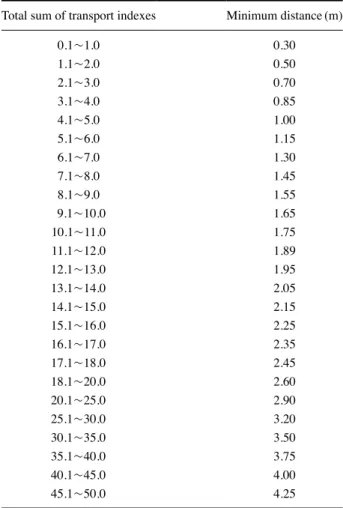
사업소 안의 운반에 관한 법령은 방사선안전관리 등의 기 술기준에 관한 규칙 제35조 및 원자력안전위원회고시 제 2017-56호 제15조 제4항에 명시되어 있으며, 방사선안전관 리 등의 기술기준에 관한 규칙 제35조에서는 개봉선원 및 그에 의하여 오염된 물질을 사업소 안에서 운반하는 경우에 대한 상세기준을 기술하고 있다. 해당 규칙의 제1항 제2호 에서는 운반 시 필요한 격리거리에 대한 세부기준이 명시되 어 있으며, 자세한 내용은 아래와 같다. - 방사성동위원소 및 그에 의하여 오염된 물질을 넣은 용 기 및 이를 적재하는 차량이나 방사성동위원소 및 그 에 의하여 오염된 물질을 운반하는 기계 기구의 표면으 로부터 10센티미터 및 차량의 외부표면으로부터 2미터 떨어진 위치의 방사선량률이 각각 원자력안전위원회가 정하여 고시하는 방사선량률을 초과하지 아니하도록 하고 운반물표면의 방사성동위원소의 오염도가 허용표 면오염도를 초과하지 아니하도록 할 것 여기에서 언급된 ‘원자력안전위원회가 정하여 고시하는 방 사선량률’은 원자력안전위원회 고시 제2019-07호 제15조 제4항에 명시되어 있으며 해당 내용은 다음과 같다. 운반물 외부표면으로부터 10센티미터 떨어진 위치에서 시간당 10 밀리시버트를 초과하지 말 것, 또한 운반차량 외부표면에서 2미터 떨어진 위치에서 시간당 0.1밀리시버트를 초과하지 않아야 한다. Table 3은 국내를 포함한 국제 및 국외의 운반에 관한 방 사선량률에 대한 기준값을 보여주고 있으며, 이 기준에 대 한 산출과정은 다음과 같다. 방사성물질의 운반 시 적용하 는 선량에 관한 방사성물질과 작업자(혹은 일반인)와의 격 리거리(segregation)를 사용하여 격리거리별 운반지수를 적용하여 도출하며, 이에 대한 설명은 ICAO 2015-2016 Edition에 제시되어 있다. Table 4에 의하면, 운반지수 10 (1m 거리에서 시간당 0.1mSv)를 만족하는 최소의 격리거리 는 1.65m로 계산한다. 이에 따라 운반차량 2m 거리가 보수적 으로 결정되었으며, 선량률 또한 0.1mSv·h-1로 설정한다. 그 리고 운반물 10cm 거리는 운반지수 10에 해당하는 선량률의 거리에 비해 1/10로 줄어들므로 거리와 선량의 역자승 법칙에 따라 10cm 지점의 선량률은 100배가 된다. 이상의 계산결과 에 따라 운반물 10cm 거리의 선량률은 10mSv·h-1가 된다.2. 운반물 또는 덧포장물의 최대 방사선량률
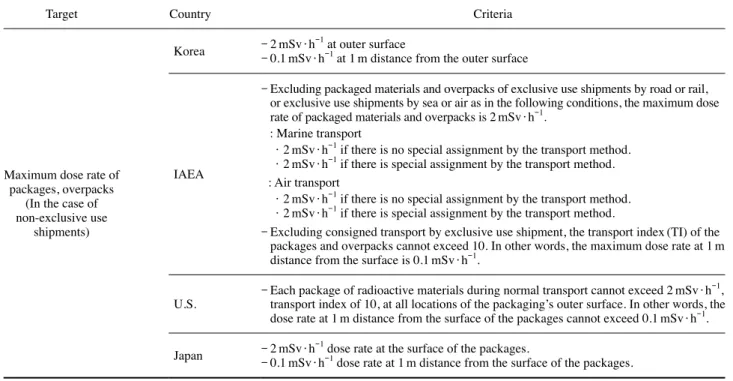
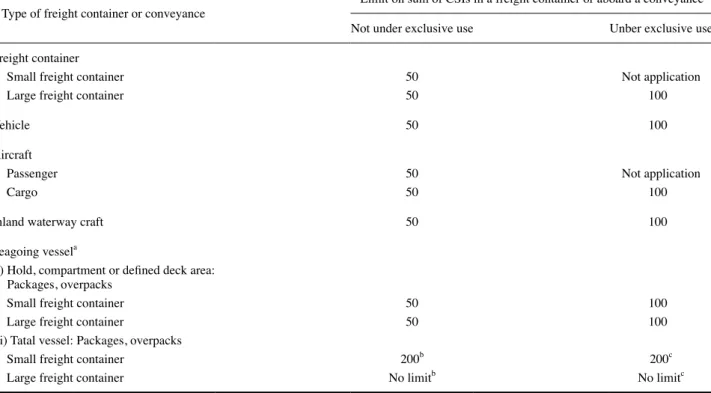
운반물 또는 덧포장물에 대한 기술기준은 방사선안전관 리 등의 기술기준에 관한 규칙 제14조, 제99조와 원자력 안전위원회 고시 제2017-56호 제22조에 명시되어 있으며, Table 5와 같은 방사선량률의 제한 값을 두고 있다. Table 6 은 국내를 포함한 국제 및 국외의 운반물 또는 덧포장물의 최대 방사선량률에 대한 기준값을 보여주고 있다. 이 기준에 대한 산출과정은 다음과 같다. 운반물의 heat flux가 15W·m-2을 초과하지 않고 에워싸고 있는 화물 (cargo)이 마대 혹은 가방이 아닐 경우 포장 혹은 덧포장 물의 운반지수는 Table 7을 만족해야 전용운반이 아닌 경 우로 적용가능하다. 그러나 운반지수가 10을 넘거나 CSI (Criticality safety index, 임계안전지수)가 50을 초과하는 경우에는 전용운반으로 운반되어야 한다. 이상에 따라 각 각 200, 10 운반지수를 적용하면 선량률은 2mSv·h-1, 0.1 mSv·h-1가 된다. 임계안전지수는 핵분열성 물질을 포함하 는 운반물에 적용하며, 그 값은 Table 8과 같다.Table 4. Setting for separation distance between source and
work-er about transport and package
Total sum of transport indexes Minimum distance(m)
0.1~1.0 0.30 1.1~2.0 0.50 2.1~3.0 0.70 3.1~4.0 0.85 4.1~5.0 1.00 5.1~6.0 1.15 6.1~7.0 1.30 7.1~8.0 1.45 8.1~9.0 1.55 9.1~10.0 1.65 10.1~11.0 1.75 11.1~12.0 1.89 12.1~13.0 1.95 13.1~14.0 2.05 14.1~15.0 2.15 15.1~16.0 2.25 16.1~17.0 2.35 17.1~18.0 2.45 18.1~20.0 2.60 20.1~25.0 2.90 25.1~30.0 3.20 30.1~35.0 3.50 35.1~40.0 3.75 40.1~45.0 4.00 45.1~50.0 4.25
If you more than one package, overpack or freight container is placed in the aircraft, the minimum separation distance for each individual package, overpack or freight container must be determined in accordance with the above table, on the individual packages, overpacks or freight containers. Alternatively, if the packages, overpacks or freight containers are separated into groups, the minimum distance from the nearest inside surface of the passenger cabin or flight deck partitions or floors to each group is the distance applicable to the sum of the transport indexes within the individual groups, provided that each group is separated from each other group by at least three times the distance applicable to the one that has the larger sum of transport indexes.
Note. - For total sum of transport indexes over 50 to be carried by cargo aircraft only, see Table 7-3.
3. 적재한도
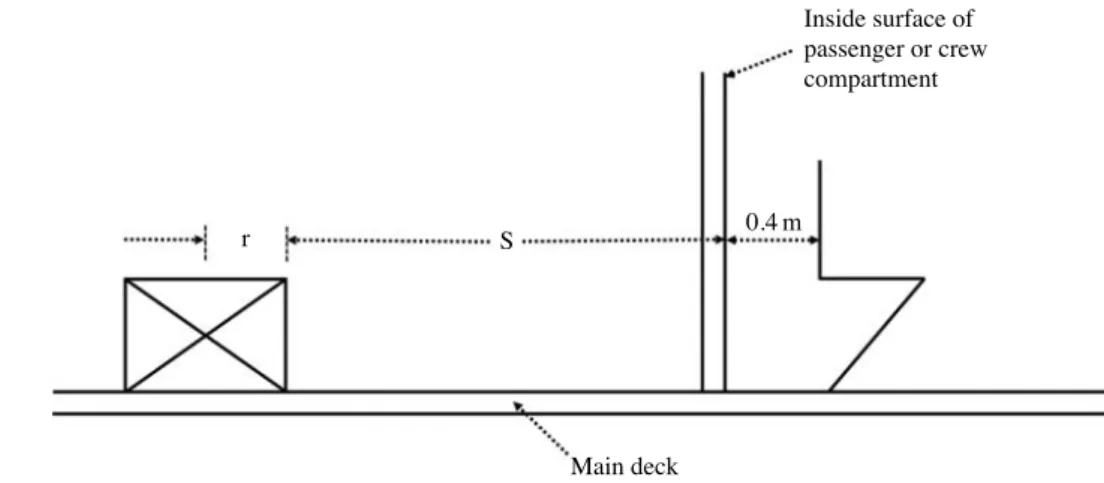
적재한도에 대한 기술기준은 원자력안전위원회 방사선안 전관리 등의 기술기준에 관한 규칙 제108조에 명시되어 있 다. 적재한도는 표면으로부터의 평균 열방출률이 제곱미터 당 15와트를 초과하는 운반물 또는 덧포장은 이를 다른 화 물과 함께 운반해서는 안 된다. 또한 운반물·덧포장 및 화 물컨테이너의 적재는 일정 방사선량률을 초과해서는 안 되 며, Table 9에 국내·외 기준에 대해 요약하였다. 운반수단의 외부표면 2mSv·h-1, 2m 거리 선량률 0.1mSv·h-1에 대한 산출근거는 운반물 및 덧포장물의 선량기준 도출방법과 동 일하다. 사람이 승하차하는 위치 0.02mSv·h-1에 대한 산출근거 는 IAEA Specific Safety Guide No. SSG-26(2012)에서 찾을 수 있다. IAEA Specific Safety Guide No. SSG-26에 의하면 운전자의 승하차 위치에 관한 개략도는 Fig. 1과 같다. 여기에서, 운반물과 운반자 혹은 일반인의 최소 격리거리를 결정하기 위한 선량기준에 대한 산출식은 다음과 같다.MATP=1000h·y-1, RTF=1/4, MAET(1000h·y-1)×(1/4)=250h·y-1
DV= 5mSv·y-1 (IAEA Specific Safety Guide No. SSG-26 paragraph 562.4에서 설명하고 있으며, 작업자와 운
Table 5. Maximum dose rate of packages or overpacks(in Korea)
Statute Criteria
The rules on technical standards for radiation safety management, etc -Article 14
(About the transport of fertile material)
-The dose rate at the outer surface cannot exceed 2mSv·h-1.
-The dose rate at 1m distance from the outer surface cannot exceed 0.1mSv·h-1.
The rules on technical standards for radiation safety management, etc -Article 99
(Maximum dose rate of packages, overpacks)
- The dose rate at the outer surface cannot exceed 2mSv·h-1. In the case of exclusive use shipments, however, it cannot exceed 10mSv·h-1 at outer surface.
- The dose rate at 1m distance from the outer surface cannot exceed 0.1mSv·h-1, except in the case of exclusive use shipments.
NSSC Notice
-No.2017-56 Article 12
(Any transport container that carries radioactive material)
-The dose rate at the outer surface cannot exceed 2mSv·h-1 at outer surface.
-In the case of exclusive use shipments, the dose rate at the outer surface cannot exceed 10mSv·h-1.
Table 6. Maximum dose rate of packages or overpacks
Target Country Criteria
Maximum dose rate of packages, overpacks
(In the case of non-exclusive use
shipments)
Korea --20.1mSv·hmSv·h-1 at outer surface-1 at 1m distance from the outer surface
IAEA
- Excluding packaged materials and overpacks of exclusive use shipments by road or rail, or exclusive use shipments by sea or air as in the following conditions, the maximum dose rate of packaged materials and overpacks is 2mSv·h-1.
: Marine transport
·2mSv·h-1 if there is no special assignment by the transport method. ·2mSv·h-1 if there is special assignment by the transport method. : Air transport
·2mSv·h-1 if there is no special assignment by the transport method. ·2mSv·h-1 if there is special assignment by the transport method.
- Excluding consigned transport by exclusive use shipment, the transport index(TI) of the packages and overpacks cannot exceed 10. In other words, the maximum dose rate at 1m distance from the surface is 0.1mSv·h-1.
U.S. - Each package of radioactive materials during normal transport cannot exceed 2mSv·h -1, transport index of 10, at all locations of the packaging’s outer surface. In other words, the dose rate at 1m distance from the surface of the packages cannot exceed 0.1mSv·h-1. Japan --20.1mSv·hmSv·h-1 dose rate at the surface of the packages.-1 dose rate at 1m distance from the surface of the packages.
반물의 격리거리 산정 시 기준값으로 사용) RDR=(5mSv·y-1) /(250h·y-1)=0.02mSv·h-1 입력인자 설명
- MATP(Maximum annual travel periods): 운반자 혹은 일반인의 연간 최대이동시간
- RTF(Radioactive traffic factor): 연간 총 이동시간 대비 2종 황색 포장물과 3종 황색 포장물 운반시간의 비 - MAET(Maximum annual exposure times): MATP와
RTF를 곱한 값으로 운반자 혹은 일반인의 연간 최대피 폭시간
- DV(Applicable dose value): 작업자의 경우 5mSv·h-1 - RDR(Reference dose rates): 운반물과 운반자 혹은 일
반인의 최소 격리거리를 결정하기 위한 선량기준으로 DV/MAET
4. 전용운반 방사선량률 기준
전용운반 방사선량률은 방사선안전관리 등의 기술기준에 관한 규칙 제125조에 명시되어 있으며 다음과 같다. 전용으 로 운반하는 운반물 또는 덧포장의 외부표면은 시간당 10Table 7. Type of freight container and transport in non-exclusive
use shipment
Type of freight container or conveyance Transport index(TI) Freight container
Small freight container 50 Large freight container 50
Vehicle 50
Aircraft
Passenger 50
Cargo 200
Inland waterway craft 50 Seagoing vessela
(i) Hold, compartment or defined deck area: Packages, overpacks
Small freight container 50 Large freight container 200 (ii) Tatal vessel: Packages, overpacks
Small freight container 200 Large freight container No limit
aPackages or overpacks carried in or on a vehicle that are in accordance with
the provisions of para. 573 may be transported by vessels provided that they are not removed from the vehicle at any time while on board the vessel.
Table 8. Limit on CSIs for transport and freight container including fissile material
Type of freight container or conveyance Limit on sum of CSIs in a freight container or aboard a conveyance Not under exclusive use Unber exclusive use Freight container
Small freight container 50 Not application
Large freight container 50 100
Vehicle 50 100
Aircraft
Passenger 50 Not application
Cargo 50 100
Inland waterway craft 50 100
Seagoing vessela
(i) Hold, compartment or defined deck area: Packages, overpacks
Small freight container 50 100
Large freight container 50 100
(ii) Tatal vessel: Packages, overpacks
Small freight container 200b 200c
Large freight container No limitb No limitc
aPackages or overpacks carried in or on a vehicle that are in accordance with the provisions of para. 573 may be transported by vessels provided that they are
not removed from the vehicle at any time while on board the vessel. In this case, the entries under the heading “under exclusive use” apply.
bThe consignment shall be so handled and stowed that the sum of CSIs in any group does not exceed 50 and that each group is handled and stowed so as to
maintain a spacing of at least 6m from other groups.
cThe consignment shall be so handled and stowed that the sum of CSIs in any group does not exceed 100 and that each group is handled and stowed so as to
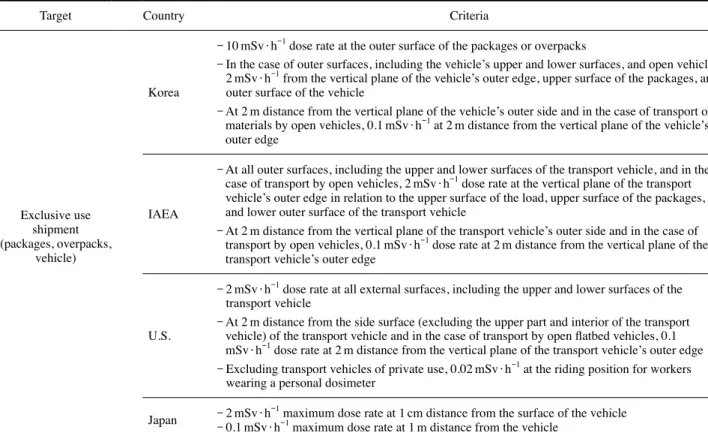
밀리시버트를 초과해서는 안 된다. 다만, 차량 내부로의 접 근이 방지된 밀폐형 차량이며, 운반물 또는 덧포장이 움직 이지 않도록 고정되어 있고 운반 중 적재 또는 하역이 없는 경우가 아닐 시, 시간당 2밀리시버트를 초과해서는 안 된다. 또한 차량의 상하부 표면을 포함한 외부표면, 개방형 차량 의 경우에는 차량의 외부 가장자리의 수직평면, 화물의 상 부표면 및 차량의 외부표면 하부는 시간당 2밀리시버트로 방사선량률이 제한되어 있다. 마지막으로 차량 외부측면의 수직평면으로부터 2미터 떨어진 지점과, 화물을 개방형 차 량으로 운반하는 경우에는 차량 외부 가장자리의 수직평면 으로부터 2미터 떨어진 지점에서는 시간당 0.1밀리시버트 를 초과해서는 안 된다. 이와 관련한 국외기준은 Table 10에 서 확인할 수 있다. 운반물 또는 덧포장의 외부표면은 시간당 10밀리시버트 를 초과해서는 안 되며, 이에 대한 산출근거는 ICAO 2015-2016 Edition에서 찾을 수 있다. Table 4에 의하면, 운반지수 10(1m 거리에서 시간당 0.1mSv)를 만족하는 최소의 격리 거리는 1.65m으로 계산한다. 따라서 운반차량 2m 거리가 보수적으로 결정되었으며, 선량률 또한 0.1mSv·h-1로 설정 한다. 그리고 운반물 10cm 떨어진 지점의 선량률은 운반지 수 10에 해당하는 선량률의 거리에 비해 1/10로 줄어들므로 거리와 선량의 역자승 법칙에 따라 10cm 지점의 선량률은 100배가 된다. 이상의 계산결과에 따라 운반물 10cm 거리 의 선량률은 10mSv·h-1가 된다. 차량의 외부 가장자리의 수직평면, 화물의 상부표면 및 차량의 외부표면 하부에 대한 방사선량률의 제한은 2 mSv·h-1이며, 이에 대한 산출근거는 운반물 및 덧포장물의 선량기준 도출방법과 동일하다. 차량의 외부 가장자리의 수직평면으로부터 2미터 떨어진 지점에서는 0.1mSv·h-1를 초과할 수 없으며, 이에 대한 산출 근거는 적재한도와 마찬가지로 IAEA Specific Safety Guide No. SSG-26(2012)에서 찾을 수 있다. IAEA Specific Safety Guide No. SSG-26에 의하면 운전자의 승하차 위치에 관한 개략도는 Fig. 1과 같으며, 계산 결과는 아래 식과 같다.
Table 9. Load limit
Target Country Criteria
Load limit (Based on transport vehicle and riding position of people)
Korea -2mSv·h
-1 at outer surface of transport vehicle
-0.1mSv·h-1 at 2m distance from the outer surface of the transport vehicle -0.02mSv·h-1 at riding position of people
IAEA
Excluding the exclusive use shipment by road or rail, 2mSv·h-1 from the outer surface of the transport vehicle and 0.1mSv·h-1 at 2m distance from the outer surface of the transport vehicle
U.S.
- Each package of radioactive materials during normal transport cannot exceed 2mSv·h-1, transport index of 10, at all locations of the packaging’s outer surface. In other words, the dose rate at 1 m distance from the surface of the packages cannot exceed 0.1mSv·h-1.
Japan --20.1mSv·hmSv·h-1 maximum dose rate at 1-1 maximum dose rate at 1cm distance from the surface of the vehiclem distance from the vehicle
Fig. 1. Typical configuration of main deck stowage on a combi or cargo aircraft.
Inside surface of passenger or crew compartment
Main deck
RDR=(TI/100)(TFf)(1.0+r)2 / (S+0.4+r)2 =(50/100)(0.7)(1.0+0.4)2 / (2.0+0.4+0.4)2 =0.09mSv·h-1≒0.1mSv·h-1
입력인자 정의
- RDR(Reference dose rate at seat height)(mSv·h-1) - TI(Transport index divided by 100, 운반지수, Table 11
참조)
- TFf(Transmission factor of the passenger compartment floor)
- S(차량의 외부 가장자리의 수직평면으로부터 2미터 떨 어진 지점)
- r(운반물의 반지름)(m)
- AMD(Actual minimum distance to the dose point)(m), AMD=r+S+0.4
5. 선박 및 항공운반에 관한 방사선량률 기준
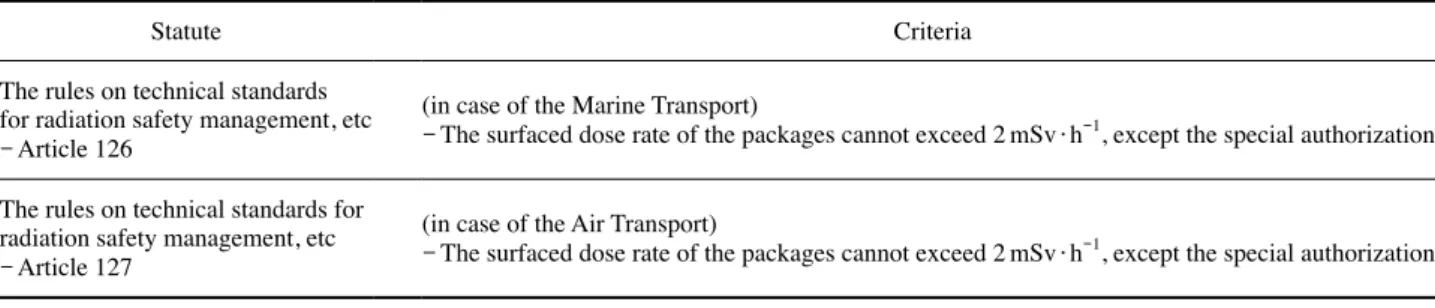
선박 및 항공운반에 관한 방사선량률 기준은 방사선안전 관리 등의 기술기준에 관한 규칙 제126조와 제127조에 기 술되어 있으며, 각각의 해당되는 내용은 Table 12와 같다. 선박 및 항공운반에 관한 방사선량률 기준의 산출방법 은 포장, 운반에 관한 운반지수로 결정하며, 이에 대한 설명 은 IAEA Safety Safety Requirements No. TS-R-1 Table 10 을 참고할 수 있다. 운반지수에 관한 근거인 IAEA Safety Requirements No. TS-R-1 Table 10은 전용운반이 아닌 경우 운반수단에 대한 운반지수를 요약한 표로서 수송유형별 운 반지수는 Table 7과 같다. 이에 의하면 항공기, 선박운반 시 화물(대)은 운반지수 200으로 규정하며, 이에 따라 선량률 은 시간당 2mSv 이내이다. 또한 Table 13을 통해 선박 및 항공운반에 관한 방사선량률의 국외 기준을 알 수 있다.6. 운반수단, 장비 및 관련 부속물의 제염 기준/재사용
금지 기준
운반수단, 장비 및 관련 부속물의 제염 기준/재사용 금지 기준은 방사선안전관리 등의 기술기준에 관한 규칙 제101 조에 기술되어 있으며, 이와 관련한 국외 기준은 Table 14를 통해 확인할 수 있다. 운반물의 외부표면과 덧포장·화물컨 테이너 및 탱크의 내·외부표면의 제거성 표면오염도는 임Table 11. Transport index
Transport index
(TI) Transmission factor(TFf) Package radius(r)(m)
0~1.0 1.0 0.05
1.1~2.0 0.8 0.1
2.1~50 0.7 0.4
Table 10. Dose rate standard for exclusive use shipment
Target Country Criteria
Exclusive use shipment (packages, overpacks,
vehicle)
Korea
-10mSv·h-1 dose rate at the outer surface of the packages or overpacks
- In the case of outer surfaces, including the vehicle’s upper and lower surfaces, and open vehicles, 2mSv·h-1 from the vertical plane of the vehicle’s outer edge, upper surface of the packages, and outer surface of the vehicle
- At 2m distance from the vertical plane of the vehicle’s outer side and in the case of transport of materials by open vehicles, 0.1mSv·h-1 at 2m distance from the vertical plane of the vehicle’s outer edge
IAEA
- At all outer surfaces, including the upper and lower surfaces of the transport vehicle, and in the case of transport by open vehicles, 2mSv·h-1 dose rate at the vertical plane of the transport vehicle’s outer edge in relation to the upper surface of the load, upper surface of the packages, and lower outer surface of the transport vehicle
- At 2m distance from the vertical plane of the transport vehicle’s outer side and in the case of transport by open vehicles, 0.1mSv·h-1 dose rate at 2m distance from the vertical plane of the transport vehicle’s outer edge
U.S.
- 2mSv·h-1 dose rate at all external surfaces, including the upper and lower surfaces of the transport vehicle
- At 2m distance from the side surface (excluding the upper part and interior of the transport vehicle) of the transport vehicle and in the case of transport by open flatbed vehicles, 0.1 mSv·h-1 dose rate at 2m distance from the vertical plane of the transport vehicle’s outer edge - Excluding transport vehicles of private use, 0.02mSv·h-1 at the riding position for workers
wearing a personal dosimeter
의의 표면 300제곱센티미터 이상에 대하여 측정한 평균값 이 베타·감마방출체 및 저독성 알파방출체는 제곱센티미 터당 4베크렐, 그 외의 모든 알파방출체는 제곱센티미터당 0.4베크렐을 초과하지 아니하여야 한다. 그러나 제거성 표 면오염도의 제한 값 이상으로 오염되었거나 표면에서의 방 사선량률이 시간당 5마이크로시버트를 초과하는 운반수단 장비 및 관련부속물은 가능한 신속하게 제염해야 한다. 또 한 제거성 표면오염도의 제한 값을 초과하거나 제염 후 표 면의 고착성 오염으로 인한 방사선량률이 시간당 5마이크 로시버트를 초과하는 운반수단 장비 또는 관련부속물은 이 를 재사용해서는 안 된다. 포장물 표면의 유리성 표면오염한도는 저독성 알파방출 체나 베타/감마방출체인 경우 4Bq·cm-2, 기타 알파방출체 인 경우 0.4Bq·cm-2의 방사능 기준을 가지고 있다. 이와 같 은 유리성 표면오염한도는 운반수단 및 장비들의 300cm2 의 표면에 대한 평균 오염도를 의미하므로, 이는 운반수단 및 장비들이 면적선원의 형태로 오염되어 있음을 의미한다. 그러므로 일반적으로 상기의 오염도로 베타·감마선원에 의 해 오염되어 있다고 가정했을 때, 이에 의해 오염된 운반수 단 및 장비들에 대한 제염 및 재사용을 위한 선량기준은 만 약 이 선량기준을 초과하면 작업자의 연간 작업시간(2000 시간) 중 운반 작업으로 인해 받을 수 있는 선량이 실제 운
Table 12. Dose rate for Marine and Air Transport(in Korea)
Statute Criteria
The rules on technical standards for radiation safety management, etc -Article 126
(in case of the Marine Transport)
-The surfaced dose rate of the packages cannot exceed 2mSv·h-1, except the special authorization. The rules on technical standards for
radiation safety management, etc -Article 127
(in case of the Air Transport)
-The surfaced dose rate of the packages cannot exceed 2mSv·h-1, except the special authorization.
Table 13. Dose rate for Marine and Air Transport
Target Country Criteria
Dose rate standard for Marine Transport
Korea -2mSv·h-1 dose rate at the surface of the packages IAEA -2mSv·h-1 dose rate at the surface of the packages
U.S.
-The dose rate standard for the surface of the packages is not applicable for exclusive use shipments. -Dose rate standard for crew
·7μSv·h-1 for 700 work hours per year ·1.8Sv·h-1 for 2750 work hours per year -Dose rate standard for passenger
· 1.8Sv·h-1 based on 550 hours per year in consideration of the cargo’s relocation during transport
Japan
- 2mSv·h-1 if there is no significant increase in the maximum dose equivalent rate at the surface during normal transport condition. However, 100mSv·h-1 if there is authorization in accordance to Article 107(3) of the Regulation on Maximum Dose Equivalent Rate.
- If the test conditions recognized by the Ministry of Land, Infrastructure, Transport and Tourism, 2mSv·h-1 if there is no significant increase in the maximum dose equivalent rate at the surface. However, 100mSv·h-1 if there is authorization in accordance to Article 107(3) of the Regulation on Maximum Dose Equivalent Rate.
Dose rate standard for Air Transport
Korea -2mSv·h-1 dose rate at the surface of the packages IAEA -2mSv·h-1 dose rate at the surface of the packages
U.S. -2mSv·h-1 dose rate at the package’s surface for non-exclusive use shipment
Japan
- 2mSv·h-1 maximum dose rate for containers that are storing radioactive materials, and 100μSv·h-1 dose rate at 1 m distance from 1m surface
- 2mSv·h-1 maximum dose rate for the surfaces of aircrafts that are storing radioactive materials, and 100μSv·h-1 dose rate at 1m distance from the surface
반시간을 적용했을 때 연간 10mSv을 초과한다는 것을 의 미한다. 여기서, 10mSv는 오염원을 구성하는 방사성동위원 소별 선량 기여분을 고려하여 합산한 값이다.
결 론
방사선 산업의 발달과 동시에 방사성물질의 운반 현황도 지속적으로 증가하고 있으며, 육로, 수로, 항공 등 다양한 형 태로 국제적 또는 국내에서 광범위하게 운반되고 있다. 방 사성물질의 운반은 사고 시 공공에 직접적인 영향을 미칠 수 있는 위험성을 지녔기 때문에 규제의 안전성 확보와 국 제적 기준 적용의 조화가 중요하다. 그러나 2년마다 주기적 으로 개정 및 보완작업이 이뤄지는 국제법과는 달리 국내 는 법체계 및 적용범위, 내용 등의 차이로 인해 다양한 요구 를 적시에 수용하지 못하고 있다. 이로 인해 실무 기관들 사 이에선 방사선의 위해성과 이의 과학적 근거에 대한 학술적 논란이 제기되고 있다. 위와 같은 상황에서 원자력안전법, 방사선안전관리 등의 기술기준에 관한 규칙, 방사선방호 등에 관한 기준에 제시 된 방사선량(률) 및 방사능 기준의 설정배경, 산출근거, 수 치 산출을 위한 입력인자 값 등 해당 항목들이 사용된 근거 조사·분석은 방사선방호 기준의 국내 적용 적합성 확보 및 국내 환경에 부합하는 변수 값을 적용하기 위한 근거자료 확보 차원에서 중요성이 있다. 이에 본 연구에서는 현 방사성물질 운반기준의 타당성 분 석에 대한 일환으로서 방사성물질의 운반에 관한 선량기준 의 근거가 되는 국내·외 기준을 조사하고 비교하였으며, 문 헌, 전문가 활용 등을 통해 산출배경 및 근거를 도출하였다. 본 연구에서 기술된 방사성물질의 운반관련 기준은 방사선 안전관리 등의 기술기준에 관한 규칙 및 원자력안전위원회 고시에 명시되어 있는 기준으로 1) 사업소안의 운반, 2) 운 반물 또는 덧포장물의 최대 방사선량률, 3) 적재한도, 4) 전 용운반 방사선량률 기준, 5) 선박 및 항공운반에 관한 방사 선량률 기준, 6) 운반수단/장비 관련 부속물의 제염 기준 및 재사용 금지 기준 이렇게 총 6개 항목에 대해 조사 및 분석 하였다. 이러한 결과물은 방사성물질의 운반에 대한 선량기 준과 관련하여 국제적인 흐름을 파악할 수 있으며, 향후 국 내 실정에 맞는 운반 규정의 개선 시 기초자료로 활용할 수 있을 것으로 판단된다.요 약
국내 방사선 및 방사성동위원소 이용실태조사에 따르면, 방사선 등의 활용 분야가 확장됨에 따라, 방사성물질의 운Table 14. Decontamination standard/reuse prohibition standard for transport vehicles, equipment, and accessories
Target Country Criteria
Dose standard for decontamination
Korea -5μSv·h-1 surface dose rate for transport vehicles, equipment, etc.
IAEA - If the transport vehicle, equipment, etc. exceed the non-fixed surface contamination limit or if the surface dose rate exceeds 5μSv·h-1, contamination must be implemented immediately.
U.S. - If the transport vehicle, equipment, etc. exceed the non-fixed surface contamination limit or if the surface dose rate exceeds 5μSv·h-1, contamination must be implemented immediately. Japan -There are no standards.
Dose rate standard for reuse
prohibition
Korea -5μSv·h-1 surface dose rate for transport vehicles, equipment, etc.
IAEA
- Reuse is prohibited if the non-fixed surface contamination limit is exceeded or if the transport vehicle exceeds 5μSv·h-1 dose rate caused by non-fixed contamination on the surface. : Non-fixed surface contamination limit
·4Bq·cm-2 for low toxicity alpha emitters, beta/gamma emitters ·0.4Bq·cm-2 for other alpha emitters
U.S.
- Reuse is prohibited if the non-fixed surface contamination limit is exceeded or if the trans-port vehicle exceeds 5 μSv/h dose rate caused by non-fixed contamination on the surface. : Non-fixed surface contamination limit
·4Bq·cm-2 for low toxicity alpha emitters, beta/gamma emitters ·0.4Bq·cm-2 for other alpha emitters
Japan - ·Removable surface contamination limit4Bq·cm-2 for low toxicity alpha emitters, beta/gamma emitters ·0.4Bq·cm-2 for other alpha emitters
반 횟수도 증가하고 있는 추세이다. 국제원자력기구(IAEA) 는 최신 과학기술과 현재까지 축적된 방사선 보건영향에 대 한 데이터를 기반으로 방사성물질의 운반에 대한 기준을 지 속적으로 개정 및 보완하고 있으나 국가마다 수용 가능한 여건이 상이하기 때문에 일괄적으로 적용하기엔 어려움이 있다. 이러한 국제적인 추세에 능동적으로 대처하고 규제선 진화를 달성하기 위해서 현재 국내에 적용되는 방사성물질 운반기준을 검토하고, 국내 방사선이용환경에 대한 특성을 조사하여, 실정에 맞는 방사선방호 규제기준을 마련할 필요 가 있다. 따라서 본 연구에서는 방사성물질의 운반에 관한 선량기준에 대하여 국내 기준 및 제·개정이력을 조사하고, 국외의 동일한 기준과의 설정치를 비교하였으며, 이를 근거 로 관련 기준의 산출배경을 도출하였다. 이러한 결과물은 국내 방사선물질 운반 규정의 개선을 위한 기초자료로 활용 될 수 있다.
사 사
본 논문은 원자력안전위원회에서 주관하는 원자력안전연 구개발사업인 ‘국내 방사선작업종사자 방호최적화 판단을 위한 평가기술개발’ 과제(1805016-0320-SB120)로부터 지 원받아 수행되었습니다.참 고 문 헌
이복형. 2008. 방사성물질 운반안전관리에 대한 고찰. 과학기 술법연구. 14(1):115-134. 원자력안전위원회. 2017. 방사성물질등의 포장 및 운반에 관 한 규정. 원자력안전위원회고시 제2017-56호. 원자력안전위원회. 2019. 방사선안전관리 등의 기술기준에 관 한 규칙. 원자력안전위원회고시 제23호. 차성민. 2010. 방사성물질의 안전운반규범 비교 연구. 한국비 교정부학보. 14(1):77-100. 한국방사선진흥협회. 2019. 2017년도 방사선 및 방사성동위 원소 이용실태 조사. p.68, 125. 한남대학교. 2009. 방사성물질 포장 및 운반 법령체계 최적화 방안 연구. 한국원자력안전기술원. KINS/HR-971.IAEA. 2006. Appraisal for Japan of the Safety of the Trans-port of Radioactive Material. Safety Standards Applica-tions-TranSAS-7. International Atomic Energy Agency.
IAEA. 2009. Regulations for the Safety Transport of Radioac-tive Material. IAEA Safety Requirements No. TS-R-1. In-ternational Atomic Energy Agency.
IAEA. 2012. Advisory Material for the IAEA Regulations for the Safe Transport of Radioactive Material. IAEA Specific Safety Guide No. SSG-26. International Atomic Energy Agency.
IAEA. 2012. Regulations for the Safety Transport of Radio-active Material. IAEA Specific Safety Requirements No. SSR-6. International Atomic Energy Agency.
ICAO. 2015-2016. Technical Instructions for the Safe Trans-port of Dangerous Goods by Air. International Civil Avia-tion OrganizaAvia-tion Doc 9284 An/905.
JRIA. 2014. 방사선장해에 관한 법령-개설과 요점. Japan Ra-dioisotope Association 개정 10판.
MLIT. 2008. 선박에 의한 방사성물질의 운송 기준의 특성 등 을 정하는 고시. Ministry of Land, Infrastructure, Transport and Tourism.
MLIT. 2016. 방사성물질 등의 수송규제. Ministry of Land, In-frastructure, Transport and Tourism.
MLIT. 2018. 항공기에 의한 방사성 물질 등의 수송기준을 정 하는 고시. Ministry of Land, Infrastructure, Transport and Tourism.
US NRC. 1999. Standard Review Plan for Transportation Packages for Radioactive Material. United States Nuclear Regulatory Commission.
US NRC. 2006. Carriage by Aircraft. United States Nuclear Regulatory Commission 49 CFR Part 175.
US NRC. 2008. Shippers-General Requirements for Shipments and packaging. United States Nuclear Regulatory Commis-sion 49 CFR Part 173 Subpart I-Class 7(Radioactive) Ma-terials.
US NRC. 2011. Carriage by Public Highway. United States Nuclear Regulatory Commission 49 CFR Part 177 Subpart B-Loading and Unloading.
US NRC. 2011. Carriage by Vessel. United States Nuclear Regulatory Commission 49 CFR Part 176.
US NRC. 2018. Packaging and Transportation of Radioactive Material. United States Nuclear Regulatory Commission 10 CFR Part 71.
Received: 13 December 2019 Revised: 18 March 2020 Revision accepted: 11 April 2020