© Korean Powder Metallurgy Institute 1227
-1. Introduction
Hydrogen will gradually take charge of the future energy supply because of the rapid depletion of the fossil fuels. In order to control the supply and demand of electricity, energy storage medium are necessary and this could be solved by the combination of water electrolysis and fuel cell.
At present hydrogen production technology status, water electrolysis is the most promising method for mass hydrogen production. Among three types of alkaline, polymer electrolyte membrane (PEM), and high temperature electrolysis technologies, PEM electrolysis has demonstrated it advantageous over the other electrolysis systems from a view point of cost, safety, reliability, compactness. In this regard, much attention has been paid into the development of PEM electrolysis systems.
The constituents of PEM electrolysis systems are classified into electrodes, polymer electrolyte membrane, and current collectors. And it is well known that the performance and cost of the PEM electrolyzer is crucially influenced by the electrode materials. In the present study, we investigated the electrochemical properties of the novel metal powders used as the electrode in polymer electrolyte membrane electrolysis.
2. Experimental and Results
Commercially available Pt black (Aldrich, USA) and IrO2 (Kojima, Japan) powders were used for the fabrication
of electrode materials. The electrodes were prepared from the mixture of powders, Nafion ionomer (Aldrich, USA), and PTFE binder (Aldrich, USA) in an iso-propyl-alcohol. The mixture slurry was thoroughly agitated under ultrasonic condition for 30 min and then poured into the 5 × 5 cm
mould. The slurry was dried in a forced convective oven at 30 oC for 4 h to form the electrode material. In order to
form the membrane-electrode assembly (MEA), the electrode, a polymer electrolyte membrane (Nafion 117), and a counter electrode were hot-pressed together at 120 oC
with 100 kgf cm-2 for 7 min. Prior to the electrochemical
measurements, the MEA was soaked in D.I. water for 24 h Fig. 1 shows the temperature dependence of electrolysis cell with Pt black (cathode) and IrO2 (anode) powder
electrodes. As cell temperature increased from 30 to 80 oC,
the cell voltage decreased from 2.04 to 1.76 V at the current density of 1 A cm-2. This implies that high temperature
operation is advantageous for water electrolysis. However, considering the thermal stability of Nafion membrane, optimum cell temperature was selected as 80 oC. If not
specifically indicated, all the electrochemical measurements in the present study were carried out at 80 oC.
It was reported that the anode materials exhibit much higher overvoltage than cathode materials and hence, we proceed to test effect of anode on the cell performance by leaving the effect of cathode out of consideration, which is shown in Fig. 2. As can be seen in Fig. 2, the cell voltage of Pt black increased more rapidly than that of IrO2 at low
current densities below 0.3 A cm-2. However, at
inter-mediate current densities, the rate of cell voltage increase was almost same for both electrocatalysts.
The voltage losses at low current densities are ascribed to the activation overvoltage, which is caused by the slowness of the reactions taking place on the surface of the electrode. On the other hand, at intermediate current densities, the voltage losses are mainly due to the ohmic losses of the electrolyte between two electrodes. Under the circum-stances, it can be said that the catalytic activity of the IrO2
for oxygen evolution reaction was much higher than that of the Pt black.
2006 POWDER METALLURGY World Congress
PC11-W-18
Electrochemical Properties of Novel Metal Powder Electrodes for Polymer
Electrolyte Membrane Electrolysis
Chang Hee Kima, Kyung Soo Kangb, Chu Sik Parkc, Gab Jin Hwangd, and Ki Kwang Baee
Hydrogen Energy Research Group Korea Institute of Energy Research
71-2 Jang-dong, Yuseong-gu, Daejeon 305-343, Korea
a
[email protected], [email protected], [email protected], [email protected], [email protected]
Abstract
The electrochemical properties of novel metal powders were investigated for the electrode materias of polymer electrolyte memebrane electrolysis. Two types of Pt black and IrO2 powder electrodes were hot-pressed on the polymer electrolyte membrane to form membrane electrode assembly. The galvanodynamic polarization methode was used to characterize the electrochemical properties of both electrodes. From the experimental results, we concluded that the IrO2 powder electrode exhibits better electrochemical performance than Pt black as cathode material for the electrolysis.
© Korean Powder Metallurgy Institute 1228 -20 30 40 50 60 70 80 90 1.4 1.6 1.8 2.0 2.2 current density 1.0 Acm-2 0.6 Acm 0.2 Acm Cell V o lta g e / V Temperature / o C
Fig. 1. Temperature dependence of electrolysis cell with Pt black (cathode) and IrO2 (anode) powder electrodes. 0 0.2 0.4 0.6 0.8 1.0 1.2 1.4 1.6 1.2 1.4 1.6 1.8 2.0 2.2 2.4 anode material IrO2 powder Pt black powder Cel l V o lt a ge / V Current Density / A cm-2
Fig. 2. Galvanodynamic polarization curves measured on the electrolysis cells with different anode powder electrodes at 80 ℃. The cathode was Pt black powder. 3 4 5 6 7 1.72 1.74 1.76 1.78
current density: 1.0 Acm-2
Ce
ll Voltag
e / V
Anode Powder Loading / mg cm-2
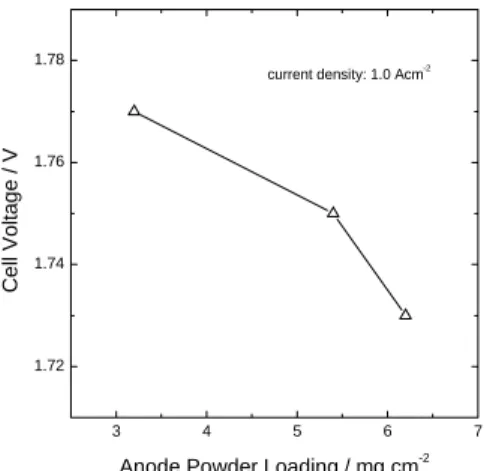
Fig. 3. Plot of cell voltage vs. anode powder loading measured on the electrolysis cell at 80 ℃.
Fig. 3 demonstrates the effect of anode powder loading on the electrolysis cell performance. The cell voltage was decreased with increasing the amount of IrO2 powder. From
the results, it can be said that the IrO2 loading in anode
material crucially influences the electrolysis cell perfor-mance.
3. Summary
The electrolysis cell performance was enhanced with increasing cell temperature. However, owing to the thermal stability of the polymer electrolyte membrane, the optimum cell temperature was limited to the 80 ℃. IrO2 powder
electrode exhibited much higher catalytic activity for oxygen evolution reaction as comprared with Pt black powder electrode. Moreover, the higher the amount of IrO2
powder loading was, the better resulted in the electrolysis cell performance.
Acknowlegement
This Research was performed for the Hydrogen Energy R&D Center, one of the 21st Century Frontier R&D
Program, funded by the Ministry of Science and Technology of Korea.
4. References
1. H. Takenaka, E. Torikai, Y. Kawami, and N. Wakabayashi, Int. J. Hydrogen Energy, 7, 397 (1982). 2. E. Raten, G. Hagen, and R. Tunold, Electrochim. Acta,
48, 3945 (2003).
3. H. B. Suffredini, J. L. Cerne, F. C. Crnkovic, S. A. S. Machado, and L. A. Avaca, Int. J. Hydrogen Energy, 25, 415 (2000).
4. H. Wendt, Electrochemical Hydrogen Technologies: Electrochemical Production and Combustion of Hydrogen, Elsevier Science Publishers B.V., The Netherlands, p. 213, 1990.
5. P. Millet, R. Durand, and M. Pineri, Int. J. Hydrogen Energy, 15, 245 (1990).