Interfacial Wavy Motion in Film Boiling Heat Transfer from Downward-facing Surfaces
Chan S. Kim, Mong J. Yu, Kune Y. Suh*Seoul National Univerisity: San 56-1 Sillim-dong, Gwanak-gu, Seoul, 151-742, *[email protected]
1. Introduction
The laminar film boiling analysis has been found to underpredict the film boiling heat transfer coefficients on relatively large downward-facing and vertical surfaces. The film boiling heat transfer coefficients were obtained from DELTA (Downward Ebullient Laminar Transition Apparatus) to estimate the effect of the geometrical size.
2. Methods and Results
2.1 Experimental Setup
The DELTA experimental setup and preliminary results have previously been reported. [1-3]
The quenching experiment for the hemispherical surface is called DELTA SS (Spherical Surface). The hemispherical test sections had two diameters: 120 mm and 294 mm. The test sections were made of copper to maintain the Biot number below 0.1 whence to neglect the conduction heat transfer within the test sections in the film boiling regime [4]. Little difference was found between results from quenching and steady-state tests in the film boiling regime. [5]
DELTA FS (Flat Surface) was carried out in a quasi-steady state to estimate the effect of the inclination angle on the interfacial wavy motion. It includes a test section, a viewing chamber, a boiler, and a flow line to initiate and maintain the film boiling process. The DELTA FS test section was made of copper of size 120×60×50 mm3 to simulate the isothermal condition
and the interfacial wavy motion. The DELTA FS test section can be revolved from the downward (0°) to upward (180°) surfaces at the 15° intervals. The film boiling heat transfer coefficients were calculated from measurement of two-dimensional temperature histories.
All the experimental data from DELTA could be compared with a laminar film boiling correlation [6,7] and a laminar wavy film boiling correlation. [8,9]
2.2 DELTA SS Results
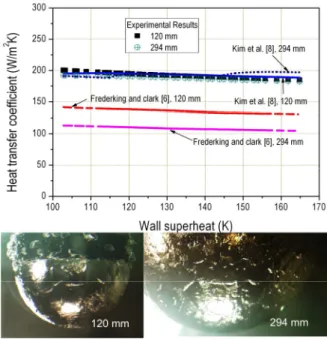
Figure 1 demonstrates the film boiling heat transfer coefficients varying with the wall superheat measured from diameters of 120 mm and 294 mm and predicted by other correlations. All the experimental results are greater than those from the laminar film boiling analysis. Kim et al’s [8] correlation agreed with the measured heat transfer coefficients within 4.5 %. However, the difference of laminar film boiling heat transfer coefficients at the 120 mm tests is relatively smaller than that at the 294 mm diameter tests. Hence,
two pictures show that the relatively stable vapor film is formed on the 120 mm diameter downward-facing hemisphere but a rough vapor film interface covers most of the 294 mm downward-facing hemisphere.
Figure 1. Heat transfer coefficients and snapshots of film boiling from the downward-facing hemispheres.
2.3 DELTA FS Results
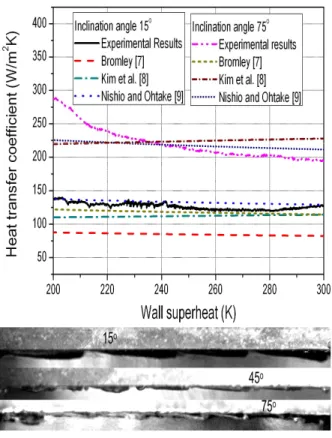
Figure 2 summarizes the heat transfer coefficients and film boiling phenomena for three inclination angles in DELTA FS. All the test results were compared with the laminar film boiling [7] and laminar wavy film boiling [8,9] correlations. The laminar wavy film boiling correlations were always in better agreement with test data than laminar film boiling correlation. The large inclination angle widens the difference between the experimental data and laminar film boiling heat transfer coefficients. The snapshots show that the inclination angle increases the number of the interfacial waves. It results from a more active interfacial wavy motion of film boiling heat transfer at larger inclination angles.
3. Conclusion
The interfacial wavy motion by the Kelvin-Helmholtz instability is the most governing mechanism that determines the film boiling heat transfer coefficients for relatively large test sections exceeding a few centimeters. The motion limits the increase of
Transactions of the Korean Nuclear Society Autumn Meeting Busan, Korea, October 27-28, 2005
vapor film thickness. Hence, it results in higher heat transfer coefficient than that from laminar film boiling analysis. From this paper, the wavy laminar film boiling correlations are more predictable than the simple laminar film boiling correlations for the relatively large downward-facing surfaces.
Figure 2. Heat transfer coefficients and snapshots of film boiling from the downward-facing flat plates.
REFERENCES
[1] C. S. Kim, K. Y. Suh, U. C. Lee, G. C. Park, and H. J. Yoon, Film Boiling Heat Transfer from Relatively Large Diameter Downward-facing Hemispheres, Journal of the Korean Nuclear Society, Vol. 35, No. 4, p. 274, 2003.
[2] U. C. Lee, et al., Optimized Emergency Core Cooling System for Advanced Reactors, Ministry of Science & Technology, Seoul, pp. 152-153, 2004. [3] K. Y. Suh, et al., In-vessel Retention Strategy for High Power Reactors, Ministry of Science & Technology, Seoul, pp. 110-104, 2005.
[4] F. P. Incropera and D. P. Dewitt, Fundamentals of Heat and Mass Transfer, 3rd edition, John Wiley and
Sons, New York, NY, USA, pp. 243-245, 2002. [5] W. Peyayopanakul and J. W. Westwater, Evaluation of the Unsteady-state Quenching Method for Determining Boiling Curves, International Journal of Heat and Mass Transfer, Vol. 21, p. 1437, 1978.
[6] T. H. Frederking and J. A. Clark, Natural Convection Film Boiling on a Sphere, Advanced Cryogenic Engineering, Vol. 8, p. 501, 1963.
[7] L. A. Bromley, Heat Transfer in Stable Film Boiling, Chemical Engineering Progress, Vol. 46, p. 221, 1950. [8] C. S. Kim, K. Y. Suh, J. L. Rempe, F. B. Cheung, and S. B. Kim, Effect of Interfacial Wavy Motion on Film Boiling Heat Transfer from Isothermal Downward-facing Hemispheres, Nuclear Engineering and Design, Vol. 235, Issue 20, p. 2141, 2005.
[9] S. Nishio and H. Ohtake, Vapor-film-unit Model and Heat Transfer Correlation for Natural-convection Film Boiling with Wave Motion under Subcooled Conditions, International Journal of Heat and Mass Transfer, Vol. 36, No. 10, p. 2541, 1993.