Vol. 11, No. 2, pp. 26-28, December 2012
An Experimental Study on the Flexural Strength of Fiber
Reinforced Concrete Structures
Won-Kyu Chai*
Department of Civil Engineering, Shingu University, Seongnam 462-743, Korea (Received July 8, 2012; Accepted December 10)
Abstract : In this thesis, fracture tests were carried out in order to investigate the flexural strength behavior of FRC(fiber reinforced concrete) structures. FRC beams were used in the tests, the initial crack load and the ultimate load of the beams were observed under the static loading. According to the results, the ultimate loads increase with the fiber content, and these tendency is clear in the specimens with large fiber aspect ratio. From the results of the regression analysis, practical formulae for predicting the flexural strength of FRC were suggested.
Key words : fracture test, fiber reinforced concrete, flexural strength, average spacing, practical formulae
1. Introduction
From the results of previous studies, the mechanism of the FRC beams under static loading has been well known, but recently it has become necessary to know the initial crack load, the ultimate load and the flexural strength of the FRC beams.
Romualdi and Batson [1, 2] studied the mechanism of FRC firstly. Romualdi and Mandel [3] showed that the tensile strength of concrete is dependent upon the spac-ing of fibers. Chai [4] studied that when the fiber con-tent is 2.0% the estimated tensile strength was 0.15 times of the average compressive strength.
On this basis, in this study, the initial crack load and the ultimate load of FRC beams under static loading has been investigated. In this work, the relationship between the fiber content and the ultimate load, the relationship between the average spacing of random fiber and the initial crack load, and the relationship between the fiber content multiplication the aspect ratio and the flexural strength have been studied.
2. Test Program
The fibers with diameter of 0.9 mm were used to reinforce the concrete beams. Density, elastic modulus and tensile strength of the fiber are 78.5 KN/m3, 200 GPa,
and 1275 MPa, respectively.
The portland cement was used and the maximum size of coarse aggregate is 19 mm. The used mix proportion is shown in Table 1. Where W is water content, C is cement content, S is fine aggregate content, and G is coarse aggregate content, respectively.
Beam specimen of 100 mm×100 mm×600 mm are used. The specimen series are classified according to the fiber contents varying 0.0%, 0.5%, 1.0%, 1.5%, and to the fiber aspect ratios 60, 80, 100.
The three point loading system is used in the fracture tests. In these tests, the initial crack load and the ulti-mate load were detected.
3. Results of Fracture Test
3.1 Relationship between the fiber content and the ultimate load
As shown in Fig. 1, the ultimate loads increase with the fiber content, and these tendency is clear in the spec-imens with large fiber aspect ratio. By taking average value of the ultimate loads, it could be said that the ulti-mate loads of the specimens with the fiber aspect ratio
*Corresponding author: [email protected]
Table 1. Mix proportion of concrete
W(N/m3) C(N/m3) S(N/m3) G(N/m3)
An Experimental Study on the Flexural Strength of Fiber Reinforced Concrete Structures 27
of 100 are increased as 1.25 times, as compared with that of the specimens with the fiber aspect ratio of 60.
In addition, from Fig. 2, it can be concluded that the effects on the ultimate load can hardly be expected in concrete with fiber content below 0.5%. But when the fiber content is 1.5%, the ultimate load of FRC speci-mens is increased 1.3 times of that of the plain concrete specimen. We can also find that even specimens have the same fiber content, the larger the fiber aspect ratio is, the larger the ultimate load increases.
3.2 Relationship between the average spacing of ran-dom fibers and the initial crack load
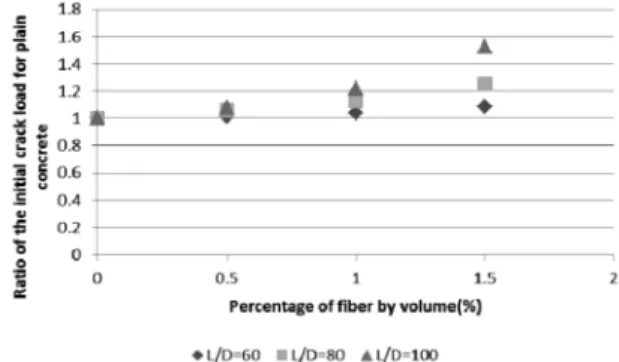
As shown in Fig. 3, the initial crack loads increase with the fiber content like the ultimate load, and these tendency is clear in the specimens with large fiber aspect ratio.
The relationship between the number of fibers per unit volume of FRC, N, and the number of fibers cross-ing over a unit cross section, n, are as follows:
(1)
Where, Vf is the fiber content, D is the diameter of a
fiber, L is the length of a fiber, and β is the effective-ness factor of random fiber.
For β = 0.405 according to Romualdi's theory [2], the average spacing of random fibers, s, can be written as follows:
(2)
(3)
Applying the average spacing of random fibers by Romualdi's theory, we can compare the initial crack loads with the average spacing of random fibers as shown in Fig. 4. This figure indicates that, if the aver-age spacing of random fibers is less than about 15 mm, the initial crack load of FRC is increased rapidly.
3.3 Flexural strength
The flexural strength is observed in order to find the crack-growth-limiting capacity of FRC for the changes of the fiber content and the fiber aspect ratio.
N Vf 25πD2L --- n βL ---= = s2 1 n ---= s 1n--- 25πD 2 Vfβ --- 13.9 D Vf ---= = =
Fig. 1. Relationship between the fiber content and the ultimate load.
Fig. 2. Relationship between the fiber content and the ratio of the ultimate load for plain concrete.
Fig. 3. Relationship between the fiber content and the ratio of the initial crack load for plain concrete.
Fig. 4. Relationship between the average spacing of random fiber and the initial crack load.
28 Won-Kyu Chai
In this thesis, on the basis of the above equation, the flexural strength is presented as follows.
(4)
Where, fcf is the flexural strength of FRC at the ulti-mate load, Vf is the fiber content, L/D is the fiber
aspect ratio, and A and B are the experimental con-stants.
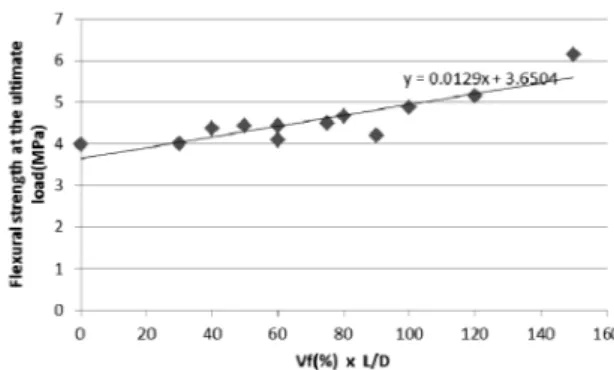
The results of the regression are shown in Fig. 5. From these results, the flexural strength of FRC could be predicted as follows:
(5)
4. Conclusions
1. The ultimate loads increase with the fiber content,
and these tendency is clear in the specimens with large fiber aspect ratio. The ultimate load of FRC could be increased 1.3 times of that of plain concrete by using the fiber content of 1.5%.
2. Although the same fiber content is used, the ulti-mate load of FRC could be increased more using larger the fiber aspect ratio. The ultimate loads of the speci-mens with the fiber aspect ratio of 100 are increased as 1.25 times, as compared with that of the specimens with the fiber aspect ratio of 60.
3. The initial crack load of FRC is increased largely when the average spacing of random fibers is less than about 15 mm.
4. Practical formulae for predicting the flexural strength of FRC are suggested.
References
[1] Romualdi J.P. and Batson G.B., Behavior of reinforced concrete beams with closely spaced reinforcement, Journal of ACI, Proceeding Vol. 60, pp 775-790, 1963. [2] Romualdi J.P. and Batson G.B., Mechanics of crack arrest in concrete, Journal of ASCE, EM3, pp 147-168, 1963.
[3] Romualdi J.P. and Mandel J.A., Tensile strength of concrete affected by uniformly distributed and closely spaced short lengths of wire reinforcement, Journal of ACI, Proceeding Vol. 61, pp 657-671, 1964.
[4] Chai W.K., An experimental study on the fracture strength of steel fiber reinforced concrete, International Journal of Safety, Vol. 11, No.1, pp 19-21, 2012.
fcf = A+B⋅Vf⋅⎝ ⎠⎛ ⎞D----L
fcf = 3.65+0.103×Vf⋅⎝ ⎠⎛ ⎞D----L
Fig. 5. Relationship between the fiber content multiplication the aspect ratio and the flexural strength.